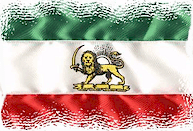


Islamic Republic sponsored annual march through the streets of London is due on Sunday 28th Sept.
http://www.ihrc.org.uk/show.php?id=3603
To oppose this Islamic Republic propaganda march, we will assmeble for a standing counter-demo at Piccadilly Circus at 1:00 PM. Join us to oppose the Islamic Republic on this day.
IMPERIAL EMBLEM

PERSIA
Iranian Freedom Fighters UNITE
Showing posts with label Qods. Show all posts
Showing posts with label Qods. Show all posts
Saturday, September 20, 2008
Thursday, April 17, 2008
Intercepted al-Qaida Letter Reveals Tactics, Strategy
By John J. Kruzel - American Forces Press Service
WASHINGTON, April 16, 2008 – Use silenced guns to kill coalition forces at Iraqi security checkpoints, smuggle weapons in gradual shipments to reduce the risk of detection, and poison Iraq’s water supply with nitric acid to spread disease and death.
Coalition forces found a chart showing senior al-Qaida leaders recently killed or captured and several pages of a letter found on the body of a terrorist. The items were released April 16, 2008, in Baghdad, Iraq, during a media briefing by U.S. Army Maj. Gen. Kevin Bergner, a Multinational Force Iraq spokesman.
(Click photo for screen-resolution image);high-resolution image available.Such tactics were fleshed out in a terrorist letter intended for Abu Ayyub al-Masri, the foreign-born leader of al-Qaida in Iraq. But the document never reached Masri. Instead, coalition forces lifted it from the body of a terrorist they killed last month during an operation 30 miles northwest of Baghdad. The slain terrorist and author of the 11-page missive was Abu Safyan, from Diyala, Iraq, according to military officials who made available all but two pages deemed “not releasable” on the Multinational Force Iraq Web site. Providing a glimpse into the proposed inner workings of al-Qaida in Iraq, the author discusses the need to split jihadists into three groups: snipers, assassination experts and martyrs. Each well-trained group should have an emir, or unit commander, at the lead. Through a series of coordinated surprise attacks, groups should work in unison to “bring down the city or the area,” he wrote. In addition to outlining extremist combat methods, Safyan advocated waging economic and psychological warfare, and his roadmap for success hinged on “continuous conflict” between Iraq’s Shiite government, Sunni members of “Awakening Movements” and Kurdish nationalists. “This will lessen the pressure against us and the Mujahidin brothers in all of Iraq when the enemies fight among themselves and weaken,” according to the handwritten Arabic letter, penned in blue ink on lined paper, that coalition forces captured in a remote farmhouse March 5 along with a suicide vest and computer equipment. Army Maj. Gen. Kevin Bergner, a Multinational Force Iraq spokesman, today said the intercepted pages offer insight into the mind of a terrorist and provide further evidence about al-Qaida’s overarching strategy and tactics of violence. “This document is just one man’s articulation, one terrorist’s views about instigating conflict and turning Iraqis against each other. But it is also quite consistent with the patterns of violence we see from AQI,” Bergner told reporters during a news conference in Baghdad, referring to al-Qaida in Iraq by the acronym AQI. To strike at Iraq’s economy, the document proposes attacking the fields, wells and pipelines that make up the national oil infrastructure. The author recommends targeting oil tankers and ships, specifically those in Basra, Kirkuk and Baghdad. “Attack all the targets that strengthen the enemy economically and militarily,” Safyan wrote. “Even the American Army will weaken since it depends on the Iraqi oil and gas wealth. The enemy will gradually drown step by step.” The letter advises that a chemical offensive can inflict both physical and mental harm. Contaminating Iraqis’ water can produce “killing and dangerous illness,” and also convince the enemy “that we have a dangerous chemical weapon,” Safyan wrote. “But in fact,” he continues, “it’s a psychological war that places fear in the enemy.” Page 8 of the document focuses on instigating fights between coalition forces and Iraqi groups, especially Sunnis who have rejected foreign extremism and terrorism in droves in what has been referred to as “Awakening Groups.” Safyan suggested infiltrating the Sunni cadres before planting and detonating mines “in their villages and streets.” Bergner said the author’s call for violence against the Awakening movement typifies the kind of extremism many Iraqis have turned against. The confiscated document also reveals the threat such groups present to terrorists, he added. “These writings are further examples of the corrupt ideology that Iraqis are broadly rejecting,” he said. “We have seen about 100,000 men choose a different path and join local volunteer groups like the Sons of Iraq instead.” Later in the briefing, Bergner told reporters that coalition forces had captured or killed 53 al-Qaida in Iraq leaders since his most recent news conference early this month. The 10 most significant targets, according to Bergner, were: -- Abd-al-Rahman Ibrahim Jasim Thair, the military emir responsible for al-Qaida’s operations in Mosul. Thair is the former emir in Beiji, who moved to Mosul because of the city’s importance to al-Qaida. -- Muhammad Fathi Hammad Husayn, an al-Qaida cell leader in Sharqat. Like Thair, he also moved from Beiji, where he was formerly the emir in charge of assassinations. -- Jasim Najm Khalaf Muhammad, a leader in al-Qaida’s network in Khark who was attempting to reconstitute terrorist networks around Baghdad when coalition forces captured him in Tarmiyah. -- Ali Mustashar Ali, a car bomb network operative in Baghdad. He and his associates moved explosives, vehicles and suicide bombers throughout the Iraqi capital. -- Hamid Awayd Muhammad, a car- and truck-bomb attack operative in Baghdad. Once the al-Qaida emir responsible for Anbar province, he handled the logistics for vehicle-bomb attacks north of Baghdad at the time of his capture. -- Ahmad Husayn Ghanim Ali, the security emir for eastern Mosul. -- Abu Mansur, al-Qaida’s deputy emir for Mosul, who acted as a judge in the terror network’s illegal courts. The role of Mansur, who died March 8, was to “cloak their corrupt ideology with religious sanction.” -- Tumah Khalaf Mutar Hassan, the leader of al-Qaida’s cell in Samarra, who worked closely with the area’s emir. Coalition forces captured him in Samarra in early March. -- Muqdad Ibrahim Abbas Husayn, al-Qaida’s military emir for Jalam, located east of Baghdad. He coordinated terror operations with counterparts from Tikrit, Samarra and Mosul, and arranged al-Qaida leadership meetings in the Tigris River valley. Husayn also oversaw kidnappings for ransom that terrorists relied on for operational funding. -- Mahmud Abd-al-Hamid Isa Aaywi, al-Qaida’s military emir for southern Karkh. His operations focused on trying to use car and truck bombs in Rashid, Karrada and Mansour. “These terrorists are just one component of the mosaic of security threats that seek to destabilize Iraq and incite a cycle of violence the Iraqi people broadly reject,” Bergner said. He noted that recent violence against Iraqi citizens “highlights the need to keep going forward and the need to keep pursuing these terrorists.”
Related Sites:Abu Safyan’s letter Briefing Transcript
A confiscated letter written by an al-Qaida in Iraq operative to the organization's top commander outlines terrorist tactics and broad strategy for defeating coalition forces and their Iraqi allies. From a Multinational Force Iraq presentation released April 16, 2008. Download screen-resolution Download high-resolution
Homicide Bomber Hits Iraqi Funeral, Killing at Least 50 in Deadliest Strike in Months ...
WASHINGTON, April 16, 2008 – Use silenced guns to kill coalition forces at Iraqi security checkpoints, smuggle weapons in gradual shipments to reduce the risk of detection, and poison Iraq’s water supply with nitric acid to spread disease and death.
Coalition forces found a chart showing senior al-Qaida leaders recently killed or captured and several pages of a letter found on the body of a terrorist. The items were released April 16, 2008, in Baghdad, Iraq, during a media briefing by U.S. Army Maj. Gen. Kevin Bergner, a Multinational Force Iraq spokesman.
(Click photo for screen-resolution image);high-resolution image available.Such tactics were fleshed out in a terrorist letter intended for Abu Ayyub al-Masri, the foreign-born leader of al-Qaida in Iraq. But the document never reached Masri. Instead, coalition forces lifted it from the body of a terrorist they killed last month during an operation 30 miles northwest of Baghdad. The slain terrorist and author of the 11-page missive was Abu Safyan, from Diyala, Iraq, according to military officials who made available all but two pages deemed “not releasable” on the Multinational Force Iraq Web site. Providing a glimpse into the proposed inner workings of al-Qaida in Iraq, the author discusses the need to split jihadists into three groups: snipers, assassination experts and martyrs. Each well-trained group should have an emir, or unit commander, at the lead. Through a series of coordinated surprise attacks, groups should work in unison to “bring down the city or the area,” he wrote. In addition to outlining extremist combat methods, Safyan advocated waging economic and psychological warfare, and his roadmap for success hinged on “continuous conflict” between Iraq’s Shiite government, Sunni members of “Awakening Movements” and Kurdish nationalists. “This will lessen the pressure against us and the Mujahidin brothers in all of Iraq when the enemies fight among themselves and weaken,” according to the handwritten Arabic letter, penned in blue ink on lined paper, that coalition forces captured in a remote farmhouse March 5 along with a suicide vest and computer equipment. Army Maj. Gen. Kevin Bergner, a Multinational Force Iraq spokesman, today said the intercepted pages offer insight into the mind of a terrorist and provide further evidence about al-Qaida’s overarching strategy and tactics of violence. “This document is just one man’s articulation, one terrorist’s views about instigating conflict and turning Iraqis against each other. But it is also quite consistent with the patterns of violence we see from AQI,” Bergner told reporters during a news conference in Baghdad, referring to al-Qaida in Iraq by the acronym AQI. To strike at Iraq’s economy, the document proposes attacking the fields, wells and pipelines that make up the national oil infrastructure. The author recommends targeting oil tankers and ships, specifically those in Basra, Kirkuk and Baghdad. “Attack all the targets that strengthen the enemy economically and militarily,” Safyan wrote. “Even the American Army will weaken since it depends on the Iraqi oil and gas wealth. The enemy will gradually drown step by step.” The letter advises that a chemical offensive can inflict both physical and mental harm. Contaminating Iraqis’ water can produce “killing and dangerous illness,” and also convince the enemy “that we have a dangerous chemical weapon,” Safyan wrote. “But in fact,” he continues, “it’s a psychological war that places fear in the enemy.” Page 8 of the document focuses on instigating fights between coalition forces and Iraqi groups, especially Sunnis who have rejected foreign extremism and terrorism in droves in what has been referred to as “Awakening Groups.” Safyan suggested infiltrating the Sunni cadres before planting and detonating mines “in their villages and streets.” Bergner said the author’s call for violence against the Awakening movement typifies the kind of extremism many Iraqis have turned against. The confiscated document also reveals the threat such groups present to terrorists, he added. “These writings are further examples of the corrupt ideology that Iraqis are broadly rejecting,” he said. “We have seen about 100,000 men choose a different path and join local volunteer groups like the Sons of Iraq instead.” Later in the briefing, Bergner told reporters that coalition forces had captured or killed 53 al-Qaida in Iraq leaders since his most recent news conference early this month. The 10 most significant targets, according to Bergner, were: -- Abd-al-Rahman Ibrahim Jasim Thair, the military emir responsible for al-Qaida’s operations in Mosul. Thair is the former emir in Beiji, who moved to Mosul because of the city’s importance to al-Qaida. -- Muhammad Fathi Hammad Husayn, an al-Qaida cell leader in Sharqat. Like Thair, he also moved from Beiji, where he was formerly the emir in charge of assassinations. -- Jasim Najm Khalaf Muhammad, a leader in al-Qaida’s network in Khark who was attempting to reconstitute terrorist networks around Baghdad when coalition forces captured him in Tarmiyah. -- Ali Mustashar Ali, a car bomb network operative in Baghdad. He and his associates moved explosives, vehicles and suicide bombers throughout the Iraqi capital. -- Hamid Awayd Muhammad, a car- and truck-bomb attack operative in Baghdad. Once the al-Qaida emir responsible for Anbar province, he handled the logistics for vehicle-bomb attacks north of Baghdad at the time of his capture. -- Ahmad Husayn Ghanim Ali, the security emir for eastern Mosul. -- Abu Mansur, al-Qaida’s deputy emir for Mosul, who acted as a judge in the terror network’s illegal courts. The role of Mansur, who died March 8, was to “cloak their corrupt ideology with religious sanction.” -- Tumah Khalaf Mutar Hassan, the leader of al-Qaida’s cell in Samarra, who worked closely with the area’s emir. Coalition forces captured him in Samarra in early March. -- Muqdad Ibrahim Abbas Husayn, al-Qaida’s military emir for Jalam, located east of Baghdad. He coordinated terror operations with counterparts from Tikrit, Samarra and Mosul, and arranged al-Qaida leadership meetings in the Tigris River valley. Husayn also oversaw kidnappings for ransom that terrorists relied on for operational funding. -- Mahmud Abd-al-Hamid Isa Aaywi, al-Qaida’s military emir for southern Karkh. His operations focused on trying to use car and truck bombs in Rashid, Karrada and Mansour. “These terrorists are just one component of the mosaic of security threats that seek to destabilize Iraq and incite a cycle of violence the Iraqi people broadly reject,” Bergner said. He noted that recent violence against Iraqi citizens “highlights the need to keep going forward and the need to keep pursuing these terrorists.”
Related Sites:Abu Safyan’s letter Briefing Transcript
A confiscated letter written by an al-Qaida in Iraq operative to the organization's top commander outlines terrorist tactics and broad strategy for defeating coalition forces and their Iraqi allies. From a Multinational Force Iraq presentation released April 16, 2008. Download screen-resolution Download high-resolution
Homicide Bomber Hits Iraqi Funeral, Killing at Least 50 in Deadliest Strike in Months ...
Thursday, March 22, 2007
Shiite Militia May Be Disintergrating : By HAMZA HENDAWI
BAGHDAD (AP) - The violent Shiite militia known as the Mahdi Army is breaking into splinter groups, with up to 3,000 gunmen now financed directly by Iran and no longer loyal to the firebrand cleric Muqtada al-Sadr, adding a potentially even more deadly element to Iraq's violent mix. Two senior militia commanders told The Associated Press that hundreds of these fighters have crossed into Iran for training by the elite Quds force, a branch of Iran's Revolutionary Guard thought to have trained Hezbollah guerrillas in Lebanon and Muslim fighters in Bosnia and Afghanistan. The breakup is an ominous development at a time when U.S. and Iraqi forces are working to defeat religious-based militias and secure Iraq under government control. While al-Sadr's forces have battled the coalition repeatedly, including pitched battles in 2004, they've mostly stayed in the background during the latest offensive.
The U.S. military has asserted in recent months that Iran's Revolutionary Guards and Quds force have been providing Shiite militias with weapons and parts for sophisticated armor-piercing bombs. The so called EFPs - explosively formed penetrators - are responsible for the deaths of more than 170 American and coalition soldiers since mid-2004, the military says.
In the latest such attack, four U.S. soldiers were killed March 15 by a roadside bomb in eastern Baghdad.
At the Pentagon, a military official confirmed there were signs the Mahdi Army was splintering. Some were breaking away to attempt a more conciliatory approach to the Americans and the Iraqi government, others moving in a more extremist direction, the official said. However, the official, who was not authorized to be quoted by name on the topic, was not aware of direct Iranian recruitment and financing of Mahdi Army members. The outlines of the fracture inside the Mahdi Army were confirmed by senior Iraqi government officials with access to intelligence reports prepared for Prime Minister Nouri al-Maliki. The information indicates a disintegrating organization yet a potentially even more dangerous foe, they revealed, on condition that their names not be used. The militia commanders and al-Maliki's reports identify the leader of the breakaway faction as Qais al-Khazaali, a young Iraqi cleric who was a close al-Sadr aide in 2003 and 2004. He was al-Sadr's chief spokesman for most of 2004, when he made nearly daily appearances on Arabic satellite news channels. He has not been seen in public since late that year. Al-Sadr has been in Iran since early February, apparently laying low during the U.S.-Iraqi offensive, according to the U.S. military. He is not known to be close to Iran's leadership or Iraq's top Shiite cleric, Iranian-born Grand Ayatollah Ali al-Sistani. While Al-Sadr's strategy appears to be to wait out the government offensive and preserve his force, his absence has left loyal fighters unsure of his future and pondering whether they had been abandoned by their leader, the commanders said. Al-Sadr tried to return to Iraq last month but turned back before he reached the Iraqi border upon learning of U.S. checkpoints on the road to Najaf, the Shiite holy city south of Baghdad where he lives. ``Conditions are not suitable for him to return,'' said an al-Sadr aide, who requested anonymity because of the sensitivity of the subject. ``His safety will not be guaranteed if he returns.'' The Mahdi Army commanders, who said they would be endangered if their names were revealed, said Iran's Revolutionary Guards were funding and arming the defectors from their force, and that several hundred over the last 18 months had slipped across the Iranian border for training by the Quds force. In recent weeks, Mahdi Army fighters who escaped possible arrest in the Baghdad security push have received $600 each upon reaching Iran. The former Mahdi Army militiamen working for the Revolutionary Guards operate under the cover a relief agency for Iraqi refugees, they said. Once fighters defect, they receive a monthly stipend of $200, said the commanders. Alireza Jafarzadeh, a spokesman for an Iranian dissident group, told reporters in New York on Tuesday that Iraqi Shiite guerrillas and death squads were being trained in secret camps in Iran with the blessing of top Tehran government leaders and at least three senior Iraqi political figures. Inside Iraq, the breakaway troops are using the cover of the Mahdi Army itself, the commanders said. The defectors are in secret, small, but well-funded cells. Little else has emerged about the structure of their organization, but most of their cadres are thought to have maintained the pretense of continued Mahdi Army membership, possibly to escape reprisals. Estimates of the number of Mahdi Army fighters vary wildly, with some putting the figure at 10,000 and others as many as 60,000.
The extent of al-Sadr's control over his militia has never been clear. Like many of Iraq's warring parties, it's a loosely knit force. The fiery cleric inspires loyalty with his speeches and edicts, and the Shiite gunmen are also bonded by the goal of maintaining Shiite dominance in a country long controlled by the rival Sunni Muslims, most recently Saddam Hussein. Commanders thought to have disobeyed Mahdi Army orders or abused their power are publicly renounced during Friday prayers, a move that has forced them to quit their posts or go into hiding. Mahdi Army militiamen also could be attracted by the cash promises of the splinter group. They don't receive wages or weapons from al-Sadr, but are allowed to generate income by charging government contractors protection money when they work in Shiite neighborhoods. The two Mahdi Army commanders blamed several recent attacks on U.S. forces in eastern Baghdad on the splinter group. The commanders also said they believed the breakaway force had organized the attempt last week to kill Rahim al-Darraji, the mayor of Sadr City. Al-Darraji, who is close to the Sadrist movement, was involved in talks with the U.S. military about extending the five-week-old Baghdad security sweep into Sadr City, the Mahdi Army stronghold in eastern Baghdad that was a no-go zone for American forces until about three weeks ago. Al-Darraji was seriously wounded and two of his bodyguards were killed when gunmen ambushed their convoy in a mainly Shiite district near Sadr City. There was no claim of responsibility. The commanders said recruitment of Mahdi Army gunmen by Iran began as early as 2005. But it was dramatically stepped up in recent months, especially with the approach of the U.S.-Iraqi security operation which was highly advertised before it began Feb. 14. Many Mahdi Army fighters are believed to have crossed the border to escape arrest. Calls by the AP to seek comment from the Iranian Foreign Ministry have not been returned. The Iranian recruitment of the Mahdi Army fighters appears to be an extension of its efforts to exert influence in Iraq, in part to keep the U.S. bogged down in a war that already has stretched into its fifth year. Iran already has the allegiance of the Badr Brigade, a Shiite militia founded and trained in Iran in the 1980s that maintains close links to Iraq's ruling Shiite politicians. The Bush administration has carefully not ruled out military action against Iran, but the war in Iraq keeps U.S. ground forces at least stretched thin.
The U.S. military has asserted in recent months that Iran's Revolutionary Guards and Quds force have been providing Shiite militias with weapons and parts for sophisticated armor-piercing bombs. The so called EFPs - explosively formed penetrators - are responsible for the deaths of more than 170 American and coalition soldiers since mid-2004, the military says.
In the latest such attack, four U.S. soldiers were killed March 15 by a roadside bomb in eastern Baghdad.
At the Pentagon, a military official confirmed there were signs the Mahdi Army was splintering. Some were breaking away to attempt a more conciliatory approach to the Americans and the Iraqi government, others moving in a more extremist direction, the official said. However, the official, who was not authorized to be quoted by name on the topic, was not aware of direct Iranian recruitment and financing of Mahdi Army members. The outlines of the fracture inside the Mahdi Army were confirmed by senior Iraqi government officials with access to intelligence reports prepared for Prime Minister Nouri al-Maliki. The information indicates a disintegrating organization yet a potentially even more dangerous foe, they revealed, on condition that their names not be used. The militia commanders and al-Maliki's reports identify the leader of the breakaway faction as Qais al-Khazaali, a young Iraqi cleric who was a close al-Sadr aide in 2003 and 2004. He was al-Sadr's chief spokesman for most of 2004, when he made nearly daily appearances on Arabic satellite news channels. He has not been seen in public since late that year. Al-Sadr has been in Iran since early February, apparently laying low during the U.S.-Iraqi offensive, according to the U.S. military. He is not known to be close to Iran's leadership or Iraq's top Shiite cleric, Iranian-born Grand Ayatollah Ali al-Sistani. While Al-Sadr's strategy appears to be to wait out the government offensive and preserve his force, his absence has left loyal fighters unsure of his future and pondering whether they had been abandoned by their leader, the commanders said. Al-Sadr tried to return to Iraq last month but turned back before he reached the Iraqi border upon learning of U.S. checkpoints on the road to Najaf, the Shiite holy city south of Baghdad where he lives. ``Conditions are not suitable for him to return,'' said an al-Sadr aide, who requested anonymity because of the sensitivity of the subject. ``His safety will not be guaranteed if he returns.'' The Mahdi Army commanders, who said they would be endangered if their names were revealed, said Iran's Revolutionary Guards were funding and arming the defectors from their force, and that several hundred over the last 18 months had slipped across the Iranian border for training by the Quds force. In recent weeks, Mahdi Army fighters who escaped possible arrest in the Baghdad security push have received $600 each upon reaching Iran. The former Mahdi Army militiamen working for the Revolutionary Guards operate under the cover a relief agency for Iraqi refugees, they said. Once fighters defect, they receive a monthly stipend of $200, said the commanders. Alireza Jafarzadeh, a spokesman for an Iranian dissident group, told reporters in New York on Tuesday that Iraqi Shiite guerrillas and death squads were being trained in secret camps in Iran with the blessing of top Tehran government leaders and at least three senior Iraqi political figures. Inside Iraq, the breakaway troops are using the cover of the Mahdi Army itself, the commanders said. The defectors are in secret, small, but well-funded cells. Little else has emerged about the structure of their organization, but most of their cadres are thought to have maintained the pretense of continued Mahdi Army membership, possibly to escape reprisals. Estimates of the number of Mahdi Army fighters vary wildly, with some putting the figure at 10,000 and others as many as 60,000.
The extent of al-Sadr's control over his militia has never been clear. Like many of Iraq's warring parties, it's a loosely knit force. The fiery cleric inspires loyalty with his speeches and edicts, and the Shiite gunmen are also bonded by the goal of maintaining Shiite dominance in a country long controlled by the rival Sunni Muslims, most recently Saddam Hussein. Commanders thought to have disobeyed Mahdi Army orders or abused their power are publicly renounced during Friday prayers, a move that has forced them to quit their posts or go into hiding. Mahdi Army militiamen also could be attracted by the cash promises of the splinter group. They don't receive wages or weapons from al-Sadr, but are allowed to generate income by charging government contractors protection money when they work in Shiite neighborhoods. The two Mahdi Army commanders blamed several recent attacks on U.S. forces in eastern Baghdad on the splinter group. The commanders also said they believed the breakaway force had organized the attempt last week to kill Rahim al-Darraji, the mayor of Sadr City. Al-Darraji, who is close to the Sadrist movement, was involved in talks with the U.S. military about extending the five-week-old Baghdad security sweep into Sadr City, the Mahdi Army stronghold in eastern Baghdad that was a no-go zone for American forces until about three weeks ago. Al-Darraji was seriously wounded and two of his bodyguards were killed when gunmen ambushed their convoy in a mainly Shiite district near Sadr City. There was no claim of responsibility. The commanders said recruitment of Mahdi Army gunmen by Iran began as early as 2005. But it was dramatically stepped up in recent months, especially with the approach of the U.S.-Iraqi security operation which was highly advertised before it began Feb. 14. Many Mahdi Army fighters are believed to have crossed the border to escape arrest. Calls by the AP to seek comment from the Iranian Foreign Ministry have not been returned. The Iranian recruitment of the Mahdi Army fighters appears to be an extension of its efforts to exert influence in Iraq, in part to keep the U.S. bogged down in a war that already has stretched into its fifth year. Iran already has the allegiance of the Badr Brigade, a Shiite militia founded and trained in Iran in the 1980s that maintains close links to Iraq's ruling Shiite politicians. The Bush administration has carefully not ruled out military action against Iran, but the war in Iraq keeps U.S. ground forces at least stretched thin.
Monday, March 19, 2007
Intelligence War in Iran
Intelligence War in Iran
By Kenneth R. Timmerman
FrontPageMagazine.com | March 19, 2007
As the debate between the Democrats and themselves over the war in Iraq becomes increasingly absurd, inside Iran another debate of momentous proportions is underway.
It involves Iran’s involvement with Iraq, and who is to blame for recent Iranian failures that have led to the capture of high-ranking Iranian intelligence officials by multinational forces in Iraq and the defection of two senior Revolutionary Guards intelligence officers, probably to the U.S.
The Revolutionary Guards Corps and the Ministry of Information and Security (MOIS, aka VEVAK) are hurling stink bombs at each other in the corridors of power in Tehran. Each is accusing the other of having screwed up in Iraq and allowing Iran’s intelligence and terrorist-support networks to get rolled up over the past three months.
More importantly, my sources in Tehran tell me: each organization also suspects the other of secret ties to U.S., British, and/or Israeli intelligence. True or not, this is terrific news for the United States. Mutual suspicion is the first stage of a crippling sick think that has ruined more than one world-class intelligence organization.
MOIS is the civilian branch of Iran’s intelligence. It tracks the Iranian opposition, handles internal security and counterespionage work. It also does Secret Service-style protection of the leadership.
The Rev. Guards Intelligence Department is tasked with penetrating foreign military organizations, acquiring defense technology, and liaising with armed terrorist organizations overseas, such as Hezbollah.
Both support Iranian government-ordered terrorist operations, from sending hit squads to assassinate dissidents, to blowing up U.S. and Israeli embassies. And both are deeply involved in Iraq.
In public, Iranian officials gloat over the coming American “defeat” in Iraq. In private, however, they fear the Bush administration will stand firm. The one thing giving them hope is the Democrats in Washington and their talk of an Iraq pullout.
Shortly after U.S. troops raided an Iranian intelligence headquarters in northern Iraq on the night of Jan. 10, the encourage of Supreme Leader Ayatollah Khamenei began referring to America as the Cobra standing on its tail.
Ayatollah Khamenei hastily convened a national security damage control committee to devise new strategies for reducing Iran’s footprint in Iraq. It was staffed almost exclusively with top Rev. Guards officers, including the head of IRGC intelligence, Maj. Gen. Morteza Rezai, and former deputy IRGC commander, Brig. Gen. Mohammad Baqr Zolqadr, now a deputy interior minister.
They accused MOIS of leaking information on rival IRGC networks in Iraq to the British, who passed the information to the Americans. That led to the capture over Christmas of a top IRGC operative, Brig. Gen. Amir Mohsen Shirazi.
As the U.S. raids on Iranian networks in Iraq intensified, the IRGC leaders urged Khamenei to order Ahmadinejad and MOIS to terminate their operations in Iraq, because they were “unprofessional.”
They also issued the Supreme Leader a dire warning: if MOIS continued to leak operational details of IRGC networks in Iraq to the British and the Americans, they would be compelled to strike back hard at the Americans. And that, in turn, could lead Iran into an open shooting war with the U.S. military.
Many Iranians believe this is just what Ahmadinejad wants, since his chiliastic vision of the End Times calls for an orgy of bloodshed on a planetary scale to usher in the return the 12th imam, the Imam Mahdi.
Even as this infighting continues, the Revolutionary Guards Qods Force is inserting fresh operatives into Iraq, according to my sources. More than one hundred fresh operatives have entered Iraq in recent weeks, even as militiamen loyal to Iranian stooge Muqtada al-Sadr have laid low.
The Iranian intelligence war and the rear guard effort by the IRGC to re-establish its operational networks in Iraq aren’t the only signs that the U.S. is starting to win in Iraq.
Last Friday, Maj. Gen. Benjamin Mixon, commander of Multinational Division-North and the 25th Infantry Brigade in Iraq, told reporters that his troops have seized another cache of Iranian-made weapons and have "got momentum" in the fight against the insurgents.
Speaking from Baghdad via live video-conference to reporters at the Pentagon, Mixon said he has beefed up his forces in the Diyala province northeast of Baghdad in recent months and is now asking for more units to take counter-insurgency operations beyond the provincial capital, Baquba.
"I've got momentum and want to press forward," Mixon said. "I know what I would do with more troops." The full transcript of Mixon’s remarks is here.
So with these first encouraging signs of a turning tide in Iraq, wouldn’t you think that Congress would get behind the war effort, to send a strong message to the insurgents and to their primary backer, Iran?
You would be wrong.
On Thursday, the House Appropriations Committee conducted a marathon hearing on the President’s supplemental budget request to fund the war in Iraq.
For anyone who caught part of the hearing on C-SPAN, there were comic moments to this underlying tragedy.
At one point, Rep. Bill Young of Florida introduced an amendment to prohibit the use of any funds in the supplemental from being used for combat operations in Iraq, other than what was strictly necessary to protect U.S. lives and cover the withdrawal of U.S. forces.
Rep. Young made clear he didn’t support his own amendment. However, because the appropriations bill was binding legislation – as opposed to the non-binding resolution calling for a U.S. withdrawal that passed a few weeks ago - he thought it was the proper moment to get committee members on the record on the war.
In the voice vote, more than a half-dozen of the committee’s 66 members voted “Yes” to the resolution. But when Rep. Young called for a recorded vote, not a single weasel stood by their vote.
The vote was 66 to nothing and the amendment was “narrowly defeated,” Chairman David Obey (D, WI) quipped.
Rep. Obey was filmed last week telling left-wing supporters that a vote for the supplemental was not a vote to prolong the war. They were wrong to protest his efforts to pass the president’s bill, because the Democrats had laid secret traps in the language that would actually end the war.
“We're trying to use the supplemental to end the war. But you can't end the war if you vote against the supplemental. It's time these idiot liberals understand that,” Obey said.
In case the “idiot liberals” didn’t get it, Obey got even more specific. “The language we have in the resolution ends the authority for the war. It makes it illegal to proceed with the war. You don’t have to defund something if the war doesn’t exist. That’s the problem. The liberal groups … don’t understand what the hell is in the bill.”
Thank-you, Congressman Obey. Just when the bad guys were beginning to lose hope, you are coming to their rescue.
By Kenneth R. Timmerman
FrontPageMagazine.com | March 19, 2007
As the debate between the Democrats and themselves over the war in Iraq becomes increasingly absurd, inside Iran another debate of momentous proportions is underway.
It involves Iran’s involvement with Iraq, and who is to blame for recent Iranian failures that have led to the capture of high-ranking Iranian intelligence officials by multinational forces in Iraq and the defection of two senior Revolutionary Guards intelligence officers, probably to the U.S.
The Revolutionary Guards Corps and the Ministry of Information and Security (MOIS, aka VEVAK) are hurling stink bombs at each other in the corridors of power in Tehran. Each is accusing the other of having screwed up in Iraq and allowing Iran’s intelligence and terrorist-support networks to get rolled up over the past three months.
More importantly, my sources in Tehran tell me: each organization also suspects the other of secret ties to U.S., British, and/or Israeli intelligence. True or not, this is terrific news for the United States. Mutual suspicion is the first stage of a crippling sick think that has ruined more than one world-class intelligence organization.
MOIS is the civilian branch of Iran’s intelligence. It tracks the Iranian opposition, handles internal security and counterespionage work. It also does Secret Service-style protection of the leadership.
The Rev. Guards Intelligence Department is tasked with penetrating foreign military organizations, acquiring defense technology, and liaising with armed terrorist organizations overseas, such as Hezbollah.
Both support Iranian government-ordered terrorist operations, from sending hit squads to assassinate dissidents, to blowing up U.S. and Israeli embassies. And both are deeply involved in Iraq.
In public, Iranian officials gloat over the coming American “defeat” in Iraq. In private, however, they fear the Bush administration will stand firm. The one thing giving them hope is the Democrats in Washington and their talk of an Iraq pullout.
Shortly after U.S. troops raided an Iranian intelligence headquarters in northern Iraq on the night of Jan. 10, the encourage of Supreme Leader Ayatollah Khamenei began referring to America as the Cobra standing on its tail.
Ayatollah Khamenei hastily convened a national security damage control committee to devise new strategies for reducing Iran’s footprint in Iraq. It was staffed almost exclusively with top Rev. Guards officers, including the head of IRGC intelligence, Maj. Gen. Morteza Rezai, and former deputy IRGC commander, Brig. Gen. Mohammad Baqr Zolqadr, now a deputy interior minister.
They accused MOIS of leaking information on rival IRGC networks in Iraq to the British, who passed the information to the Americans. That led to the capture over Christmas of a top IRGC operative, Brig. Gen. Amir Mohsen Shirazi.
As the U.S. raids on Iranian networks in Iraq intensified, the IRGC leaders urged Khamenei to order Ahmadinejad and MOIS to terminate their operations in Iraq, because they were “unprofessional.”
They also issued the Supreme Leader a dire warning: if MOIS continued to leak operational details of IRGC networks in Iraq to the British and the Americans, they would be compelled to strike back hard at the Americans. And that, in turn, could lead Iran into an open shooting war with the U.S. military.
Many Iranians believe this is just what Ahmadinejad wants, since his chiliastic vision of the End Times calls for an orgy of bloodshed on a planetary scale to usher in the return the 12th imam, the Imam Mahdi.
Even as this infighting continues, the Revolutionary Guards Qods Force is inserting fresh operatives into Iraq, according to my sources. More than one hundred fresh operatives have entered Iraq in recent weeks, even as militiamen loyal to Iranian stooge Muqtada al-Sadr have laid low.
The Iranian intelligence war and the rear guard effort by the IRGC to re-establish its operational networks in Iraq aren’t the only signs that the U.S. is starting to win in Iraq.
Last Friday, Maj. Gen. Benjamin Mixon, commander of Multinational Division-North and the 25th Infantry Brigade in Iraq, told reporters that his troops have seized another cache of Iranian-made weapons and have "got momentum" in the fight against the insurgents.
Speaking from Baghdad via live video-conference to reporters at the Pentagon, Mixon said he has beefed up his forces in the Diyala province northeast of Baghdad in recent months and is now asking for more units to take counter-insurgency operations beyond the provincial capital, Baquba.
"I've got momentum and want to press forward," Mixon said. "I know what I would do with more troops." The full transcript of Mixon’s remarks is here.
So with these first encouraging signs of a turning tide in Iraq, wouldn’t you think that Congress would get behind the war effort, to send a strong message to the insurgents and to their primary backer, Iran?
You would be wrong.
On Thursday, the House Appropriations Committee conducted a marathon hearing on the President’s supplemental budget request to fund the war in Iraq.
For anyone who caught part of the hearing on C-SPAN, there were comic moments to this underlying tragedy.
At one point, Rep. Bill Young of Florida introduced an amendment to prohibit the use of any funds in the supplemental from being used for combat operations in Iraq, other than what was strictly necessary to protect U.S. lives and cover the withdrawal of U.S. forces.
Rep. Young made clear he didn’t support his own amendment. However, because the appropriations bill was binding legislation – as opposed to the non-binding resolution calling for a U.S. withdrawal that passed a few weeks ago - he thought it was the proper moment to get committee members on the record on the war.
In the voice vote, more than a half-dozen of the committee’s 66 members voted “Yes” to the resolution. But when Rep. Young called for a recorded vote, not a single weasel stood by their vote.
The vote was 66 to nothing and the amendment was “narrowly defeated,” Chairman David Obey (D, WI) quipped.
Rep. Obey was filmed last week telling left-wing supporters that a vote for the supplemental was not a vote to prolong the war. They were wrong to protest his efforts to pass the president’s bill, because the Democrats had laid secret traps in the language that would actually end the war.
“We're trying to use the supplemental to end the war. But you can't end the war if you vote against the supplemental. It's time these idiot liberals understand that,” Obey said.
In case the “idiot liberals” didn’t get it, Obey got even more specific. “The language we have in the resolution ends the authority for the war. It makes it illegal to proceed with the war. You don’t have to defund something if the war doesn’t exist. That’s the problem. The liberal groups … don’t understand what the hell is in the bill.”
Thank-you, Congressman Obey. Just when the bad guys were beginning to lose hope, you are coming to their rescue.
Friday, March 16, 2007
What Was Once a Revolutionary Guard Is Now Just a Mafia By Mohsen Sazegara
Back in October 1978, none of us in exile with Ayatollah Ruhollah Khomeini imagined that victory for the Islamic Revolution would be attained only a few months later. It was during those days in Neuf-le-Chateau that the notion of starting a “people’s army” first took hold, and expecting that our battle would be a long one, we took as models for our soon-to-be established army the forces in Algeria and Cuba. But on February 1, 1979, we stepped off a plane from France into Tehran, and 10 days later we were in power. Suddenly we had a position to protect, and the model for our people’s army changed dramatically. It seemed more appropriate to emulate such forces as the Swiss Armed Forces, United States National Guard or Israel Defense Forces. The thought was that if the Islamic Republic had two separate armies with independent command structures, the country could insulate itself against a coup. If ordinary citizens were given military training in preparation for combat, we believed, then any military commander would think twice before contemplating overthrowing the government. In the three decades since, there has not been a coup. That people’s army, however, has grown into a multi-headed monster. Today the Army of the Guardians of the Islamic Revolution — known in Farsi as the Sepah-e Pasdaran and in English as the Revolutionary Guard — is a mafia-like organization with a corrupting influence on Iran’s army, police, media, industries, judiciary and government. It is imperative that every effort now be made to contain the Revolutionary Guard’s powers, because its political and economic adventurism will ultimately lead to a serious crisis, not just in Iran but also across the Middle East.
Please read the rest here :
http://www.forward.com/articles/what-was-once-a-revolutionary-guard-is-now-just-a/
Please read the rest here :
http://www.forward.com/articles/what-was-once-a-revolutionary-guard-is-now-just-a/
Friday, March 09, 2007
New U.S. Commander in Iraq Won’t Rule Out Need for Added Troops
New U.S. Commander in Iraq Won’t Rule Out Need for Added Troops
By RICHARD A. OPPEL Jr. and ALISSA J. RUBIN
BAGHDAD, March 8 — The new American commander in Iraq, Gen. David H. Petraeus, warned Thursday that American troops here faced a long road ahead and left open the possibility of calling in even more soldiers as he described the difficult task of calming the country. In a broad review of the challenges he faces, General Petraeus suggested the need to be open to working with some of the groups at the center of Iraq’s security struggle. He said the future of the Mahdi Army, the ubiquitous Shiite militia that has fought battles with United States troops, should be left up to Iraqi leaders and noted that many countries had “auxiliary police.” He also suggested that political dialogue with some Sunni militants and Sunni leaders was crucial to finding a solution for problems that military action alone would never be able to fix. General Petraeus repeatedly stressed the long-term nature of the troop increase, but his assertions about the need for open-endedness in the American commitment came as Congressional Democrats in Washington worked toward a fixed date for withdrawal. He said there were no “looming” requests for additional troops and that he had not yet taken a position on an assessment by the second-ranking commander in Iraq, Lt. Gen. Raymond T. Odierno, that the greatly enlarged American force remain until February 2008. But he added, “If you’re going to achieve the kinds of effects that we probably need, it would need to be sustained certainly for some time well beyond the summer.” Military officials in Iraq have indicated that they would need a large American troop presence for at least a year and probably far longer to achieve lasting stability. For now, Congress seems persuaded to give General Petraeus’s strategy a year to yield results, setting the summer of 2008 as a deadline for the return of all troops. General Petraeus’s open-ended strategy appeared to be an effort to avoid a repeat of the pattern that has doomed past American efforts to halt the insurgency. In hot spots including Tal Afar and Diyala, United States soldiers have cracked down on insurgents and then reduced the American presence only to see insurgents retake old ground. In his first extended public comments since taking over one month ago, General Petraeus, 54, cited a handful of early favorable indicators since American and Iraqi forces began sweeping through militia- and insurgent-dominated neighborhoods and building new outposts as part of a Baghdad security plan widely seen as a last-ditch effort to stave off civil war. “While too early to discern significant trends, there have been a few encouraging signs,” General Petraeus said. “Sectarian killings, for example, have been lower in Baghdad over the past several weeks than in the previous month.” He also said that fewer families were being forced out of homes by sectarian gangs and that troops had uncovered significant illegal stashes of bombs and weapons. But he emphasized that successes had come with devastating setbacks. “Schools, health clinics and marketplaces have all been attacked,” he said. “Car bombs have targeted hundreds of innocent Iraqis,” including worshipers in Habbaniya and college students in Baghdad. He also underscored how crucial it would be to prevent the insurgents and death squad members who are believed to have fled Baghdad from exporting violence to nearby areas — like attacks in Hilla on Tuesday that killed more than 100 Shiite religious pilgrims — and to block efforts by insurgents forced to abandon Baghdad from returning. “Anyone who knows about securing Baghdad knows that you must also secure the Baghdad belts, in other words, the areas that surround Baghdad,” he said. One especially violent area, Diyala Province, is “very likely” to get more troops, he said. More American soldiers have been killed already in Diyala this year than in all of 2006 — 29 in 2007 and 20 in 2006, according to icasualties.org. The first two additional brigades coming to Iraq will work in Baghdad; military officials say a large number of troops in the remaining three brigades may have to patrol areas just outside the capital. General Petraeus repeated observations by previous commanders that there is “no military solution” to Iraq’s grave problems. The only long-run success, he said, will come after “reconciling differences with some of those who have felt that the new Iraq did not have a place for them.” According to one government official, some coalition and Iraqi officials have been holding talks with some Sunni insurgent groups who reject the more extremist approaches of groups like Al Qaeda in Mesopotamia. Similarly, General Petraeus appeared to take a softer line on the Mahdi militia led by the anti-American cleric Moktada al-Sadr, saying that many coalition countries had a “variety of auxiliary police” but that Iraqi leaders must ultimately decide the Mahdi militia’s fate. The challenge, he said, “has been to determine how do you incorporate those who want to serve in a positive way, as neighborhood watches, let’s say, but unarmed in our own communities, but without turning into something much more than that.” With barely a third of the additional American and Iraqi troops on the ground, the new security plan is only beginning to take effect. The troops are in the initial phase of clearing out insurgent bases and taking up residence in neighborhoods. Later phases will involve building trust with the communities so that the Iraqi government can undertake the repairs to infrastructure and the job creation programs that the architects of the troop increase believe are critical to the project’s success. Nonetheless for Iraqis living in Baghdad there already are some perceptible differences. Checkpoints, manned by Iraqi military or police, have sprung up all over the city and security officers appear to be more systematic in determining which cars to pull over and which to let go. In several neighborhoods, most notably Sadr City, the joint American and Iraqi forces have begun to set up operating bases from which they plan to conduct foot patrols and re-establish links with the community to improve intelligence. This is a reversal of the past practice of keeping American troops on large bases except for periodic drives through the neighborhoods or combat missions against suspected militants. Larger neighborhoods, like Sadr City, will eventually have several small, joint bases, though for the moment only a couple are in place. Foot patrols, long viewed as too dangerous for American soldiers to undertake on a regular basis, have begun again even in some of the most violent Sunni neighborhoods as a part of the counterinsurgency effort. The effect on violence in Baghdad is hard to judge, but on a daily basis it appears that the police have found fewer victims of sectarian violence in the city’s empty lots and back alleys, according to reports from the Interior Ministry. General Petraeus also noted that United States troops working with their Iraqi counterparts had tried to improve security at markets, which are especially vulnerable to suicide bombings, and had been sweeping through neighborhoods and arresting people they believed were violent militants or criminals. While military officials point to positive signs emerging from the three-week-old effort, the United States cannot point to any Arab-dominated region in Iraq where it has completely vanquished the indigenous insurgency.
By RICHARD A. OPPEL Jr. and ALISSA J. RUBIN
BAGHDAD, March 8 — The new American commander in Iraq, Gen. David H. Petraeus, warned Thursday that American troops here faced a long road ahead and left open the possibility of calling in even more soldiers as he described the difficult task of calming the country. In a broad review of the challenges he faces, General Petraeus suggested the need to be open to working with some of the groups at the center of Iraq’s security struggle. He said the future of the Mahdi Army, the ubiquitous Shiite militia that has fought battles with United States troops, should be left up to Iraqi leaders and noted that many countries had “auxiliary police.” He also suggested that political dialogue with some Sunni militants and Sunni leaders was crucial to finding a solution for problems that military action alone would never be able to fix. General Petraeus repeatedly stressed the long-term nature of the troop increase, but his assertions about the need for open-endedness in the American commitment came as Congressional Democrats in Washington worked toward a fixed date for withdrawal. He said there were no “looming” requests for additional troops and that he had not yet taken a position on an assessment by the second-ranking commander in Iraq, Lt. Gen. Raymond T. Odierno, that the greatly enlarged American force remain until February 2008. But he added, “If you’re going to achieve the kinds of effects that we probably need, it would need to be sustained certainly for some time well beyond the summer.” Military officials in Iraq have indicated that they would need a large American troop presence for at least a year and probably far longer to achieve lasting stability. For now, Congress seems persuaded to give General Petraeus’s strategy a year to yield results, setting the summer of 2008 as a deadline for the return of all troops. General Petraeus’s open-ended strategy appeared to be an effort to avoid a repeat of the pattern that has doomed past American efforts to halt the insurgency. In hot spots including Tal Afar and Diyala, United States soldiers have cracked down on insurgents and then reduced the American presence only to see insurgents retake old ground. In his first extended public comments since taking over one month ago, General Petraeus, 54, cited a handful of early favorable indicators since American and Iraqi forces began sweeping through militia- and insurgent-dominated neighborhoods and building new outposts as part of a Baghdad security plan widely seen as a last-ditch effort to stave off civil war. “While too early to discern significant trends, there have been a few encouraging signs,” General Petraeus said. “Sectarian killings, for example, have been lower in Baghdad over the past several weeks than in the previous month.” He also said that fewer families were being forced out of homes by sectarian gangs and that troops had uncovered significant illegal stashes of bombs and weapons. But he emphasized that successes had come with devastating setbacks. “Schools, health clinics and marketplaces have all been attacked,” he said. “Car bombs have targeted hundreds of innocent Iraqis,” including worshipers in Habbaniya and college students in Baghdad. He also underscored how crucial it would be to prevent the insurgents and death squad members who are believed to have fled Baghdad from exporting violence to nearby areas — like attacks in Hilla on Tuesday that killed more than 100 Shiite religious pilgrims — and to block efforts by insurgents forced to abandon Baghdad from returning. “Anyone who knows about securing Baghdad knows that you must also secure the Baghdad belts, in other words, the areas that surround Baghdad,” he said. One especially violent area, Diyala Province, is “very likely” to get more troops, he said. More American soldiers have been killed already in Diyala this year than in all of 2006 — 29 in 2007 and 20 in 2006, according to icasualties.org. The first two additional brigades coming to Iraq will work in Baghdad; military officials say a large number of troops in the remaining three brigades may have to patrol areas just outside the capital. General Petraeus repeated observations by previous commanders that there is “no military solution” to Iraq’s grave problems. The only long-run success, he said, will come after “reconciling differences with some of those who have felt that the new Iraq did not have a place for them.” According to one government official, some coalition and Iraqi officials have been holding talks with some Sunni insurgent groups who reject the more extremist approaches of groups like Al Qaeda in Mesopotamia. Similarly, General Petraeus appeared to take a softer line on the Mahdi militia led by the anti-American cleric Moktada al-Sadr, saying that many coalition countries had a “variety of auxiliary police” but that Iraqi leaders must ultimately decide the Mahdi militia’s fate. The challenge, he said, “has been to determine how do you incorporate those who want to serve in a positive way, as neighborhood watches, let’s say, but unarmed in our own communities, but without turning into something much more than that.” With barely a third of the additional American and Iraqi troops on the ground, the new security plan is only beginning to take effect. The troops are in the initial phase of clearing out insurgent bases and taking up residence in neighborhoods. Later phases will involve building trust with the communities so that the Iraqi government can undertake the repairs to infrastructure and the job creation programs that the architects of the troop increase believe are critical to the project’s success. Nonetheless for Iraqis living in Baghdad there already are some perceptible differences. Checkpoints, manned by Iraqi military or police, have sprung up all over the city and security officers appear to be more systematic in determining which cars to pull over and which to let go. In several neighborhoods, most notably Sadr City, the joint American and Iraqi forces have begun to set up operating bases from which they plan to conduct foot patrols and re-establish links with the community to improve intelligence. This is a reversal of the past practice of keeping American troops on large bases except for periodic drives through the neighborhoods or combat missions against suspected militants. Larger neighborhoods, like Sadr City, will eventually have several small, joint bases, though for the moment only a couple are in place. Foot patrols, long viewed as too dangerous for American soldiers to undertake on a regular basis, have begun again even in some of the most violent Sunni neighborhoods as a part of the counterinsurgency effort. The effect on violence in Baghdad is hard to judge, but on a daily basis it appears that the police have found fewer victims of sectarian violence in the city’s empty lots and back alleys, according to reports from the Interior Ministry. General Petraeus also noted that United States troops working with their Iraqi counterparts had tried to improve security at markets, which are especially vulnerable to suicide bombings, and had been sweeping through neighborhoods and arresting people they believed were violent militants or criminals. While military officials point to positive signs emerging from the three-week-old effort, the United States cannot point to any Arab-dominated region in Iraq where it has completely vanquished the indigenous insurgency.
Friday, March 02, 2007
High Ranking Qods Officer defects.IRI is desperatly looking for him now
آدينه، 11 اسفند ماه 1385 برابر با 2007 Friday 02 March
فرار یکی از فرماندهان سپاه، ضربه ای جدی به رژيم
سرتيپ پاسدار عليرضا عسگری یکی از فرماندهان نيروی قدس سپاه پاسداران كه سالها فرمانده سپاه لبنان در نيروی قدس بود و در لبنان اهداف رژيم را با فرماندهی سپاه لبنان پيگيری می كرد، هنگام اقامت در ترکیه ناپدید شده است. برخی منابع می گویند این افسر بلندپایه نیروی قدس سپاه پاسداران فرار کرده است. او اطلاعات مهمی از فعاليتهای تروريستی رژیم و رابطه جمهوری اسلامی با گروه های تروریستی در منطقه بویژه حزب الله لبنان در اختیار دارد. فرار عليرضا عسگری، ضربه ای جدی به رژيم متزلزل جمهوری اسلامی بشمار می رود. از همین رو رژیم با تمام قوا بدنبال اوست. جمهوری اسلامی برای پیدا کردن این فرمانده نیروی قدس دست به دامن تركيه شده است، ولی حاضر نيست هويت كامل او و اهمیت این مسئله را به مقامات آنکارا بگويد. از سوی دیگر رژيم برای حفظ روحيه نیروهایش تلاش ميكند از طریق رسانه های خبری خود بگوید عليرضا عسگری در ترکیه ربوده شده است.
فرار یکی از فرماندهان سپاه، ضربه ای جدی به رژيم
سرتيپ پاسدار عليرضا عسگری یکی از فرماندهان نيروی قدس سپاه پاسداران كه سالها فرمانده سپاه لبنان در نيروی قدس بود و در لبنان اهداف رژيم را با فرماندهی سپاه لبنان پيگيری می كرد، هنگام اقامت در ترکیه ناپدید شده است. برخی منابع می گویند این افسر بلندپایه نیروی قدس سپاه پاسداران فرار کرده است. او اطلاعات مهمی از فعاليتهای تروريستی رژیم و رابطه جمهوری اسلامی با گروه های تروریستی در منطقه بویژه حزب الله لبنان در اختیار دارد. فرار عليرضا عسگری، ضربه ای جدی به رژيم متزلزل جمهوری اسلامی بشمار می رود. از همین رو رژیم با تمام قوا بدنبال اوست. جمهوری اسلامی برای پیدا کردن این فرمانده نیروی قدس دست به دامن تركيه شده است، ولی حاضر نيست هويت كامل او و اهمیت این مسئله را به مقامات آنکارا بگويد. از سوی دیگر رژيم برای حفظ روحيه نیروهایش تلاش ميكند از طریق رسانه های خبری خود بگوید عليرضا عسگری در ترکیه ربوده شده است.
Monday, February 26, 2007
U.S. Says Raid in Iraq Supports Claim on Iran
By JAMES GLANZ and RICHARD A. OPPEL Jr.
BAGHDAD, Feb. 25 — A raid on a Shiite weapons cache in the southern city of Hilla one week ago is providing what American officials call the best evidence yet that the deadliest roadside bombs in Iraq are manufactured in Iran, but critics contend that the forensic case remains circumstantial and inferential.The new evidence includes infrared sensors, electronic triggering devices and information about plastic explosives used in bombs that the Americans say lead back to Iran. The explosive material, triggering devices, other components and the method of assembly all produce weapons with an Iranian signature that has never been found outside Iraq or southern Lebanon, where Hezbollah is believed to have used weapons supplied by Iran, the Americans say.
But critics assert that nearly all the bomb components could have been produced in Iraq or somewhere else in the region. Even if the evidence were to establish that Iran is the source, they add, that does not necessarily mean that the Iranian leadership is responsible. The raid by American and Iraqi forces discovered a fake boulder made of polyurethane and containing three of the deadliest kind of roadside bombs in Iraq. Smeared with dirt and pebbles to give it the color and texture of a rock, the polyurethane blob was resting in the back seat of a Toyota, apparently in preparation for a roadside attack, American officials said in lengthy briefings with two New York Times reporters last week. The Toyota, along with a second vehicle and a nearby house described as an assembly point, contained components and other weaponry that the officials say demonstrate that the bomb parts must have originated in Iran. Called explosively formed penetrators, or E.F.P.’s, bombs like the ones hidden inside the fake boulder are designed to eject molten slugs that slice through American armor with deadly precision. The assertion that the latest find greatly bolsters the theory of the Iranian origin of the E.F.P.’s is significant because it could provide the United States with a new justification to take action against Iran. But the evidence is unlikely to satisfy skeptics who have been suspicious that the Bush administration is trying to lay the groundwork for isolating or even attacking Iran. They point to the flawed intelligence used by the administration to accuse Saddam Hussein of harboring unconventional weapons before invading Iraq nearly four years ago. Still, American military officials appear to be making an attempt to respond to critics who say the evidence is inconclusive. In the course of the detailed briefing on the Hilla discovery, Maj. Marty Weber, an explosives expert, said that most of the E.F.P.’s in Iraq use C-4 plastic explosive manufactured in Iran. At the request of the Bush administration, The Times is withholding some specific details about the weapons to protect intelligence sources and methods. In addition to the Hilla discovery, military officials are expected to disclose at a briefing on Monday details about materials found in a raid in Diyala Province, the mixed Sunni-Shiite battleground north of Baghdad, that, according to one military official, included enough components to make more than 100 E.F.P.’s. The official asked not to be identified because the matter is so sensitive. All of the items found in the Hilla raid have been used by Hezbollah in southern Lebanon, said Major Weber, a master explosives ordnance technician who has studied many kinds of improvised bombs in the Middle East and elsewhere and is closely involved in the effort in Iraq. In addition, the shallow concave caps, which are made of copper and change into armor-piercing balls when the E.F.P.’s explode, were smooth and flawless, indicating to the explosives expert that they were manufactured in Iran because of the high precision required to make them so. Also found during the raid were 10 107-millimeter Strella rockets that had Iranian markings.
A Question of Technology
The most specialized part of the E.F.P.’s that were found is the concave copper disc, called a liner, that rolls into a deadly armor-piercing ball when the device explodes. Although American explosives experts say that the liner is deceptively difficult to make properly, the discs in Hilla look like a thick little alms plate or even a souvenir ashtray minus the indentations for holding cigarettes. The electronics package is built around everyday items like the motion sensors used in garage-door openers and outdoor security systems; in fact, at the heart of some of the bombs found in Iraq is a type of infrared sensor commonly sold at electronic stores like RadioShack. Major Weber said the use of precision copper discs combined with passive infrared sensors amounted to “a no-brainer” that the explosive components were of Iranian origin, because no one has used that sort of configuration except Iranian-backed Shiite militias. Could copper discs be manufactured with the required precision in Iraq? “You can never be certain,” Major Weber said. But he said that “having studied all these groups, I’ve only seen E.F.P.’s used in two areas of the world: The Levant and here,” meaning in Hezbollah areas of Lebanon and in Iraq. Hezbollah is thought to be armed and trained by Iran.
Skeptics say the new details do not support a conclusion that only Iran could be providing the components. “Iran may well be involved in the supply of these weapons, but so far they haven’t proved it,” said Joseph Cirincione, senior vice president for National Security at the Center for American Progress, a liberal research and advocacy organization. “Before we act on the assumption that these are Iranian we’ve got to rule out all these other possibilities,” he said. “The military hasn’t done that.” He noted that a related weapon, the shape charge, “has been around for decades. “This is not new stuff,” he continued. “There is a vast international arms market selling shape charges from many countries.”
New Details
The new information is more substantial than the limited details disclosed earlier this month in Baghdad, said John Pike, director of GlobalSecurity.org, a research group based in Alexandria, Va.“That initial briefing was not much to write home about,” Mr. Pike said. “The points that they are making here are rather more convincing. Whether they’re true is a completely different question.”Mr. Pike said he was not swayed by arguments that the copper discs could only be made by equipment in Iran. All that is required are machine tools, he said. “You can buy them,” he said. “I mean, look at all those cylinders people use for L.P.G. cooking gas. Do you think they are all imported from Iran? Probably not. I bet there are guys all over Iraq who make those things for a living.”But he found other details more persuasive. “The two points they are making about the tradecraft of the fuse and the wrappings of the explosives, those are pretty good pieces of evidence,” he said. “I will say that, totally apart from any of this evidence, I would be astonished if Iran was not providing military support to the Shia militias. It should be self-evident that they are doing that.”
Afternoon Attack
American officials gave this account of the Hilla raid:It took place at 1:30 p.m. on Feb. 17 after an informant reported seeing a tow truck carrying rockets.The fake rock with three E.F.P. canisters inside was sitting on the back seat of a different vehicle, a Toyota Crown. The trunk of the same car contained various equipment including an infrared sensor, a G.P.S. unit, two compasses and a jug filled with an unknown explosive.Tools and materials for making fake rocks were found inside the house along with a partly completed rock and two E.F.P.’s. Among the items found there were seven battery packs needed to set off the blasting caps that initiate the E.F.P. explosion, four cans of epoxy foam and three of the infrared sensors.The E.F.P.’s were designed to inflict maximum damage. The positioning of the sensor and the exact angles of the E.F.P.’s inside the rock were fixed to find weak points in American armored vehicles like Humvees and Strykers.“The E.F.P. canisters are typically arrayed at angles to minimize the effects of countermeasures,” Major Weber said. “They want to hit the truck when it is already well into the kill zone.”The infrared sensors could be armed and disarmed at a distance with cellphones, long-distance cordless phones or radios. That allows the attackers to arm the devices only when convoys are approaching. Then, when the convoys trip the sensors, the E.F.P.’s explode.Major Weber said many of those techniques were clearly Iranian in origin. Critics said that all of them could be replicated by skilled Iraqis or others in the Middle East with a solid knowledge of electronics and basic manufacturing techniques.Still, Major Weber said, there were other indications of Iranian involvement in Hilla. In the raid, the Iraqi and American troops also found a red 1988 Chevy tow truck carrying 10 Strella rockets under a false bottom in the bed. The rockets had MJ-1 contact fuses and were probably made in China and repainted with Iranian markings — the usual practice for weapons that Iran imports and re-sells. Following international convention, the markings were in English, not Persian. They indicated that the rockets had been made in 2005 and each carried 18 kilograms of explosive.As to why the Iranians would leave such obvious markings on the shells, Major Weber speculated that they had simply been taken out of stock and shipped across the border.
Comparisons to OthersMajor Weber said he doubted that Hezbollah — the group that the Mahdi militia leader Moktada al-Sadr has used as a model for his political movement — would have provided the material and technology to the Mahdi militia or to other Shiite fighters in Iraq. “It is possible, but based upon my experience we have not seen Hezbollah share information or technology on anything until they have been told to,” he said.“The E.F.P. is their silver bullet,” he said, referring to Iran and its allied militias.Major Weber also said that the use of passive infrared sensors, or P.I.R.’s, was one of the strongest markers of Iranian involvement, based on years of experience indicating that only Iranian-backed groups employ the sensors in that manner. But he also acknowledged that the electronic components needed to make the sensors were easily available off the shelf at places like RadioShack.Those components are used in commercial products, like motion sensors for a lighting system or garage door openers. Those products are opened up, rewired and repackaged.Sometimes on products requiring the triggering of multiple beams to close the circuit, masking tape is used to cover up some beams so that only one is triggered.“Every P.I.R. in Iraq has been RadioShack, Digigard or Everspring,” Major Weber said. “But in southern Lebanon I never saw them use RadioShack.”While he maintained that the copper liner also required specialized equipment and skills to make properly, that assertion also rests on some rather subtle distinctions. A senior military official displayed pictures of a stack of some 30 copper E.F.P. liners seized in a raid in Mahmudiya, a town south of Baghdad. Such liners, Major Weber said, were “copycats” stamped in Iraq, not Iran. To the untrained eye, the liners initially looked identical to the genuine ones.But Major Weber then pointed out that there were often slightly visible cracks forming circles around the tops of the liners when they were set on a table with their concave sides pointing down. Those imperfections were signs that the liners had been made in Iraq, Major Weber said. And because of the imperfections, he said, an E.F.P. made with them would be much less deadly. Such an E.F.P. would fragment rather than curl into a ball, he said, and the fragments would be much less likely to pierce armor.Michael R. Gordon and Scott Shane contributed reporting from Washington.
BAGHDAD, Feb. 25 — A raid on a Shiite weapons cache in the southern city of Hilla one week ago is providing what American officials call the best evidence yet that the deadliest roadside bombs in Iraq are manufactured in Iran, but critics contend that the forensic case remains circumstantial and inferential.The new evidence includes infrared sensors, electronic triggering devices and information about plastic explosives used in bombs that the Americans say lead back to Iran. The explosive material, triggering devices, other components and the method of assembly all produce weapons with an Iranian signature that has never been found outside Iraq or southern Lebanon, where Hezbollah is believed to have used weapons supplied by Iran, the Americans say.
But critics assert that nearly all the bomb components could have been produced in Iraq or somewhere else in the region. Even if the evidence were to establish that Iran is the source, they add, that does not necessarily mean that the Iranian leadership is responsible. The raid by American and Iraqi forces discovered a fake boulder made of polyurethane and containing three of the deadliest kind of roadside bombs in Iraq. Smeared with dirt and pebbles to give it the color and texture of a rock, the polyurethane blob was resting in the back seat of a Toyota, apparently in preparation for a roadside attack, American officials said in lengthy briefings with two New York Times reporters last week. The Toyota, along with a second vehicle and a nearby house described as an assembly point, contained components and other weaponry that the officials say demonstrate that the bomb parts must have originated in Iran. Called explosively formed penetrators, or E.F.P.’s, bombs like the ones hidden inside the fake boulder are designed to eject molten slugs that slice through American armor with deadly precision. The assertion that the latest find greatly bolsters the theory of the Iranian origin of the E.F.P.’s is significant because it could provide the United States with a new justification to take action against Iran. But the evidence is unlikely to satisfy skeptics who have been suspicious that the Bush administration is trying to lay the groundwork for isolating or even attacking Iran. They point to the flawed intelligence used by the administration to accuse Saddam Hussein of harboring unconventional weapons before invading Iraq nearly four years ago. Still, American military officials appear to be making an attempt to respond to critics who say the evidence is inconclusive. In the course of the detailed briefing on the Hilla discovery, Maj. Marty Weber, an explosives expert, said that most of the E.F.P.’s in Iraq use C-4 plastic explosive manufactured in Iran. At the request of the Bush administration, The Times is withholding some specific details about the weapons to protect intelligence sources and methods. In addition to the Hilla discovery, military officials are expected to disclose at a briefing on Monday details about materials found in a raid in Diyala Province, the mixed Sunni-Shiite battleground north of Baghdad, that, according to one military official, included enough components to make more than 100 E.F.P.’s. The official asked not to be identified because the matter is so sensitive. All of the items found in the Hilla raid have been used by Hezbollah in southern Lebanon, said Major Weber, a master explosives ordnance technician who has studied many kinds of improvised bombs in the Middle East and elsewhere and is closely involved in the effort in Iraq. In addition, the shallow concave caps, which are made of copper and change into armor-piercing balls when the E.F.P.’s explode, were smooth and flawless, indicating to the explosives expert that they were manufactured in Iran because of the high precision required to make them so. Also found during the raid were 10 107-millimeter Strella rockets that had Iranian markings.
A Question of Technology
The most specialized part of the E.F.P.’s that were found is the concave copper disc, called a liner, that rolls into a deadly armor-piercing ball when the device explodes. Although American explosives experts say that the liner is deceptively difficult to make properly, the discs in Hilla look like a thick little alms plate or even a souvenir ashtray minus the indentations for holding cigarettes. The electronics package is built around everyday items like the motion sensors used in garage-door openers and outdoor security systems; in fact, at the heart of some of the bombs found in Iraq is a type of infrared sensor commonly sold at electronic stores like RadioShack. Major Weber said the use of precision copper discs combined with passive infrared sensors amounted to “a no-brainer” that the explosive components were of Iranian origin, because no one has used that sort of configuration except Iranian-backed Shiite militias. Could copper discs be manufactured with the required precision in Iraq? “You can never be certain,” Major Weber said. But he said that “having studied all these groups, I’ve only seen E.F.P.’s used in two areas of the world: The Levant and here,” meaning in Hezbollah areas of Lebanon and in Iraq. Hezbollah is thought to be armed and trained by Iran.
Skeptics say the new details do not support a conclusion that only Iran could be providing the components. “Iran may well be involved in the supply of these weapons, but so far they haven’t proved it,” said Joseph Cirincione, senior vice president for National Security at the Center for American Progress, a liberal research and advocacy organization. “Before we act on the assumption that these are Iranian we’ve got to rule out all these other possibilities,” he said. “The military hasn’t done that.” He noted that a related weapon, the shape charge, “has been around for decades. “This is not new stuff,” he continued. “There is a vast international arms market selling shape charges from many countries.”
New Details
The new information is more substantial than the limited details disclosed earlier this month in Baghdad, said John Pike, director of GlobalSecurity.org, a research group based in Alexandria, Va.“That initial briefing was not much to write home about,” Mr. Pike said. “The points that they are making here are rather more convincing. Whether they’re true is a completely different question.”Mr. Pike said he was not swayed by arguments that the copper discs could only be made by equipment in Iran. All that is required are machine tools, he said. “You can buy them,” he said. “I mean, look at all those cylinders people use for L.P.G. cooking gas. Do you think they are all imported from Iran? Probably not. I bet there are guys all over Iraq who make those things for a living.”But he found other details more persuasive. “The two points they are making about the tradecraft of the fuse and the wrappings of the explosives, those are pretty good pieces of evidence,” he said. “I will say that, totally apart from any of this evidence, I would be astonished if Iran was not providing military support to the Shia militias. It should be self-evident that they are doing that.”
Afternoon Attack
American officials gave this account of the Hilla raid:It took place at 1:30 p.m. on Feb. 17 after an informant reported seeing a tow truck carrying rockets.The fake rock with three E.F.P. canisters inside was sitting on the back seat of a different vehicle, a Toyota Crown. The trunk of the same car contained various equipment including an infrared sensor, a G.P.S. unit, two compasses and a jug filled with an unknown explosive.Tools and materials for making fake rocks were found inside the house along with a partly completed rock and two E.F.P.’s. Among the items found there were seven battery packs needed to set off the blasting caps that initiate the E.F.P. explosion, four cans of epoxy foam and three of the infrared sensors.The E.F.P.’s were designed to inflict maximum damage. The positioning of the sensor and the exact angles of the E.F.P.’s inside the rock were fixed to find weak points in American armored vehicles like Humvees and Strykers.“The E.F.P. canisters are typically arrayed at angles to minimize the effects of countermeasures,” Major Weber said. “They want to hit the truck when it is already well into the kill zone.”The infrared sensors could be armed and disarmed at a distance with cellphones, long-distance cordless phones or radios. That allows the attackers to arm the devices only when convoys are approaching. Then, when the convoys trip the sensors, the E.F.P.’s explode.Major Weber said many of those techniques were clearly Iranian in origin. Critics said that all of them could be replicated by skilled Iraqis or others in the Middle East with a solid knowledge of electronics and basic manufacturing techniques.Still, Major Weber said, there were other indications of Iranian involvement in Hilla. In the raid, the Iraqi and American troops also found a red 1988 Chevy tow truck carrying 10 Strella rockets under a false bottom in the bed. The rockets had MJ-1 contact fuses and were probably made in China and repainted with Iranian markings — the usual practice for weapons that Iran imports and re-sells. Following international convention, the markings were in English, not Persian. They indicated that the rockets had been made in 2005 and each carried 18 kilograms of explosive.As to why the Iranians would leave such obvious markings on the shells, Major Weber speculated that they had simply been taken out of stock and shipped across the border.
Comparisons to OthersMajor Weber said he doubted that Hezbollah — the group that the Mahdi militia leader Moktada al-Sadr has used as a model for his political movement — would have provided the material and technology to the Mahdi militia or to other Shiite fighters in Iraq. “It is possible, but based upon my experience we have not seen Hezbollah share information or technology on anything until they have been told to,” he said.“The E.F.P. is their silver bullet,” he said, referring to Iran and its allied militias.Major Weber also said that the use of passive infrared sensors, or P.I.R.’s, was one of the strongest markers of Iranian involvement, based on years of experience indicating that only Iranian-backed groups employ the sensors in that manner. But he also acknowledged that the electronic components needed to make the sensors were easily available off the shelf at places like RadioShack.Those components are used in commercial products, like motion sensors for a lighting system or garage door openers. Those products are opened up, rewired and repackaged.Sometimes on products requiring the triggering of multiple beams to close the circuit, masking tape is used to cover up some beams so that only one is triggered.“Every P.I.R. in Iraq has been RadioShack, Digigard or Everspring,” Major Weber said. “But in southern Lebanon I never saw them use RadioShack.”While he maintained that the copper liner also required specialized equipment and skills to make properly, that assertion also rests on some rather subtle distinctions. A senior military official displayed pictures of a stack of some 30 copper E.F.P. liners seized in a raid in Mahmudiya, a town south of Baghdad. Such liners, Major Weber said, were “copycats” stamped in Iraq, not Iran. To the untrained eye, the liners initially looked identical to the genuine ones.But Major Weber then pointed out that there were often slightly visible cracks forming circles around the tops of the liners when they were set on a table with their concave sides pointing down. Those imperfections were signs that the liners had been made in Iraq, Major Weber said. And because of the imperfections, he said, an E.F.P. made with them would be much less deadly. Such an E.F.P. would fragment rather than curl into a ball, he said, and the fragments would be much less likely to pierce armor.Michael R. Gordon and Scott Shane contributed reporting from Washington.
Monday, February 19, 2007
GCC FOCUSES ON AIR DEFENSE, NAVY
ABU DHABI [MENL] -- Gulf Cooperation Council militaries have launched an effort to bolster the air defense and navies to prepare for any war with Iran. Western industry sources said Gulf Arab states such as Kuwait, Saudi Arabia and United Arab Emirates have led the way with procurement and development programs meant to bolster defenses in the Gulf. The sources said the three GCC states envisioned an Iranian attack on their oil facilities amid any U.S.-led war against Teheran. "The key threats will be an Iranian attack on oil facilities or on oil ships in the Straits of Hormuz," a Gulf industry source said. "These countries need an answer to these threats and quickly." The sources said the GCC focus would be on attack helicopters, fast attack craft, radars and air and missile defense. They said GCC states expect massive Iranian missile fire in any war with the United States.
0
comments

 Labels:
Ahmadinejad,
Air Force,
Iran,
IRCG,
Islamic Republic,
Khamanei,
Persian Gulf,
Qods,
US Naval Vessel. Persian Gulf,
US Navy,
USA,
War
Labels:
Ahmadinejad,
Air Force,
Iran,
IRCG,
Islamic Republic,
Khamanei,
Persian Gulf,
Qods,
US Naval Vessel. Persian Gulf,
US Navy,
USA,
War
Labels:
Ahmadinejad,
Air Force,
Iran,
IRCG,
Islamic Republic,
Khamanei,
Persian Gulf,
Qods,
US Naval Vessel. Persian Gulf,
US Navy,
USA,
War
Sunday, February 18, 2007
Sanction must Target Iranian Forces
Please follow this link :
http://iranvajahan.net/cgi-bin/news.pl?l=en&y=2007&m=02&d=16&a=7
http://iranvajahan.net/cgi-bin/news.pl?l=en&y=2007&m=02&d=16&a=7
Thursday, February 15, 2007
How the west can avert war with Iran
By Reuel Marc Gerecht and Gary Schmitt
Do the Europeans really want to prevent a war between the US or Israel and Iran? If they had to choose between curtailing trade with the Islamic republic, or seeing either America or Israel preventatively strike Iran’s nuclear facilities, which would London, Paris and Berlin prefer? These are not unfair questions: at no time since the European Union started the “EU3” negotiations with Iran’s clerical regime in 2004 have the Europeans probably had more leverage over Tehran’s actions. At no time since 2002, when it became clear that the mullahs were conducting a clandestine nuclear research programme, has there been a more critical moment for determining which path – diplomatic or military – the US and Israel will choose to try to stop Iran’s pursuit of the bomb.
Washington and Jerusalem clearly have no desire to attack Iran. But if the Europeans close down the option of boosting the soft-power of sanctions, the odds on military strikes will increase significantly. Most in Europe’s political elite may well agree with President Jacques Chirac of France when he recently revealed he had no problem with Iran having “one or two” nuclear weapons. Embracing the theory of deterrence, Mr Chirac apparently envisioned the Israelis or the Americans threatening annihilation of Iran as a means of escaping from the international contretemps provoked by the mullahs’ nuclear aspirations. The European hope is that the Americans and the Israelis will realise that an attack on Iran’s nuclear sites is unthinkable.
But what if the Americans or the Israelis do not see it that way? George W. Bush and many other Americans are not convinced that the theory of deterrence is either a moral or effective idea when used against a terrorist-supporting state. Is the US going to slaughter hundreds of thousands – even millions – of Iranians for an unclaimed nuclear terrorist strike? If Tehran launched a conventional terrorist attack on a US facility – such as the one it is strongly suspected of having masterminded on the Khobar Towers complex in Saudi Arabia in 1996 – would not Washington be even less likely to respond, knowing the other side has the bomb?
We know that Iran’s leaders allowed members of al-Qaeda to pass through their territory after al-Qaeda had successfully displayed its penchant for slaughtering Americans. Even after the anti-Semitic tirades of Mr Ahmadi-Nejad, which echo the “bye-bye-Israel” nuclear bravado of former president Ali Akbar Hashemi Rafsanjani, the Europeans remain surreally casual about how a nuclear Iran could effectively intimidate Israel – politically, spiritually and economically. Both Americans and Israelis reflect seriously on the awful prospect of ideologically volatile Sunni Arab dictatorships obtaining their own nuclear weapons to counter Shia Iran’s bomb-enhanced ambitions.
Within Iran, is the clerical regime likely to reform, or become more paranoid, as internal dissent mounts? The permanently dysfunctional nature of the Islamic republic – the tension between theocracy and democracy and the corrupt, impoverishing statist economic structure guarantee the continuing insecurity of the regime and hence, in part, its willingness to use violence internally and externally. Since the death of Ayatollah Ruhollah Khomeini in 1989, Iranian society has been shearing away from its clerical overlords, who see themselves as the vanguard of the Iranian nation and the Muslim world. This process will continue and, with it, the anti-American and anti-Israeli animosity of the regime.
In 2003 when the British, French and Germans feared that Mr Bush might attack another “axis of evil” member, European nuclear negotiations with Tehran began in earnest. One of the most serious diplomatic undertakings in the EU’s history, the EU3 process signalled to the Iranians, as well as to all EU members and the US, that Europe would use both carrots and sticks to persuade the mullahs to cease their uranium enrichment activities. In the intervening four years, the EU3 has dangled various inducements before Tehran to no avail. Proceeding with tougher sanctions is a real opportunity for transatlantic relations; conversely, failure to do so will only signal how great remains the divide in relations.
Timing in a poker game is critical: if you do not know when to raise, you always lose. There are signs of serious political and economic turbulence inside the Islamic republic’s autocratic, socialist system. Iran’s rulers have now seen the Americans deploy a new battle group to the Persian Gulf, implement more aggressive rules to counter Iranian meddling in Iraq, interrupt the cash-flow of Iranian banks overseas (with some European participation), and watched the Americans and Europeans move forward with a sanctions regime at the United Nations. It is no coincidence that the internal Iranian discussion about Mr Ahmadi-Nejad’s competence and the “nuclear energy” programme has heated up. The effect inside Iran of EU-imposed sanctions could be considerable, given the fragility of the Iranian economy and concerns among Iranians about the possible cascading effect of sanctions. Poker may well have been invented in Iran, but it came to the Americans via the Europeans. Do the Europeans still know how to play?
The writers are scholars at the American Enterprise Institute
Do the Europeans really want to prevent a war between the US or Israel and Iran? If they had to choose between curtailing trade with the Islamic republic, or seeing either America or Israel preventatively strike Iran’s nuclear facilities, which would London, Paris and Berlin prefer? These are not unfair questions: at no time since the European Union started the “EU3” negotiations with Iran’s clerical regime in 2004 have the Europeans probably had more leverage over Tehran’s actions. At no time since 2002, when it became clear that the mullahs were conducting a clandestine nuclear research programme, has there been a more critical moment for determining which path – diplomatic or military – the US and Israel will choose to try to stop Iran’s pursuit of the bomb.
Washington and Jerusalem clearly have no desire to attack Iran. But if the Europeans close down the option of boosting the soft-power of sanctions, the odds on military strikes will increase significantly. Most in Europe’s political elite may well agree with President Jacques Chirac of France when he recently revealed he had no problem with Iran having “one or two” nuclear weapons. Embracing the theory of deterrence, Mr Chirac apparently envisioned the Israelis or the Americans threatening annihilation of Iran as a means of escaping from the international contretemps provoked by the mullahs’ nuclear aspirations. The European hope is that the Americans and the Israelis will realise that an attack on Iran’s nuclear sites is unthinkable.
But what if the Americans or the Israelis do not see it that way? George W. Bush and many other Americans are not convinced that the theory of deterrence is either a moral or effective idea when used against a terrorist-supporting state. Is the US going to slaughter hundreds of thousands – even millions – of Iranians for an unclaimed nuclear terrorist strike? If Tehran launched a conventional terrorist attack on a US facility – such as the one it is strongly suspected of having masterminded on the Khobar Towers complex in Saudi Arabia in 1996 – would not Washington be even less likely to respond, knowing the other side has the bomb?
We know that Iran’s leaders allowed members of al-Qaeda to pass through their territory after al-Qaeda had successfully displayed its penchant for slaughtering Americans. Even after the anti-Semitic tirades of Mr Ahmadi-Nejad, which echo the “bye-bye-Israel” nuclear bravado of former president Ali Akbar Hashemi Rafsanjani, the Europeans remain surreally casual about how a nuclear Iran could effectively intimidate Israel – politically, spiritually and economically. Both Americans and Israelis reflect seriously on the awful prospect of ideologically volatile Sunni Arab dictatorships obtaining their own nuclear weapons to counter Shia Iran’s bomb-enhanced ambitions.
Within Iran, is the clerical regime likely to reform, or become more paranoid, as internal dissent mounts? The permanently dysfunctional nature of the Islamic republic – the tension between theocracy and democracy and the corrupt, impoverishing statist economic structure guarantee the continuing insecurity of the regime and hence, in part, its willingness to use violence internally and externally. Since the death of Ayatollah Ruhollah Khomeini in 1989, Iranian society has been shearing away from its clerical overlords, who see themselves as the vanguard of the Iranian nation and the Muslim world. This process will continue and, with it, the anti-American and anti-Israeli animosity of the regime.
In 2003 when the British, French and Germans feared that Mr Bush might attack another “axis of evil” member, European nuclear negotiations with Tehran began in earnest. One of the most serious diplomatic undertakings in the EU’s history, the EU3 process signalled to the Iranians, as well as to all EU members and the US, that Europe would use both carrots and sticks to persuade the mullahs to cease their uranium enrichment activities. In the intervening four years, the EU3 has dangled various inducements before Tehran to no avail. Proceeding with tougher sanctions is a real opportunity for transatlantic relations; conversely, failure to do so will only signal how great remains the divide in relations.
Timing in a poker game is critical: if you do not know when to raise, you always lose. There are signs of serious political and economic turbulence inside the Islamic republic’s autocratic, socialist system. Iran’s rulers have now seen the Americans deploy a new battle group to the Persian Gulf, implement more aggressive rules to counter Iranian meddling in Iraq, interrupt the cash-flow of Iranian banks overseas (with some European participation), and watched the Americans and Europeans move forward with a sanctions regime at the United Nations. It is no coincidence that the internal Iranian discussion about Mr Ahmadi-Nejad’s competence and the “nuclear energy” programme has heated up. The effect inside Iran of EU-imposed sanctions could be considerable, given the fragility of the Iranian economy and concerns among Iranians about the possible cascading effect of sanctions. Poker may well have been invented in Iran, but it came to the Americans via the Europeans. Do the Europeans still know how to play?
The writers are scholars at the American Enterprise Institute
0
comments
Labels:
Ahmadinejad,
Bomb,
EU,
Iran,
Islamic Republic,
Khamanei,
Military engagment,
Missile,
Nuclear,
Persian Gulf,
Petrol,
Qods,
Rafsanjani,
SANCTIONS,
US,
US ARMY,
Us pressure,
War
Labels:
Ahmadinejad,
Bomb,
EU,
Iran,
Islamic Republic,
Khamanei,
Military engagment,
Missile,
Nuclear,
Persian Gulf,
Petrol,
Qods,
Rafsanjani,
SANCTIONS,
US,
US ARMY,
Us pressure,
War
Wednesday, February 14, 2007
Iranian Revolutionary Guard's Qods Force
http://www.npr.org/templates/story/story.php?storyId=7400297&ft=1&f=17
U.S. military leaders have suggested that Iran is assisting Iraqi insurgents in attacks on U.S. troops. The target of the accusations has been Iranian Revolutionary Guard's Qods Force. Ken Pollack, senior fellow in foreign policy studies at the Brookings Institution, talks with Alex Chadwick.
Iran's elite and mysterious fighters
Does the government control the Quds Force? Experts aren't sure.By Borzou Daragahi and Peter SpiegelTimes Staff WritersFebruary 15, 2007BAGHDAD — Among the myriad military and intelligence agencies that make up Iran's security forces, none has the skill and reach of the Quds Force, an elite unit nominally within the command structure of the Iranian Revolutionary Guard Corps.Like the Revolutionary Guard, the Quds Force and its predecessors were among the semiofficial militias, charities and centers of clerical power born of the paranoia and zeal of the tumultuous years after Iran's 1979 Islamic Revolution, which brought Ayatollah Ruhollah Khomeini to power.Originally, the Revolutionary Guard played a defensive role. In the 1980s, Iran's Shiite revolutionaries faced a war against Iraq as well as the hostility of Iranian secular nationalists, the West and Sunni-dominated regimes of the Middle East.The Revolutionary Guard was entrusted to protect Khomeini's theocracy. But the revolutionaries also were inspired to spread their vision abroad.The Quds Force and its predecessors consisted of the Guard's most skilled warriors. Experts said they were highly secretive commando units sent abroad to help Shiites usurp monarchies in the Persian Gulf, gun down enemies and battle Israeli forces in southern Lebanon. They also reportedly have run operations in Sudan, South Asia and Western Europe.Their plans sometimes coincided with U.S. interests, as when they supported Afghans fighting the Soviet Union in the 1980s and Bosnian Muslims battling Serbs in the 1990s.The Quds Force also has been involved in Iraq. It assisted Kurdish rebels fighting Saddam Hussein in the 1980s and Shiites battling his regime in the 1990s. Even Ahmad Chalabi's expatriate Iraqi National Congress had Quds Force help, experts say.At most, the force numbers 2,000, said Mahan Abedin, director of research at the Center for the Study of Terrorism, a London think tank."It's a remarkably efficient organization, quite possibly one of the best special forces units in the world," he said.The extent to which the Quds Force is controlled by the government has been hotly debated in U.S. foreign policy circles."This has been a topic of debate among Iran experts inside and outside the government for 25 years," said Kenneth M. Pollack, an Iran expert at the Brookings Institution's Saban Center for Middle East Policy. "There are people who believe the Quds Force does not move a muscle without getting explicit orders from [supreme leader Ayatollah Ali] Khamenei; there are other people who believe they are rogues. The weight of evidence is somewhere in the middle."There are signs that Quds Force-linked operatives have taken orders from Tehran for overseas missions.Most notable, Pollack said, were the 1992 killings of an Iranian Kurdish separatist leader and three associates in Berlin by four gunmen led by an Iranian agent. In 1997, a German court found that the slayings had been ordered by a government committee in Tehran that included Khamenei and then-President Hashemi Rafsanjani.There has been evidence of rifts between Iran's government and the Revolutionary Guard and Quds Force. The Revolutionary Guard occasionally has tried to push the government into more extremist positions.In 1998, for example, thousands of Guard troops gathered on the border with Afghanistan in what appeared to be a move against the Taliban regime. There was suspicion that the Revolutionary Guard was working independently. The government later sent conventional forces to "keep a watch" on the Guard, Pollack said."We do have evidence here and there, circumstantial in many ways, that the Quds Force guys and other people in the Revolutionary Guard like to push the edge of the envelope," Pollack said, speculating that the Quds Force could be freelancing in Iraq."Tehran almost certainly told the Quds Force to go into Iraq," he said. "What we don't know is: Did they say something as vague as, 'Protect our interests in Iraq without actually going to war with the Americans'? Or did they say something very specific: 'Do this, do that, don't do this.' "We don't know."
In addition to supplying weapons to Iraqi militias, the Quds Force has been recruiting Iraqi Shiites, giving them up to a month and sending some to Iran for training, the Shiite political party official told the AP. Caldwell acknowledged that detainees had said, under interrogation, that Quds operatives were supplying weapons to factions in the U.S.-backed Iraqi government. He said U.S. officials had asked political parties and government officials about the material. "Some explained that there is a need for certain weaponry to come in for protection purposes," he told a Baghdad news conference Wednesday. "The concern we had ... is that on that list were sniper rifles, mortars and some elements that are clearly offensive in nature." At most, Iran's entire Quds Force probably numbers only about 2,000 - only about 800 of whom are core operatives, according to Abedin, the expert at the London-based think tank. Abedin doubted the Quds Force was directly giving militias weapons, arguing that militias have their own domestic networks for building and obtaining weapons. But he said Quds was undoubtedly was providing intelligence and other organizational help. "It would be very incriminating and dangerous for Iran to directly supply weapons to the militias, and it's not a part of Iranian policy to directly confront the Americans," he said. Instead, the goal is likely "to enable these armed formations ... to gain an advantage over their Sunni rivals" in the battle for power that Iran expects could erupt later. "They are looking to beyond, when the Americans withdraw," he said. "They see the Shiite militias as natural allies."
A look at Iran's military
Iran has two military branches: the armed forces and the specialized Islamic Revolutionary Guard Corps. Each has a navy and air force. The Revolutionary Guard has a special forces unit called the Quds Force, which U.S. officials say is aiding Iraqi militants. Al Quds is the Arabic name for Jerusalem, a city considered holy to Islam. Some U.S. analysts say the two military branches are in competition for resources and influence in the government.Islamic Republic of Iran Regular ForcesGround troops: 350,000Navy: 18,000Air force: 30,000Islamic Revolutionary Guard CorpsGround troops: 100,000Navy: 20,000Air force: UnspecifiedQuds Force: 2,000Basij paramilitary force: 2 million---Sources: CIA, Times reporting
U.S. military leaders have suggested that Iran is assisting Iraqi insurgents in attacks on U.S. troops. The target of the accusations has been Iranian Revolutionary Guard's Qods Force. Ken Pollack, senior fellow in foreign policy studies at the Brookings Institution, talks with Alex Chadwick.
Iran's elite and mysterious fighters
Does the government control the Quds Force? Experts aren't sure.By Borzou Daragahi and Peter SpiegelTimes Staff WritersFebruary 15, 2007BAGHDAD — Among the myriad military and intelligence agencies that make up Iran's security forces, none has the skill and reach of the Quds Force, an elite unit nominally within the command structure of the Iranian Revolutionary Guard Corps.Like the Revolutionary Guard, the Quds Force and its predecessors were among the semiofficial militias, charities and centers of clerical power born of the paranoia and zeal of the tumultuous years after Iran's 1979 Islamic Revolution, which brought Ayatollah Ruhollah Khomeini to power.Originally, the Revolutionary Guard played a defensive role. In the 1980s, Iran's Shiite revolutionaries faced a war against Iraq as well as the hostility of Iranian secular nationalists, the West and Sunni-dominated regimes of the Middle East.The Revolutionary Guard was entrusted to protect Khomeini's theocracy. But the revolutionaries also were inspired to spread their vision abroad.The Quds Force and its predecessors consisted of the Guard's most skilled warriors. Experts said they were highly secretive commando units sent abroad to help Shiites usurp monarchies in the Persian Gulf, gun down enemies and battle Israeli forces in southern Lebanon. They also reportedly have run operations in Sudan, South Asia and Western Europe.Their plans sometimes coincided with U.S. interests, as when they supported Afghans fighting the Soviet Union in the 1980s and Bosnian Muslims battling Serbs in the 1990s.The Quds Force also has been involved in Iraq. It assisted Kurdish rebels fighting Saddam Hussein in the 1980s and Shiites battling his regime in the 1990s. Even Ahmad Chalabi's expatriate Iraqi National Congress had Quds Force help, experts say.At most, the force numbers 2,000, said Mahan Abedin, director of research at the Center for the Study of Terrorism, a London think tank."It's a remarkably efficient organization, quite possibly one of the best special forces units in the world," he said.The extent to which the Quds Force is controlled by the government has been hotly debated in U.S. foreign policy circles."This has been a topic of debate among Iran experts inside and outside the government for 25 years," said Kenneth M. Pollack, an Iran expert at the Brookings Institution's Saban Center for Middle East Policy. "There are people who believe the Quds Force does not move a muscle without getting explicit orders from [supreme leader Ayatollah Ali] Khamenei; there are other people who believe they are rogues. The weight of evidence is somewhere in the middle."There are signs that Quds Force-linked operatives have taken orders from Tehran for overseas missions.Most notable, Pollack said, were the 1992 killings of an Iranian Kurdish separatist leader and three associates in Berlin by four gunmen led by an Iranian agent. In 1997, a German court found that the slayings had been ordered by a government committee in Tehran that included Khamenei and then-President Hashemi Rafsanjani.There has been evidence of rifts between Iran's government and the Revolutionary Guard and Quds Force. The Revolutionary Guard occasionally has tried to push the government into more extremist positions.In 1998, for example, thousands of Guard troops gathered on the border with Afghanistan in what appeared to be a move against the Taliban regime. There was suspicion that the Revolutionary Guard was working independently. The government later sent conventional forces to "keep a watch" on the Guard, Pollack said."We do have evidence here and there, circumstantial in many ways, that the Quds Force guys and other people in the Revolutionary Guard like to push the edge of the envelope," Pollack said, speculating that the Quds Force could be freelancing in Iraq."Tehran almost certainly told the Quds Force to go into Iraq," he said. "What we don't know is: Did they say something as vague as, 'Protect our interests in Iraq without actually going to war with the Americans'? Or did they say something very specific: 'Do this, do that, don't do this.' "We don't know."
In addition to supplying weapons to Iraqi militias, the Quds Force has been recruiting Iraqi Shiites, giving them up to a month and sending some to Iran for training, the Shiite political party official told the AP. Caldwell acknowledged that detainees had said, under interrogation, that Quds operatives were supplying weapons to factions in the U.S.-backed Iraqi government. He said U.S. officials had asked political parties and government officials about the material. "Some explained that there is a need for certain weaponry to come in for protection purposes," he told a Baghdad news conference Wednesday. "The concern we had ... is that on that list were sniper rifles, mortars and some elements that are clearly offensive in nature." At most, Iran's entire Quds Force probably numbers only about 2,000 - only about 800 of whom are core operatives, according to Abedin, the expert at the London-based think tank. Abedin doubted the Quds Force was directly giving militias weapons, arguing that militias have their own domestic networks for building and obtaining weapons. But he said Quds was undoubtedly was providing intelligence and other organizational help. "It would be very incriminating and dangerous for Iran to directly supply weapons to the militias, and it's not a part of Iranian policy to directly confront the Americans," he said. Instead, the goal is likely "to enable these armed formations ... to gain an advantage over their Sunni rivals" in the battle for power that Iran expects could erupt later. "They are looking to beyond, when the Americans withdraw," he said. "They see the Shiite militias as natural allies."
A look at Iran's military
Iran has two military branches: the armed forces and the specialized Islamic Revolutionary Guard Corps. Each has a navy and air force. The Revolutionary Guard has a special forces unit called the Quds Force, which U.S. officials say is aiding Iraqi militants. Al Quds is the Arabic name for Jerusalem, a city considered holy to Islam. Some U.S. analysts say the two military branches are in competition for resources and influence in the government.Islamic Republic of Iran Regular ForcesGround troops: 350,000Navy: 18,000Air force: 30,000Islamic Revolutionary Guard CorpsGround troops: 100,000Navy: 20,000Air force: UnspecifiedQuds Force: 2,000Basij paramilitary force: 2 million---Sources: CIA, Times reporting
Subscribe to:
Posts (Atom)




 Posts
Posts




 اخبار مربوط به زندانیان سیاسی و نقض حقوق بشر


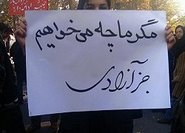





 Tulips in Holland