Alliance For democracy In Iran

Please have a look at my other weblog, Iran Democracy - http://irandemocray.blogspot.com/

IMPERIAL EMBLEM

IMPERIAL EMBLEM
PERSIA

Shahanshah Aryameher

S U N OF P E R S I A

Iranian Freedom Fighters UNITE

Showing posts with label Khamanei. Show all posts

Wednesday, July 16, 2008

Khamenie wants to assassinate George W. Bush....

اگر کسی حماقتی نسبت به جمهوری اسلامی ایران مرتکب شود، جواب عملی جمهوری اسلامی، دندان شکن خواهد بود. خامنه ای افزود:‌ اگر ذشمن مرتکب حماقت شوند، بدانند ملت ایران، آن دستی را که به جمهوری اسلامی تجاوز کند، قطع خواهند کرد.وی گفت: برای ملت ایران فرقی نمی کند که این دست جنایتکار در مسئولیت دولتی باشد و یا خارج از مسئولیت دولتی.وی خاطرنشان کرر: اینکه برخی بگویند رئیس جمهوری امریکا در ماههای آخر مسئولیت خود اقدامی را انجام دهد و دردسر آن برای دولت آینده بگذارد، تصور اشتباهی است زیرا اگر کسی اقدامی انجام دهد، ملت ایران او را حتی در زمانی که در مسئولیت هم نباشد مورد پیگرد قرار خواهد داد و مجازات خواهد کرد.
President Bush has authorized the most significant U.S. diplomatic contact with Iran since the Islamic Revolution.
The attack on an Iraqi base came as troops prepared for a battle to try to reclaim Diyala from jihadi fighters.
Kurds Protest Iraqi Election Law By CAMPBELL ROBERTSON
The entire bloc of Kurdish lawmakers walked out of Iraq’s Parliament in protest at a proposed provincial election law, part of which they claimed was unconstitutional.

Thursday, July 03, 2008

Thursday, May 29, 2008

HIH Prince Reza Pahlavi : A worming to Khamenie and his cohorts


«هشداری به آقای علی خامنه ای و دست یارانشان»
May 24 th Live interview on Persian Radio TV


من نیز، همانند اکثریت قاطع هم میهنانم، دیریست که حکومت جابرانه و خودکامۀ شما را بر ایران عزیز و بر مردم آزاده و شریفش، از هر نوع مشروعیت قانونی و اعتبار اخلاقی بی نصیب می دانم. چه، اگرانقلاب از رهگذر مشارکت نسنجیدۀ مردم ایران مشروعیتی داشت، با آغاز و ادامۀ حکومت ولایت فقیه، که شما و یارانتان، چون بختکی سنگین برسینۀ ایرانیان فرود آوردید، ذره ای از آن مشروعیت بر دامن به خون و فساد آلودۀ شما برجای نمانده است.
اعتبار و مشروعیت هرحکومتی تنها مشروط به تبعیتش از رای شهروندان و، مهم تر از آن، منوط به لیاقتش در برآوردن خواست های برحق و آرمان های انسانی آن هاست. حکومتی که نه پاسخگوی شهروندانش باشد و نه کارساز مشکلاتشان، همانقدر مشروع و معتبراست که حکومت بیگانگان در سرزمینی اشغال شده. کارنامۀ سیاه سی سالۀ ولایت فقیه، آقای خامنه ای، بی گمان معرف وجود و حضور چنین حکومتی در میهن عزیزماست.
دلایل بی اعتنایی حکومت شما به رای مردم ایران چنان بدیهی و بی شمارند که مشکل بتوان کسی را، در ایران یا در سراسر جهان، یافت که از آن بی خبرباشد. نزدیک به سی سال است که شما و دستیارانتان، با توسل به خشونت بی کران و تهدیدها و ترفندهای گوناگون مجال ابراز رای و اظهارنظر آزادانه را از مردم ایران سلب کرده اید و در زندانی به پهنای سرزمین بزرگ ایران نه از مطبوعاتی که خواست ها و آرای شهروندان محروم را آزادانه بازتاب دهند نشانی برجای گذاشته اید و نه از احزاب مستقلی که بتوانند گویا و مدافع منافع و مصالح طبقات گوناگون جامعه باشند.
کارگران و کارمندان ایران که در این سال های سخت و عصیان زا متحمل بیشترین محرومیت ها شده اند نه حق تشکیل سندیکاها و انجمن های خود را داشته اند و نه حتی حق تجمع و تظاهر مسالمت آمیز در اعتراض به حکومتی که چنین مصیبت ها و محرومیت هایی بر آنان تحمیل کرده است. میلیون ها دانشجوی ایرانی، این نمایندگان واقعی ملت، این سخنگویان هشیار و فرهیختۀ مردم ایران، هرگاه سخنی در بیان واقعیت های تلخ زندگی خویش، در دفاع از مصلحت میهن رنجورشان، به زبان و قلم آورند پاسخ آن تحمل شکنجه و زندان و مرگ است. همین بها را سال هاست که زنان شیردل ایران، مادران و دختران محروم وطن، نیز پرداخته اند، آن هم به اتهام حق طلبی، به گناه تجاوز از حصار و حریم قرون وسطایی، به جرم تلاش برای گسیختن زنجیرهای بندگی و حقارتی که حکومت شما بر آنان تحمیل کرده است. حتی روحانیان حق طلب نیز که به نقش شما در سست کردن اعتقادات مذهبی بخش بزرگی از مردم ایران پی برده اند اگر زبان به انتقاد و اعتراض گشایند از انتقام شما مصون نمی مانند.
تنها دو نهادی را که می توانند معرف و مترجم واقعی خواست و ارادۀ عمومی باشند، که همانا انتخابات ادواری و مجلس شوراست، به نمایشی مبتذل و فرمایشی و به ابزاری شرم آور برای فریب مردمان فرو کاسته اید. بی حضور احزاب و مطبوعات آزاد و دادگستری مستقل، مردم ایران همانقدر از انتخابات شما بهره برده اند که مردم اتحاد جماهیر شوروی سابق از انتخابات نظام استالینی.
و این جاست، آقای خامنه ای، که باید به دلیل دوم سلب کامل اعتبار و مشروعیت ولایت مطلقۀ فقیه پرداخت که همانا بی کفایتی مزمن شما و پیشینیانتان در برآوردن حداقل نیازهای اقتصادی مردم ایران است. ابعاد وحشتناک این بی کفایتی به ویژه با توجه به درآمد سرشار سی سالۀ ایران از فروش نفت آشکارمی شود. به سخن دیگر، نظام ولایی شما افزون بر سلب همۀ حقوق و آزادی های مردم ایران، و علیرغم دست یافتن به ثروتی باد آورده و عظیم، ایران آباد و بالندۀ آستانۀ انقلاب اسلامی را که رشک جوامع همسایه بود به سراشیب ورشکستگی اقتصادی کشانده و مردم کوشا و مستعدش را به مصیبت های جانکاه تورم و بیکاری روزافزون دچار کرده است. در سراسر جهان، از شمار انگشتان یک دست بیشتر نیستند حکومت هایی که شهروندان خویش را، بسان حکومت شما، هم از آزادی های اساسی بشری محروم کرده باشند و هم از حداقل حقوق مادی. عجیب نیست اگر برخی از یاران معدود شما درعرصۀ بین المللی، از جمله سوریه و سودان و کرۀ شمالی، نیز در جرگۀ چنین حکومت هایی جای دارند.
اما، آقای خامنه ای، سلب حقوق و آزادی های مردم ایران و خم کردن پشتشان با سنگینی مشکلات روزافزون اقتصادی با همۀ اهمیتشان در برابر خطرها و تهدیدهایی که از سر جهل و غوغاگری متوجۀ امنیت و تمامیت ارضی میهن عزیز ما کرده اید رنگ می بازند. واقعیت مسلم آن است که سال ها پیش از تسلط شما و یارانتان بر مسند حکومت، سودای بهره جویی از اهرم مذهب برای دخالت در جوامع همسایۀ ایران مهم ترین وسوسۀ ذهنی شما بوده است. در مقدمۀ قانون اساسی جمهوری اسلامی، که «سند سلب حقوق ملت» نامی برازندۀ آن است، از چنین سودایی به صراحت سخن رفته.
تلاش شما برای حادثه آفرینی و مبارز طلبی برای تحریف افکار مردم ایران ریشه ای بس دیرینه دارد. از همان آغاز تسلط شما و یارانتان بر مسند قدرت بود که به خوار شمردن بزرگان و قهرمانان تاریخی و تحقیر آثار گرانقدر باستانی ایران پرداختید و عناد و خصومت خویش با هویت و فرهنگ کهن ایران، یعنی شالوده های استوار همبستگی هزاران سالۀ مردمانش، را تایید کردید. از همان آغاز بود که با درهم شکستن شیرازه های ارتش مجهز و مقتدر ایران و ریختن خون سردارانش، به حکومت عراق بهانه و فرصت دادید تا جسورانه بر میهن عزیز ما بتازد. از همان آغاز بود که با سرکوب اقوام گوناگون ایرانی، با تهدید و تحقیر ایرانیان پیرو مذاهبی جز تشیع، شالوده های دیرینۀ همبستگی و همزیستی میان ایرانیان را سست کردید. جنگ با عراق را، به بهای سنگین قربانی کردن صدها هزار جوان و نوجوان ایرانی و اتلاف سرمایه های بی حساب، آن هم به سودای تسلط بر عراق و رسیدن به قدس، چنان به درازا کشاندید تا ایران قربانی تجاوز، خود در نظر جهانیان و در داوری شورای امنیت سازمان ملل متحد، همتراز متجاوزان شناخته شود. با نقض یکی از کهن ترین و مسلم ترین اصول حقوق بین الملل به اشغال سفارت آمریکا و دستگیری و شکنجۀ اعضایش پرداختید، و با وادار ساختن این کشور به قطع رابطه با ایران، تنگناهای اقتصادی و سیاسی بی سابقه و پر هزینه ای برای مردم ایران به ارمغان آوردید.
با دخالت مستقیم و غیر مستقیم در امور داخلی همسایگان دور و نزدیک ایران، از جمله عراق و لبنان و فلسطین و افغانستان، و با حمایت تبلیغاتی و مالی و نظامی خود از تندروترین و خشونت گراترین دشمنان آزادی و همزیستی در این جوامع، نه تنها نام ایران عزیز را در جوامع بین المللی همنشین صفات پلیدی چون «تروریست» و «یاغی» کردید بلکه شماری بزرگ از کشورهای بزرگ و کوچک جهان را به صف دشمنانش راندید. اگر تا کنون ساده لوحانی در جهان نقش مستقیم حکومت شما را در آشوب ها و کشتارهای سرزمین های دور و نزدیک ایران نمی دیدند سخنانی که برای نخستین بار از زبان یار دیرین شما، آقای محمد خاتمی، در اعتراف بی پرده به این نقش جاری شد جای تردید برای کسی باقی نگذاشت.
اما، این همه نیز برای تحقق اهداف اصلی شما که منحرف کردن افکار مردم ایران، از راه تحریک دیگران به دشمنی با ایران و برافروختن آتش ستیز و جنگ، است کافی نبود. از همین رو، به بهانۀ دسترسی به انرژی هسته ای برای مقاصد صلح آمیز، درصدد دسترسی به سلاح های خوفناک تری برآمده اید تا بار دیگر ایران را آماج تهدید و تعرض دیگران سازید. از رهگذراصرار شما برچنین سودایی است که امروز کشور عزیزما با بحرانی بی سابقه و خطرناک روبروست؛ بحرانی که هم میهنان عزیز صلح دوست من کمترین نقشی در ایجاد آن نداشته اند.
مردم آگاه و دوراندیش ایران منفعت و مصلحت خویش را نه دخالت مسلحانه و موذیانۀ شما در سرنوشت مردم فلسطین و عراق و لبنان می بینند، نه در دشمنی شما با جوامع آزاد و پیشرفتۀ جهان و نه در اصرار دیوانه وارتان بر دست یافتن به سلاح هسته ای. مردم ایران از یاد نبرده اند که موجبات دسترسی به فنآوری و انرژی هسته ای، آن هم با موافقت و همکاری جامعۀ بین المللی، سال ها پیش از انقلاب فراهم شده بود زیرا هیچ کشوری در جهان بیمی از هدف ها و سیاست های حکومت آن روز ایران نداشت. شما و پیشینیان شما، اما، با هدف های تجاوز طلبانه و سیاست های تحریک آمیز خود نه تنها آن فضای اعتماد و تفاهم را یکسره نابود کرده اید بلکه با جهل و عمد اکثریت قریب به اتفاق دولت های جهان را از نزدیک و دور، به دشمنان ایران مبدل ساختید تا برای سرکوب هرچه بیشتر مردم آزادۀ ایران بهانۀ دیگری بیابید.
گرچه در آغاز این سخن، حکومت شما آقای خامنه ای و دستیارانتان را محروم از هر نوع اعتبار و مشروعیت در چشم هموطنانم خواندم، و بنابراین نمی بایست شما و حکومت شما را مخاطب خود سازم، اما، عشق به سرزمین پاک نیاکانم و نگرانی از سرنوشت هم میهنان محرومم مرا ناگزیر از آن می کند که به شما هشدار دهم که مسئولیت اصلی هر آسیب و خدشه ای که از سوی هر نیرو و قدرتی به تمامیت و یکپارچگی ایران عزیز، به هر گوشه ای از این سرزمین مقدس، وارد آید با شما و دستیاران شماست.
بدانید که در صورت رخ دادن فاجعه ای از اینگونه، سرنوشت شما و یارانتان بهتر از سرنوشت حاکمان خودکامه ای که در سال های اخیر بر کرسی متهمان به جنایت علیه بشریت نشستند و کیفری در خور یافتند نخواهد بود. از سرنوشت آنان اگر پند نمی گیرید، اگر آزادی و بهروزی شهروندان ایران کمترین محلی در دل و اندیشۀ شما ندارد، دستکم نگران سرزمینی باشید که در آن زاده شدید. اگر امروز که می توانید نخواهید سر به خواست های ملت دهید و به دامن بخشش بی کرانش دست آویزید، بدانید مسند قدرتی که چنین فرعون وار برآن تکیه زده اید در برابر عصیان روزافزون مردم ایران تاب نخواهد آورد، فرو خواهد شکست و شما را سرانجام بر کرسی پاسخ گویی به آنان برای محرومیت ها و مصیبت های سی ساله خواهد نشاند.
خداوند نگهدار ایران باد
رضا پهلوی


<>'>http://rezapahlavi.org/print/?persian&id=300" A ><>


****L*******O*******V*******E****

“How can I fall in love with this person more fully?

How can I appreciate every aspect of this person?
How can I find new things that I am not attached to,
but I can love because
I see my reflection in them?”


"Beacons of Light 'Hologram of Love' May 2008

Greetings from Home


Hang on to Your Crystals . . .


Here We Go!
Dear ones, this is a special day.
This is the activation of a process you began some time ago. It is now integrating into the human experience on a daily basis. This activation is helping to awaken a new level of humanity.

This is the crystal awakening on Planet Earth. As a note of explanation, the group has often used the word “crystal” to describe the new energy and higher vibrations that we are moving rapidly toward on this wild ride.

They say that humans and crystals have a natural resonance. Crystal is the highest level of the mineral (Earth) kingdom and humanity is the highest level of the animal kingdom; therefore, they have a natural understanding and harmony..

The rapid evolution of humanity has recently reached a vibrational resonance. This is similar to an energy ceiling, where evolution meets a natural resistance..It is about to break loose. Here new things will show up in your every day world almost as if they were there all along. These are seeds that were planted and are now sprouting in the collective of humanity. Ideas and concepts once thought to be on the edge are now becoming part of your reality every day.

They are leading you into the age of the empowered human. We offer you ideas and concepts to help you stretch some of your belief systems, so that you can more easily adapt and use this energy. By doing so, you will find how this can fit into your life in some way and where it can be used on a daily basis. Our intent is to offer you opportunities to see things from a different perspective..

This day we wish to speak about a form of energy that exists in your reality known as light. The light we have spoken of is completely misunderstood among humanity—especially in your scientific world. What you have termed the electromagnetic spectrum is actually only a small portion of the entire spectrum of light. More importantly, let us speak to you about what it looks like and how it has been used in the past so you can see what is going to take place in the future..

Ready, Set, Create!
Things are moving very quickly now and many of the divisions in the timelines and some of the dates you have set for yourself, such as 2012, have all been pushed forward. You are experiencing things that were never meant to be experienced by humans in this game. This is why all eyes are upon you now as you make your choices. You were not supposed to continue the game for this long, yet here you are making adjustments to carry more of the light from Home..

Mastery of Thought – Directing Light
You have decided to step into a new reality and create this as you move forward, to create the path beneath your feet before your foot hits the ground. Of course, you do this in a very magical way. You do not see the magic that happens as your foot hits the ground. You have no clue that you created that path yourself. Your expectation is what creates it; this is what science is beginning to understand. The intent of the experiment predetermines the outcome of the experiment. Humanity’s creation abilities are growing much faster than ever before. Before, there was always a time lag in place that kept you safe from your inability to master your thoughts. Without the safeguard of the time lag, your every thought created instantly and it was easy to get stuck in an endless loop going nowhere. So, in the beginning of the game you put in a time lag where you would have a thought and it would be a while b efore it would actually manifest. This broke the loop and seemed to work for a while, but with the continual rise in the vibration of humanity even this is no longer serving you the way it once did. That time lag is going away very quickly. Every thought that you now have and hold for more than seven seconds starts the manifestation process. Much of your energy in the transitional period ahead is going to be spent trying to wipe out creations that you really did not want, but just happened to be thinking of in that moment..

Retro-Causality
We ask you to take a look at your own mental process, because mastery of thought is not about only holding perfect thoughts in your mind. It is not possible for you to only have perfect or energetically positive thoughts all the time. You have placed yourself in a game where you have to experience negative energy in order to even understand what positive energy is. As a result, there must be continual contrast throughout your experience. There must be a rhythm to life. There will always be negative thoughts that enter your mind. If you claim them or attach yourself to them, they instantly become your reality. However, if you let them simply flow through your mind and say, “That is a really negative thought. I do not want to hang onto this one” and let it flow through, another thought will be very close behind it. Re-member that you are part of a Universal Energy and a Universal Subconscious mind an d all thoughts go through your brain. All emotions travel through your emotional body; all thoughts travel through your brain. . You have choice over which thoughts and emotions you are going to call your own. You have choice over which ones feed you, which ones drain your energy, and which ones you wish to keep in your field and incorporate. Learning how to flow the energy through your field to allows you to become an active participant in making choices. This is what humans do best and what you came here to work with. The key here is to follow your heart, for it knows the real difference between things that feed you and things that drain you. Listen to that voice within..Let us give you a practical illustration. We are going to go back to the beginning of Earth. We are going to tell you something that happened before the big bang, because it is still unclear what the big bang was in the first place. Exactly what exploded in order for everything to happen? (Here the group is making a direct reference to our collective human creative abilities. They say we still have not written our past as far back as the big bang.) Now science is starting to question and to understand there is a time connection that is not real. They are starting to understand they can go back to the beginning and change things like the big bang, which in turn changes all of your experience up to this point. It is possible to go back into what you call your history and change or alter it. That is going to be a big part of the future you are creating. Earth, as in all things, began as a thought of god. If we take that concept a little further, it is easy for humans to understand because you believe god to be the almighty, the all powerful. Every thought that god has manifests instantly. Is that not just what we told you was happening to humans? Do you see the similarities here? We hope you are beginning to see a mirror, because that is what is taking place. The mirror is starting to clear; you are starting to see behind the veil. You will see your own manifestations begin through your thought process. So let us give you some ideas about how to work with that, and ideas of things you can do to work with this energy for a positive state for yourself..

In the Beginning
In the beginning, a thought of god sent out a ray of what we call light. The ray of light in your physical being is felt as love. You feel it as the emotion of love, so therefore it is possible for us to say that love is the base energy of light. We will use that term for a moment. Now how does that work? It is very simple because the moment any person or any being of godlike nature holds a thought, a beam of energy comes from them and enters their own energy field and interacts with the world and the Universal Energy around them. The field is magnetized to attract the creation. What if you then had another thought of god that was another way of looking at that same creation? Now imagine this creation from many points of perception. Then you have multiple rays of light coming from different angles to meet as one. This gives the illusion of a physical three dimensional object. You know it in your reality as a h ologram. Multiple beams of light intersecting at one point create the illusion of real three dimensional objects. That is all that is necessary, for all of life is nothing more than an illusion.. Earth began as a hologram of light, as did the universe. This was the beginning and from that point a universe was created around it including a big bang to set it into motion. Earth was created intentionally with two sisters, Venus and Mars. The three sisters shared the balance of what you call carbon dioxide and created life on all three planets. There came a point where only one planet was able to balance enough carbon dioxide to maintain, so the two sisters put their energy into the one sister in the middle and breathed life into a planet that began as a hologram of light. In some ways it is as if the three lights created an additional hologram that reprinted Earth..

Forming a Hologram of Love
Now, let us talk of love. Love confuses many Lightworkers, dear ones. Let us talk about the energy of love. We see love as the base energy of all life. Compare that to the human definition of love and you will see how they vary. We tell you that love is a form of energy within the spectrum that we call light. Therefore, a hologram that can be created with light can also be created with love. We wish to share with you how to make a hologram of love..The way we see the expression of human love is in the act of balancing. Each one of you is slightly out of balance with some part of your energy. Find a person who can help you balance that energy and you have great potential for a deep, lasting, relationshift. Basically, relationshifts are a mirror. You see yourself through their eyes and you reflect them. When two people come together and form a connection and one person looks into another’s eyes and sees themselves through those eyes, that is the true reflection of the heart. If you like the person you see through their eyes, you become a friend. If you love the person you see through their eyes, you form a love relationship. The word love has meant so much and yet so little. It has been so restricted to small areas, including the small area of sexuality and relationships. Humans have developed habits of working with conditional love. Cond itional love has worked very well in the lower vibrations of your existence. As you move forward, it is no secret that you will be moving out of conditional love and into unconditional love. You will find that conditional love is a rather unique human invention. Therefore, it is not possible to make a hologram of conditional love..

Unconditional Light
Let us give you a specific example. Let us say that you have one relationship that means a lot to you. You really care about this person and the relationship between you. We actually see three vibrations here: the two of you and the third vibration, which is the harmonic of the two of you. When the two vibrations meet and support each other they create a third vibration, which we call the relationship. Many of you are attached to the relationship, not to the love you see reflected. This has to do with your attachment to the idea or concept of love. As you continue to evolve you will begin releasing your attachment to love. This is the first movement into unconditional love. It is not easy to do this, for your history of successes is largely based on conditional love..What happens is that you look at yourself through this person’s eyes and you love the reflection you see, so you start to build something with them. Over a period of time you build a relationship. At some point, one or both of you begin to grow very quickly, and the relationship begins to grow apart. If you can start the hologram of love, it can move into a multidimensional level which will make all of these transitions easier. Let us give you some practical examples as to how you can do this. Let us start with a love relationship. Let’s say that you fall in love with the way someone makes you feel. Focus on that, then find another point to fall in love with. Yes, find something else about them that you can fall in love with. Imagine this as a beam of light hitting the target from a different angle. Make it something new and build it as strong as you can. Then find at least one mo re point that you can fall in love with, and do your best to focus and build all of them. You have just created a Hologram of Love. That is now an energy imprint that stays in the ethers. If the imprint is left unhampered, it will be the form around which energy will naturally gather. The hologram of love can be used to enhance many other things including business, projects and many levels of relationships. All of it is based on unconditional love. It will not create a relationship, because relationships are built rather than created. But it will make a space for the best reflection possible within a relationship and greatly communication..Understand that this is your reflection in each of the ways you fall in love with them. In a way you are creating the hologram by falling in love with your own reflection..

Multifaceted Love
Each person is multifaceted. There are different parts of you inside each dimensional reality. If you are able to fall in love with the artist and the healer in someone —different dimensions of that person -- then you are able to recognize different aspects of the same person. This too can be used to create a hologram of love which is very magical. It allows you to see yourself in a very unique way—a way that will only get stronger as you move from one level to the other. But it means looking for those possibilities. It means searching for those different parts of this person that you can fall in love with. It also means releasing the restriction. It means letting go of the fear of falling in love and the fear of being hurt. Are you going to be hurt again? Yes, we pretty much guarantee it. Yes, at least once and maybe more if you are lucky..The more unconditional love from different angles that you can bring into each relationship, the deeper and easier the communications will be and the tendency to grow apart will not be a problem. This will allow you to see a very unique and special view of yourself, and ultimately you fall in love with yourself. When that happens, you will start to release the need for love outside of yourself. That is actually the best point from which to build a relationship where two very strong individuals who can walk side by side and support each other unconditionally. The more unconditional love you can bring into any relationship—whether it be in a love relationship, with your children at home, or boss at work, find those pieces that reflect you well and amplify those pieces. You may ask, “How can I fall in love with this person more fully? How can I appreciate every aspect of this person? How can I find new things tha t I am not attached to, but I can love because I see my reflection in them?” You are now at a level of vibration where you can create this energy and walk forward with a new form of love, which will easily move from one level the next. We have no conditions. That is our expectation of you: none. We love you for being who you are..

Overtime
You have had the courage to leave Home, to leave your heritage, to come down and play this game, to put a veil on and not even re-member that you are magical. You have the courage to come down here and bump into one another and create pain and difficulties so that you could have a human experience of the soul, and that takes courage. You are some of the greatest healers that have ever lived, even though some of you do not consider yourselves healers. You are making a difference not only in your reality and not only in your world, but throughout All That Is. Never before has there been a race of beings that went past the end to take the game into overtime. That is what has happened with humanity and you are creating the game as you go forward. There is no grand plan in place and you are doing it exceedingly well..
You are starting to uncover the secrets that have kept the veil in front of your face. The more you can play with love, the more that you can see how to look through someone else’s eyes and love yourself unconditionally, without expectations. You have the opportunity to be happy on this planet. It is not easy. If it were easy, everyone would be a human. As it is, only the highest have become humans and we thank you for sharing your light with us. You have no idea what this looks like, really. All dimensional realities come together and there is one beam of light that comes out of everything and it is planet Earth—and it is the humans taking this to an entirely new level. You will walk with your wings on and we hope you have fun creating many holograms of light to see your reflection in different ways.. It is with the greatest of honor that we greet you and hold you in our arms. We hope to reflect who you really are and help you re-member what you already know deep inside. We leave you with three simple reminders: to treat each other with the greatest respect for you are not alone on this path. Open the door whenever possible and nurture one another at every opportunity. Re-member that it is a game and play well together..

Sunday, May 04, 2008

Holding Back Imperial Iranian Theocracy : Paulo Casaca


Holding Back Imperial Iranian Theocracy

While extreme nationalist and political passions are far from dissipated, religious fanaticism, Islamic fanaticism in particular has became the driving force of much of the intolerance found around the world.A perpetual source of conflict with Islam itself has been between fundamentalist and evolutionist readings of the Koran, greater perhaps than any theological dispute within that faith. But the new brand of fanaticism born towards the end of the 20th century is of a totally different nature.The theocratic doctrine that came to light in the second half of the 20th century in the main Shi'ite school of Najaf in Iraq, later to be put in practice by Ayatollah Khomeini in 1979 in Iran, introduced three devastating elements: (1) the principle of the rule of the religious authority; (2) suicidal terrorism as a major political-religious-military tool; and (3) world domination, the first step being "through Karbala to al-Quds [Jerusalem]," with the ultimate goal of "introducing the Islamic revolution to all of mankind" (President Ahmadinejad to the Assembly of Experts, IRNA, February 25, 2008 - translation by MEMRI).THE IRANIAN clergy's traditional weapon of manipulation and dissimulation has so far proved more successful than any other in winning its first strategic objective: to dominate Karbala, the Shi'ite holy city located in Iraq.On the other hand, Ayatollah Khonmeini's strategic decision to develop a nuclear weapon, made at the time he drunk from the "glass of the poison of peace" with Iraq, has been hampered by sheer incompetence and, even more so, by the resilience of the Iranian resistance, which revealed to the world the regime's nuclear plans despite decades of ferocious persecution by Iranian authorities in cooperation with Western governments.Western diplomacy has been busy searching for the reasonable, peace-loving Iranian cleric who will reject embarrassing human rights abuses, imperial aims and, last but not least, Holocaust denial and threats to wipe Israel off the map as made Ayatollah Khomeini and recently reaffirmed by President Ahmadinejad.The loose interpretation of United Nations resolutions 1737, 1747 and 1803 on sanctions against Iran given by some EU member states - Austria conspicuous among them - is astonishingly enough supported by the European Commission. This demands a firm response from clear-thinking, anti-fascist EU politicians. In addition, closer analysis of possible judicial action is called for.Although the European Court of Justice jurisprudence has a historical bias against what might be considered class-action suits, recent developments and the special life-threatening characteristics of the Iranian imperial threat should make us carefully consider this option.We have to think of smart alternatives to avoid being squeezed between "business as usual" and war.AN INTELLIGENT strategy to face theocratic imperialism must begin by supporting a realistic political and popular opposition instead of betting on fake reformist alternatives.Europe has been unable to act as a united force in facing Teheran, not even through economic strategy. Yet the Iranian regime badly needs Western technology which it will not find easily in the rest of the world.An intelligent combination of economic and diplomatic sanctions is an essential piece of any reliable strategy to stop the nuclear bomb of fanaticism.The writer is a Portuguese Socialist member of the European parliament. He will be attending the international conference The Iranian Threat, organized by the STOP THE BOMB coalition, that takes place today in Vienna.

The Bloody lier Says that : Ex-Iranian President: Fomenting Violence Abroad 'Treason' - May 03, 2008 The Associated Press Ali Akbar Dareini

TEHRAN, Iran -- A former Iranian president has said that exporting violence to other countries is "treason" against Islam and Iran's 1979 revolution, an apparent accusation that the country's hard-line rulers are engineering unrest abroad.Mohammad Khatami, a reformist and popular intellectual, made no mention of U.S. and Iraqi accusations that Iran is arming and training Shiite extremists in neighboring Iraq. But he said Iran should avoid actions that give it a bad image.

HERE IS THE BIG LIE : Engineering violence in other countries would be contrary to the goals of the 1979 Islamic revolution led by Ayatollah Ruhollah Khomeini, Khatami said. "What did Imam (Khomeini) want and what did he mean by 'exporting the revolution'? Taking up arms and causing explosions in other countries and establishing groups to carry out sabotage in other countries? Imam was strongly opposed to these behaviors," Khatami told students in northern Iran on Friday."This is the biggest treason to Islam and the revolution."

Khatami's remarks were published by the daily Kargozaran Saturday and also posted on the Web site of a pro-democracy foundation he heads.Iraqi and U.S. officials accuse Iran of arming and training Shiite militias in Iraq but Tehran denies it. Senior Shiite Iraqi politicians are in Iran to confront authorities with evidence of Iran's involvement.On Thursday, the Iraqi delegates met with Gen. Ghassem Soleimani, commander of the Quds Force, an elite unit of Iran's Revolutionary Guard Corps that has been accused of training and funneling weapons to Shiite extremists in Iraq.The Guards chief is appointed by Iran's top leader Ayatollah Ali Khamenei and Guards' commanders have openly supported the country's hard-line leaders.Iraqi officials said the delegation had documents and other material implicating the Quds Force in supplying weapons and training fighters.U.S. military officials have said the evidence includes caches of weapons that have date stamps showing they were produced in Iran this year — including mortars, rockets and armor-piercing roadside bombs known as explosively formed penetrators, or EFPs.

Saturday, March 15, 2008

Iran's call to vote ignored by millions

Iran's Supreme Leader cast his vote in parliamentary elections yesterday and, in his solemn and severe dark robes, told his compatriots that taking part was their "national and religious duty". ( bullocks ) . Yet millions of Iranians appeared to be registering a silent protest against the regime by ignoring Ayatollah Ali Khamenei's plea.

14 March 2008: Iran's Supreme Leader urges public to vote
14 March 2008: Young bloggers hold key as Iran goes to polls

Liam Fox: Understanding what we have in common
David Blair: Iran can only wait and pray

Airing Views and Casting Ballots at A Tehran Mosque

Hard-Liners See Victory in Iranian Vote
For Iranian Voters, It's the Economy
Iranians Vote in Parliament Elections

Related Video
Iran votes (CNN Video) 3/14/2008 9:36:57 AM
Voting begins in Iran polls (BBC Video World) 3/14/2008 7:52:10 AM
What's next for Iran? (CNN Video) 3/14/2008 6:40:14 AM
Khamenei casts his vote (CNN Video) 3/14/2008 4:19:51 AM
Iran Prepares For Elections (CBS News Video) 3/13/2008 8:07:47 PM
Related Audio
Iranian Vote Tests Support for President (NPR World News) 3/14/2008 8:38:27 AM
Prospects Uncertain as Reformists Unite in Iran (NPR World News) 3/13/2008 7:20:25 PM
Iran Elections Exclude Many Reform Candidates (NPR World News)

In Tehran, voters have to select 30 candidates, write out each by name, then add a special code number - Polling stations across Tehran were quiet, orderly and only sparsely attended. One virtually empty polling station in a mosque on Dowlat Street pointedly declined to say how many people had voted by 3pm. "You are not allowed to know that," said the official in charge.

After about 90 per cent of reformist candidates were banned from contesting the election, Iran's 70 million people - two thirds of whom are under 30 - were left to choose between an array of hardline conservatives.State television devoted hours to exhorting people to vote, with one official feeling confident enough to proclaim a "glorious" response. But early signs suggested the turnout might equal the 52 per cent registered in the last election in 2004.This compares with turnouts exceeding 80 per cent in the presidential polls of 1997 and 2001, both won by Mohammed Khatami, a reformist cleric.At the gates of Tehran University, a polling station was devoid of students and served a modest procession of elderly men with white beards."All Iranians have a national duty to vote," said Abbas Noroozi, 79, leaning heavily on a walking stick."Elections decide the destiny of the nation. The students will come to vote later. There is still time."Nearby, a preacher told an audience at Friday prayers that America was hoping for a low turnout. "Bush is interfering in Iran and asking people to stay away from the election. But Mr Bush, look and see that the Iranian people are voting," he said, before leading vigorous chants of: "Death to America!"Voting procedures could hardly be more cumbersome. In Tehran, Iranians must select 30 candidates - one for each of the city's constituencies - then write out each name by hand and add a special code number. Processing one voter takes at least 15 minutes.This was not why a 27-year-old student declined to participate. "I don't agree with any of the candidates. We are only allowed to vote for the candidates who are approved by the government. So what is the point?" he asked. Another 25-year-old said: "I would have voted if the reformers had been allowed to stand."When Mr Khatami was president of Iran, he did much for the young and people were not miserable as they are today. But those who are responsible for the country now do nothing for us."Iran's inflation runs at 20 per cent and crushing levels of unemployment blight the prospects of the young. This election might change the course of Iranian politics if hardline opponents of President Mahmoud Ahmadinejad do well. Whatever the outcome, however, Ayatollah Khamenei's position as Iran's chief power-broker will probably be reinforced.But a low turnout would rob the contest of legitimacy and signal the quiet but persistent discontent of millions of young Iranians. Early results are expected tomorrow .

Saturday, March 01, 2008

IRAN'S INCREASING DRUGS PROBLEM

Khamenei Smoking opium


Afghan opium trade booming: US

The US State Department has issued a new report which says that last year, Afghanistan grew more opium poppies than ever before and was responsible for 93 per cent of the world supply.The report urged the Afghan Government to take action, saying that the drugs trade deters progress towards a stable, economically independent democracy.It said that hardline Taliban insurgents benefit with growers and traffickers exchanging money and guns for Taliban-sponsored protection.State Department official David Johnson says the Taliban is reaping the gains of the trade."There's incontrovertible evidence that the Taliban used drug trafficking proceeds to fund insurgent activities," he said."Poppy production soared in the southern provinces where the insurgency is strong."At the same time, poppy cultivation has declined in the poor but more secure northern and central provinces."The report also revealed that Afghan President Hamid Karzai had considered limited aerial spraying of opium crops last year but opted not to do it.It was acknowledged that this action would have been extremely dangerous and unpopular.

IRAN'S INCREASING DRUGS PROBLEM
[Tehran] Ten years ago, calculating the number of drug users in Iran was pure guesswork. These days it is rather more scientific, and the veil is being drawn aside from a social ill hidden for decades by conservative governments. Today, new statistics are endorsed by the United Nations Office on Drugs and Crime (UNODC).

In 1999, the UNODC was launched in Iran and together with the Iranian administration started releasing more realistic figures. It is now accepted by both parties that Iran has roughly 1.2 million regular users and around 800,000 periodic users throughout its cities and provinces. Depending on who you are talking to, the numbers still vary. The initial survey started alarm bells ringing in government circles as results suggested an epidemiology within Iran's borders, with new trends developing across all spectrums of society, and a shift from opiate-based drugs to synthetic ones. A local NGO, the Center for Human Regeneration, helps people suffering from opium addiction. One of its rehabilitation facilities it has helped 7,000 people so far, and it has six more facilities in Iran. Its founder is a former addict who, during one Ramadan month, eventually kicked his habit after realizing that he could cure himself by lowering his opium intake gradually. This is a view that former addicts turned counselors share. One of them is Mehrdad, who entered the Center looking for help, and now helps others to clean up. “Treatment at the Center takes Iran’s specific drug problem into account. Cold turkey doesn't work here. We use opium in our rehab process rather than methadone. People addicted to opium are addicted to 12 alkaloids rather than the one in methadone.” Pressed for further information, Mehrdad explains, “Methadone users still experience pain and even sexual dysfunction, which causes them to relapse. Opium is natural and can be used to battle addiction and pain, all counselors here are former addicts and must pass a test to be able to sit where I am now.”One of the more controversial aspects of this treatment plan is that it allows addicts to buy their own opium. “We give them scales and tell them how much they can use in a day, the patients keep the drug themselves and we have an agreement with the police whereby they won’t get arrested if they are caught while receiving treatment with us. Each month we tell them to reduce their consumption by 20 percent. The onus is on the addict to take responsibility as we can only help those who want to help themselves.” The center also offers addicts different ways to express themselves while in therapy. One is through sport and 12 different sports are provided. Soccer, rugby, volleyball, and darts are all on the menu, but the most successful venture is archery. Two former male addicts and one female now represent Iran at international level and may be sent to the Beijing Olympics. The center also operates a needle exchange. The experience that counselors pass on is invaluable for those in rehab and with a relapse rate around 12%, something is clearly working. It can be compared to a 2004 report by Shiraz University which then showed a relapse rate of anywhere between 60 and 80%, depending on where the addict was treated. One American rehab center suggests a similar figure of 16%.Mehrdad explains, “Rehab is revolutionary in Iran, ten years ago admitting the problem existed would have got you imprisoned or shot. [The government] listened to outside advice because they were afraid of a spectacular health crisis, we have had army generals and government officials come through our doors.” Consumption in Iran is not just limited to the poor. Center staff deal with a large cross-section of the community. But what has caused the increase in numbers? Mehrdad pauses before he answers, “At the lower end of society, the problem is poverty driven; at the high end, it's boredom. Or pleasure seeking.” The Iranian authorities seize an estimated three to four hundred tons of narcotics every year. This is hardly surprising since Afghanistan shares a 750-mile eastern border with the Islamic Republic and some 93% of the world’s opium is grown in Afghanistan. Iran is caught in the unenviable position of being a key trafficking route to Europe and the Western markets for narcotics consumption. Rumor has it that drug seizures by government drug agencies follow tip offs by organized gangs, who then are allowed to run larger quantities of narcotics through Tehran and into Europe. Although such claims cannot be verified, the country's present failure to deal with domestic corruption issues allegedly surrounding many government institutions (confirmed by ‘Ali Hashemi, when head of the Drugs Control Headquarters in 2005 — he admitted that a few Iranian officials had been involved in trafficking) may be a sign it is true. Iran supports the international anti-corruption convention, but has yet to ratify the agreement. As more money is diverted towards intercepting shipments of narcotics, it is no surprise that Iran is the leading country in the world for drugs seizures. This point is not lost on UNODC representative, Roberto Arbitrio, who has been in working in Iran for the past four years. Aribtrio is well versed in the region’s drug problems and praises work being done by the government. “Iran is a country that is already working in the area of drug control and is considered in the region as one of the most effective. Iran has built an excellent protection system along the borders with Pakistan and Afghanistan over the main trafficking routes. It is a unique example in the region, so they are doing good work. What we as UNODC do is assist them in developing software capacity. In border control, what's needed is cross-border cooperation and that is where the U.N. can facilitate in making sure Iran, Afghanistan, and Pakistan coordinate action.”With Iran spending more resources on fighting organized crime, why is the drug problem spreading? Arbitrio’s answer involves Afghanistan like much of Iran's narcotics. “Opium use is common to many cultures in this region as a pain killer and sometimes it is used for recreational purposes. Over the past 15 years, opium production in Afghanistan has become an industrialized industry feeding Western markets. As a result of passing trade, the region became a consumer…Afghanistan now has over 1 million users. In turn, they've become a major market producing and consuming narcotics. There is a knock on effect in places like Iran, Pakistan, and other central Asian countries.” So it is all to do with the scale of production? “Yes, and the business needs of traffickers means they create local markets. Where you have trafficking you also have an increasing problem of organized crime and terrorism. There is now a clear link between trafficking of narcotics and specific manifestations of terrorism.” One cause for concern for UNODC and the Iranian authorities is the rise in number of people using heroin-based ‘crack’. “It's different from the crack used in the U.S. and Europe, which is cocaine-based, here it is heroin-based and we are still not entirely sure of its composition. UNODC with some government agencies are conducting a study on the drug. All we know is its impact is completely devastating, we have seen the terrible effects of this substance on people, and it's becoming more widespread, as is injecting heroin, and that's across the whole spectrum of society.”Heroin-based crack is causing much concern among ordinary Iranians. State television recently showed videos of suffering addicts to try to raise awareness. The government is trying to quell the local markets and its efforts are managed by the Drug Control Headquarters (DCH), whose remit is to develop, coordinate, and implement all local and national drug control policies. The DCH represents several ministries, including health, and controls the interior ministry and anti-narcotics police. The organization is led by a secretary general who is appointed directly by the president and answerable to him. The UNODC deals directly with this body, which it uses to circulate information to the NGOs. Arbitrio is enthusiastic about the diverse nature of the NGOs, “We work with 100 to 150 centers specializing in treatment and prevention and issues like curbing HIV. These problems are widespread in Iran and we are helping to improve the capability that's already set up and lend our expertise.” Why are NGOs effective in policy implementation? “They use a lot of different approaches. There is treatment through methadone, which moves users from heroin, and they also give psychological religious counseling.” Arbitrio also praised the religious counseling offered by the Rebirth Foundation. The foundation works in communities developing ways to help addicts cope and recover from drug abuse. It gained official recognition in 2005 when it won the U.N.’s Vienna Civil Society award, an honor bestowed to only one or two NGOs throughout the world each year. NGOs not only work with members of the public. One or two offer medical support to prisons inmates nationwide, trying to prevent the spread of HIV/ AIDS in the country.The UNODC representative believes the Iranian authorities are doing all they can to tackle the drug problem and applauds them for inviting missions from the Far East, Pakistan, and countries neighboring the Islamic Republic to demonstrate what is being done to reduce drug abuse and treat addicts. There is still more to be done, says Arbitrio, “We encourage all parties to come together and boost the status of bi-lateral cooperation. I must say the level of assistance provided bi-laterally is limited because the opportunities of cooperation between Iran and the international community are limited... the UN is the main provider of assistance, our current budget is a most $8-9 million over three years. This is quite a limited amount of money for a country with a problem like this. Drug control should be viewed as a non-political area for cooperation, because it's a destabilizing factor for all of us—for everybody in the international community.”

Iran's addicts fall victim to geography (and Islam)
von Anna Fifield (Tehran)

Iran shares a long border with Afghanistan, which produces 90 per cent of the world's opium, and as much as half of that is smuggled through Iran. The country's proximity to the world's biggest opium producer has led an estimated 5m into narcotics. Three years ago things could hardly have been worse for Ali-Reza Fatehi. His family had disowned him, he had lost his profitable business selling socks in the Tehran bazaar and his television set was his only
friend. When he was not watching television he was rifling through rubbish bins to collect plastic that he could sell on to recycling companies. "It was a very degrading job and completely out of character for me," says Mr Fatehi, looking down at his stained shaking hands through dark-ringed eyes. "But at the time I was doing crack and heroin and I wasn't myself."
Explosion in opium production since US-led invasion
Officially there are 1m drug addicts in Iran but international health workers estimate that the figure is much closer to 5m, in a country of 70m people. While much is known about the problem in neighbouring Afghanistan, and particularly about the explosion in opium production since the US-led invasion seven years ago, Iran's significant drug challenge is below the radar. But Iran shares a long border with Afghanistan, which produces 90 per cent of the world's opium, and as much as half of that is smuggled through Iran, partly for export and partly for consumption by people such as Mr Fatehi. Only a handful of stations can treat drug users in IranIran's addicts spend $3bn - the equivalent of 15 per cent of Iran's annual oil income - on drugs each year and their problem has led to a multitude of social ills, including an increase in HIV infections. There are about 70,000 HIV/Aids sufferers in Iran, about 60 per cent of whom were infected by sharing needles. But just as Iran is a victim of its geography, Mr Fatehi, 37, was in some ways a victim of his success. "I dropped out of school and started selling socks and stockings," he says at the Persepolis centre, a non-governmental treatment centre in southern Tehran where he goes every day for methadone, an opiate-replacement therapy. "I was making very good money so I hired someone to run the business for me. I had a lot of free time to go to my friends' houses and have fun, but one of them introduced me to opium." He progressed to heroin, crack cocaine and crystal meth and was an addict for more than a decade, until he finally sought help three years ago. "Physically I'm clean now but mentally I'm not. I can't imagine not having any substances in my life," he says. "But this medicine has helped me a lot." The Persepolis centre is one of a handful of pioneering institutions that treats drug users. It focuses on harm reduction - giving fresh syringes and condoms to addicts - and provides methadone to about 250 people a day, a fifth of whom are women.
Spread of HIV and AIDS
"Many addicts catch other diseases such as HIV or hepatitis so we teach them how to inject cleanly and to uphold healthy practices," says Gaila Darvishany, one of the centre's managers. Volunteer workers dole out plastic cups of methadone and change the dressings on the wounds of crack users who have accidentally burnt themselves. Iran is a natural bridge between Afghanistan and Europe - ideal for smugglingThe government is trying to stem the flow of drugs into the country, a struggle that has led to the killing of more than 4,000 police officers in the course of drug control operations since the 1979 Islamic revolution. Iran has built what Roberto Arbitrio, the head of the United Nations office on drugs and crime in Tehran, calls an "Iranian Great Wall" of ditches and fences along the border with Afghanistan and Pakistan.
Heroin trafficking on a huge scale
"Iran is a natural bridge between Afghanistan and the 'Balkan route' to Europe. Plus, to the north there is the Caspian Sea and the Russian market, and to the south is the Gulf, increasingly a route for hashish," Mr Arbitrio says. "But this is not a situation where you've got a guy coming across the border with a suitcase containing 1kg of heroin," Mr Arbitrio says. Traffickers in 4WDs carry Kalashnikov machine guns and rocket-propelled grenade launchers, travelling "like an army" and using guerrilla warfare, he says. After waging waging his own struggle, Mr Fatehi - who has now found himself a cleaner line of work, selling cigarettes from a sack on the pavement - has modest ambitions for the future. "My life has already got a lot better," he says. "But now I'd like to get married and have kids. I'd like my mother to come and visit me more. I'd like for my dad to accept me. I'd like to be myself again."

Crossfire War - Taliban in Afghanistan Prepares Three Pronged Attack on Kabul

WARDAK PROVINCE - The South Asia Daily News Scan, of retired India Brigadier Rahul Bhonsle, referred today to an investigation by Asia Times Online on the deteriorating situation in Afghanistan as NATO continues to counter more Taliban-al-Qaeda forces than Brussels ever projected.

Neither the Taliban or al-Qaeda could exist without Tehran's active support.

For the Brussels based alliance Afghanistan was supposed to be NATO's grand power projection beyond Europe as it trained the new Afghan army to replace the Taliban who were initially defeated in 2001. But Tehran stated late that year it found some of the Taliban useful so Iran waited for NATO to commit more forces there as Iran knew it could use Afghanistan to keep the West busy on a wasteland front whose main raw material and contribution to the international economy is opium. NATO's showcase front has become a smaller version of the trap in Iraq as Brussels and the West want to do anything except attack the center of international terrorism and the biggest threat to the West-Iran. [SASTSCAN] This is one of the best examples in modern history of the power of illusory thinking in governments decision making process and it revolves around the West's fear of confronting a more powerful enemy than they ever believed would emerge as a result of the 1979 Khomeini revolution in Iran which he launched while he was based in a Paris suburb. Industrial services along Boulevard Haussmann and the West assumed Khomeini's influence would not reach beyond Central Asia and the Caucasus which would provide Moscow with another reason to continue its historical expansion (invasion) south and re-occupy Iran as they did with the British in World War II. With Iran's oil resources under a communist economy it would reduce the price of Iran's oil exports to the West but they had no idea Khomeini's beliefs would impact the Arab world even after his death in 1989 nor was the massive military support Beijing provided Iran-Pakistan anticipated either. Beijing did so knowing if Tehran-Islamabad were successful three of China's international rivals would become weaker, the West-India-Russia. So China provided Iran-Pakistan with the foundation of their nuclear-ballistic missile programs which Beijing could also send through North Korea.
In the meantime enter the Taliban emerging in 1996 from radical religious schools on the Pakistan-Afghanistan border, refugees inspired by an extreme interpretation of the Quran and hatred of the West as it replaced the Soviet occupation of the country which invaded Afghanistan in 1979 to outflank China. Iran matched its support of the Taliban based on the level of military commitment by NATO just enough to force Brussels, obsessed with making a success it could be proud of, to continue to deploy more forces as the occupation and NATO's training programs were under attack. The alliance became increasingly uncomfortable since it never wanted any heavy combat anywhere. I believe it was NATO's General James Jones who commented about five years ago when the Taliban re-emerged, that asking NATO governments to send more troops to Afghanistan was like passing the hat.The fighting in the country became heavier two years ago as Tehran was completing its final preparations for (f)allout war, 2006 being the year Iran conducted military maneuvers almost all that year. That same year the Taliban were able to take control of the Taghab valley, northeast of the capital Kabul and the Nasayab valley south of the capital but were unable to hold them for more than a few months. According to the latest reports the Taliban are prepared to re-enter both areas more heavily equipped, supplied and with more units than before, by establishing a network of bases from the Pakistan border to the capital. The network runs from the Mohamand and Bajaur agency in Pakistan through Kunar-Nooristan provinces in Afghanistan to the Taghap valley in Kapisa province just 60 miles (100 km) northeast of Kabul. It is a three pronged strategy that has enabled the Taliban to operate freely in Wardak province just 18 miles (30 km) east of Kabul. The Taliban are believed to have 18,000 fighters in Mohamand and between 20-25,000 in Bajaur and if they are kept supplied it would enable them to maintain an offensive from April to September in an area just a few miles from Washington's airbase in Kunar.NATO is frantically trying to piece together an offensive for next month to disrupt the Taliban's preparations but not only is the alliance increasingly reluctant to sustain any losses Brussels is also depending on sincere support from Islamabad. Pakistan only provided token support for Washington's mythological war on terror as it pursued the phantom Bin Laden a video decoy. Islamabad did so in order to receive an enormous amount of aid and a resumption of F-16 fighter's sales which can carry a nuclear bomb. Pakistan's latest excuse for not participating in more than a few sorties is the unstable political situation in the country which President General Pervez Musharraf encourages as a strategic domestic smokescreen.Khan Yunis - Some power in Israel's port city Ashkelon was knocked out by Qassam rocket fire as Palestinians fired 45 rockets and dozens of mortar shells between 3 pm - 7:30 pm Wednesday after Israel killed five Hamas militant trainers near Khan Yunis in southern Gaza. This is the largest daily total since Qassam fire began eight years ago and is one of many signs the war in the region is about to expand. Haaretz reports according to Israeli intelligence, Shin Bet, said the severity of the rocket attack response reflected the importance of the militants who were killed. The action started Wednesday morning as five Hamas militants, trained in Iran-Syria, were killed when an air strike hit their minivan. Israel conducted another air strike in northern Gaza and Israeli commandos encountered some armed Palestinians in the West Bank city of Nablus. [HAARETZ]
Jerusalem has stated it is only their operations in the West Bank that keep Hamas from controlling the territory.

Tuesday, February 12, 2008

Artificial Intelligence : Using TAGHIEH against the mullahs

US Intel Links Iran With Nuke Bomb Bid
February 14, 2008 The Associated Press George Jahn

VIENNA, Austria -- The U.S. has recently shared new intelligence with the International Atomic Energy Agency on key aspects of Iran's nuclear program that Washington says shows Tehran was directly engaged in trying to make a bomb, diplomats said Thursday.One of the diplomats said Washington also gave the IAEA permission to confront Iran with at least some of the evidence in an attempt to pry details out of the Islamic republic, as part of the U.N. nuclear watchdog's attempts to investigate Iran's suspicious nuclear past.The diplomats suggested that such moves by the U.S. administration would be a reflection of Washington's' drive to pressure Iran into acknowledging that it had focused part of its nuclear efforts toward developing a weapons program.The U.S. is leading the push for a third set of U.N. sanctions against Iran. Tehran insists its program is intended only to produce energy and has refused U.N. demands that it suspend its uranium enrichment program - technology that can produce both fuel for nuclear reactors and the fissile material for a bomb.A recent U.S. intelligence assessment that Iran had a clandestine weapons program but stopped working on it four years ago has hurt Washington's attempts to have the U.N. Security Council impose a third set of sanctions.While the Americans have previously declassified and then forwarded intelligence to the IAEA to help its investigations, they do so on a selective basis.Following Israel's bombing of a Syrian site late last year, and media reports citing unidentified U.S. officials as saying the target was a nuclear installation, IAEA chief Mohamed ElBaradei turned in vain to the U.S. in asking for details on what was struck, said a diplomat who - like others - spoke on condition of anonymity in exchange for divulging confidential information.Over the past two years, the U.S. already has shared material on a laptop computer reportedly smuggled out of Iran. In 2005, U.S. intelligence assessed that information as indicating that Tehran had been working on details of nuclear weapons, including missile trajectories and ideal altitudes for exploding warheads.After declassification, U.S. intelligence also was forwarded on two other issues: the "Green Salt Project" - a plan the U.S. alleges links diverse components of a nuclear weapons program, including uranium enrichment, high explosives testing and a missile re-entry vehicle - and material in Iran's possession showing how to mold uranium metal into warhead form.Two of the diplomats said the material forwarded to the IAEA over the past two weeks expanded on the previous information from the Americans, but had no additional details.Iran is already under two sets of U.N. Security Council sanctions for refusing to suspend uranium enrichment, which it started developing during nearly two decades of covert nuclear activity built on illicit purchases and revealed only five years ago.Since then, IAEA experts have uncovered activities, experiments, and blueprints and materials that point to possible efforts by Iran to create nuclear weapons, even though Tehran insists its nuclear project is peaceful and aimed only at creating a large-scale enrichment facility to make reactor fuel.Its leaders consistently dismiss allegations that they are interested in enrichment for its other use - creating fissile material suitable for arming warheads.Instead of heeding Security Council demands to freeze enrichment, Iran has expanded its program. On Wednesday, diplomats told the AP that Iran's new generation of advanced centrifuges have begun processing small quantities of the gas that can be used to make the fissile core of nuclear warheads.

US Confirms Upcoming Talks with Iran on Iraq
WASHINGTON -- The United States confirmed Monday reports that it is planning a new round of talks with Iran on the future of war-ravaged Iraq, but that the two sides have yet to agree on a date. By AFP
Many Iranians Says Revolutionary Ideals Still Unmet
In Tehran Monday, tens of thousands celebrated the 29th anniversary of the Islamic Revolution in 1979. By The Christian Science Monitor
A Campaign to Stop Stoning
Iranian judges apparently didn't get the memo about the moratorium on stoning issued in 2002 by Ayatollah Shahroudi, head of the judiciary. According to Amnesty International, nine women and two men are currently in prison awaiting this cruel and barbaric punishment, which is usually meted out for sexual transgressions. By The Nation
Many in Iran Bear the U.S. No Ill Will
TEHRAN -- When the shah ruled Iran, the Westernized elite would enjoy Hollywood movies at a small theater in the center of the city. Today, that theater is an Islamic cultural center and a meeting place for fundamentalists. By The International Herald Tribune
Iran Parades Captured British Naval Boat
The Iranian president today attempted to humiliate Britain by parading a captured naval boat in a huge rally marking the anniversary of the 1979 Islamic revolution. Mahmoud Ahmadinejad also used the occasion to tell huge crowds in Tehran that Iran will not back down "one iota" in its nuclear dispute with Western powers. By Daily Mail
A Hard Winter in Iran
If the upcoming parliamentary elections in Iran were open and democratic, President Mahmoud Ahmadinejad and the ruling mullahs would have a lot to worry about. How would you like your allies to face an electorate when, in one of the coldest winters in recent memory, the government has left thousands of people for days or even weeks with no natural gas for heat? When even those in Tehran have suffered rolling blackouts every night for a month, robbing people of electricity and heat for hours at a time? And all this while the country's major export -- oil -- is at nearly 100 dollars a barrel? By Chicago Tribune
Iran Sets Up Banks to Sidestep US Curbs
Iran's first investment banks will start operating next month, part of Tehran's strat­egy of opening new banking channels but also part of its effort to circumvent US restrictions on its financial sector. more By The Financial Times
Polish Gas Monopoly Signs Preliminary Gas Deal with Iran
WARSAW -- Polish gas monopoly PGNiG signed a preliminary deal with an Iranian state-owned oil company to cooperate on managing already-discovered gas reserves, it said on Monday. more By Reuters
US Captures Militia Leader With Iran Ties
U.S. soldiers captured a suspected Shiite militia commander and one other suspect Monday, the latest of several days of raids in Shiite holy cities south of Baghdad. more By The Associated Press
Iran Sees Less Threat in Exiled MKO Militants
TEHRAN, Iran -– Gholam Reza Sadeghi felt certain of his fate if he ever returned to Iran: torture and execution, given his years as a member of the antiregime Mujahideen-e Khalq, or "People's Holy Warriors." more By The Christian Science Monitor
Iran's Old Guard Pushed Aside
TEHRAN -- After Ayatollah Ruhollah Khomeini's followers toppled a U.S.-backed autocracy in Iran, he brought to power a coterie of politically engaged clerics who sought to create the world's first Islamic republic. Nearly 30 years later, a new generation of politicians is sweeping aside those clerics, many of whom had become proponents of better relations with the West and gradual steps toward greater democracy. By The Washington Post
Thousands Rally to Mark Revolution, Defy Nuclear Pressure
TEHRAN -- Tens of thousands of Iranians rallied on Monday to mark the 29th anniversary of the Islamic revolution, in a show of defiance of Western pressure on Iran to suspend its disputed nuclear program. By Reuters
Does Iranian Government Fear Educated Women?
Who’s afraid of girls? The Iranian government, it seems. Recent years have seen a dramatic rise in the number of Iranian girls enrolling in universities and other institutions of higher education. While many governments would see this as a blessing worth boasting about, that's not the case in Iran. By Radio Free Europe/RadioLiberty

Artificial Intelligence : Using TAGHIEH against the mullahs

February 11, 2008 The Washington Institute for Near East Policy Patrick Clawson
Though the White House press release read "President Bush to travel to Middle East to follow up on progress made at Annapolis," his January trip actually centered on Iran, a country he did not visit. America's friends -- the Persian Gulf monarchs as well as Israel -- fear that the publication of the recent National Intelligence Estimate (NIE) means the United States is weakening in its resolve to confront the rising threat from Iran. President Bush made his Middle East jaunt, in part, to assure them that that assessment was premature.Since its appearance in December, the NIE has given pause to Israeli policy makers and provided succor for State Department analysts who believe the Bush administration is overestimating the case for Tehran's nuclear intentions. That is because the report implies that the threat from Iran has diminished. But in fact, a careful and close reading of the NIE does not warrant this interpretation. In the end, the report will only make it harder to address a growing threat to world peace.Indeed, Americans might believe we no longer have to worry about Iran's nuclear program. In fact, the problem is worse because diplomacy may be more complicated, though not necessarily impossible. The most troubling prospect is that the United States and Israel are headed in opposite directions, which could lead to a severe strain in their relationship.The NIE begins: "We judge with high confidence that in fall 2003, Tehran halted its nuclear weapons program." That's nice, but it does not matter very much. As the NIE states, "We assess with high confidence that Iran has the scientific, technical, and industrial capacity eventually to produce nuclear weapons if it decides to do so." The key word in that sentence is "eventually" because the most vital question is when Iran will be able to produce its first nuclear weapon. The NIE says nothing about how the reported halt of Iran's nuclear weapons program affects that date.Despite the impression given by the wording in the NIE, Iran has by no means stopped its nuclear activities. In fact, Iran proudly shows off the progress it is making with its huge uranium-enrichment facilities. The Nobel Peace Prize-winning director of the International Atomic Energy Agency (IAEA), Mohamed ElBaradei, has said that when those facilities are completed, Iran would need only "a few months" more to build a nuclear weapon. That estimate suggests that the hard part is enriching the uranium -- not making a bomb. In other words, the wording of the NIE is deceptive: building a bomb is relatively easy. Producing nuclear material is not.That is why the 40-year effort to verify and enforce the Nuclear Nonproliferation Treaty (NPT) has been based on controlling the production of fissile material -- that is, enriched uranium or plutonium. NPT enforcement is based on safeguarding nuclear material, not only looking to see if a country is building a weapon. Iran does not need to have a weapons program -- that is, a bomb-design program -- until it is close to producing fissile material. After all, Iran does not need a sophisticated warhead such as the ones that go atop missiles. It could put a bulky, heavy nuclear device into a ship container or a truck -- similar to the truck Iran's proxies used to bomb the U.S. Marine barracks in Beirut in 1983.So what does the NIE say about when Iran will be able to make sufficient fissile material for a bomb? The old estimate, made in 2005, stated this was "unlikely before early-to-mid next decade." The new NIE says, "Iran probably would be technically capable of producing enough HEU [highly enriched uranium] for a weapon sometime during the 2010-2015 time frame." The only caveat is from the State Department's intelligence arm, which "judges that Iran is unlikely to achieve this capability before 2013." How nice -- we may even have as long as five years. That is better than nothing, but it is not very good.International Pressure, U.S. Engagement or Military Force?The NIE argues that Iran can be persuaded through sticks and carrots: "We judge with high confidence that the halt [in Iran's nuclear weapons program] was directed primarily in response to increasing international scrutiny and pressure resulting from exposure of Iran's previously undeclared nuclear work."Iran's decision to suspend its nuclear weapons program, in fact, came in the fall of 2003, after the British, French and German leaders bluntly told Iran: suspend your nuclear program or suffer the consequences. Their stand was unprecedented in its forcefulness for the usually mild Europeans. And, of course, they acted in the wake of what then looked like a successful U.S. invasion of Iraq. The lesson the NIE draws is that when Iran sees a united international community, it backs down."Our assessment that the [nuclear weapons] program probably was halted primarily in response to international pressure suggests Iran may be more vulnerable to influence on the issue than we judged previously," the NIE reads.I think that is correct; a longtime theme of my work has been Iran's vulnerability to influence on the nuclear issue, so it would be comforting to think that the NIE is accurate in this regard. But honesty as an analyst compels me to report that the NIE provides little reason to come to this conclusion.The alternative, more cynical interpretation from many of my Israeli friends is that Iran understood that suspending its nuclear weapons program would have no effect on its progress toward nuclear weapons, yet would reduce the risk that IAEA inspectors would discover Iran's true intentions. In other words, the NIE displays undue confidence that the U.S. intelligence community knows not just what happened but the reasons why.That over-confidence fits a pattern. The sad reality is that the U.S. intelligence community's track record on Iran suggests that its knowledge has been not much better than it was about Iraq or North Korea. As the new NIE points out, the 2005 estimate assessed "with high confidence that Iran currently is determined to develop nuclear weapons," whereas the new estimate is that Iran halted its nuclear weapons program in fall 2003 -- well before the 2005 estimate came out.Since the intelligence community has now decided it was wrong in 2005, one might think that U.S. intelligence agencies would be more cautious about what they now purport to know. It is possible that the new information is the last word on the subject, but it is vital to remember that deciding whether or not Iran is "determined" is a matter of interpretation, not just information.According to the NIE, Iran did in fact have a covert nuclear weapons program up until 2003. If that information is correct, then Iran has been in complete violation of its obligations under the NPT, both by having a program until 2003 and then not reporting it up through the present day. Only full disclosure can provide confidence that Iran will not restart the program.What if Iran gets to the brink of a bomb?If Iran gets to the brink of a bomb, then there will be a vigorous debate about what to do. The two obvious alternatives are: stop Iran's nuclear program by force or live with it by deterring it. Military force is always a terrible choice, so we need to carefully consider whether there is a better alternative. Deterrence sounds attractive; after all, it worked during the Cold War.But deterrence is not a simple policy. Even during the Cold War, it meant accepting great risks, as evident from the Cuban missile crisis. And deterring a nuclear Iran is likely to prove much more difficult than deterrence was during the Cold War for a host of reasons: The Cold War required committing hundreds of thousands of troops and hundreds of billions of dollars a year for decades. The international community may not have the political will to assemble a broad coalition of states ready to commit forces to deter a nuclear Iran or the staying power to maintain such a military coalition over a period of decades. The Cold War saw mid-size powers like Germany and Italy reluctantly accept protection from the superpowers rather than build their own nuclear weapons. It will be no small challenge to deter the dozens of other potential proliferators who may conclude from Iran's experience that there is little price to be paid for violating the NPT or withdrawing from it. Since Iran's clandestine nuclear activities were brought to light, nine Middle East countries have announced they are rethinking their nuclear options. The Middle East security environment is much more complicated than the straightforward East-West Cold War. The Iran-Iraq war killed a half million people, at least 10 times more than have died in all Israeli-Arab fighting. Introduce nuclear weapons into this messy situation, and many more may die. The Soviet Union more or less lived up to agreements it made. The Islamic Republic of Iran has a long history of dissimulation. Iran may be tempted to try covert, deniable nuclear weapons delivery -- for instance, by terrorist groups -- which the United States would have difficulty attributing to it.For all its faults, the Soviet Union was a tightly run ship. Iran's regime is dotted with factions that seem to pay little attention to any central authority. What's worse, the Revolutionary Guards, the same radical elements that provide support to terrorists, control aspects of the nuclear program. To say that there are potential command-and-control problems is an understatement. The Soviet communist system wanted to rule the world. In Islamic Iran, some radical elements appear to be willing to destroy the world. They are so highly confident God is on their side that they are ready to risk bringing on the apocalypse.What Will Israel Do?If the United States decides to live with a nuclear-armed Iran, Israel may not accede. For the United States, Iranian nuclear capability is a big problem but by no means an existential threat. By contrast, Israel has to worry that Iran will supplement the hundreds of millions of dollars it spends each year to arm those fighting to wipe Israel off the map (Hamas and Hezbollah) with nuclear threats aimed at the same purpose.If Israel decides to use force on its own, that would have many disadvantages for U.S. interests. An Israeli strike would convert a global issue about Iran's failure to comply with its obligations under international treaties into an Iranian-Israeli dispute, where many around the world would automatically take sides against Israel.An Israeli strike could engender such international criticism that Iran would be confident it can rebuild without fearing international disapproval, much less a second round of strikes. Many around the world would assume that Washington gave Israel permission, if not assistance, so the United States would face much the same reaction as if it had carried out a raid itself. That could mean vicious Iranian responses against U.S. interests.If Israel acts against the wishes of the United States, the worst of all situations would be created if it does the job poorly. In such a case, the threat from Iran's nuclear program would be magnified, and the U.S.-Israel alliance would be damaged. Unfortunately, this case is distinctly possible. This makes it all the more urgent that we reinforce diplomacy with tough sanctions and close international coordination at the highest levels to maximize the chances, admittedly fading, that Iran agrees to a compromise.Patrick Clawson, the deputy director for research of The Washington Institute for Near East Policy, is the author of several books on Iran.

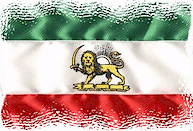
Thursday, November 08, 2007

So What about the Ring Leaders - RASMAN JANIE and KHAMENEH JUNIE ? ( Rafsanjani and Khamenaei)

A Look at 6 Put on Interpol Wanted List : Wednesday, November 07, 2007

Some information on five Iranians and one Lebanese put on Interpol's most-wanted list in connection with 1994 bombing that killed 85 people at a Jewish center in Argentina:

ALI FALLAHIAN: Former Iranian intelligence minister and midlevel cleric who graduated from seminary in Qom, Iran, widely seen as breeding ground of Islamic militants. Now on Experts Assembly, elected body responsible for appointing Iran's supreme leader. Has been accused of links to other attacks _ slaying of three Iranian Kurd dissidents in Berlin and murders of five Iranian political dissidents; denies involvement.
IMAD MOUGHNIEH: Only non-Iranian sought by Argentina. Served as intelligence officer for Lebanese militant group Hezbollah. U.S. has put $25 million bounty on him. Allegedly involved in kidnappings of Westerners in Lebanon in 1980s and suicide attacks on U.S. Embassy and U.S. Marine base in Lebanon _ bombings that killed more than 260 Americans. Whereabouts unknown.
AHMAD VAHIDI: General in Iran's Revolutionary Guards regarded as father of country's missile program. Believed to working in Defense Ministry, but little information publicly available.
MOHSEN RABBANI: Mid-ranking Iranian cleric was cultural attache at Iranian Embassy in Argentina in 1994. Also has been implicated in 1992 terror bombing at Israeli Embassy in Buenos Aires. No longer in Iranian government.
MOHSEN REZAEI: Commanded Revolutionary Guards during Iran's 1980-88 war with Iraq. Retired from military and entered politics. Now serves on Expediency Council, body that arbitrates between Iran's parliament and Guardians' Council.
AHMAD REZA ASGHARI: Served as third secretary in Iranian Embassy in Buenos Aires, but believed to have been linked to Revolutionary Guards. Not known whether he still works for Iranian government.

HOW MUCH WAS PAID TO SPARE THOSE TWO FROM BEING RED LISTED?
An Israeli delegate said Wednesday afternoon that Interpol has voted to issue 'Wanted' notices for five Iranians and a Lebanese terror suspect, despite objections from Iran. The six men are Iranians Ali Fallahian, Ahmad Vahidi, Mohsen Rabbani, Mohsen Rezaei, Ahmad Reza Asghari, and Lebanese Imad Moughnieh. Apart from Fallahian, the Iranian fugitives are all wanted for involvement in the 1994 bombing of a Jewish cultural center in Buenos Aires that killed 85 people. Moughnieh is a Lebanese Shi'ite considered one of the most wanted terrorists in the world. Fallahian, a middle ranking cleric, served as Iran's Intelligence Minister and has been accused of involvement in two cases of assassination. In 1997, a German court ruled that the killing of three Iranian Kurd dissidents in a Berlin restaurant had been ordered by Fallahian. Prosecutors had indicted him for the assassination, but he evaded justice by staying in Iran. The Iranian investigative journalist Akbar Ganji accused Fallahian of involvement in the 1998 murders of five political dissidents. Fallahian denied involvement. The Intelligence Ministry blamed the murders on "rogue agents" and a court convicted little-known officials of some of the killings. Fallahian graduated from a seminary in Qom that is widely seen as a breeding ground of Islamic militants. He now serves on the Experts Assembly, an elected body that is charged with appointing Iran's supreme leader. Vahidi is regarded as the father of Iran's missile program. A general in the Revolutionary Guards, he is believed to be working in the Defense Ministry apparatus, but little information is publicly available about him. Rabbani is a middle ranking cleric and served as the cultural attaché at the Iranian Embassy in Buenos Aires in 1994. Argentina accused him of involvement in the bombing and issued an international warrant for his arrest in 2003. Rabbani was also implicated in a terrorist attack on the Israeli Embassy in Buenos Aires in 1992. He is no longer in government. Rezaei led the elite Revolutionary Guards during the 1980-88 war with Iraq, later retiring from the military to enter politics. He now serves on the Expediency Council, a body that arbitrates between Iran's parliament and Guardians' Council. Asghari served as a third secretary in the Iranian Embassy in Buenos Aires, but he is believed to have been linked to the Revolutionary Guards. It is not known whether he still works for the government. The only non-Iranian on the Argentine list, Moughnieh is one of the most sought-after terrorist suspects in the world. The United States has put him on its list of Most Wanted terrorists with a bounty of US$25 million. He is a Lebanese Shi'ite Muslim who worked in intelligence for Hizbullah. He is wanted for his alleged role in the kidnapping of Westerners in Lebanon in the 1980s and suicide attacks on the US Embassy and a US Marine base in Lebanon - bombings that killed more than 260 Americans. His whereabouts are not known but US officials suspect he moves between Lebanon, Iran and Syria. Hizbullah officials refuse to discuss Moughnieh.

Iranians named over Buenos Aires bombing : By Philip Sherwell in New York: Last Updated: 2:19am GMT 12/11/2007

Iran's deputy defence minister is one of five top Teheran officials placed on Interpol's most wanted list for the 1994 bombing of a Jewish centre in Argentina that killed 85 people, The Telegraph can reveal. Ahmad Vahidi, a brigadier-general in the elite Islamic Revolutionary Guards, is in charge of the regime's defence procurement and rocket and missile programme.

Image Hosted by ImageShack.us

A man walks over the rubble left after the 1994 bombing of a Jewish centre in Argentina that killed 85 people

The role would put him at the heart of the secret nuclear bomb project that Western intelligence claims Iran is pursuing. Gen Vahidi was the commander of the Quds (Jerusalem) Force, the Guards' international operations wing accused by the West of organising foreign terrorist activities, at the time of the deadliest attack on a Jewish target since the Second World War. Ali Fallahian, the former intelligence minister who is now a senior security advisor to Supreme Leader Ayatollah Ali Khamenei, and Mohsen Rezai, then commander-in-chief of the Revolutionary Guards, were also added to the Interpol so-called "red notices" list last week in the face of furious objections by Iran. Their high-ranking careers have been tracked by the National Council of Resistance of Iran (NCRI), a cultish exiled umbrella group, through its contacts within the regime.The international police co-ordinating agency named two other senior Iranian officials and Lebanese operative Imad Moughnieh, one of the world's most notorious terrorists, as wanted for the van bomb attack that levelled the seven-storey community centre in Buenos Aires in July 1994, claiming 85 lives and injuring 200.Argentine prosecutors cite witness testimony, telephone records and travel documents as proof that the plot was put together at a 1993 meeting in the Iranian city of Mashad and then carried out by Hezbollah, the Lebanese terror group trained and funded by the Quds Force. Iran has always steadfastedly denied any involvement and the initial Argentine investigation was dogged by allegations of incompetence and corruption, prompting Interpol to reject its findings two years ago. But a new prosecutor took over the case, issuing arrest warrants against the six men and presenting a beefed-up case to Interpol.Teheran's envoys mounted a fierce defence ahead of the agency's general assembly in Morocco last week, accusing Israel and the US of trying to hijack its operations to harm Iran's image. International delegates rejected their arguments, voting by 76 to 14 to issue the "red notices" after a heated closed-door session. Such notices are circulated by Interpol to member countries naming individuals wanted for extradition and seeking the assistance of national police forces. In this case, the decision is partly symbolic as Iran has made clear that it will not hand the men over, although it does mean they cannot travel abroad without risking arrest. Interpol's decision to add the men to its most wanted list is particularly embarrassing for Iran as it comes as the regime denies it is conducting a covert atomic bomb programme or supplying weapons and improvised explosive devices to insurgents in Iraq and Afghanistan. Several of the men have been at the heart of the regime's security and intelligence operations for more than two decades. Most notably, Gen Vahidi ran the Revolutionary Guards Lebanon Corps before he appointed by Ayatollah Khamenei to lead the newly-created Quds Force's mission to export Iran's Islamic revolution. His units have been linked to a series of international terror attacks, including the 1983 attack on the US marine base in Beirut that killed 241 servicemen and the bombing of the Khobar Towers in Saudi Arabia in 1996 that killed claimed the lives of 19 American military personnel. In his current status as deputy defence minister, he maintains a low profile but he reportedly heads the country's missile programme that would provide a delivery system for the nuclear devices that the West claim Iran is developing. Teheran denies it is seeking a bomb and say its nuclear programme is for peaceful energy purposes. Maryam Rajavi, the NCRI's cult leader, said: "These arrest warrants demonstrate the extent to which officials of the Iranian regime, many of whom are Islamic Revolutionary Guards commanders, are involved in the export of terrorism and fundamentalism. "The Guards Corps is the pillar of the mullahs' survival. In addition to the torture and execution of tens of thousands of political prisoners at home, it is directly involved in the production of weapons of mass destruction and nuclear weapons, and is the mullahs' most important organ for terrorism abroad."

White House frustrated with Brown over Iran