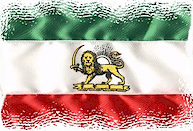

IMPERIAL EMBLEM

PERSIA
Iranian Freedom Fighters UNITE

Showing posts with label ARMY. Show all posts
Showing posts with label ARMY. Show all posts
Tuesday, July 01, 2008
18 Tir Taghdir Nameh Taghdemi be Darajeh Daran-e Artish Shah-hanshahi
Sarbazan organization would like to take this golden moment in 18 Tir to remember and to salute all Honorable Immortal Sergeants/Darajeh Dar whether they took part in 18 Tir uprising or not and they gave their precious life for His Majesty, Light of Aryan, King of Kings Mohammad Reza PAHLAVI and Iran without second thought, and their hard labor shall become a pillar for others to remember that freedom of Iran is a primary duty of every Iranian from hands of savage mullahs.
Thursday, November 08, 2007
Iran kills three Kurdish militias in western province
www.chinaview.cn 2007-11-08 16:59:10
TEHRAN, Nov. 8 (Xinhua) -- Iranian military forces have killed three "foreign" Kurdish separatists during a battle in the western province of Kordestan, the state media reported Thursday. "The three people are nationals of a neighboring country, and are members of the Party of Free Life of Kurdistan (PJAK) terrorist group, they were killed in Kamyaran county (500 km southwest of the capital, Tehran)," said the report. The report didn't mention the specific time and other details of the battle. Iran's West Azarbaijan, Kordestan and Kermanshah provinces border Iraq and have substantial Kurdish populations. The Kurdish PJAK militant group was linked to the outlawed Kurdish Workers' Party (PKK) which was fighting with the Turkey, and had launched a string of deadly attacks against Iranian security forces in northwestern Iran in the past months. In last February and August, 20 Iranian military personnel, including some Revolutionary Guards commanders, were killed in two helicopter crashes during operations against the guerillas. Tehran has described the rebels as "mercenary elements", and has repeatedly accused the U.S. and Britain of trying to make convulsions in the country's bordering areas with Turkey, Iraq, Pakistan and Afghanistan.
TEHRAN, Nov. 8 (Xinhua) -- Iranian military forces have killed three "foreign" Kurdish separatists during a battle in the western province of Kordestan, the state media reported Thursday. "The three people are nationals of a neighboring country, and are members of the Party of Free Life of Kurdistan (PJAK) terrorist group, they were killed in Kamyaran county (500 km southwest of the capital, Tehran)," said the report. The report didn't mention the specific time and other details of the battle. Iran's West Azarbaijan, Kordestan and Kermanshah provinces border Iraq and have substantial Kurdish populations. The Kurdish PJAK militant group was linked to the outlawed Kurdish Workers' Party (PKK) which was fighting with the Turkey, and had launched a string of deadly attacks against Iranian security forces in northwestern Iran in the past months. In last February and August, 20 Iranian military personnel, including some Revolutionary Guards commanders, were killed in two helicopter crashes during operations against the guerillas. Tehran has described the rebels as "mercenary elements", and has repeatedly accused the U.S. and Britain of trying to make convulsions in the country's bordering areas with Turkey, Iraq, Pakistan and Afghanistan.
Wednesday, November 07, 2007
Sizing up Iran's Military :www.Foreign Policy.com - May 1, 2006
Army
At 350,000 strong, the Iranian army is one of the largest in the neighborhood. But its size may not matter. More than half of the army is conscripts who are reported to be undisciplined, unmotivated, and poorly trained. In a war, many of them may be on foot as well. During the Iran-Iraq war of the 1980s, the majority of Iran’s armored vehicles were captured or destroyed. Nearly three decades of arms sale restrictions have kept Iran from acquiring the spare parts and equipment it needs to maintain even its diminished inventory.
The Navy
Iran is no naval power, but it does have enough capabilities to play the spoiler. In the event of war, Iran would likely try to jam up waterways by conducting unconventional operations, including deploying small attack boats to strike at shipping tankers. Nearly a quarter of the global oil supply is shipped through the Strait of Hormuz every day. But shipping lanes would grind to a halt if Iran put its seven mine warfare ships to work.In April, the Iranians tested what was reported to be the world’s fastest underwater missile, capable of eluding radar and traveling up to 233 miles per hour. Most experts scoffed at the announcement as little more than chest-thumping. More seriously, Iran’s navy has purchased three Russian Kilo-class submarines, whose quiet diesel engines could make them dangerous to Western warships. As with so much else about Iran’s military, however, there is a catch: The subs don’t seem to run well in the warm waters of the Persian Gulf.
Air Force
The Iranian Air Force has been in a tailspin since the shah fled his palace in 1979. International restrictions on arms purchases have made it nearly impossible for Iran to obtain spare parts for its planes, and experts suggest that fewer than half of the 300 aircraft in its inventory are airworthy. Tehran recently unveiled plans for a domestically produced fighter jet, but the first prototype won’t be completed before 2008—too late to play a role in the current crisis. It’s not just the planes that are in disrepair. The Islamic government purged U.S.-trained pilots after the revolution, and the Air Force has never recovered. It’s been more than 15 years since Iranian pilots have been able to participate in air-to-air combat simulations or other realistic training. Any combat over Iranian airspace would likely be quick and one-sided.Ballistic MissilesInformation about Iran’s missile force is often as imprecise as the missiles themselves. Tehran likely has between 250 and 300 Scud B missiles (180-mile range) and more than 60 Scud C missiles (310-mile range). It is currently testing an 800-mile range Shahab-3 missile based on North Korean technology, and developing the Shahab-4 with a potential range of 1,250 miles. In January 2006, Jane’s Defence Weekly reported that Iran had acquired intermediate-range ballistic missiles from North Korea. Those missiles can carry nuclear warheads and travel up to 1,550 miles—not far enough to hit Western Europe, but more than enough for Jerusalem. Ubi Rubin, former director of an Israeli missile defense organization, notes, “Iran has been careful not to develop capabilities that would threaten Europe.” Regional rivals—and any Western military forces in the area—are vulnerable, however.
Islamic Revolutionary Guard Corps
As the United States has discovered in Iraq, the regular military is not always the toughest opponent. Groups of diehards, like the Fedayeen in Iraq, can live on even after the main army has crumbled. Iran’s equivalent is the Islamic Revolutionary Guard Corps, also known as the Pasdaran.A paramilitary force independent of the regular military, it was formed by the clerical regime soon after the revolution. In essence, the military protects the country, and the Pasdaran protects the regime. It has some very prominent alums: President Mahmoud Ahmadinejad and more than 80 parliamentarians are former Pasdaran members. The group also has some unsavory international contacts. The Pasdaran is widely believed to train groups such as Lebanon’s Hezbollah and Palestinian Hamas and Islamic Jihad. Numbering around 120,000 men, the Pasdaran controls most of Iran’s missiles, fields its own navy and air force, and trains several special operations groups. According to John Pike, director of GlobalSecurity.org, the Pasdaran would likely resist an invasion fiercely, mainly through attacks on naval units and on commercial shipping. Bottom lineIt is hard to envision Iran’s ramshackle forces giving a modern Western force the “burning hell” Iran’s leaders have promised. Only Iranian ingenuity has kept the military from falling into complete disarray, according to Pike. “Their understanding of war is about a century behind America’s understanding of war,” he says. Given that reality, it is not surprising that Iran may want the ultimate defense: a nuclear weapon.
What could Iran do if pushed in conflict?
The U.S. military could unleash superior military force if it attacked Iran over its nuclear program but analysts say Washington may struggle to prevent Tehran from hitting back in Iraq and threatening oil supplies. Following are some tactics Iran could employ, including unconventional or so-called "asymmetric" methods that have either already been used by Iranian forces or blamed on Iran in the past:
HIT-AND-RUN RAIDS IN THE GULF
During Iran's 1980s war the two OPEC states sought to knock out each others oil exports, Iran's military mounted hit-and-run raids on oil tankers and other shipping in the Gulf. Experts say the Revolutionary Guards, the ideological wing of Iran's military, were a driving force in developing such tactics, often involving small speedboats mounted with a missile and which would stand a better chance of evading detection until the last minute. The Revolutionary Guards has already warned its "martyrdom-seeking" volunteers could cause havoc in the strategic Gulf waterway, if the need arose.
STRIKING U.S. INTERESTS
Supreme Leader Ayatollah Ali Khamenei has said Iran would strike U.S. interests in the region if pushed. Iran's military has declared that they have missiles that can sink "big warships" and others with a range to hit targets across the Gulf, which could include U.S. bases in Qatar and Bahrain, though military experts say U.S. anti-missile defenses could stop such rockets. Outside the Gulf, the United States has blamed Lebanon's Iranian-backed Hezbollah for the 1983 bombing of its marines barracks in Beirut that killed 241 soldiers. Iran's longest range missile, the Shahab 3, can reach Israel.
VIOLENCE IN IRAQ
The United States accuses Iran of backing militants in Iraq, although Tehran denies this. Some Western diplomats say Iran appears to have imposed at least some restrictions to prevent weapons flooding across the border into Iraq, in part because ultimately Iran wants a stable neighbor. But they say, if it came under pressure, Tehran could quickly make the border porous and add to problems for U.S. troops trying to quell violence. U.S. officials say Iran is using rogue elements in the Mehdi Army, led by firebrand cleric Moqtada al-Sadr, to weaken the Iraqi government and boost its influence. Iran has historical ties with Shi'ite Muslim groups in Iraq's government because some of their leaders were exiled in Iran, but analysts say it is unclear if Tehran now holds much sway over policy.
DESTABILISING AFGHANISTAN
Iran says it wants a stable neighbor to its east, Afghanistan, but Western officials say weapons have been crossing the border from Iran and found their way into the hands of the Taliban, though they say this may be partly because the area is already full of weapons held by well-equipped drugs smuggling gangs. Shi'ite Muslim Iran is vehemently opposed to the strict Sunni views of the Taliban and almost went to war with Afghanistan when the Taliban were in power in 1998. But analysts suggest Iran could assist its sworn enemy if that meant hurting the United States during any conflict.
HOSTAGE-TAKING
Iran was blamed by the West for helping mastermind some of the kidnappings of U.S. and other foreigners during the 1975-1990 civil war in Lebanon. The Iran-Contra Affair involved selling arms to Iran, at the time fighting Iraq, in return for Tehran's assistance in releasing hostages held by Lebanese groups. In an added twist, profits from the arms sales were used to fund anti-Communist rebels, the Contras, in Nicaragua. The dealings were exposed in 1986.
At 350,000 strong, the Iranian army is one of the largest in the neighborhood. But its size may not matter. More than half of the army is conscripts who are reported to be undisciplined, unmotivated, and poorly trained. In a war, many of them may be on foot as well. During the Iran-Iraq war of the 1980s, the majority of Iran’s armored vehicles were captured or destroyed. Nearly three decades of arms sale restrictions have kept Iran from acquiring the spare parts and equipment it needs to maintain even its diminished inventory.
The Navy
Iran is no naval power, but it does have enough capabilities to play the spoiler. In the event of war, Iran would likely try to jam up waterways by conducting unconventional operations, including deploying small attack boats to strike at shipping tankers. Nearly a quarter of the global oil supply is shipped through the Strait of Hormuz every day. But shipping lanes would grind to a halt if Iran put its seven mine warfare ships to work.In April, the Iranians tested what was reported to be the world’s fastest underwater missile, capable of eluding radar and traveling up to 233 miles per hour. Most experts scoffed at the announcement as little more than chest-thumping. More seriously, Iran’s navy has purchased three Russian Kilo-class submarines, whose quiet diesel engines could make them dangerous to Western warships. As with so much else about Iran’s military, however, there is a catch: The subs don’t seem to run well in the warm waters of the Persian Gulf.
Air Force
The Iranian Air Force has been in a tailspin since the shah fled his palace in 1979. International restrictions on arms purchases have made it nearly impossible for Iran to obtain spare parts for its planes, and experts suggest that fewer than half of the 300 aircraft in its inventory are airworthy. Tehran recently unveiled plans for a domestically produced fighter jet, but the first prototype won’t be completed before 2008—too late to play a role in the current crisis. It’s not just the planes that are in disrepair. The Islamic government purged U.S.-trained pilots after the revolution, and the Air Force has never recovered. It’s been more than 15 years since Iranian pilots have been able to participate in air-to-air combat simulations or other realistic training. Any combat over Iranian airspace would likely be quick and one-sided.Ballistic MissilesInformation about Iran’s missile force is often as imprecise as the missiles themselves. Tehran likely has between 250 and 300 Scud B missiles (180-mile range) and more than 60 Scud C missiles (310-mile range). It is currently testing an 800-mile range Shahab-3 missile based on North Korean technology, and developing the Shahab-4 with a potential range of 1,250 miles. In January 2006, Jane’s Defence Weekly reported that Iran had acquired intermediate-range ballistic missiles from North Korea. Those missiles can carry nuclear warheads and travel up to 1,550 miles—not far enough to hit Western Europe, but more than enough for Jerusalem. Ubi Rubin, former director of an Israeli missile defense organization, notes, “Iran has been careful not to develop capabilities that would threaten Europe.” Regional rivals—and any Western military forces in the area—are vulnerable, however.
Islamic Revolutionary Guard Corps
As the United States has discovered in Iraq, the regular military is not always the toughest opponent. Groups of diehards, like the Fedayeen in Iraq, can live on even after the main army has crumbled. Iran’s equivalent is the Islamic Revolutionary Guard Corps, also known as the Pasdaran.A paramilitary force independent of the regular military, it was formed by the clerical regime soon after the revolution. In essence, the military protects the country, and the Pasdaran protects the regime. It has some very prominent alums: President Mahmoud Ahmadinejad and more than 80 parliamentarians are former Pasdaran members. The group also has some unsavory international contacts. The Pasdaran is widely believed to train groups such as Lebanon’s Hezbollah and Palestinian Hamas and Islamic Jihad. Numbering around 120,000 men, the Pasdaran controls most of Iran’s missiles, fields its own navy and air force, and trains several special operations groups. According to John Pike, director of GlobalSecurity.org, the Pasdaran would likely resist an invasion fiercely, mainly through attacks on naval units and on commercial shipping. Bottom lineIt is hard to envision Iran’s ramshackle forces giving a modern Western force the “burning hell” Iran’s leaders have promised. Only Iranian ingenuity has kept the military from falling into complete disarray, according to Pike. “Their understanding of war is about a century behind America’s understanding of war,” he says. Given that reality, it is not surprising that Iran may want the ultimate defense: a nuclear weapon.
What could Iran do if pushed in conflict?
The U.S. military could unleash superior military force if it attacked Iran over its nuclear program but analysts say Washington may struggle to prevent Tehran from hitting back in Iraq and threatening oil supplies. Following are some tactics Iran could employ, including unconventional or so-called "asymmetric" methods that have either already been used by Iranian forces or blamed on Iran in the past:
HIT-AND-RUN RAIDS IN THE GULF
During Iran's 1980s war the two OPEC states sought to knock out each others oil exports, Iran's military mounted hit-and-run raids on oil tankers and other shipping in the Gulf. Experts say the Revolutionary Guards, the ideological wing of Iran's military, were a driving force in developing such tactics, often involving small speedboats mounted with a missile and which would stand a better chance of evading detection until the last minute. The Revolutionary Guards has already warned its "martyrdom-seeking" volunteers could cause havoc in the strategic Gulf waterway, if the need arose.
STRIKING U.S. INTERESTS
Supreme Leader Ayatollah Ali Khamenei has said Iran would strike U.S. interests in the region if pushed. Iran's military has declared that they have missiles that can sink "big warships" and others with a range to hit targets across the Gulf, which could include U.S. bases in Qatar and Bahrain, though military experts say U.S. anti-missile defenses could stop such rockets. Outside the Gulf, the United States has blamed Lebanon's Iranian-backed Hezbollah for the 1983 bombing of its marines barracks in Beirut that killed 241 soldiers. Iran's longest range missile, the Shahab 3, can reach Israel.
VIOLENCE IN IRAQ
The United States accuses Iran of backing militants in Iraq, although Tehran denies this. Some Western diplomats say Iran appears to have imposed at least some restrictions to prevent weapons flooding across the border into Iraq, in part because ultimately Iran wants a stable neighbor. But they say, if it came under pressure, Tehran could quickly make the border porous and add to problems for U.S. troops trying to quell violence. U.S. officials say Iran is using rogue elements in the Mehdi Army, led by firebrand cleric Moqtada al-Sadr, to weaken the Iraqi government and boost its influence. Iran has historical ties with Shi'ite Muslim groups in Iraq's government because some of their leaders were exiled in Iran, but analysts say it is unclear if Tehran now holds much sway over policy.
DESTABILISING AFGHANISTAN
Iran says it wants a stable neighbor to its east, Afghanistan, but Western officials say weapons have been crossing the border from Iran and found their way into the hands of the Taliban, though they say this may be partly because the area is already full of weapons held by well-equipped drugs smuggling gangs. Shi'ite Muslim Iran is vehemently opposed to the strict Sunni views of the Taliban and almost went to war with Afghanistan when the Taliban were in power in 1998. But analysts suggest Iran could assist its sworn enemy if that meant hurting the United States during any conflict.
HOSTAGE-TAKING
Iran was blamed by the West for helping mastermind some of the kidnappings of U.S. and other foreigners during the 1975-1990 civil war in Lebanon. The Iran-Contra Affair involved selling arms to Iran, at the time fighting Iraq, in return for Tehran's assistance in releasing hostages held by Lebanese groups. In an added twist, profits from the arms sales were used to fund anti-Communist rebels, the Contras, in Nicaragua. The dealings were exposed in 1986.
Tuesday, November 06, 2007
Iran army head: 'alien' troops warned off
Nov. 5, 2007 at 4:29 PM
TEHRAN, Nov. 5 (UPI) -- The head of the Iranian army said Monday units of "alien" troops deployed at a border shared with an unnamed neighboring country have been removed.
Maj. Gen. Ataollah Salehi said the troops quickly abandoned their positions after Iranian forces issued a warning to them, Iran's Fars News Agency reported Monday."Several alien troops were stationed in a wrong position by mistake and after they received a warning from the army they left the area in a great hurry and in such a manner that it looked like an escape," Salehi said.The general did not specify the border or the country of origin of the "alien" troops, but the term is commonly applied by Iranian officials to trans-regional opponents, most commonly the United States, the news agency said.
Iran Role in Argentina Bombing Examined
Tuesday November 6, 2007 1:31 AM : By JAMEY KEATEN - Associated Press Writer
MARRAKECH, Morocco (AP) - Iran has backed away from an effort to stop an Interpol vote on putting five Iranians and a Lebanese man on the international police agency's most wanted list for an Argentina bombing that killed 85 people, officials said Monday. Iran's decision clears the way for a vote on the issue at the three-day Interpol general assembly that began Monday in Marrakech, Morocco. Delegates will be asked to adjudicate in a dispute between Interpol members Iran and Argentina over the July 18, 1994, bombing when an explosives-laden van leveled the seven-story Jewish community center in Buenos Aires.
Argentine prosecutors allege Iranian officials orchestrated the bombing and entrusted the Lebanon-based militant group Hezbollah to carry it out. Prosecutors in Argentina say they have enough evidence for Interpol's 186-member general assembly to approve ``red'' notices for the six suspects which means they are wanted for possible extradition. While the red notice does not force countries to arrest or extradite suspects, people with red-notice status appear on Interpol's equivalent of a most-wanted list. ``We do believe the government of Argentina and Interpol should distance themselves from the political approach,'' the spokesman of Iran's Foreign Ministry, Mohammad Ali Hosseini, told reporters Monday at his weekly news conference. Interpol should protect its technical and legal nature and not allow others to have political influence.'' The Interpol vote is expected Wednesday. Interpol, whose executive committee recommended in March the issuance of the notices, is expected to outline arguments from both Argentina and Iran. Only a simple majority of delegates' votes is needed for approval. Many frustrated relatives of the victims are looking for support from Interpol because there have been no convictions 13 years after the attack. ``I believe that insofar as any of them can be brought to Argentina to testify, that would be helpful,'' Diana Malamud, who lost her husband in the bombing, said of the progress toward an Interpol vote. ``But I see it would be very difficult.'' In the run-up to the gathering, Iran had sought to delay the issue until next year, said an Interpol official on condition of anonymity because of agency policy. But the government did not formalize such a request as the meeting opened. A vote against Iran could be a powerful symbol at a time of high tension with the United States and other Western powers suspicious that the country is secretly trying to develop nuclear weapons. The United States also alleges Iran is supplying insurgents in Iraq with deadly weapons that kill American troops. Iran denies both claims. Authorities in Argentina say the case is not political. But Iran's ambassador to Argentina has accused the United States and Israel of pressuring Interpol. ``We do believe the government of Argentina and Interpol should distance themselves from the political approach. Interpol should protect its technical and legal nature and not to allow others to have political influence (on the case),'' the spokesman of Iran's Foreign Ministry, Mohammad Ali Hosseini, said Monday. Whatever the outcome, Iran would be unlikely to hand over any suspect to Argentina.
Among those wanted by Argentina are former Iranian intelligence chief Ali Fallahian, former leader of the elite Revolutionary Guards Mohsen Rezaei and Hezbollah militant Imad Moughnieh, one of the world's most sought terror suspects. ( and Rafsanjani, Khamanei )
Moughnieh is wanted for his alleged role in the kidnapping of Westerners in Lebanon in the 1980s, and suicide attacks on the U.S. Embassy and a Marine base in Lebanon that killed more than 260 Americans. His whereabouts are unknown.
The Buenos Aires attack shook the South American country's 200,000-member Jewish community, Latin America's largest. It came just two years after a bombing that shattered Israel's embassy in Buenos Aires, killing 29. Victims' relatives have complained for years that the investigation was bungled. Amid allegations he paid a key witness, the investigating judge on the case was removed and later impeached. The case poses one of the toughest challenges for the international police liaison group based in Lyon, France, which mostly deals with routine police requests.
Pentagon Head, Chinese President Talk about Iran
Tuesday November 6, 2007 5:01 AM : By LOLITA C. BALDOR : Associated Press Writer
BEIJING (AP) - Defense Secretary Robert Gates and his Chinese counterpart agreed to work together to steer Iran away from its nuclear ambitions in talks that Chinese President Hu Jintao described Tuesday as ``very candid and friendly.'' Gates agreed with Hu's assessment.Gates and Hu spoke briefly with reporters before they met Tuesday morning for a discussion which, Gates later revealed, did not involve Iran directley.
The flow of the conversation was such that we really spent all of our time on our military relationship and Taiwan,'' Gates told reporters during a tour of Beijing's Forbidden City. Taiwan and China split amid civil war in 1949, although China still claims the island as part of its territory.
After a 90-minute meeting Monday with Chinese Defense Minister Cao Gangchuan, Gates said he and Cao ``agreed that is it important to pursue efforts to persuade the Iranian government to change their behavior and their policies peacefully, through diplomatic means.'' And, with a nod to China's reluctance to support greater economic sanctions against Iran, Gates said he stressed to Cao the importance of using such pressure to convince the Iranian government ``to make different choices.'' Tehran is suspected of seeking to develop nuclear weapons, something it denies. U.S. defense officials, describing Gates' meeting with Cao on condition of anonymity because it was private, said the U.S.delegation was pleased with the quality of the discussion about Iran. The Chinese, they said, were ``very strong'' in saying that they are united in opposing a nuclear-armed Iran. Hu said Tuesday that he understood that Gates and Cao had a very candid and friendly discussion that will be conducive to the building of a deeper trust between us. Before Gates' meeting with Hu, the defense officials said they were hoping for a stronger statement from the Chinese leader on the use of sanctions and other pressure against Iran. But Gates said Iran did not come up with Hu on Tuesday because I didn't feel the need to bring it up again. However, the defense secretary said he hoped his meeting with Hu will lead to ``a longer-term dialogue about ... the threat of nuclear proliferation.'' The U.S. has repeatedly raised concerns that the Chinese are providing conventional weapons and other dual-use technologies that can have nuclear applications to countries like Iran, Cuba and Venezuela. Some weapons sold to Iran have surfaced in Afghanistan and Iraq, prompting the Pentagon to call for the Chinese to better control their sales to Iran.
Read the full article here: http://tinyurl.com/23ofhc
TEHRAN, Nov. 5 (UPI) -- The head of the Iranian army said Monday units of "alien" troops deployed at a border shared with an unnamed neighboring country have been removed.
Maj. Gen. Ataollah Salehi said the troops quickly abandoned their positions after Iranian forces issued a warning to them, Iran's Fars News Agency reported Monday."Several alien troops were stationed in a wrong position by mistake and after they received a warning from the army they left the area in a great hurry and in such a manner that it looked like an escape," Salehi said.The general did not specify the border or the country of origin of the "alien" troops, but the term is commonly applied by Iranian officials to trans-regional opponents, most commonly the United States, the news agency said.
Iran Role in Argentina Bombing Examined
Tuesday November 6, 2007 1:31 AM : By JAMEY KEATEN - Associated Press Writer
MARRAKECH, Morocco (AP) - Iran has backed away from an effort to stop an Interpol vote on putting five Iranians and a Lebanese man on the international police agency's most wanted list for an Argentina bombing that killed 85 people, officials said Monday. Iran's decision clears the way for a vote on the issue at the three-day Interpol general assembly that began Monday in Marrakech, Morocco. Delegates will be asked to adjudicate in a dispute between Interpol members Iran and Argentina over the July 18, 1994, bombing when an explosives-laden van leveled the seven-story Jewish community center in Buenos Aires.
Argentine prosecutors allege Iranian officials orchestrated the bombing and entrusted the Lebanon-based militant group Hezbollah to carry it out. Prosecutors in Argentina say they have enough evidence for Interpol's 186-member general assembly to approve ``red'' notices for the six suspects which means they are wanted for possible extradition. While the red notice does not force countries to arrest or extradite suspects, people with red-notice status appear on Interpol's equivalent of a most-wanted list. ``We do believe the government of Argentina and Interpol should distance themselves from the political approach,'' the spokesman of Iran's Foreign Ministry, Mohammad Ali Hosseini, told reporters Monday at his weekly news conference. Interpol should protect its technical and legal nature and not allow others to have political influence.'' The Interpol vote is expected Wednesday. Interpol, whose executive committee recommended in March the issuance of the notices, is expected to outline arguments from both Argentina and Iran. Only a simple majority of delegates' votes is needed for approval. Many frustrated relatives of the victims are looking for support from Interpol because there have been no convictions 13 years after the attack. ``I believe that insofar as any of them can be brought to Argentina to testify, that would be helpful,'' Diana Malamud, who lost her husband in the bombing, said of the progress toward an Interpol vote. ``But I see it would be very difficult.'' In the run-up to the gathering, Iran had sought to delay the issue until next year, said an Interpol official on condition of anonymity because of agency policy. But the government did not formalize such a request as the meeting opened. A vote against Iran could be a powerful symbol at a time of high tension with the United States and other Western powers suspicious that the country is secretly trying to develop nuclear weapons. The United States also alleges Iran is supplying insurgents in Iraq with deadly weapons that kill American troops. Iran denies both claims. Authorities in Argentina say the case is not political. But Iran's ambassador to Argentina has accused the United States and Israel of pressuring Interpol. ``We do believe the government of Argentina and Interpol should distance themselves from the political approach. Interpol should protect its technical and legal nature and not to allow others to have political influence (on the case),'' the spokesman of Iran's Foreign Ministry, Mohammad Ali Hosseini, said Monday. Whatever the outcome, Iran would be unlikely to hand over any suspect to Argentina.
Among those wanted by Argentina are former Iranian intelligence chief Ali Fallahian, former leader of the elite Revolutionary Guards Mohsen Rezaei and Hezbollah militant Imad Moughnieh, one of the world's most sought terror suspects. ( and Rafsanjani, Khamanei )
Moughnieh is wanted for his alleged role in the kidnapping of Westerners in Lebanon in the 1980s, and suicide attacks on the U.S. Embassy and a Marine base in Lebanon that killed more than 260 Americans. His whereabouts are unknown.
The Buenos Aires attack shook the South American country's 200,000-member Jewish community, Latin America's largest. It came just two years after a bombing that shattered Israel's embassy in Buenos Aires, killing 29. Victims' relatives have complained for years that the investigation was bungled. Amid allegations he paid a key witness, the investigating judge on the case was removed and later impeached. The case poses one of the toughest challenges for the international police liaison group based in Lyon, France, which mostly deals with routine police requests.
Pentagon Head, Chinese President Talk about Iran
Tuesday November 6, 2007 5:01 AM : By LOLITA C. BALDOR : Associated Press Writer
BEIJING (AP) - Defense Secretary Robert Gates and his Chinese counterpart agreed to work together to steer Iran away from its nuclear ambitions in talks that Chinese President Hu Jintao described Tuesday as ``very candid and friendly.'' Gates agreed with Hu's assessment.Gates and Hu spoke briefly with reporters before they met Tuesday morning for a discussion which, Gates later revealed, did not involve Iran directley.
The flow of the conversation was such that we really spent all of our time on our military relationship and Taiwan,'' Gates told reporters during a tour of Beijing's Forbidden City. Taiwan and China split amid civil war in 1949, although China still claims the island as part of its territory.
After a 90-minute meeting Monday with Chinese Defense Minister Cao Gangchuan, Gates said he and Cao ``agreed that is it important to pursue efforts to persuade the Iranian government to change their behavior and their policies peacefully, through diplomatic means.'' And, with a nod to China's reluctance to support greater economic sanctions against Iran, Gates said he stressed to Cao the importance of using such pressure to convince the Iranian government ``to make different choices.'' Tehran is suspected of seeking to develop nuclear weapons, something it denies. U.S. defense officials, describing Gates' meeting with Cao on condition of anonymity because it was private, said the U.S.delegation was pleased with the quality of the discussion about Iran. The Chinese, they said, were ``very strong'' in saying that they are united in opposing a nuclear-armed Iran. Hu said Tuesday that he understood that Gates and Cao had a very candid and friendly discussion that will be conducive to the building of a deeper trust between us. Before Gates' meeting with Hu, the defense officials said they were hoping for a stronger statement from the Chinese leader on the use of sanctions and other pressure against Iran. But Gates said Iran did not come up with Hu on Tuesday because I didn't feel the need to bring it up again. However, the defense secretary said he hoped his meeting with Hu will lead to ``a longer-term dialogue about ... the threat of nuclear proliferation.'' The U.S. has repeatedly raised concerns that the Chinese are providing conventional weapons and other dual-use technologies that can have nuclear applications to countries like Iran, Cuba and Venezuela. Some weapons sold to Iran have surfaced in Afghanistan and Iraq, prompting the Pentagon to call for the Chinese to better control their sales to Iran.
Read the full article here: http://tinyurl.com/23ofhc
0
comments

 Labels:
ARMY,
Arrest,
Boarders,
China,
interpol,
Iran,
Khamanei,
Rafsanjani,
Rasman Jani,
USA
Labels:
ARMY,
Arrest,
Boarders,
China,
interpol,
Iran,
Khamanei,
Rafsanjani,
Rasman Jani,
USA
Labels:
ARMY,
Arrest,
Boarders,
China,
interpol,
Iran,
Khamanei,
Rafsanjani,
Rasman Jani,
USA
Friday, March 09, 2007
New U.S. Commander in Iraq Won’t Rule Out Need for Added Troops
New U.S. Commander in Iraq Won’t Rule Out Need for Added Troops
By RICHARD A. OPPEL Jr. and ALISSA J. RUBIN
BAGHDAD, March 8 — The new American commander in Iraq, Gen. David H. Petraeus, warned Thursday that American troops here faced a long road ahead and left open the possibility of calling in even more soldiers as he described the difficult task of calming the country. In a broad review of the challenges he faces, General Petraeus suggested the need to be open to working with some of the groups at the center of Iraq’s security struggle. He said the future of the Mahdi Army, the ubiquitous Shiite militia that has fought battles with United States troops, should be left up to Iraqi leaders and noted that many countries had “auxiliary police.” He also suggested that political dialogue with some Sunni militants and Sunni leaders was crucial to finding a solution for problems that military action alone would never be able to fix. General Petraeus repeatedly stressed the long-term nature of the troop increase, but his assertions about the need for open-endedness in the American commitment came as Congressional Democrats in Washington worked toward a fixed date for withdrawal. He said there were no “looming” requests for additional troops and that he had not yet taken a position on an assessment by the second-ranking commander in Iraq, Lt. Gen. Raymond T. Odierno, that the greatly enlarged American force remain until February 2008. But he added, “If you’re going to achieve the kinds of effects that we probably need, it would need to be sustained certainly for some time well beyond the summer.” Military officials in Iraq have indicated that they would need a large American troop presence for at least a year and probably far longer to achieve lasting stability. For now, Congress seems persuaded to give General Petraeus’s strategy a year to yield results, setting the summer of 2008 as a deadline for the return of all troops. General Petraeus’s open-ended strategy appeared to be an effort to avoid a repeat of the pattern that has doomed past American efforts to halt the insurgency. In hot spots including Tal Afar and Diyala, United States soldiers have cracked down on insurgents and then reduced the American presence only to see insurgents retake old ground. In his first extended public comments since taking over one month ago, General Petraeus, 54, cited a handful of early favorable indicators since American and Iraqi forces began sweeping through militia- and insurgent-dominated neighborhoods and building new outposts as part of a Baghdad security plan widely seen as a last-ditch effort to stave off civil war. “While too early to discern significant trends, there have been a few encouraging signs,” General Petraeus said. “Sectarian killings, for example, have been lower in Baghdad over the past several weeks than in the previous month.” He also said that fewer families were being forced out of homes by sectarian gangs and that troops had uncovered significant illegal stashes of bombs and weapons. But he emphasized that successes had come with devastating setbacks. “Schools, health clinics and marketplaces have all been attacked,” he said. “Car bombs have targeted hundreds of innocent Iraqis,” including worshipers in Habbaniya and college students in Baghdad. He also underscored how crucial it would be to prevent the insurgents and death squad members who are believed to have fled Baghdad from exporting violence to nearby areas — like attacks in Hilla on Tuesday that killed more than 100 Shiite religious pilgrims — and to block efforts by insurgents forced to abandon Baghdad from returning. “Anyone who knows about securing Baghdad knows that you must also secure the Baghdad belts, in other words, the areas that surround Baghdad,” he said. One especially violent area, Diyala Province, is “very likely” to get more troops, he said. More American soldiers have been killed already in Diyala this year than in all of 2006 — 29 in 2007 and 20 in 2006, according to icasualties.org. The first two additional brigades coming to Iraq will work in Baghdad; military officials say a large number of troops in the remaining three brigades may have to patrol areas just outside the capital. General Petraeus repeated observations by previous commanders that there is “no military solution” to Iraq’s grave problems. The only long-run success, he said, will come after “reconciling differences with some of those who have felt that the new Iraq did not have a place for them.” According to one government official, some coalition and Iraqi officials have been holding talks with some Sunni insurgent groups who reject the more extremist approaches of groups like Al Qaeda in Mesopotamia. Similarly, General Petraeus appeared to take a softer line on the Mahdi militia led by the anti-American cleric Moktada al-Sadr, saying that many coalition countries had a “variety of auxiliary police” but that Iraqi leaders must ultimately decide the Mahdi militia’s fate. The challenge, he said, “has been to determine how do you incorporate those who want to serve in a positive way, as neighborhood watches, let’s say, but unarmed in our own communities, but without turning into something much more than that.” With barely a third of the additional American and Iraqi troops on the ground, the new security plan is only beginning to take effect. The troops are in the initial phase of clearing out insurgent bases and taking up residence in neighborhoods. Later phases will involve building trust with the communities so that the Iraqi government can undertake the repairs to infrastructure and the job creation programs that the architects of the troop increase believe are critical to the project’s success. Nonetheless for Iraqis living in Baghdad there already are some perceptible differences. Checkpoints, manned by Iraqi military or police, have sprung up all over the city and security officers appear to be more systematic in determining which cars to pull over and which to let go. In several neighborhoods, most notably Sadr City, the joint American and Iraqi forces have begun to set up operating bases from which they plan to conduct foot patrols and re-establish links with the community to improve intelligence. This is a reversal of the past practice of keeping American troops on large bases except for periodic drives through the neighborhoods or combat missions against suspected militants. Larger neighborhoods, like Sadr City, will eventually have several small, joint bases, though for the moment only a couple are in place. Foot patrols, long viewed as too dangerous for American soldiers to undertake on a regular basis, have begun again even in some of the most violent Sunni neighborhoods as a part of the counterinsurgency effort. The effect on violence in Baghdad is hard to judge, but on a daily basis it appears that the police have found fewer victims of sectarian violence in the city’s empty lots and back alleys, according to reports from the Interior Ministry. General Petraeus also noted that United States troops working with their Iraqi counterparts had tried to improve security at markets, which are especially vulnerable to suicide bombings, and had been sweeping through neighborhoods and arresting people they believed were violent militants or criminals. While military officials point to positive signs emerging from the three-week-old effort, the United States cannot point to any Arab-dominated region in Iraq where it has completely vanquished the indigenous insurgency.
By RICHARD A. OPPEL Jr. and ALISSA J. RUBIN
BAGHDAD, March 8 — The new American commander in Iraq, Gen. David H. Petraeus, warned Thursday that American troops here faced a long road ahead and left open the possibility of calling in even more soldiers as he described the difficult task of calming the country. In a broad review of the challenges he faces, General Petraeus suggested the need to be open to working with some of the groups at the center of Iraq’s security struggle. He said the future of the Mahdi Army, the ubiquitous Shiite militia that has fought battles with United States troops, should be left up to Iraqi leaders and noted that many countries had “auxiliary police.” He also suggested that political dialogue with some Sunni militants and Sunni leaders was crucial to finding a solution for problems that military action alone would never be able to fix. General Petraeus repeatedly stressed the long-term nature of the troop increase, but his assertions about the need for open-endedness in the American commitment came as Congressional Democrats in Washington worked toward a fixed date for withdrawal. He said there were no “looming” requests for additional troops and that he had not yet taken a position on an assessment by the second-ranking commander in Iraq, Lt. Gen. Raymond T. Odierno, that the greatly enlarged American force remain until February 2008. But he added, “If you’re going to achieve the kinds of effects that we probably need, it would need to be sustained certainly for some time well beyond the summer.” Military officials in Iraq have indicated that they would need a large American troop presence for at least a year and probably far longer to achieve lasting stability. For now, Congress seems persuaded to give General Petraeus’s strategy a year to yield results, setting the summer of 2008 as a deadline for the return of all troops. General Petraeus’s open-ended strategy appeared to be an effort to avoid a repeat of the pattern that has doomed past American efforts to halt the insurgency. In hot spots including Tal Afar and Diyala, United States soldiers have cracked down on insurgents and then reduced the American presence only to see insurgents retake old ground. In his first extended public comments since taking over one month ago, General Petraeus, 54, cited a handful of early favorable indicators since American and Iraqi forces began sweeping through militia- and insurgent-dominated neighborhoods and building new outposts as part of a Baghdad security plan widely seen as a last-ditch effort to stave off civil war. “While too early to discern significant trends, there have been a few encouraging signs,” General Petraeus said. “Sectarian killings, for example, have been lower in Baghdad over the past several weeks than in the previous month.” He also said that fewer families were being forced out of homes by sectarian gangs and that troops had uncovered significant illegal stashes of bombs and weapons. But he emphasized that successes had come with devastating setbacks. “Schools, health clinics and marketplaces have all been attacked,” he said. “Car bombs have targeted hundreds of innocent Iraqis,” including worshipers in Habbaniya and college students in Baghdad. He also underscored how crucial it would be to prevent the insurgents and death squad members who are believed to have fled Baghdad from exporting violence to nearby areas — like attacks in Hilla on Tuesday that killed more than 100 Shiite religious pilgrims — and to block efforts by insurgents forced to abandon Baghdad from returning. “Anyone who knows about securing Baghdad knows that you must also secure the Baghdad belts, in other words, the areas that surround Baghdad,” he said. One especially violent area, Diyala Province, is “very likely” to get more troops, he said. More American soldiers have been killed already in Diyala this year than in all of 2006 — 29 in 2007 and 20 in 2006, according to icasualties.org. The first two additional brigades coming to Iraq will work in Baghdad; military officials say a large number of troops in the remaining three brigades may have to patrol areas just outside the capital. General Petraeus repeated observations by previous commanders that there is “no military solution” to Iraq’s grave problems. The only long-run success, he said, will come after “reconciling differences with some of those who have felt that the new Iraq did not have a place for them.” According to one government official, some coalition and Iraqi officials have been holding talks with some Sunni insurgent groups who reject the more extremist approaches of groups like Al Qaeda in Mesopotamia. Similarly, General Petraeus appeared to take a softer line on the Mahdi militia led by the anti-American cleric Moktada al-Sadr, saying that many coalition countries had a “variety of auxiliary police” but that Iraqi leaders must ultimately decide the Mahdi militia’s fate. The challenge, he said, “has been to determine how do you incorporate those who want to serve in a positive way, as neighborhood watches, let’s say, but unarmed in our own communities, but without turning into something much more than that.” With barely a third of the additional American and Iraqi troops on the ground, the new security plan is only beginning to take effect. The troops are in the initial phase of clearing out insurgent bases and taking up residence in neighborhoods. Later phases will involve building trust with the communities so that the Iraqi government can undertake the repairs to infrastructure and the job creation programs that the architects of the troop increase believe are critical to the project’s success. Nonetheless for Iraqis living in Baghdad there already are some perceptible differences. Checkpoints, manned by Iraqi military or police, have sprung up all over the city and security officers appear to be more systematic in determining which cars to pull over and which to let go. In several neighborhoods, most notably Sadr City, the joint American and Iraqi forces have begun to set up operating bases from which they plan to conduct foot patrols and re-establish links with the community to improve intelligence. This is a reversal of the past practice of keeping American troops on large bases except for periodic drives through the neighborhoods or combat missions against suspected militants. Larger neighborhoods, like Sadr City, will eventually have several small, joint bases, though for the moment only a couple are in place. Foot patrols, long viewed as too dangerous for American soldiers to undertake on a regular basis, have begun again even in some of the most violent Sunni neighborhoods as a part of the counterinsurgency effort. The effect on violence in Baghdad is hard to judge, but on a daily basis it appears that the police have found fewer victims of sectarian violence in the city’s empty lots and back alleys, according to reports from the Interior Ministry. General Petraeus also noted that United States troops working with their Iraqi counterparts had tried to improve security at markets, which are especially vulnerable to suicide bombings, and had been sweeping through neighborhoods and arresting people they believed were violent militants or criminals. While military officials point to positive signs emerging from the three-week-old effort, the United States cannot point to any Arab-dominated region in Iraq where it has completely vanquished the indigenous insurgency.
Saturday, February 24, 2007
One by One, they are quietly being dispatched. If it goes on much longer none of thenm will remain.
شنبه، 5 اسفند ماه 1385 برابر با 2007 Saturday 24 February
دو تن از فرماندهان لشگر ویژه سپاه پاسداران کشته شدند
دو تن از فرماندهان لشگر ویژه سپاه پاسداران کشته شدند
سایت حکومتی بازتاب در گزارشی با عنوان "ترور دو سردار سپاه با موشک های آمريکايی؟" ، از کشته شدن هشت تن از نیروهای سپاه پاسداران در منطقه خوی در استان آذربایجان غربی خبر داده است.این سایت حکومتی نوشت: "خبرنگار بازتاب از اروميه گزارش داد در حادثه ظهر دیروز حدود هشت تن از نیروهای سپاهپاسداران انقلاب اسلامی در منطقه خوی به شهادت رسیدند. بنا بر اين گزارش؛ ظهر روز گذشته زماني كه يكي فروند بالگرد حامل هشت تن از نيروهاي سپاه پاسداران براي سركشي به منطقه خوي عزيمت گرده بودند بالگرد آنها دچار مشكل شده و فرود اضطراري مي كند، و پس از دقايقي با منفجر شدن اين بالگرد نيروهاي مذكور به شهادت مي رسند. در حالي كه برخي منابع، نقص فني و برخورد بالگرد با برخي موانع را علت انفجار بالگرد عنوان مي كنند، برخی دیگر مدعي شده اند برخورد موشك هاي آمريكايي sa-7 موجب انفجار بالگرد و شهادت نيروهاي سپاه شده است. براساس اطلاعات رسيده؛ سردار قهاري و سردار حنيف دروسي از فرماندهان لشگر ويژه شهدا در ميان سرنشينان اين بالگرد بوده اند."
Subscribe to:
Posts (Atom)




 Posts
Posts




 اخبار مربوط به زندانیان سیاسی و نقض حقوق بشر







 Tulips in Holland