

BAGHDAD (Reuters) - A U.S. air strike killed senior insurgents suspected of targeting American helicopters in Iraq, and the Iraqi government said 39 militants had been killed in volatile western Anbar province in recent fighting.The U.S. military said on Saturday the air strike took place on Friday north of Baghdad near the town of Taji, which is home to a major U.S. air base. It said weaponry, including a vehicle mounted with anti-aircraft artillery, was destroyed."Coalition forces believe key terrorists were killed during the air strike ... Intelligence reports indicated this network is responsible for threats to coalition aircraft," the military said in a statement without elaborating.Insurgents have shot down eight helicopters since January 20 in Iraq, killing a total of 28 people, mostly soldiers. Six of those helicopters were U.S. military aircraft and two belonged to a private American security firm.U.S. commanders say those responsible for the downings are being hunted. They have said insurgents appeared to be targeting helicopters to undermine a new security crackdown in Baghdad that began last month and which is seen as a last ditch effort to stop Iraq from tearing itself apart.The Iraqi Defence Ministry said in a statement Iraqi security forces had killed 39 militants in the vast western province of Anbar on Friday and had detained 30 others.The toll could not be independently verified and it was unclear if there were any government casualties.Iraqi and U.S. officials hope the Baghdad plan can weaken the grip of Sunni insurgents and Shi'ite militias. Violence has ebbed since the plan kicked off.
One of the most critical areas is Anbar, where Sunni tribal leaders have been engaged in an increasingly violent power struggle with Sunni al Qaeda.According to the Interior Ministry, dozens of militants including foreign fighters were killed on Wednesday in a battle for an Anbar village between al Qaeda and Iraqi security forces.The struggle between Sunni tribes and al Qaeda is seen by some Iraqi officials as the best hope of pacifying Anbar, which is the most dangerous for U.S. soldiers in Iraq but also home to vital trade routes to neighbouring Jordan and Syria.The U.S. military says it cannot defeat al Qaeda in Anbar without the help of the traditionally minded tribal leaders, who oppose the militant group's plan to impose an Islamic caliphate.In other violence, insurgents killed six members of one Sunni family on Saturday when they stormed a home in the town of Yusufiya, just south of Baghdad, police said.Relatives said insurgents had sent death threats after the family had met with local Shi'ite leaders in an attempt at reconciliation.
IMPERIAL EMBLEM

PERSIA
Iranian Freedom Fighters UNITE
Showing posts with label war.proxy War. Show all posts
Showing posts with label war.proxy War. Show all posts
Saturday, March 03, 2007
Friday, March 02, 2007
TELL THE DOOR .....HOPING THAT THE WALL TOO WILL HEAR......
"Algeria became the pivotal Third World state, but the cost of its status - above all the financial cost - was staggering. It ate up millions of dollars for which the country had a crying need ... Gradually, the gap between Ben Bella's domestic and foreign policies grew wider. The contrast deepened. Algeria had earned an international reputation as a revolution state ... it was an example for the non-European continents, a model, bright and entrancing; while at home, the country was stagnating; the unemployed filled the square of every city; there was no investment; illiteracy ruled, bureaucracy, reaction, fanaticism ran riot; intrigues absorbed the attention of the government ... The country cannot carry the burden of these polices. It cannot afford to and it has no interest in them."
The matter with Iran Fred Halliday 1 - 3 - 2007
Fred Halliday is professor of international relations at the LSE, and visiting professor at the Barcelona Institute of International Studies (IBEI). His books include Islam and the Myth of Confrontation (IB Tauris, 2003) and 100 Myths About the Middle East (Saqi, 2005)
The key to understanding Iran's contemporary role in the middle east is less its millennia of statehood or its Shi'a identity than its political dynamic as a revolutionary state, says Fred Halliday. A few years ago, during a visit to Tehran to give some lectures at the foreign ministry research and training institute, I was taken to lunch by a senior Iranian diplomat at a once fashionable Italian restaurant in the northern middle-class suburb of Tajrish. Educated as a scientist in the United States before the 1979 revolution, he had been an important figure in the post-revolutionary regime, and later a senior diplomat. I had met him at various conferences on European-Iranian relations and we had struck up something of a rapport. On this occasion, after the usual semi-official tour d'horizon, we began talking about the early history of the Iranian revolution and of its foreign policy.
"We made three big mistakes", he said: first, in holding the American diplomats hostages for a year and a half and thereby deeply antagonising the US; second, by not accepting the very favourable peace which Saddam Hussein had offered in the summer of 1982, when Iran had the upper hand in the war, then already two years old; and third - to me the most surprising of his points - in not supporting the communist regime that came to power in Afghanistan in 1978, and instead backing the pro-American guerrillas that (with eventual success) opposed them.
The reflections of this diplomat are of considerable relevance to the situation in which Iran finds itself today. For sure, the pressure being put on Iran by the US is arrogant and in many ways illegal. For Washington to protest about Iranian "interference" in Iraq when it is the US which invaded the country in 2003, and when it is Iranian allies (if not clients) who staff much of the government and armed forces of Iraq, is also ridiculous. So too is the attempt to blame Iran for the spread of Sunni terrorism, including al-Qaida activities, in the region. No country has a greater interest in the stability of Iraq than Iran, a point Washington has stupidly failed to note these four years past.
Read the rest here :http://www.opendemocracy.net/themes/article.jsp?id=6&articleId=4396
Monday, February 26, 2007
Militant Iraqi Shiite Cleric Denounces Security Push after consulting with Khamenei in Tehran and Qom
By DAMIEN CAVE and WISAM A. HABEEB
BAGHDAD, Feb. 25 — Iraq’s most powerful Shiite militant cleric publicly repudiated the new Baghdad security plan for the first time on Sunday, according to a statement distributed by his aides that said the push to quell violence was doomed to fail as long as it was directed by the American military. The cleric, Moktada al-Sadr, controls the Mahdi Army, the largest Shiite militia in Iraq, and without his support for the stepped-up security effort, the prospects for continued sectarian violence and a direct conflict with American troops could increase. His precise whereabouts have remained unknown since Prime Minister Nuri Kamal al-Maliki announced the start of the plan two weeks ago. Until now Mr. Sadr seemed to cooperate, allowing his most unruly commanders to be arrested and ordering his organization to focus on political rather than military resistance.
It was unclear why he would turn against the joint American-Iraqi plan, but many of his followers have been losing patience with the failure of the security push to eliminate violence against Shiites. On Sunday, that violence included a suicide bombing by a woman that killed 40 people at an elite Baghdad university attended mainly by Shiite students. “There is no good that comes from a security plan controlled by our enemies, the occupiers,” the statement said. “If you stay away from them, God will protect you from horror and harm. Make sure your plans are purely Iraqi and not sectarian.” The statement attributed to Mr. Sadr was read to a crowd of several hundred supporters in Baghdad’s largest Shiite neighborhood by a top aide to his organization. The statement, which did not call on supporters to resist the plan but reiterated his longstanding demands for an immediate American withdrawal, is likely to put more pressure on Prime Minister Maliki, who recently called the security plan a “dazzling success.” In fact, since the plan started, violence in the capital has seemed to abate only marginally, with some days of relative calm and others pocked with violence that begins at dawn and continues until dark.The Americans have repeatedly asked for patience and have emphasized that the plan’s results will only become evident after several months.On Sunday, Lt. Col. Scott R. Bleichwehl, an American military spokesman, said the denunciation by Mr. Sadr — who controls 30 seats in Parliament that the prime minister relies on for power — would not deter the security push. He said Iraqis supported the effort. “The coalition is committed to working together with our Iraqi partners to reduce the violence and help protect the population,” he said. “All of our operations are being done with the full cooperation with the Baghdad operational command and the duly elected Iraqi government.”

The bombing on Sunday at Mustansiriya University’s college of economy and administration wounded at least 55 people, most of them students, many of them women. Most suicide attacks in Iraq have been conducted by men, but since the first woman exploded herself at an army recruiting station near the Syrian border in September 2005, a handful of other women have carried out attacks.The suicide bomber at Mustansiriya arrived at the busiest time of day, at about 12:40 p.m., minutes before the start of afternoon exams.Officials said she approached the campus through a middle pathway, between separate canopied entrances for men and women. When guards saw her trying to enter, they questioned her, and she moved quickly toward the building, the officials said. The blast shattered glass all the way through the surrounding academic buildings, from front to back. An hour and a half later, the walkway where the explosion occurred was covered with blood, body parts, skirts, veils, blood-stained textbooks and steel ball bearings. Inside the main room of the security building closest to the blast, where women are checked before being allowed in, a pool of water red with blood rippled at the doorway. After the attack, about 10 American Humvees, along with Iraqi Army vehicles, were deployed at the site. Iraqi police officers patrolled the scene after hearing reports that a second suicide bomber might be on the way.In a campus courtyard about 25 yards from where the explosion hit, students and neighbors dug small holes around a flower bed so they could bury some of what was left at the scene. Hussain Ali al-Mousawi, a middle-aged blacksmith who said he lived across the street from the university, collected body parts on a notebook, placing severed fingers, pieces of skull and flesh on pages covered with student notes. He said he had been carrying bodies, and the sleeves of his striped cotton shirt were soaked bright red. He walked over to the holes and placed clothing, flesh and debris into the ground. Stunned Iraqi policemen stared. All around him, students crouched or sat on the ground crying. At one point, a group of young men pulled away a wailing first-year accounting student who could not bear to leave. His arms resting on the shoulders of two friends, he shouted through tears; “I don’t want to go home, I don’t want to go home. I want to die here! I want to die here where my friends have died! How can I come back tomorrow without them?”Mr. Mousawi continued his work.

He showed a reporter the remains he sought to bury. “I don’t know what they’ve done to deserve this,” he said. “What have they done wrong?” Many of the surviving students expressed defiance. Falah Hasan, 35, a third-year management student standing nearby blamed Syria, Saudi Arabia and other countries for sowing destruction in his country. He said that Iraqis would not give up.“We are burying here the minds of our society,” he said, pointing to the ad hoc graves being filled by Mr. Mousawi, the blacksmith. “We are planting them anew. How many of our great minds have they killed? They are targeting the students who are carrying pencils — our dirty neighbors.”“We shall reconstruct the great Iraqi mind from the beginning. This land will produce more minds than ever.”The attack Sunday was the second recent assault at a branch of the university. Two car bombs and a suicide bomber killed at least 70 people at a nearby campus on Jan. 16. Other colleges throughout Iraq have been made targets in the past year, reflecting what is widely viewed as an attempt by Sunni extremist groups like Al Qaeda to drive out Iraq’s middle class, the secular and the educated.Also on Sunday, a car bomb struck near the Iranian Embassy in central Baghdad, killing one person and wounding four. Several mortars landed in Abu Dshir in southern Baghdad, and another car bomb in central Baghdad wounded four. Iraqi President in Jordan for Tests
AMMAN, Jordan, Feb. 25 (Reuters) — President Jalal Talabani of Iraq arrived in Jordan for medical tests on Sunday after suffering a drop in blood pressure, Jordanian and Iraqi officials said. A close aide to the Iraqi president, who is in his early 70s, denied news media reports that he had suffered a heart attack, saying Mr. Talabani was exhausted from a long week of meetings. Mr. Talabani’s post is largely ceremonial, but the former Kurdish guerrilla leader is an influential political figure with close links to Washington. Reporting was contributed by Ali Adeeb, Khalid al-Ansary, Qais Mizher and Diana Oliva Cave.
BAGHDAD, Feb. 25 — Iraq’s most powerful Shiite militant cleric publicly repudiated the new Baghdad security plan for the first time on Sunday, according to a statement distributed by his aides that said the push to quell violence was doomed to fail as long as it was directed by the American military. The cleric, Moktada al-Sadr, controls the Mahdi Army, the largest Shiite militia in Iraq, and without his support for the stepped-up security effort, the prospects for continued sectarian violence and a direct conflict with American troops could increase. His precise whereabouts have remained unknown since Prime Minister Nuri Kamal al-Maliki announced the start of the plan two weeks ago. Until now Mr. Sadr seemed to cooperate, allowing his most unruly commanders to be arrested and ordering his organization to focus on political rather than military resistance.
It was unclear why he would turn against the joint American-Iraqi plan, but many of his followers have been losing patience with the failure of the security push to eliminate violence against Shiites. On Sunday, that violence included a suicide bombing by a woman that killed 40 people at an elite Baghdad university attended mainly by Shiite students. “There is no good that comes from a security plan controlled by our enemies, the occupiers,” the statement said. “If you stay away from them, God will protect you from horror and harm. Make sure your plans are purely Iraqi and not sectarian.” The statement attributed to Mr. Sadr was read to a crowd of several hundred supporters in Baghdad’s largest Shiite neighborhood by a top aide to his organization. The statement, which did not call on supporters to resist the plan but reiterated his longstanding demands for an immediate American withdrawal, is likely to put more pressure on Prime Minister Maliki, who recently called the security plan a “dazzling success.” In fact, since the plan started, violence in the capital has seemed to abate only marginally, with some days of relative calm and others pocked with violence that begins at dawn and continues until dark.The Americans have repeatedly asked for patience and have emphasized that the plan’s results will only become evident after several months.On Sunday, Lt. Col. Scott R. Bleichwehl, an American military spokesman, said the denunciation by Mr. Sadr — who controls 30 seats in Parliament that the prime minister relies on for power — would not deter the security push. He said Iraqis supported the effort. “The coalition is committed to working together with our Iraqi partners to reduce the violence and help protect the population,” he said. “All of our operations are being done with the full cooperation with the Baghdad operational command and the duly elected Iraqi government.”
The bombing on Sunday at Mustansiriya University’s college of economy and administration wounded at least 55 people, most of them students, many of them women. Most suicide attacks in Iraq have been conducted by men, but since the first woman exploded herself at an army recruiting station near the Syrian border in September 2005, a handful of other women have carried out attacks.The suicide bomber at Mustansiriya arrived at the busiest time of day, at about 12:40 p.m., minutes before the start of afternoon exams.Officials said she approached the campus through a middle pathway, between separate canopied entrances for men and women. When guards saw her trying to enter, they questioned her, and she moved quickly toward the building, the officials said. The blast shattered glass all the way through the surrounding academic buildings, from front to back. An hour and a half later, the walkway where the explosion occurred was covered with blood, body parts, skirts, veils, blood-stained textbooks and steel ball bearings. Inside the main room of the security building closest to the blast, where women are checked before being allowed in, a pool of water red with blood rippled at the doorway. After the attack, about 10 American Humvees, along with Iraqi Army vehicles, were deployed at the site. Iraqi police officers patrolled the scene after hearing reports that a second suicide bomber might be on the way.In a campus courtyard about 25 yards from where the explosion hit, students and neighbors dug small holes around a flower bed so they could bury some of what was left at the scene. Hussain Ali al-Mousawi, a middle-aged blacksmith who said he lived across the street from the university, collected body parts on a notebook, placing severed fingers, pieces of skull and flesh on pages covered with student notes. He said he had been carrying bodies, and the sleeves of his striped cotton shirt were soaked bright red. He walked over to the holes and placed clothing, flesh and debris into the ground. Stunned Iraqi policemen stared. All around him, students crouched or sat on the ground crying. At one point, a group of young men pulled away a wailing first-year accounting student who could not bear to leave. His arms resting on the shoulders of two friends, he shouted through tears; “I don’t want to go home, I don’t want to go home. I want to die here! I want to die here where my friends have died! How can I come back tomorrow without them?”Mr. Mousawi continued his work.
He showed a reporter the remains he sought to bury. “I don’t know what they’ve done to deserve this,” he said. “What have they done wrong?” Many of the surviving students expressed defiance. Falah Hasan, 35, a third-year management student standing nearby blamed Syria, Saudi Arabia and other countries for sowing destruction in his country. He said that Iraqis would not give up.“We are burying here the minds of our society,” he said, pointing to the ad hoc graves being filled by Mr. Mousawi, the blacksmith. “We are planting them anew. How many of our great minds have they killed? They are targeting the students who are carrying pencils — our dirty neighbors.”“We shall reconstruct the great Iraqi mind from the beginning. This land will produce more minds than ever.”The attack Sunday was the second recent assault at a branch of the university. Two car bombs and a suicide bomber killed at least 70 people at a nearby campus on Jan. 16. Other colleges throughout Iraq have been made targets in the past year, reflecting what is widely viewed as an attempt by Sunni extremist groups like Al Qaeda to drive out Iraq’s middle class, the secular and the educated.Also on Sunday, a car bomb struck near the Iranian Embassy in central Baghdad, killing one person and wounding four. Several mortars landed in Abu Dshir in southern Baghdad, and another car bomb in central Baghdad wounded four. Iraqi President in Jordan for Tests
AMMAN, Jordan, Feb. 25 (Reuters) — President Jalal Talabani of Iraq arrived in Jordan for medical tests on Sunday after suffering a drop in blood pressure, Jordanian and Iraqi officials said. A close aide to the Iraqi president, who is in his early 70s, denied news media reports that he had suffered a heart attack, saying Mr. Talabani was exhausted from a long week of meetings. Mr. Talabani’s post is largely ceremonial, but the former Kurdish guerrilla leader is an influential political figure with close links to Washington. Reporting was contributed by Ali Adeeb, Khalid al-Ansary, Qais Mizher and Diana Oliva Cave.
0
comments

 Labels:
Baghdad,
Concern in Iran,
Iran,
Iraq,
Khamanei,
Moghtada Sader,
Qom,
USA,
war.proxy War
Labels:
Baghdad,
Concern in Iran,
Iran,
Iraq,
Khamanei,
Moghtada Sader,
Qom,
USA,
war.proxy War
Labels:
Baghdad,
Concern in Iran,
Iran,
Iraq,
Khamanei,
Moghtada Sader,
Qom,
USA,
war.proxy War
U.S. Says Raid in Iraq Supports Claim on Iran
By JAMES GLANZ and RICHARD A. OPPEL Jr.
BAGHDAD, Feb. 25 — A raid on a Shiite weapons cache in the southern city of Hilla one week ago is providing what American officials call the best evidence yet that the deadliest roadside bombs in Iraq are manufactured in Iran, but critics contend that the forensic case remains circumstantial and inferential.The new evidence includes infrared sensors, electronic triggering devices and information about plastic explosives used in bombs that the Americans say lead back to Iran. The explosive material, triggering devices, other components and the method of assembly all produce weapons with an Iranian signature that has never been found outside Iraq or southern Lebanon, where Hezbollah is believed to have used weapons supplied by Iran, the Americans say.
But critics assert that nearly all the bomb components could have been produced in Iraq or somewhere else in the region. Even if the evidence were to establish that Iran is the source, they add, that does not necessarily mean that the Iranian leadership is responsible. The raid by American and Iraqi forces discovered a fake boulder made of polyurethane and containing three of the deadliest kind of roadside bombs in Iraq. Smeared with dirt and pebbles to give it the color and texture of a rock, the polyurethane blob was resting in the back seat of a Toyota, apparently in preparation for a roadside attack, American officials said in lengthy briefings with two New York Times reporters last week. The Toyota, along with a second vehicle and a nearby house described as an assembly point, contained components and other weaponry that the officials say demonstrate that the bomb parts must have originated in Iran. Called explosively formed penetrators, or E.F.P.’s, bombs like the ones hidden inside the fake boulder are designed to eject molten slugs that slice through American armor with deadly precision. The assertion that the latest find greatly bolsters the theory of the Iranian origin of the E.F.P.’s is significant because it could provide the United States with a new justification to take action against Iran. But the evidence is unlikely to satisfy skeptics who have been suspicious that the Bush administration is trying to lay the groundwork for isolating or even attacking Iran. They point to the flawed intelligence used by the administration to accuse Saddam Hussein of harboring unconventional weapons before invading Iraq nearly four years ago. Still, American military officials appear to be making an attempt to respond to critics who say the evidence is inconclusive. In the course of the detailed briefing on the Hilla discovery, Maj. Marty Weber, an explosives expert, said that most of the E.F.P.’s in Iraq use C-4 plastic explosive manufactured in Iran. At the request of the Bush administration, The Times is withholding some specific details about the weapons to protect intelligence sources and methods. In addition to the Hilla discovery, military officials are expected to disclose at a briefing on Monday details about materials found in a raid in Diyala Province, the mixed Sunni-Shiite battleground north of Baghdad, that, according to one military official, included enough components to make more than 100 E.F.P.’s. The official asked not to be identified because the matter is so sensitive. All of the items found in the Hilla raid have been used by Hezbollah in southern Lebanon, said Major Weber, a master explosives ordnance technician who has studied many kinds of improvised bombs in the Middle East and elsewhere and is closely involved in the effort in Iraq. In addition, the shallow concave caps, which are made of copper and change into armor-piercing balls when the E.F.P.’s explode, were smooth and flawless, indicating to the explosives expert that they were manufactured in Iran because of the high precision required to make them so. Also found during the raid were 10 107-millimeter Strella rockets that had Iranian markings.
A Question of Technology
The most specialized part of the E.F.P.’s that were found is the concave copper disc, called a liner, that rolls into a deadly armor-piercing ball when the device explodes. Although American explosives experts say that the liner is deceptively difficult to make properly, the discs in Hilla look like a thick little alms plate or even a souvenir ashtray minus the indentations for holding cigarettes. The electronics package is built around everyday items like the motion sensors used in garage-door openers and outdoor security systems; in fact, at the heart of some of the bombs found in Iraq is a type of infrared sensor commonly sold at electronic stores like RadioShack. Major Weber said the use of precision copper discs combined with passive infrared sensors amounted to “a no-brainer” that the explosive components were of Iranian origin, because no one has used that sort of configuration except Iranian-backed Shiite militias. Could copper discs be manufactured with the required precision in Iraq? “You can never be certain,” Major Weber said. But he said that “having studied all these groups, I’ve only seen E.F.P.’s used in two areas of the world: The Levant and here,” meaning in Hezbollah areas of Lebanon and in Iraq. Hezbollah is thought to be armed and trained by Iran.
Skeptics say the new details do not support a conclusion that only Iran could be providing the components. “Iran may well be involved in the supply of these weapons, but so far they haven’t proved it,” said Joseph Cirincione, senior vice president for National Security at the Center for American Progress, a liberal research and advocacy organization. “Before we act on the assumption that these are Iranian we’ve got to rule out all these other possibilities,” he said. “The military hasn’t done that.” He noted that a related weapon, the shape charge, “has been around for decades. “This is not new stuff,” he continued. “There is a vast international arms market selling shape charges from many countries.”
New Details
The new information is more substantial than the limited details disclosed earlier this month in Baghdad, said John Pike, director of GlobalSecurity.org, a research group based in Alexandria, Va.“That initial briefing was not much to write home about,” Mr. Pike said. “The points that they are making here are rather more convincing. Whether they’re true is a completely different question.”Mr. Pike said he was not swayed by arguments that the copper discs could only be made by equipment in Iran. All that is required are machine tools, he said. “You can buy them,” he said. “I mean, look at all those cylinders people use for L.P.G. cooking gas. Do you think they are all imported from Iran? Probably not. I bet there are guys all over Iraq who make those things for a living.”But he found other details more persuasive. “The two points they are making about the tradecraft of the fuse and the wrappings of the explosives, those are pretty good pieces of evidence,” he said. “I will say that, totally apart from any of this evidence, I would be astonished if Iran was not providing military support to the Shia militias. It should be self-evident that they are doing that.”
Afternoon Attack
American officials gave this account of the Hilla raid:It took place at 1:30 p.m. on Feb. 17 after an informant reported seeing a tow truck carrying rockets.The fake rock with three E.F.P. canisters inside was sitting on the back seat of a different vehicle, a Toyota Crown. The trunk of the same car contained various equipment including an infrared sensor, a G.P.S. unit, two compasses and a jug filled with an unknown explosive.Tools and materials for making fake rocks were found inside the house along with a partly completed rock and two E.F.P.’s. Among the items found there were seven battery packs needed to set off the blasting caps that initiate the E.F.P. explosion, four cans of epoxy foam and three of the infrared sensors.The E.F.P.’s were designed to inflict maximum damage. The positioning of the sensor and the exact angles of the E.F.P.’s inside the rock were fixed to find weak points in American armored vehicles like Humvees and Strykers.“The E.F.P. canisters are typically arrayed at angles to minimize the effects of countermeasures,” Major Weber said. “They want to hit the truck when it is already well into the kill zone.”The infrared sensors could be armed and disarmed at a distance with cellphones, long-distance cordless phones or radios. That allows the attackers to arm the devices only when convoys are approaching. Then, when the convoys trip the sensors, the E.F.P.’s explode.Major Weber said many of those techniques were clearly Iranian in origin. Critics said that all of them could be replicated by skilled Iraqis or others in the Middle East with a solid knowledge of electronics and basic manufacturing techniques.Still, Major Weber said, there were other indications of Iranian involvement in Hilla. In the raid, the Iraqi and American troops also found a red 1988 Chevy tow truck carrying 10 Strella rockets under a false bottom in the bed. The rockets had MJ-1 contact fuses and were probably made in China and repainted with Iranian markings — the usual practice for weapons that Iran imports and re-sells. Following international convention, the markings were in English, not Persian. They indicated that the rockets had been made in 2005 and each carried 18 kilograms of explosive.As to why the Iranians would leave such obvious markings on the shells, Major Weber speculated that they had simply been taken out of stock and shipped across the border.
Comparisons to OthersMajor Weber said he doubted that Hezbollah — the group that the Mahdi militia leader Moktada al-Sadr has used as a model for his political movement — would have provided the material and technology to the Mahdi militia or to other Shiite fighters in Iraq. “It is possible, but based upon my experience we have not seen Hezbollah share information or technology on anything until they have been told to,” he said.“The E.F.P. is their silver bullet,” he said, referring to Iran and its allied militias.Major Weber also said that the use of passive infrared sensors, or P.I.R.’s, was one of the strongest markers of Iranian involvement, based on years of experience indicating that only Iranian-backed groups employ the sensors in that manner. But he also acknowledged that the electronic components needed to make the sensors were easily available off the shelf at places like RadioShack.Those components are used in commercial products, like motion sensors for a lighting system or garage door openers. Those products are opened up, rewired and repackaged.Sometimes on products requiring the triggering of multiple beams to close the circuit, masking tape is used to cover up some beams so that only one is triggered.“Every P.I.R. in Iraq has been RadioShack, Digigard or Everspring,” Major Weber said. “But in southern Lebanon I never saw them use RadioShack.”While he maintained that the copper liner also required specialized equipment and skills to make properly, that assertion also rests on some rather subtle distinctions. A senior military official displayed pictures of a stack of some 30 copper E.F.P. liners seized in a raid in Mahmudiya, a town south of Baghdad. Such liners, Major Weber said, were “copycats” stamped in Iraq, not Iran. To the untrained eye, the liners initially looked identical to the genuine ones.But Major Weber then pointed out that there were often slightly visible cracks forming circles around the tops of the liners when they were set on a table with their concave sides pointing down. Those imperfections were signs that the liners had been made in Iraq, Major Weber said. And because of the imperfections, he said, an E.F.P. made with them would be much less deadly. Such an E.F.P. would fragment rather than curl into a ball, he said, and the fragments would be much less likely to pierce armor.Michael R. Gordon and Scott Shane contributed reporting from Washington.
BAGHDAD, Feb. 25 — A raid on a Shiite weapons cache in the southern city of Hilla one week ago is providing what American officials call the best evidence yet that the deadliest roadside bombs in Iraq are manufactured in Iran, but critics contend that the forensic case remains circumstantial and inferential.The new evidence includes infrared sensors, electronic triggering devices and information about plastic explosives used in bombs that the Americans say lead back to Iran. The explosive material, triggering devices, other components and the method of assembly all produce weapons with an Iranian signature that has never been found outside Iraq or southern Lebanon, where Hezbollah is believed to have used weapons supplied by Iran, the Americans say.
But critics assert that nearly all the bomb components could have been produced in Iraq or somewhere else in the region. Even if the evidence were to establish that Iran is the source, they add, that does not necessarily mean that the Iranian leadership is responsible. The raid by American and Iraqi forces discovered a fake boulder made of polyurethane and containing three of the deadliest kind of roadside bombs in Iraq. Smeared with dirt and pebbles to give it the color and texture of a rock, the polyurethane blob was resting in the back seat of a Toyota, apparently in preparation for a roadside attack, American officials said in lengthy briefings with two New York Times reporters last week. The Toyota, along with a second vehicle and a nearby house described as an assembly point, contained components and other weaponry that the officials say demonstrate that the bomb parts must have originated in Iran. Called explosively formed penetrators, or E.F.P.’s, bombs like the ones hidden inside the fake boulder are designed to eject molten slugs that slice through American armor with deadly precision. The assertion that the latest find greatly bolsters the theory of the Iranian origin of the E.F.P.’s is significant because it could provide the United States with a new justification to take action against Iran. But the evidence is unlikely to satisfy skeptics who have been suspicious that the Bush administration is trying to lay the groundwork for isolating or even attacking Iran. They point to the flawed intelligence used by the administration to accuse Saddam Hussein of harboring unconventional weapons before invading Iraq nearly four years ago. Still, American military officials appear to be making an attempt to respond to critics who say the evidence is inconclusive. In the course of the detailed briefing on the Hilla discovery, Maj. Marty Weber, an explosives expert, said that most of the E.F.P.’s in Iraq use C-4 plastic explosive manufactured in Iran. At the request of the Bush administration, The Times is withholding some specific details about the weapons to protect intelligence sources and methods. In addition to the Hilla discovery, military officials are expected to disclose at a briefing on Monday details about materials found in a raid in Diyala Province, the mixed Sunni-Shiite battleground north of Baghdad, that, according to one military official, included enough components to make more than 100 E.F.P.’s. The official asked not to be identified because the matter is so sensitive. All of the items found in the Hilla raid have been used by Hezbollah in southern Lebanon, said Major Weber, a master explosives ordnance technician who has studied many kinds of improvised bombs in the Middle East and elsewhere and is closely involved in the effort in Iraq. In addition, the shallow concave caps, which are made of copper and change into armor-piercing balls when the E.F.P.’s explode, were smooth and flawless, indicating to the explosives expert that they were manufactured in Iran because of the high precision required to make them so. Also found during the raid were 10 107-millimeter Strella rockets that had Iranian markings.
A Question of Technology
The most specialized part of the E.F.P.’s that were found is the concave copper disc, called a liner, that rolls into a deadly armor-piercing ball when the device explodes. Although American explosives experts say that the liner is deceptively difficult to make properly, the discs in Hilla look like a thick little alms plate or even a souvenir ashtray minus the indentations for holding cigarettes. The electronics package is built around everyday items like the motion sensors used in garage-door openers and outdoor security systems; in fact, at the heart of some of the bombs found in Iraq is a type of infrared sensor commonly sold at electronic stores like RadioShack. Major Weber said the use of precision copper discs combined with passive infrared sensors amounted to “a no-brainer” that the explosive components were of Iranian origin, because no one has used that sort of configuration except Iranian-backed Shiite militias. Could copper discs be manufactured with the required precision in Iraq? “You can never be certain,” Major Weber said. But he said that “having studied all these groups, I’ve only seen E.F.P.’s used in two areas of the world: The Levant and here,” meaning in Hezbollah areas of Lebanon and in Iraq. Hezbollah is thought to be armed and trained by Iran.
Skeptics say the new details do not support a conclusion that only Iran could be providing the components. “Iran may well be involved in the supply of these weapons, but so far they haven’t proved it,” said Joseph Cirincione, senior vice president for National Security at the Center for American Progress, a liberal research and advocacy organization. “Before we act on the assumption that these are Iranian we’ve got to rule out all these other possibilities,” he said. “The military hasn’t done that.” He noted that a related weapon, the shape charge, “has been around for decades. “This is not new stuff,” he continued. “There is a vast international arms market selling shape charges from many countries.”
New Details
The new information is more substantial than the limited details disclosed earlier this month in Baghdad, said John Pike, director of GlobalSecurity.org, a research group based in Alexandria, Va.“That initial briefing was not much to write home about,” Mr. Pike said. “The points that they are making here are rather more convincing. Whether they’re true is a completely different question.”Mr. Pike said he was not swayed by arguments that the copper discs could only be made by equipment in Iran. All that is required are machine tools, he said. “You can buy them,” he said. “I mean, look at all those cylinders people use for L.P.G. cooking gas. Do you think they are all imported from Iran? Probably not. I bet there are guys all over Iraq who make those things for a living.”But he found other details more persuasive. “The two points they are making about the tradecraft of the fuse and the wrappings of the explosives, those are pretty good pieces of evidence,” he said. “I will say that, totally apart from any of this evidence, I would be astonished if Iran was not providing military support to the Shia militias. It should be self-evident that they are doing that.”
Afternoon Attack
American officials gave this account of the Hilla raid:It took place at 1:30 p.m. on Feb. 17 after an informant reported seeing a tow truck carrying rockets.The fake rock with three E.F.P. canisters inside was sitting on the back seat of a different vehicle, a Toyota Crown. The trunk of the same car contained various equipment including an infrared sensor, a G.P.S. unit, two compasses and a jug filled with an unknown explosive.Tools and materials for making fake rocks were found inside the house along with a partly completed rock and two E.F.P.’s. Among the items found there were seven battery packs needed to set off the blasting caps that initiate the E.F.P. explosion, four cans of epoxy foam and three of the infrared sensors.The E.F.P.’s were designed to inflict maximum damage. The positioning of the sensor and the exact angles of the E.F.P.’s inside the rock were fixed to find weak points in American armored vehicles like Humvees and Strykers.“The E.F.P. canisters are typically arrayed at angles to minimize the effects of countermeasures,” Major Weber said. “They want to hit the truck when it is already well into the kill zone.”The infrared sensors could be armed and disarmed at a distance with cellphones, long-distance cordless phones or radios. That allows the attackers to arm the devices only when convoys are approaching. Then, when the convoys trip the sensors, the E.F.P.’s explode.Major Weber said many of those techniques were clearly Iranian in origin. Critics said that all of them could be replicated by skilled Iraqis or others in the Middle East with a solid knowledge of electronics and basic manufacturing techniques.Still, Major Weber said, there were other indications of Iranian involvement in Hilla. In the raid, the Iraqi and American troops also found a red 1988 Chevy tow truck carrying 10 Strella rockets under a false bottom in the bed. The rockets had MJ-1 contact fuses and were probably made in China and repainted with Iranian markings — the usual practice for weapons that Iran imports and re-sells. Following international convention, the markings were in English, not Persian. They indicated that the rockets had been made in 2005 and each carried 18 kilograms of explosive.As to why the Iranians would leave such obvious markings on the shells, Major Weber speculated that they had simply been taken out of stock and shipped across the border.
Comparisons to OthersMajor Weber said he doubted that Hezbollah — the group that the Mahdi militia leader Moktada al-Sadr has used as a model for his political movement — would have provided the material and technology to the Mahdi militia or to other Shiite fighters in Iraq. “It is possible, but based upon my experience we have not seen Hezbollah share information or technology on anything until they have been told to,” he said.“The E.F.P. is their silver bullet,” he said, referring to Iran and its allied militias.Major Weber also said that the use of passive infrared sensors, or P.I.R.’s, was one of the strongest markers of Iranian involvement, based on years of experience indicating that only Iranian-backed groups employ the sensors in that manner. But he also acknowledged that the electronic components needed to make the sensors were easily available off the shelf at places like RadioShack.Those components are used in commercial products, like motion sensors for a lighting system or garage door openers. Those products are opened up, rewired and repackaged.Sometimes on products requiring the triggering of multiple beams to close the circuit, masking tape is used to cover up some beams so that only one is triggered.“Every P.I.R. in Iraq has been RadioShack, Digigard or Everspring,” Major Weber said. “But in southern Lebanon I never saw them use RadioShack.”While he maintained that the copper liner also required specialized equipment and skills to make properly, that assertion also rests on some rather subtle distinctions. A senior military official displayed pictures of a stack of some 30 copper E.F.P. liners seized in a raid in Mahmudiya, a town south of Baghdad. Such liners, Major Weber said, were “copycats” stamped in Iraq, not Iran. To the untrained eye, the liners initially looked identical to the genuine ones.But Major Weber then pointed out that there were often slightly visible cracks forming circles around the tops of the liners when they were set on a table with their concave sides pointing down. Those imperfections were signs that the liners had been made in Iraq, Major Weber said. And because of the imperfections, he said, an E.F.P. made with them would be much less deadly. Such an E.F.P. would fragment rather than curl into a ball, he said, and the fragments would be much less likely to pierce armor.Michael R. Gordon and Scott Shane contributed reporting from Washington.
Sunday, February 25, 2007
Iran says U.S. is not in position for military action against it
Associated Press

TEHRAN, Iran-- Iran's foreign minister said Saturday the United States was in no position for another war, and maintained that negotiations -- not threats -- were the only way to resolve the standoff over its nuclear activities. Manouchehr Mottaki was responding to Vice President Dick Cheney, who renewed Washington's warning to Iran earlier Saturday that "all options" were on the table if Tehran continues to defy U.N. demands to halt uranium enrichment. Mottaki said the U.S. could not afford to settle its differences with Iran by launching a third war after Afghanistan and Iraq. "We do not see America in a position to impose another crisis on its taxpayers inside America by starting another war in the region," Mottaki told reporters. The IAEA report came after Wednesday's deadline of a 60-day grace period for Iran to halt uranium enrichment. Iran has repeatedly refused to halt enrichment as a precondition to negotiations about its program. Mottaki urged the U.S. and its allies to return to dialogue when they are scheduled to meet in London next week."The only way to reach a solution for disputes is negotiations and talks. Therefore, we want the London meeting to make a brave decision and resume talks with Iran," Mottaki said. New Mexico Gov. Bill Richardson, a Democratic presidential candidate, on Saturday also urged the Bush administration to negotiate directly with Iran. "Saber-rattling is not a good way to get the Iranians to cooperate," Richardson wrote in an op-ed piece in the Washington Post. "But it is a good way to start a new war." Iran, Richardson wrote, "will not end their nuclear program because we threaten them and call them names."

Separately, Iran's elite Revolutionary Guards said it killed 17 mercenary fighters on its border with Turkey and accused the United States and its allies of seeking to provoke tensions along the country's frontiers. In a statement, the Guards said 17 "counterrevolutionary mercenaries" were killed, the official Islamic Republic News Agency reported Saturday.
Later Saturday, Iranian state television reported that a Guards' helicopter crashed in the area because of bad weather. It did not say whether anyone had died. The Guards chief, Gen. Yahya Rahim Safavi, said the U.S., Britain and Israel were seeking to incite tension on Iran's borders to undermine its government, IRNA reported. "Iran's enemies, through hiring some mercenaries and with their wishful thinking, want to create instability but ... the armed forces will strongly suppress anti-revolutionaries and rebels who are dependent to foreigners," Safavi was quoted as saying.
TEHRAN, Iran-- Iran's foreign minister said Saturday the United States was in no position for another war, and maintained that negotiations -- not threats -- were the only way to resolve the standoff over its nuclear activities. Manouchehr Mottaki was responding to Vice President Dick Cheney, who renewed Washington's warning to Iran earlier Saturday that "all options" were on the table if Tehran continues to defy U.N. demands to halt uranium enrichment. Mottaki said the U.S. could not afford to settle its differences with Iran by launching a third war after Afghanistan and Iraq. "We do not see America in a position to impose another crisis on its taxpayers inside America by starting another war in the region," Mottaki told reporters. The IAEA report came after Wednesday's deadline of a 60-day grace period for Iran to halt uranium enrichment. Iran has repeatedly refused to halt enrichment as a precondition to negotiations about its program. Mottaki urged the U.S. and its allies to return to dialogue when they are scheduled to meet in London next week."The only way to reach a solution for disputes is negotiations and talks. Therefore, we want the London meeting to make a brave decision and resume talks with Iran," Mottaki said. New Mexico Gov. Bill Richardson, a Democratic presidential candidate, on Saturday also urged the Bush administration to negotiate directly with Iran. "Saber-rattling is not a good way to get the Iranians to cooperate," Richardson wrote in an op-ed piece in the Washington Post. "But it is a good way to start a new war." Iran, Richardson wrote, "will not end their nuclear program because we threaten them and call them names."
Separately, Iran's elite Revolutionary Guards said it killed 17 mercenary fighters on its border with Turkey and accused the United States and its allies of seeking to provoke tensions along the country's frontiers. In a statement, the Guards said 17 "counterrevolutionary mercenaries" were killed, the official Islamic Republic News Agency reported Saturday.
Later Saturday, Iranian state television reported that a Guards' helicopter crashed in the area because of bad weather. It did not say whether anyone had died. The Guards chief, Gen. Yahya Rahim Safavi, said the U.S., Britain and Israel were seeking to incite tension on Iran's borders to undermine its government, IRNA reported. "Iran's enemies, through hiring some mercenaries and with their wishful thinking, want to create instability but ... the armed forces will strongly suppress anti-revolutionaries and rebels who are dependent to foreigners," Safavi was quoted as saying.
Subscribe to:
Posts (Atom)




 Posts
Posts




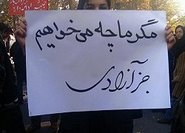
 اخبار مربوط به زندانیان سیاسی و نقض حقوق بشر







 Tulips in Holland