Alliance For democracy In Iran

Please have a look at my other weblog, Iran Democracy - http://irandemocray.blogspot.com/

IMPERIAL EMBLEM

IMPERIAL EMBLEM
PERSIA

Shahanshah Aryameher

S U N OF P E R S I A

Iranian Freedom Fighters UNITE

Showing posts with label Islamic Republic. Show all posts

Sunday, March 04, 2007

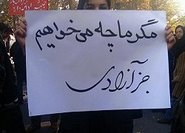
YESTERDAY MANY WOMEN PROTESTERS IN SOLIDARITY TO EARLIER ASSRESTS WERE ONCE AGAIN ARRESTED IN FRONT OF THE TEHRAN REVOLUTIONARY COURTS

یکشنبه، 13 اسفند ماه 1385 برابر با 2007 Sunday 04 March


به گزارش خبرنگار ادوار نیوز تجمع آرام فعالین جنبش زنان در برابر دادگاه انقلاب در اعتراض به فشارهای امنیتی وارده و احضار های متعدد این فعالان که از ساعت 30/8 صبح امروز آغاز شده بود، با حمله پلیس امنیت و بازداشت 21 نفر به خشونت کشیده شد.اسامی بازداشت شدگان به شرح زیر است
/

آمنه امینی، ژیلا بنی یعقوب،محبوبه عباسقلی زاده، محبوبه حسین زاده، سارا لقمانی، زارا امجدیان، مریم حسین خواه، جلوه جواهری، نیلوفر گلکار، پرستو دوکوهکی،زینب پیغمبر زاده، مریم میرزا، ساغر لقایی خدیجه مقدم، ساقی لقایی، ناهید کشاورز، مهناز محمدی، نسرین افضلی، طلعت تقی نیا، فخری شادفر، مریم شادفر، الناز انصاری، فاطمه گوارایی، آزاده فرقانی ،سمیه فرید، مینو مرتاضی، سارا ایمانیان


دستکم 36 نفر از فعالان جنبش زنان در برابر دادگاه انقلاب بازداشت شدند. به گزارش خبرنگار ادوار نیوز تجمع آرام فعالین جنبش زنان در برابر دادگاه انقلاب در اعتراض به فشارهای امنیتی وارده و احضار های متعدد این فعالان که از ساعت 30/8 صبح امروز آغاز شده بود، با حمله پلیس امنیت و بازداشت 36 نفر به خشونت کشیده شد. در حال حاضر بازداشت شدگان در دو گروه 18 نفره و در دو دستگاه مینی بوس، در برابر اداره مبارزه با مفاسد اجتماعی نیروی انتظامی (ساختمان وزرا) هستند. ماموران پلیس بازداشت شدگان را ابتدا به مقر پلیس امنیت تهران در میدان عشرت آباد برده اند. برخی منابع خبری جنبش زنان خبر می دهند ماموران سر ناهید جعفری یکی از بازداشت شدگان را به در مینی بوس کوبیده اند که در نتیجه این ضرب و شتم، دندان های ناهید جعفری شکسته است و ماموران از بردن وی به اوژانس امتناع می کنند. اسامی بازداشت شدگان به شرح زیر است: آسیه امینی، ژیلا بنی یعقوب،محبوبه عباسقلی زاده، محبوبه حسین زاده، سارا لقمانی، زارا امجدیان، مریم حسین خواه، جلوه جواهری، نیلوفر گلکار، پرستو دوکوهکی،زینب پیغمبر زاده، مریم میرزا، ساغر لقایی خدیجه مقدم، ساقی لقایی، ناهید کشاورز، مهناز محمدی، نسرین افضلی، طلعت تقی نیا، فخری شادفر، مریم شادفر، الناز انصاری، فاطمه گوارایی، آزاده فرقانی ،سمیه فرید، مینو مرتاضی، سارا ایمانیان ، ناهید جعفری، سوسن طهماسبی، پروین اردلان، نوشین احمدی خراسانی و شهلا انتصاری

همچنین منابع زنان از بازداشت
شادی صدر فعال جنبش زنان و وکیل مدافع شهلا انتصاری خبر می دهند.

Friday, March 02, 2007

TELL THE DOOR .....HOPING THAT THE WALL TOO WILL HEAR......


"Algeria became the pivotal Third World state, but the cost of its status - above all the financial cost - was staggering. It ate up millions of dollars for which the country had a crying need ... Gradually, the gap between Ben Bella's domestic and foreign policies grew wider. The contrast deepened. Algeria had earned an international reputation as a revolution state ... it was an example for the non-European continents, a model, bright and entrancing; while at home, the country was stagnating; the unemployed filled the square of every city; there was no investment; illiteracy ruled, bureaucracy, reaction, fanaticism ran riot; intrigues absorbed the attention of the government ... The country cannot carry the burden of these polices. It cannot afford to and it has no interest in them."

The matter with Iran Fred Halliday 1 - 3 - 2007

Fred Halliday is professor of international relations at the LSE, and visiting professor at the Barcelona Institute of International Studies (IBEI). His books include Islam and the Myth of Confrontation (IB Tauris, 2003) and 100 Myths About the Middle East (Saqi, 2005)

The key to understanding Iran's contemporary role in the middle east is less its millennia of statehood or its Shi'a identity than its political dynamic as a revolutionary state, says Fred Halliday. A few years ago, during a visit to Tehran to give some lectures at the foreign ministry research and training institute, I was taken to lunch by a senior Iranian diplomat at a once fashionable Italian restaurant in the northern middle-class suburb of Tajrish. Educated as a scientist in the United States before the 1979 revolution, he had been an important figure in the post-revolutionary regime, and later a senior diplomat. I had met him at various conferences on European-Iranian relations and we had struck up something of a rapport. On this occasion, after the usual semi-official tour d'horizon, we began talking about the early history of the Iranian revolution and of its foreign policy.

"We made three big mistakes", he said: first, in holding the American diplomats hostages for a year and a half and thereby deeply antagonising the US; second, by not accepting the very favourable peace which Saddam Hussein had offered in the summer of 1982, when Iran had the upper hand in the war, then already two years old; and third - to me the most surprising of his points - in not supporting the communist regime that came to power in Afghanistan in 1978, and instead backing the pro-American guerrillas that (with eventual success) opposed them.

The reflections of this diplomat are of considerable relevance to the situation in which Iran finds itself today. For sure, the
pressure being put on Iran by the US is arrogant and in many ways illegal. For Washington to protest about Iranian "interference" in Iraq when it is the US which invaded the country in 2003, and when it is Iranian allies (if not clients) who staff much of the government and armed forces of Iraq, is also ridiculous. So too is the attempt to blame Iran for the spread of Sunni terrorism, including al-Qaida activities, in the region. No country has a greater interest in the stability of Iraq than Iran, a point Washington has stupidly failed to note these four years past.
Read the rest here :http://www.opendemocracy.net/themes/article.jsp?id=6&articleId=4396

Sunday, February 25, 2007

The Redirection, New Yorker , Seymour M. Hersh

In the past few months, as the situation in Iraq has deteriorated, the Bush Administration, in both its public diplomacy and its covert operations, has significantly shifted its Middle East strategy. The “redirection,” as some inside the White House have called the new strategy, has brought the United States closer to an open confrontation with Iran and, in parts of the region, propelled it into a widening sectarian conflict between Shiite and Sunni Muslims.

To undermine Iran, which is predominantly Shiite, the Bush Administration has decided, in effect, to reconfigure its priorities in the Middle East. In Lebanon, the Administration has coöperated with Saudi Arabia’s government, which is Sunni, in clandestine operations that are intended to weaken Hezbollah, the Shiite organization that is backed by Iran. The U.S. has also taken part in clandestine operations aimed at Iran and its ally Syria. A by-product of these activities has been the bolstering of Sunni extremist groups that espouse a militant vision of Islam and are hostile to America and sympathetic to Al Qaeda. One contradictory aspect of the new strategy is that, in Iraq, most of the insurgent violence directed at the American military has come from Sunni forces, and not from Shiites. But, from the Administration’s perspective, the most profound—and unintended—strategic consequence of the Iraq war is the empowerment of Iran. Its President, Mahmoud Ahmadinejad, has made defiant pronouncements about the destruction of Israel and his country’s right to pursue its nuclear program, and last week its supreme religious leader, Ayatollah Ali Khamenei, said on state television that “realities in the region show that the arrogant front, headed by the U.S. and its allies, will be the principal loser in the region.” After the revolution of 1979 brought a religious government to power, the United States broke with Iran and cultivated closer relations with the leaders of Sunni Arab states such as Jordan, Egypt, and Saudi Arabia. That calculation became more complex after the September 11th attacks, especially with regard to the Saudis. Al Qaeda is Sunni, and many of its operatives came from extremist religious circles inside Saudi Arabia. Before the invasion of Iraq, in 2003, Administration officials, influenced by neoconservative ideologues, assumed that a Shiite government there could provide a pro-American balance to Sunni extremists, since Iraq’s Shiite majority had been oppressed under Saddam Hussein. They ignored warnings from the intelligence community about the ties between Iraqi Shiite leaders and Iran, where some had lived in exile for years. Now, to the distress of the White House, Iran has forged a close relationship with the Shiite-dominated government of Prime Minister Nuri al-Maliki. The new American policy, in its broad outlines, has been discussed publicly. In testimony before the Senate Foreign Relations Committee in January, Secretary of State Condoleezza Rice said that there is “a new strategic alignment in the Middle East,” separating “reformers” and “extremists”; she pointed to the Sunni states as centers of moderation, and said that Iran, Syria, and Hezbollah were “on the other side of that divide.” (Syria’s Sunni majority is dominated by the Alawi sect.) Iran and Syria, she said, “have made their choice and their choice is to destabilize.” Some of the core tactics of the redirection are not public, however. The clandestine operations have been kept secret, in some cases, by leaving the execution or the funding to the Saudis, or by finding other ways to work around the normal congressional appropriations process, current and former officials close to the Administration said. A senior member of the House Appropriations Committee told me that he had heard about the new strategy, but felt that he and his colleagues had not been adequately briefed. “We haven’t got any of this,” he said. “We ask for anything going on, and they say there’s nothing. And when we ask specific questions they say, ‘We’re going to get back to you.’ It’s so frustrating.” The key players behind the redirection are Vice-President Dick Cheney, the deputy national-security adviser Elliott Abrams, the departing Ambassador to Iraq (and nominee for United Nations Ambassador), Zalmay Khalilzad, and Prince Bandar bin Sultan, the Saudi national-security adviser. While Rice has been deeply involved in shaping the public policy, former and current officials said that the clandestine side has been guided by Cheney. (Cheney’s office and the White House declined to comment for this story; the Pentagon did not respond to specific queries but said, “The United States is not planning to go to war with Iran.”) .The policy shift has brought Saudi Arabia and Israel into a new strategic embrace, largely because both countries see Iran as an existential threat. They have been involved in direct talks, and the Saudis, who believe that greater stability in Israel and Palestine will give Iran less leverage in the region, have become more involved in Arab-Israeli negotiations. The new strategy “is a major shift in American policy—it’s a sea change,” a U.S. government consultant with close ties to Israel said. The Sunni states “were petrified of a Shiite resurgence, and there was growing resentment with our gambling on the moderate Shiites in Iraq,” he said. “We cannot reverse the Shiite gain in Iraq, but we can contain it.” “It seems there has been a debate inside the government over what’s the biggest danger—Iran or Sunni radicals,” Vali Nasr, a senior fellow at the Council on Foreign Relations, who has written widely on Shiites, Iran, and Iraq, told me. “The Saudis and some in the Administration have been arguing that the biggest threat is Iran and the Sunni radicals are the lesser enemies. This is a victory for the Saudi line.” Martin Indyk, a senior State Department official in the Clinton Administration who also served as Ambassador to Israel, said that “the Middle East is heading into a serious Sunni-Shiite Cold War.” Indyk, who is the director of the Saban Center for Middle East Policy at the Brookings Institution, added that, in his opinion, it was not clear whether the White House was fully aware of the strategic implications of its new policy. “The White House is not just doubling the bet in Iraq,” he said. “It’s doubling the bet across the region. This could get very complicated. Everything is upside down.” The Administration’s new policy for containing Iran seems to complicate its strategy for winning the war in Iraq. Patrick Clawson, an expert on Iran and the deputy director for research at the Washington Institute for Near East Policy, argued, however, that closer ties between the United States and moderate or even radical Sunnis could put “fear” into the government of Prime Minister Maliki and “make him worry that the Sunnis could actually win” the civil war there. Clawson said that this might give Maliki an incentive to coöperate with the United States in suppressing radical Shiite militias, such as Moqtada al-Sadr’s Mahdi Army. Even so, for the moment, the U.S. remains dependent on the coöperation of Iraqi Shiite leaders. The Mahdi Army may be openly hostile to American interests, but other Shiite militias are counted as U.S. allies. Both Moqtada al-Sadr and the White House back Maliki. A memorandum written late last year by Stephen Hadley, the national-security adviser, suggested that the Administration try to separate Maliki from his more radical Shiite allies by building his base among moderate Sunnis and Kurds, but so far the trends have been in the opposite direction. As the Iraqi Army continues to founder in its confrontations with insurgents, the power of the Shiite militias has steadily increased. Flynt Leverett, a former Bush Administration National Security Council official, told me that “there is nothing coincidental or ironic” about the new strategy with regard to Iraq. “The Administration is trying to make a case that Iran is more dangerous and more provocative than the Sunni insurgents to American interests in Iraq, when—if you look at the actual casualty numbers—the punishment inflicted on America by the Sunnis is greater by an order of magnitude,” Leverett said. “This is all part of the campaign of provocative steps to increase the pressure on Iran. The idea is that at some point the Iranians will respond and then the Administration will have an open door to strike at them.” President George W. Bush, in a speech on January 10th, partially spelled out this approach. “These two regimes”—Iran and Syria—“are allowing terrorists and insurgents to use their territory to move in and out of Iraq,” Bush said. “Iran is providing material support for attacks on American troops. We will disrupt the attacks on our forces. We’ll interrupt the flow of support from Iran and Syria. And we will seek out and destroy the networks providing advanced weaponry and training to our enemies in Iraq.” In the following weeks, there was a wave of allegations from the Administration about Iranian involvement in the Iraq war. On February 11th, reporters were shown sophisticated explosive devices, captured in Iraq, that the Administration claimed had come from Iran. The Administration’s message was, in essence, that the bleak situation in Iraq was the result not of its own failures of planning and execution but of Iran’s interference. The U.S. military also has arrested and interrogated hundreds of Iranians in Iraq. “The word went out last August for the military to snatch as many Iranians in Iraq as they can,” a former senior intelligence official said. “They had five hundred locked up at one time. We’re working these guys and getting information from them. The White House goal is to build a case that the Iranians have been fomenting the insurgency and they’ve been doing it all along—that Iran is, in fact, supporting the killing of Americans.” The Pentagon consultant confirmed that hundreds of Iranians have been captured by American forces in recent months. But he told me that that total includes many Iranian humanitarian and aid workers who “get scooped up and released in a short time,” after they have been interrogated. “We are not planning for a war with Iran,” Robert Gates, the new Defense Secretary, announced on February 2nd, and yet the atmosphere of confrontation has deepened. According to current and former American intelligence and military officials, secret operations in Lebanon have been accompanied by clandestine operations targeting Iran. American military and special-operations teams have escalated their activities in Iran to gather intelligence and, according to a Pentagon consultant on terrorism and the former senior intelligence official, have also crossed the border in pursuit of Iranian operatives from Iraq. At Rice’s Senate appearance in January, Democratic Senator Joseph Biden, of Delaware, pointedly asked her whether the U.S. planned to cross the Iranian or the Syrian border in the course of a pursuit. “Obviously, the President isn’t going to rule anything out to protect our troops, but the plan is to take down these networks in Iraq,” Rice said, adding, “I do think that everyone will understand that—the American people and I assume the Congress expect the President to do what is necessary to protect our forces.” The ambiguity of Rice’s reply prompted a response from Nebraska Senator Chuck Hagel, a Republican, who has been critical of the Administration: Some of us remember 1970, Madam Secretary. And that was Cambodia. And when our government lied to the American people and said, “We didn’t cross the border going into Cambodia,” in fact we did. I happen to know something about that, as do some on this committee. So, Madam Secretary, when you set in motion the kind of policy that the President is talking about here, it’s very, very dangerous. The Administration’s concern about Iran’s role in Iraq is coupled with its long-standing alarm over Iran’s nuclear program. On Fox News on January 14th, Cheney warned of the possibility, in a few years, “of a nuclear-armed Iran, astride the world’s supply of oil, able to affect adversely the global economy, prepared to use terrorist organizations and/or their nuclear weapons to threaten their neighbors and others around the world.” He also said, “If you go and talk with the Gulf states or if you talk with the Saudis or if you talk with the Israelis or the Jordanians, the entire region is worried. . . . The threat Iran represents is growing.” The Administration is now examining a wave of new intelligence on Iran’s weapons programs. Current and former American officials told me that the intelligence, which came from Israeli agents operating in Iran, includes a claim that Iran has developed a three-stage solid-fuelled intercontinental missile capable of delivering several small warheads—each with limited accuracy—inside Europe. The validity of this human intelligence is still being debated. A similar argument about an imminent threat posed by weapons of mass destruction—and questions about the intelligence used to make that case—formed the prelude to the invasion of Iraq. Many in Congress have greeted the claims about Iran with wariness; in the Senate on February 14th, Hillary Clinton said, “We have all learned lessons from the conflict in Iraq, and we have to apply those lessons to any allegations that are being raised about Iran. Because, Mr. President, what we are hearing has too familiar a ring and we must be on guard that we never again make decisions on the basis of intelligence that turns out to be faulty.” Still, the Pentagon is continuing intensive planning for a possible bombing attack on Iran, a process that began last year, at the direction of the President. In recent months, the former intelligence official told me, a special planning group has been established in the offices of the Joint Chiefs of Staff, charged with creating a contingency bombing plan for Iran that can be implemented, upon orders from the President, within twenty-four hours. In the past month, I was told by an Air Force adviser on targeting and the Pentagon consultant on terrorism, the Iran planning group has been handed a new assignment: to identify targets in Iran that may be involved in supplying or aiding militants in Iraq. Previously, the focus had been on the destruction of Iran’s nuclear facilities and possible regime change. Two carrier strike groups—the Eisenhower and the Stennis—are now in the Arabian Sea. One plan is for them to be relieved early in the spring, but there is worry within the military that they may be ordered to stay in the area after the new carriers arrive, according to several sources. (Among other concerns, war games have shown that the carriers could be vulnerable to swarming tactics involving large numbers of small boats, a technique that the Iranians have practiced in the past; carriers have limited maneuverability in the narrow Strait of Hormuz, off Iran’s southern coast.) The former senior intelligence official said that the current contingency plans allow for an attack order this spring. He added, however, that senior officers on the Joint Chiefs were counting on the White House’s not being “foolish enough to do this in the face of Iraq, and the problems it would give the Republicans in 2008.”
Please read the rest of this article by following this link : http://www.newyorker.com/fact/content/articles/070305fa_fact_hersh

Monday, February 19, 2007

GCC FOCUSES ON AIR DEFENSE, NAVY

ABU DHABI [MENL] -- Gulf Cooperation Council militaries have launched an effort to bolster the air defense and navies to prepare for any war with Iran. Western industry sources said Gulf Arab states such as Kuwait, Saudi Arabia and United Arab Emirates have led the way with procurement and development programs meant to bolster defenses in the Gulf. The sources said the three GCC states envisioned an Iranian attack on their oil facilities amid any U.S.-led war against Teheran. "The key threats will be an Iranian attack on oil facilities or on oil ships in the Straits of Hormuz," a Gulf industry source said. "These countries need an answer to these threats and quickly." The sources said the GCC focus would be on attack helicopters, fast attack craft, radars and air and missile defense. They said GCC states expect massive Iranian missile fire in any war with the United States.

Sunday, February 18, 2007

What do the ex CIA operatives say about USA`s War with Iran?

http://harpers.org/sb-war-with-ir-1171457451.html

Anonymous Former CIA Official #1 : A former CIA official, who asked to remain unnamed. He was stationed in the Persian Gulf during the first Gulf War and served in Iraq after the 2003 invasion. I don't think the administration is about to carry out military action. The military does not want to do this. We will lose planes if there is a massive air strike over Iran, we'll have pilots killed and captured. Iran has a lot of ways to hurt us. If they decide to come after uniformed personnel in Iraq, or more easily, civilians and contractors, things could quickly get out of hand. You could have kidnappings or a mass casualty attack—they drove us out of Lebanon in the 1980s; a mass casualty attack like the Marine barracks bombing would likely be the end in Iraq. But the administration's actions are increasing the chances for an accidental confrontation. People don't realize how small and narrow the Gulf is, especially as you approach the Straits of Hormuz. The tanker/container and related commerce traffic is incredible and it goes on twenty-four hours a day. We've already got one carrier battle group there and now we're going to put in another one, which will add a huge footprint. When you have, on both sides, nineteen-year-olds manning weapons, it's a formula for an accident that could spin out of control. Here's an example: Every night, members of the Revolutionary Guard pack up their speed boats with rugs and crafts, really pricey stuff. They weave their way through all the traffic on the Gulf and sell the stuff on remote areas of beach just north of Sharjah, Ajman, and Umm al Qaywayn. They off-load and sell their goods and then load up with Jack Daniels, porn, CDs, electronics, satellite receivers, and computers, and weave their way back through traffic to Iran. At 3 a.m. on a moonless night, one of those boats speeding across the Gulf could easily cross the defensive radar signature of a U.S. frigate, and it's going to get shot up. So you have a situation that is essentially an accident, and all of a sudden you have a crisis. Military action is not the best option. This is not like Iraq's Osirak reactor, which Israel destroyed in 1981. In that case, there was a single target. Iran's nuclear program is dispersed and our intelligence picture is thin because we don't have enough well-placed spies. It would take a massive air strike package with consecutive strikes to hit all the targets. You could hurt them and complicate their activities, but I don't think you could turn off their program. The way to pressure the Iranian government is through pressure inside Iran and inside Iraq. There's a thirst for information in Iran and we should be bombarding them with accurate information via conventional and unconventional means. We could be using TV and radio broadcasts, the Internet, Wi-Fi networks in Iraq, and underground newspapers to reach Iranians. There are about 60,000 Iranians in the Los Angeles area, many with daily contact with family and colleagues in Iran. Los Angeles is the headquarters for the American media/movie/television apparatus—and yet we're not broadcasting into Iran. Turn them loose! They can produce soap operas, talk shows, news programs, entertainment shows, all in Farsi. Propagandizing is part of the CIA's mission charter, but the current leadership has decided against it. (They've also decided against covert action, direct action, covert influence, and other active measures.) The agency did it for years in Eastern Europe, Africa, Central and South America, and other parts of the world during the Cold War, with huge impact. With advances in technology, it's so much easier to do now. When I started in this business, there was only TV, radio, and print, and it was very hard to influence what was shown on TV. Now you can plant a story on the Internet in a couple of minutes. You want to make Ahmadinejad react to stories—create the perception of a rift between him and the religious leadership and cast it as a problem in the country. The rumor mill works overtime in that part of the world. You'd want nuggets of truth in these stories, aimed at Iranian youth. We should be emphasizing the huge unemployment in Iran, the staleness of the revolution, the age of the mullahs, and how they live very well—their pious lifestyle is all baloney. But doing it requires too much effort, and careers could be risked.

Frank Anderson : Frank Anderson worked for the CIA from 1968 until 1995. He served three tours of duty in the Middle East as an agency station chief, headed the Afghan Task Force (1987-1989), and was chief of the Near East Division. He now runs a consulting practice that focuses on the Middle East.

I think that the Bush Administration has certainly ordered up contingency plans that give them military options for dealing with three possible Iran-related objectives. In decreasing order of importance, possible triggers for war are:

Reaction to Iranian support for attacks on U.S. troops;
Destruction or delay of Iranian nuclear capability; and/or
Regime change (the guys who brought us the Iraq war are still in charge).
Any administration would so prepare. This administration has, at least, a significant minority of officials who are determined to take on Iran, with the goals of destroying nuclear capabilities and/or regime change, before they leave office. Couple that with an abundant supply of provocations from an Iranian President whose political core is radically and almost recklessly anti-American. Thus, I think we're “locked and loaded” for an attack. That said, the barriers to action are formidable. The President's party has lost control of the legislature and is in trouble over war in the Middle East. Interestingly, the last Iranian elections showed that the Iranian President is also in trouble, mostly over botched economic performance, but his opponents have linked the troubled economy to Ahmadinejad's confrontational foreign and nuclear policies. So, no matter how much the national executive on both sides might want a fight, they are both constrained. Moreover, it's difficult to come up with a “target deck” that, if struck, would make a strategic difference worth the political price. Of course, even the Administration's biggest war fans have to deal with the condition of our overall military capabilities and our weakened diplomatic position. We should be trying to cope with Iran, rather than trying to take them out. Were I was still taking a government paycheck, I would be pushing for coping mechanisms but also looking hard for intelligence on which to base strikes that could take out targets clearly tied to Iranian misdeeds in Iraq, like I.E.D. engineering and supply. I'd also look for, but doubt I could find, some set of critical targets whose destruction could seriously impact the prospects for an Iranian nuclear weapon. My bottom-line guess is that we don't have the intelligence or military capability that would justify an attack on Iran that would be worth the significant cost. With the President politically constrained, that makes me bet against it, but the spread isn't big.

Anonymous Former CIA Official #2 : A former senior CIA official, who preferred to remain unidentified, but who has broad experience in the Middle East :
The Bush Administration's combative rhetoric—its accusations about Iran's nuclear program, involvement in Iraq, and support for Hezbollah and Hamas—looks like a prelude to military action. It's eerily reminiscent of the fall 2002/winter 2003 rhetoric on Iraq, when the administration was talking about WMDs and Saddam Hussein's meddling in the region. It's back to the future. The administration is unlikely to embark upon military action immediately, but it's trying to squeeze Iran, to egg on the government, and hoping that Iran commits some sort of military action that the Bush Administration can use as justification for a strike. The administration was hurt by the accusation that it conducted a war of choice against Iraq, so it's trying to create a situation where it can say this is a war of necessity against Iran. But its actions are essentially the same thing as planning to go to war. I see four types of evidence that the administration is planning military action. First, it is escalating its anti-Iran rhetoric. Second, it is parading evidence about Iranian involvement in Iraq, citing intelligence reports, serial numbers of weapons, and so on. Third, the United States is building up its military presence in the Gulf. Fourth, pro-United States regimes in the region, with encouragement, clearly, by the Bush Administration, are issuing statements denouncing Iran's threatening posture towards them, and its alleged efforts to pressure for the “Shiite-ification” of Sunni communities. Despite differences between Shiites and Sunnis, a U.S. attack on Iran would be viewed in the region as the fifth in a series of American wars against Islam—after Afghanistan, Iraq, Hamas, and Hezbollah. Iran and its supporters will seek to respond, including through attacks on Israel. An American strike poses a huge threat to Israel, which I'm not sure the administration has thought through. It will also destabilize pro-American regimes in the region, solidify the jihadists in Iraq, and unify Iranians around their government.
Also read : http://harpers.org/sb-war-with-iran-1-1171385486.html
and : http://harpers.org/sb-war-with-iran-3-1171549349.html

Friday, February 16, 2007

I`VE SAID IT BEFORE AND I`LL SAY IT AGAIN.LIER LIER PANTS ON FIRE !

Tehran`s comic Friday Prayer says that all the accusations levied against IRI is lies and Islamic republic does not kill people...HA HA HA ...LOL
آدينه، 27 بهمن ماه 1385 برابر با 2007 Friday 16 February
امامی کاشانی: این چه حرفهائی است، جمهوری اسلامی و آدم کشی؟

امامی کاشانی، امام جمعه نمایش امروز تهران با حمله به کشورهای غربی بویژه ایالات متحده گفت "اینکه می گویند جمهوری اسلامی می خواهد بمب اتمی بسازد و یا جمهوری اسلامی به عراق سلاح می دهد و سربازان آمریکايی با سلاحهای ما کشته می شوند، همه دروغ است. دشمن درغگو این مسایل را مطرح می کند." امامی کاشانی گفت "از یک طرف اینها را می گویند از طرف ديگر به كشورهای عربی مي ‏گويند جمهوری اسلامی دشمن شماست. توجه ندارند كه دنیا از آنها مي ‏پرسد اين چه حرف‌‏هايي است كه شما مي‌‏زنيد." امامي كاشاني گفت "همه مسائلي كه دشمن در باره ما مطرح مي‌‏كند، دروغ است. جمهوری اسلامی كه آدم نمی ‏كشد."امامی کاشانی در سخنان خود بر ادامه فعالیتهای هسته ای جمهوری اسلامی تاکید کرد و مدعی شد "مردم با شرکت در راهپیمايی 22 بهمن بر دستیابی به انرژی هسته ای اصرار کردند."

Thursday, February 15, 2007

How the west can avert war with Iran

By Reuel Marc Gerecht and Gary Schmitt
Do the Europeans really want to prevent a war between the US or Israel and Iran? If they had to choose between curtailing trade with the Islamic republic, or seeing either America or Israel preventatively strike Iran’s nuclear facilities, which would London, Paris and Berlin prefer? These are not unfair questions: at no time since the European Union started the “EU3” negotiations with Iran’s clerical regime in 2004 have the Europeans probably had more leverage over Tehran’s actions. At no time since 2002, when it became clear that the mullahs were conducting a clandestine nuclear research programme, has there been a more critical moment for determining which path – diplomatic or military – the US and Israel will choose to try to stop Iran’s pursuit of the bomb.
Washington and Jerusalem clearly have no desire to attack Iran. But if the Europeans close down the option of boosting the soft-power of sanctions, the odds on military strikes will increase significantly. Most in Europe’s political elite may well agree with President Jacques Chirac of France when he recently revealed he had no problem with Iran having “one or two” nuclear weapons. Embracing the theory of deterrence, Mr Chirac apparently envisioned the Israelis or the Americans threatening annihilation of Iran as a means of escaping from the international contretemps provoked by the mullahs’ nuclear aspirations. The European hope is that the Americans and the Israelis will realise that an attack on Iran’s nuclear sites is unthinkable.
But what if the Americans or the Israelis do not see it that way? George W. Bush and many other Americans are not convinced that the theory of deterrence is either a moral or effective idea when used against a terrorist-supporting state. Is the US going to slaughter hundreds of thousands – even millions – of Iranians for an unclaimed nuclear terrorist strike? If Tehran launched a conventional terrorist attack on a US facility – such as the one it is strongly suspected of having masterminded on the Khobar Towers complex in Saudi Arabia in 1996 – would not Washington be even less likely to respond, knowing the other side has the bomb?
We know that Iran’s leaders allowed members of al-Qaeda to pass through their territory after al-Qaeda had successfully displayed its penchant for slaughtering Americans. Even after the anti-Semitic tirades of Mr Ahmadi-Nejad, which echo the “bye-bye-Israel” nuclear bravado of former president Ali Akbar Hashemi Rafsanjani, the Europeans remain surreally casual about how a nuclear Iran could effectively intimidate Israel – politically, spiritually and economically. Both Americans and Israelis reflect seriously on the awful prospect of ideologically volatile Sunni Arab dictatorships obtaining their own nuclear weapons to counter Shia Iran’s bomb-enhanced ambitions.
Within Iran, is the clerical regime likely to reform, or become more paranoid, as internal dissent mounts? The permanently dysfunctional nature of the Islamic republic – the tension between theocracy and democracy and the corrupt, impoverishing statist economic structure guarantee the continuing insecurity of the regime and hence, in part, its willingness to use violence internally and externally. Since the death of Ayatollah Ruhollah Khomeini in 1989, Iranian society has been shearing away from its clerical overlords, who see themselves as the vanguard of the Iranian nation and the Muslim world. This process will continue and, with it, the anti-American and anti-Israeli animosity of the regime.
In 2003 when the British, French and Germans feared that Mr Bush might attack another “axis of evil” member, European nuclear negotiations with Tehran began in earnest. One of the most serious diplomatic undertakings in the EU’s history, the EU3 process signalled to the Iranians, as well as to all EU members and the US, that Europe would use both carrots and sticks to persuade the mullahs to cease their uranium enrichment activities. In the intervening four years, the EU3 has dangled various inducements before Tehran to no avail. Proceeding with tougher sanctions is a real opportunity for transatlantic relations; conversely, failure to do so will only signal how great remains the divide in relations.
Timing in a poker game is critical: if you do not know when to raise, you always lose. There are signs of serious political and economic turbulence inside the Islamic republic’s autocratic, socialist system. Iran’s rulers have now seen the Americans deploy a new battle group to the Persian Gulf, implement more aggressive rules to counter Iranian meddling in Iraq, interrupt the cash-flow of Iranian banks overseas (with some European participation), and watched the Americans and Europeans move forward with a sanctions regime at the United Nations. It is no coincidence that the internal Iranian discussion about Mr Ahmadi-Nejad’s competence and the “nuclear energy” programme has heated up. The effect inside Iran of EU-imposed sanctions could be considerable, given the fragility of the Iranian economy and concerns among Iranians about the possible cascading effect of sanctions. Poker may well have been invented in Iran, but it came to the Americans via the Europeans. Do the Europeans still know how to play?
The writers are scholars at the American Enterprise Institute

Wednesday, February 14, 2007

Iran ex-leader RASMAN JANI: Tehran seeks 'good will'

BUGGER OFF ! ITS TOO LITTLE AND TOO LATE

10 minutes ago
Iran will "remove obstacles" blocking negotiations with the United States if Washington shows good will, former President Hashemi Rafsanjani said Wednesday. "Any time the United States sends a signal showing good will in its dealings with Iran, we will in return remove obstacles in the way of negotiations," the official Islamic Republic News Agency quoted Rafsanjani as saying.
Rafsanjani's comments came just before U.S. President George W. Bush told reporters in Washington that he is convinced the Iranian government is supplying deadly weapons to fighters in Iraq, even if he cannot prove the orders came from the highest levels in Tehran.