

- human rights activist and former beauty queen talks to CNN's Asieh Namdar about protesting child executions in Iran.
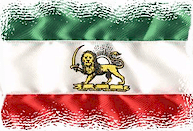
IMPERIAL EMBLEM

PERSIA
Iranian Freedom Fighters UNITE
Showing posts with label United Nations. Show all posts
Showing posts with label United Nations. Show all posts
Sunday, September 21, 2008
Thursday, July 03, 2008
Urgent Request fro all Iranians - Please read this and support this poor man.
درخواست اضطراري
Urgent Request
With hello and respect - The condition of Ayatollah Kazemeini Boroujerdi is very critical and grave. Recently they have broken and fractured his jaw and his left eye approximately is unable to see. In addition there has been a tumor in his stomach in which annoys him a lot and injected some suspecting injections as well. In other words Ayatollah Boroujerdi is in grave danger and not able to walk or do his personal affairs by himself any more in which anyone sees he may not be able to recognize him.He has set a written complaint opposed Iran regime. We urgently request you by using your great situation, you ask UN, Europe Union or every credible organization to send a legal representative for visiting Ayatollah Boroujerdi in Evin prison to get his written complaint against Iran regime and follow it formally.Ayatollah Boroujerdi is representative of huge crowd of Iranian people and wants separation of religion from state and believes in freedom of speech, press and religion as well.Documents relating to his before illnesses:http://hrw.org/english/docs/2008/06/05/iran19031.htmwww2.ohchr.org/english/bodies/hrcouncil/docs/8session/A.HRC.8.4.Add1.docwww.iranhumanrights.org/themes/news/single-news/article/49/imprisoned-clerics-life-in-danger.htmlhttps://iranbbb.org/25097.htmhttp://www.hra-iran.org/Archive_87/805.htmlhttp://web.amnesty.org/library/Index/ENGMDE131032007http://web.amnesty.org/library/index/engMDE130742007?open&of=eng-IRNhttp://web.amnesty.org/library/Index/ENGMDE130402007?open&of=ENG-2MDhttp://iranppa.blogspot.com/search?q=boroujerdi
درخواست اضطراري - با سلام و احتراموضعيت آيت الله كاظميني بروجردي بسيار وخيم است. اخيرا، فك ايشان را شكستهاند و چشم چپ ايشان تقريبا قادر به ديدن نيست، همچنين در معده ايشان غدهاي ايجاد شده كه به شدت ايشان را آزار ميدهد و حتي آمپولهاي مشكوكي به ايشان زدهاند و در يك كلام، آيت الله بروجردي به شدت در معرض قتل قرار دارد و ديگر قادر به راه رفتن و انجام امور شخصي خود نيست و هر كس ايشان را ببي 6;د نميتواند او را بشناسد.ايشان شکایتنامهای بر علیه حکومت ایران تنظیم نموده است. از شما درخواست فوري داريم كه با استفاده از موقعيت ممتاز خود، از سازمان ملل متحد يا اتحاديه اروپا و يا از هر سازمان معتبر ديگري، بخواهيد كه نمانيدهاي قانوني براي ديدار با آيت الله بروجردي در زندان اوین، فورا به ایران اعزام شود تا شكايتنامه آیت الله بروجردی از حكومت ايران را دريافت كند و رسما پیگیری نمايد.آيت الله بروجردي نماينده قشر عظيمي از مردم ايران است كه خواهان جدائي دين از حكومت هستند و به آزادي قلم و بيان و حق انتخاب دين، اعتقاد دارند.
Should The President of the United States Talk to Ahmadinejad?
Written by Cisco : Thursday, 03 July 2008
Patrick O'Brian wrote a series of twenty-one novels that are set in the Napoleonic wars and that have Captain Jack Aubrey and Dr. Stephen Maturin as the protagonists. Aubrey is an English naval captain who always sails with Maturin as his ship's surgeon. If you are not familiar with the O'Brian novels, perhaps you will recall a movie, Master and Commander of the Far Side of the World, which was loosely based upon these novels and starred Russell Crowe as Captain Aubrey. The eighth novel in this series is called The Ionian Mission, and it has Aubrey and Maturin sailing to Greece in order to fight the French.
At the time of the Napoleonic wars, Greece was part of the Muslim Ottoman Turk empire. In The Ionian Mission, the French have taken possession of the fictional city Marga, and it is Captain Aubrey's responsibility to negotiate with the Muslim beys (tribal chieftains) in the area in order to most effectively accomplish the removal of the French troops from the Grecian peninsula. There are three Muslim beys who are vying for power in the region, and the one factor that will tip the balance of power is the guns that the English are willing to provide to whichever bey is most willing to assist the English in fighting the French.
Jack Aubrey meets with each of the beys, and in the final bey that he meets with, he finds a kindred spirit. This bey, Sciahan by name, is “much more what Jack had expected of a Turk: a plain man, and one that he could trust.” Jack unilaterally determines that he will support Sciahan and tells him that he will immediately send a ship to bring the guns that Sciahan desires.
Captain Aubrey makes his decision about which bey he will support without consulting with the politico who accompanied him, a Professor Graham. When Professor Graham realizes what Captain Aubrey has agreed to, he becomes irate and begins berating Captain Aubrey for being so naïve. Professor Graham insists that “In all negotiation, and a fortiori, all Oriental negotiation, each side was expected to extract all possible profit from the balance of forces: if either did not do so, it was because there was some hidden weakness – a plain unconditional acquiescence in a demand must be taken as the greatest proof of weakness.” Professor Graham goes on to say that Captain Aubrey should have insisted on taking as hostage one of Sciahan's nephews, and should have held the nephew until Sciahan had indeed fulfilled his verbal commitment. Professor Graham goes so far as to intimate that Captain Aubrey was not fully committed by the words that he had spoken to Sciahan, and that he could renege on his commitment by begging a misunderstanding. Captain Aubrey “replied coldly that he regarded his words as wholly binding, that he was convinced that he and Sciahan understood one another.”
Captain Jack Aubrey personifies the English and American spirit. We people of the Western world, especially those of us who are American, are very much attached to the idea that if we can sit down with a person, look that person in the eye, and discuss a mutually beneficial relationship, then we tend to believe that the person into whose eye we are looking will fulfill their end of any agreement that is reached. You may call it American naiveté or English gullibility, but we people of the Western world tend to trust verbal, personal commitments. If we make an agreement without extracting the last ounce of blood from the other agreeing party, we do not care if we are are perceived as being weak for doing so. We tend to accept people at their word, rather than taking their family members as hostage in order to ensure that they will fulfill their word.
In 2007 during a Democratic presidential debate, Barak Obama said that if he were President of the United States, he would meet with Mahmoud Ahmadinejad, the president of Iran, without pre-conditions. Since that time, much has been said about the advisability of such an action. Rush Limbaugh has taken Obama to task because he believes that meeting with Ahmadinejad would be beneath the dignity of the President of the United States. Others have stated that the President of the United States should never meet with an avowed terrorist. Being something of an egalitarian, I tend to be skeptical of Limbaugh's idea of a dignity associated with the Presidential office that is not earned by the person occupying that office. And I am not altogether certain that refusing to speak with terrorists is the best method of dealing with them. Additionally, I am well aware of the fact that both Captain Jack Aubrey and Professor Graham are fictional characters. But I also know that those fictional characters do verbalize the dichotomy between the Muslim and Western worlds. I think that substantively, the advice of Professor Graham to Captain Aubrey is applicable today just as was in the early 19th century, and the politically incorrect advice that I would give to Barak Obama and to John McCain is this: You can not trust a Muslim.
Within the politically correct world of the United States, multiculturalism dictates that we look for similarities rather than differences, and so we tend to look at Islam through an American filter. As Americans, we tend to believe in a covenant-making God. The most basic instance of this idea can be found in the saying that “there are no atheists in foxholes,” which implies the idea of a covenant, that is, “God, if you will just get me out of this mess, I will do whatever you want me to do.”
The idea of a covenant-making God is not relegated to foxholes, but is a large part of both Christianity and Judaism. In Judaism we have the classic “if-then” covenants with God, such as that found in II Chronicles 7:14 which states, “If my people, which are called by name, shall humble themselves, and pray, and seek my face, and turn from their wicked ways, then will I hear from heaven, and will forgive their sin, and will hear their land.” Then in Christianity, we have Paul's covenant promise of, “That if thou shalt confess with thy mouth the Lord Jesus, and shalt believe in thine heart that God hath raised him from the dead, thou shalt be saved.”
But Islam does not serve a covenant-making god. Indeed, Allah is quite the opposite of what Christians and Jews expect from their God. The Islamic Allah is a master of deception. In the Qur'an, Sura 3:54 states “...and Allah too deceived, and the best of deceivers is Allah.” When the Qur'an is admitting of, and somewhat proud of the deception of Allah, does it not stand to reason that the adherents of Islam might not have the same negative view of deception that we in the Western world have?
When one cannot trust the fidelity of one's own god, then the next logical step is that one is allowed to be deceptive in their personal dealings. In the Qur'an, Sura 9:1 states, “Freedom from (all) obligations (is declared) from Allah and His Messenger to those of the pagans.” Martin Luther vehemently opposed the selling of indulgences by the Catholic church. He opposed the idea of forgiveness of sins based solely upon one's ability to buy forgiveness. With the Islamic religion we have something infinitely more offensive than the buying of forgiveness. We have the freedom to deceive all who are not of the Islamic faith.
This deception becomes even more sinister when it is paired with the doctrine of Takkiya. Takkiya literally means “cover up,” and this doctrine sanctions the lying to or deceiving others in order to advance the cause of Islam. Under this doctrine, an Islamist is allowed to totally deny his faith if such denial will advance the cause of Islam or preserve it's good name. This doctrine is based on Sura 16:106, and allows the Islamist to deny his faith if he fears threats, injury, or compulsion of any kind. Needless to say, this doctrine flies in the face of the Christian history of martyrdom. We tend to proclaim our beliefs, regardless of consequences, trusting in an almighty God. We have our Foxe's Book of Martyrs, but apparently there is no Islamic equivalent.
Adherents to the Islamic faith worship a god that they acknowledge is deceitful. In addition, they are instructed that they do not need to fulfill any obligations to Christians or Jews. In addition to these two beliefs which are totally abhorrent to both the Jewish and the Christian mindset, they are allowed to lie about their beliefs if they feel threatened, of if their deception will further the cause of Islam. Regardless of who our next President is, that person would do well to understand that Islamic fundamentalists have a very different view of the need for truthfulness. I love O'Brian's fictional character, Captain Jack Aubrey. But there is a part of me that thinks that taking a few Islamic fundamentalist nephews as hostage is not such a bad idea.
Monday, June 30, 2008
The United Nation - A Speech by Roya Kashefi
The United Nation _ June 16 – 19, 2008 - Geneva, Switzerland
Sponsored by the Women’s Federation for World Peace – International
Transcript as presented by Roya Kashefi - Wednesday 18 June 2008
Thank you.
It’s an honour and a privilege to be presenting my paper to such a distinguished and accomplished group of women with such diverse exciting background. I’m very happy and excited to be here and I thank Carolyn for inviting me. I only finalised my travel arrangements on Friday and last night decided to change the paper I was going to present here today. So, please forgive me if I fumble through my notes! Before I begin there are two points I’d like to say: In this talk I’m going to discuss Islamic law as it is identified in the Constitution of the Islamic Republic and applied and practised in Iran. This in NO WAY is an attack on Islam as a religion. I’m pointing out the interpretation of the Qoran and the Shari’a by the ruling Shi’a theocracy in Iran and I DO hope my Moslem sisters don’t take offence. I have great respect for their faith and choices. Secondly, as I have done every time I’ve spoken publicly in the recent months - I would like to dedicate my presentation to Hana Abdi and Ronak Safarzadeh who are paying the price for educating women in Iranian Kurdistan. You can see their pictures behind you . These young women have been in detention for almost ten months, mostly in solitary confinement, with almost no access to legal representation or the opportunity to see their families. They belong to a campaign called ‘Change for Equality’. I’ll talk more about this Campaign later. Yesterday, we heard from our beautiful young Lebanese surgeon who finished her talk by asking us to share in her dream. Well, I want to START by sharing MY DREAM with you. My dream is of EQUALITY with the men in my country. By this I don’t mean I want men and women to be the same, because we’re not.Equality for me means a society in which women and men enjoy the same opportunities, rights and obligations in all spheres of life. Equality for me is when both sexes share equally in the distribution of power and influence; when they have equal opportunities for financial independence. Equality for me means enjoying equal access to education and opportunity to develop personal ambitions, to develop interests and talents. Equality for me is when men and women share equal responsibility for the home and children. But, most importantly for me, equality is when women are completely free from coercion, intimidation and gender based violence at work and at home. I strongly believe that like everything else PEACE begins at home. We have to identify and overcome barriers and obstacles within our countries in the region first, before we can ever hope of extending it to our relations with our neighbours. I’m talking about Institutional discrimination and laws that encourage the enforcement of inequality; or legalising the worst traditional practices such as honour killings.I AM sorry to say that since the inception of the Islamic republic in 1979 it feels like WAR has been declared against Iranian women and religious minorities; never mind wiping Israel off the face of the map!Both groups – women and religious minorities - are legally discriminated against and suffer extensively because of it.So far we’ve heard how your countries are taking steps to bring their laws and policies in line with the realities of life in the 21st century. We heard of government efforts in Turkey to improve girl’s access to education
We have even heard that Iraq and Afghanistan despite the invasion and occupation and the violence we hear about daily, are removing obstacles in the way of women’s progress by introducing quotas and other such measures. Unfortunately, in my country, the Islamic Republic is going the other way. Please tell me if I’m mistaken but I think Iran is the only country that when in 2003 ratifying CEDAW was introduced to parliament, tens of thousands of Talabehs – religious students - came out in the city of Qom in a mass protest rally saying that CEDAW is an insult to Islam, human rights is a western thing and it would infect / destroy Islam. The bill was vetoed and it has never been discussed in the parliament again. And it doesn’t look like that it’s going to be reintroduced anytime soon. Under the current president, Mr Ahmadinejad, the woman in charge of ‘Women and Family Affairs’ stated that CEDAW would be ratified in Iran over ‘her dead body’! The funny thing is that other Moslem countries in the region have ratified CEDAW and yesterday we heard about Syria’s efforts in improving the situation for its women by ratifying CEDAW in 2003.
Examples of Discriminatory Laws
Anyway, lets have a look at some of the laws that I’m talking about and I’ll quickly give you some examples.OK, here are some examples of this inequality and discrimination. These can be seen in :
Compensation
Marriage
Divorce
Child Custody
Education
Employment
Travel
Inheritance
Testimony
I stress that this list is only an example of some of the discriminatory laws applied in Iran today. You can see that it touches every aspect of a woman’s life.I’ve put compensation right at the top for a reason. In Iran today, if a four months pregnant woman has an accident and lose her baby the amount of Diye or cash compensation she’ll receive is different according to the sex of her unborn baby. If the baby was a girl her compensation would be half of the amount she would receive if than it were a boy so in a sense discrimination against US begins even before we are born!
On Marriage
I should say that the legal age of marriage for girls is 13 and 15 for boys. This is thanks to activists who fought to increase girls’ marriage age. But girls as young as eight years and nine months can still be married with a judge’s permission.According to 2006 census there are 4741 widowed and divorced girls in the 10-14 age group. 2282 are widows -Men may marry up to four full wives and as many as temporary wives -When I speak of laws going backwards this is a perfect example. In reviewing family law an article has been introduced whereby the man can marry without the knowledge and/or permission of his wife as long as a judge acknowledges that he can afford to take a second wife.Back to my list ,Let’s look at employment and travel-As a simple example - and I always use this – I’m sure you have all heard of Shirin Ebadi. Shirin Ebadi the 2003 Noble Laureate could not carry on with her work if her husband didn’t want her to. Her husband could apply to the courts and legally prohibit her from working. She could not have travelled out of Iran to receive her Nobel Prize if her husband did not give her permission to travel. On education, although over 63% of university graduates are women, they form the highest number of the unemployed leading to disillusionment, dissatisfaction, and hopelessness – despondency the number of graduate women in employment have dropped five fold according to a study at Tehran University. Women are not allowed to participate in about 25% of subjects being taught at university and efforts to segregate the universities are underway. As we speak sit-ins and nationwide protests are going on about these policies by all students - male and female.
Changing Culture
Yet, despite all the problems and impediments - and I’ve only told you about a few of them - women have fought to keep themselves in the public life. The brave young Iranian women, particularly those born since the 1979 Revolution in the last thirty years, are way ahead of the regime and in practice are working to change their lives for the better without any support or government funding.Despite all the cultural, social and legal barriers facing Iranian women are standing up for their rights and demanding equality. They have found innovative and creative yet culturally acceptable methods. They try to work within the confines of existing laws while working towards change. They have even approached other Grand Ayatollahs to secure their support for their demands.Since August 2006 at least 8 campaigns have been set up with the main one entitled ‘Change for Equality’ that works towards changing the unequal laws. It started off by a petition for one million signatures demanding change. But, very quickly through talking to women in an effort to collect signatures a whole culture changing movement has mushroomed throughout Iran. A look at their website shows you that in a very short time the campaign has headquarters in most major cities with an active network in their surrounding regions. The ever growing numbers of activists believe in changing the culture through education, through raising awareness. They go out to women in the remotest of villages talking to women about equality hoping that as they are bringing up their children they won’t differentiate between their sons and daughters and that they would teach respect to their boys so that for example when he grows up he wouldn’t see violence against his wife as his RIGHT and she wouldn’t accept it as the norm.This is what Ronak and Hana were doing when they were arrested.These courageous women pay the price for their efforts to change culture through raising awareness. In the last two years over 180 women have been arrested and
Charged with threatening national security! Charged with disturbing public opinion!
They have been sentenced to long custodial sentences, to floggings and have paid over a million dollars in bail and surety. To My Recommendations : It’s very well talking about capacity building when there are no cultural or legal barriers to women’s participation or at least a governmental will to improve the situation for women but this is not necessarily the reality.
I believe therefore that: 1- In the first instance we should ‘Identify obstacles to progress’ in its smallest increments . This way you can best plan how to overcome them step by step.
2 - Secondly, As Dr In’aam Al Mufti said so eloquently yesterday: Support grassroots organisations through international awareness and support. What do I mean by this: Technology is a wonderful thing. The women in Iran indeed all the civil rights activists use the internet and email for information and contact. All of you accomplished women; all of us, could very simply belong to a group mailing list. In this way through one simple email we could inform each other of our projects. Where I’m coming from, the support of MOSLEM WOMEN in key decision making positions or positions of power, such as yourselves, for the women in Iran could have a most influential effect when an activist is arrested for demanding nothing more than equality. 3 - Thirdly, include men in the dialogue .Coming from the culture we do NONE of us could do what we do without the support of our men I believe that all of us who are here have either had a supportive father or husband. So I strongly advocate including men when capacity building and other similar subjects are being discussed.In Iran today women’s movement is at the heart of social change and benefits from the support of many men who also believe in equal laws. I would therefore like to end my presentation by showing you the face of the first man who was detained, again in solitary confinement, received torture and has very recently been sentenced to a one year prison sentence for his support of the Iranian women’s campaign for equal rights.
Amir Yaghoub Ali . My apologies to the Chair for going over my allocated time. Thank you.
Tuesday, June 17, 2008
UNESCO - THE FAT OLD SLEEPING MONEY POT
Pasargad Heritage Foundation takes legal action against Mr. Rahim Mashai and criticizes UNESCO's inaction
Mr Koichiro Matsuura
Director-General
UNESCO
7 place de Fontenoy
75352 Paris 07 SP
France
15 June 2008
Dear Mr Matsuura,
As you certainly are aware, it is almost 4 long years that in many occasions and through our numerous open and confidential letters, whose receipt has been acknowledge by your office, we have informed you about the grave dangers paused by the humidity created by Sivand Dam in Fars Province of Iran to the mausoleum of Cyrus the Great. We have also conveyed the professional opinions of experts and engineers who are deeply concerned about the destructive consequences of such a reckless development. Last year, and only a few weeks left to the inauguration of the dam, we forwarded an open letter signed by hundred of thousands of people from around the world, asking for your immediate attention and action. In that letter, we had included the very open confessions of Mr. Rahim Mashai, the head of Iranian Cultural Heritage Organization, as to the probable destructive effects of the dam. This was just to show you a legal and reliable document provided by an official of Islamic Republic of Iran.
Unfortunately, no one, or no independent person, has been able to understand the reasons behind your persistent inaction in this regard, despite the fact that the goals of your organization clearly commissions you to protect those cultural heritage that have been recognized and registered by UNESCO as the heritage belonging to the whole human race.
Now, exactly one year after the flooding of Sivand Dam near Pasargad, the mayor of this town has officially declared that the humidity from the dam has begun to shows its damaging effects on the huge cubic stones that are used in the ancient building of the mausoleum.
Based on this document and apart from the fact that a legal complaint is to be file with the authorizes against Mr. Moshai, PHF, as a registered international non-profit and non-political institution, would like to ask for your prompt attention to this grave situation for the last time, hopefully expecting that your organization would openly announce what course of action has been adopted in this regard. Naturally, this Foundation preserves the right to take further legal action with the aim of withholding those human rights that relate to the cultural heritage of the whole humanity.
Yours sincerely,
Shokooh Mirzadegi (Ms)
Director, PHF
Tuesday, March 04, 2008
NEWS CENTRAL
UN agrees new sanctions against Iran
Mar 03 2008 21:54A third package of sanctions was imposed against the Islamic republic on Monday, targeting individuals most closely involved with its alleged nuclear weapons programme Read more »
More starch in UN sanctions
December 2006: United Nations Security Council first imposes sanctions, ordering all countries to stop supplying Iran with materials and technology that could contribute to its nuclear and missile programs. It also orders countries to freeze the assets of 10 Iranian companies and 12 individuals.March 2007: Security Council votes to toughen sanctions after Iran expands its enrichment program. It bans Iranian arms exports and orders countries to freeze the assets of 28 additional individuals and organizations.March 2008: The Council's third resolution, approved Monday, does the following:•Introduces monitoring of two banks with suspected links to proliferation activities, Bank Melli and Bank Saderat.•Calls on all countries "to exercise vigilance" in entering into new trade commitments with Iran.• Orders countries to freeze the assets of 12 additional companies and 13 individuals linked to Iran's nuclear or ballistic-missile programs.•Bans travel abroad by five individuals linked to Iran's nuclear effort.•For the first time, bans trade with Iran in goods that have both civilian and military uses and authorizes inspections of shipments to and from Iran by sea and air that are suspected of carrying banned items.
Security Council Votes New Sanctions Against Iran
March 03, 2008 The New York Times Warren Hoge Elaine Sciolino
The Security Council on Monday adopted its third resolution imposing sanctions on Iran for its refusal to cease enriching uranium, an activity that Western nations say is designed to build nuclear weapons.The previous two measures gained unanimous support of the 15-member panel, but in Monday’s balloting, Indonesia abstained, saying it “remained to be convinced of the efficacy of adopting additional sanctions at this juncture.” Fourteen countries voted in favor.The resolution authorizes inspections of cargo to and from Iran that is suspected of carrying prohibited equipment, tightens the monitoring of Iranian financial institutions and extends travel bans and asset freezes against persons and companies involved in the nuclear program.It adds 13 names to the existing list of 5 individuals and 12 companies subject to travel and asset restrictions. The new names include people with direct responsibility for building fast-spinning centrifuges that enrich uranium ore and a brigadier general engaged in “efforts to get round the sanctions” in the two earlier resolutions.The new measure also bans all trade and supply of so-called dual-use items, materials and technologies that can be adapted for military as well as civilian ends.Earlier Monday in Vienna, Mohamed ElBaradei, the director of the International Atomic Energy Agency, the United Nations nuclear monitor, said that newly disclosed intelligence reports that Iran had secretly researched how to make nuclear weapons were of “serious concern” and would be pursued by his office.“Iran continues to maintain that these alleged weaponization studies related to conventional weapons only are fabricated,” Dr. ElBaradei said in a speech to the agency’s 35-country policy-making body. “However a full-fledged examination of this issue has yet to take place.”The studies were described last Monday, in a briefing for the agency’s 35-country governing body by Olli Heinonen, the agency’s senior inspector.They included sketches and a video that appeared to have come from Iran’s own military laboratories, and Mr. Heinonen said they showed work “not consistent with any application other than the development of a nuclear weapon.”In a thinly veiled criticism of Iran, Dr. ElBaradei said, “I urge Iran to be as active and cooperative as possible in working with the agency to clarify this matter of serious concern.”Iran says that the agency’s findings support its claim that its nuclear program is solely for peaceful purposes, and it has rejected all suggestions that it was studying how to make nuclear weapons.Iran’s ambassador to the agency, Ali Asghar Soltanieh, called the intelligence data “forged and fabricated” and denounced the new Council resolution Monday as “irresponsible” and “an arrow aiming at the heart of” the atomic energy agency.Iran argues that its program is devoted solely to producing fuel for nuclear reactors that generate electricity. The United States and its European allies on the council contend the real purpose is to make Iran an atomic power, and they say they are determined to prevent that from happening.The resolution voted Monday was originally scheduled for a decision on Friday, but its two sponsors, Britain and France, delayed consideration in the hope of getting as close to unanimity as possible. In addition to Indonesia, three other Council countries - Libya, South Africa and Vietnam - had expressed reservations.To address them, the final version included last minute language changes making it clear that cargo inspections must conform to local and international laws and stressing the central role of the International Atomic Energy Agency and evidence in the latest report from Dr. ElBaradei Feb. 22 that Iran was cooperating with the agency.The resolution extends the reach of punishments in the two earlier measures, adopted in December, 2006 and March, 2007, but it does not make them any tougher.The text was drawn up after months of talks among the Council’s five permanent members - Britain, China, France, Russia and the United States — and Germany, which is not a Council member.It repeats a pledge from the six countries to establish full relations and economic cooperation with Iran should it agree to suspend enrichment-related and reprocessing activities.In Vienna, Britain, France and Germany said they were preparing a draft resolution critical of Iran that could be adopted by the agency’s policy-making body later this week. The United States, Canada, Australia and Japan already have indicated privately they would support such a move.It would be the first time the board had passed such a resolution on Iran since it sent the Iran to the Security Council for review two years ago.The United States, which in the past has criticized Dr. ElBaradei for not being tough enough on Iran, expressed support for this approach. “Despite some progress in addressing past issues, troubling questions remain about Iranian activities that strongly suggest a clandestine weapons-related program,” Gregory L. Schulte, the American envoy to the agency, told reporters in Vienna.He added, “Between the indications of weapons work, which would constitute a violation of Iran’s treaty obligations and Iran’s blatant violations of Security Council resolutions, there is strong reason for Iran’s file to remain open both in New York and in Vienna.”
On Monday, the UN Security Council finally made good on its threats to slap more sanctions on Iran for its nuclear arrogance. For those keeping score, that's three sets of sanctions ... and counting.
UN Deepens the Iran Nuclear Crisis
On Monday, the United Nations Security Council adopted a third round of sanctions on Iran [1] that will likely escalate the nuclear crisis, given Tehran's stated promise to resist "unlawful" pressures and demands. This may well mean resisting a key aspect of the UN resolution that calls for the interdiction of ships and airplanes carrying suspected nuclear cargo to and from Iran.
Activist Says Barred from Leaving Iran to Get Award
TEHRAN -- An Iranian women's rights campaigner said police prevented her from flying out of Tehran on Monday to pick up a 75,000 dollars human rights award in Sweden.
New Death Sentences for Political Activists
FIDH and LDDHI express their utmost concern at the recent condemnation to death of three Kurdish activists by an Iranian revolutionary tribunal.
Iranian President Loses Face
Iran's radical president ended a red-carpet visit to Baghdad yesterday without getting the photo-op he desperately wanted with Iraq's most powerful cleric. Mahmoud Ahmadinejad had wanted to visit the holy city of Najaf to see Grand Ayatollah Ali al-Sistani, but that event was scrubbed due to a scheduling problem, according to an Iraqi TV channel, al-Sharquiyah
Stop Iran's Power Grab
Iran's campaign to become the leading power in the Middle East is moving ahead on several fronts. It may be stopped by firm international economic and diplomatic pressure, but the opportunity to act is slipping away
Iran Just Won't Stay Isolated
The U.N. Security Council on Monday passed a third round of sanctions against Iran. But at the same time that the United States and its European allies were building support for the new U.N. resolution, Iran's president was making an official visit to Iraq, the first such visit since the Islamic Revolution in 1979. The upshot is that despite the tightening of U.N. sanctions, the West's efforts to contain Iran are crumbling where it matters most: in the Middle East
Twenty-year high in rice prices sparks fears
Mar 04 2008 02:41The latest sign of global food inflation could lead to shortages and civil unrest in Asia where more than 2.5bn people depend on cheap and abundant supplies of the grain Read more »
THE FITLY SAVAMA ( SAVAK 2) WANTS YOUR SISTERS,BROTHERS,HUSBANDS, WIVES ,FATHERS AND MOTHERS TO SPY ON YOU AND LET THE BLOODY FASCIST ISLAMIC REPUBLIC OF IDIOTS KNOW SO THAT THEY CAN THROW YOU IN JAIL AND HANG YOU -
WATCH THIS:New Iranian Propaganda
به پشت بام منازل مردم می روند و ديش ها را جمع می کنند
فاز جديد جمع آوري ديش هاي ماهواره يي از پشت بام منازل مردم آغاز شده است. ديروز يگان هايي از نيروي انتظامي با وانت و کاميون به برخي مناطق شهرک غرب و سعادت آباد و شهرک اکباتان اعزام شدند و ديش هاي ماهواره يي را از پشت بام ها جمع کردند. همچنين گزارش رسيده در برخي شهرک هاي اطراف تهران هم جمع آوري ماهواره ها آغاز شده است. عرف نيروي انتظامي هم اين است که به پشت بام منازل مردم مي روند و ديش ها را از بالاي ساختمان ها به پايين پرتاب مي کنند و سپس ديش ها را با وانت و کاميون به مکان هاي معين منتقل مي کنند.
سردار از ما خواست لخت شویم و نماز جماعت بخوانیم!
سایت پیک نت: سردار سرتیپ پاسدار "زارعی" فرمانده نیروی انتظامی استان تهران و مسئول مستقیم اجرای طرح باصطلاح مقابله با اوباش در یک خانه فساد و در حالیکه با شش زن سرگرم عیش و نوش بود بازداشت شد. این بازداشت بدستور مستقیم آیت الله شاهرودی و از روی سر قاضی مرتضوی دادستان مرکز صورت گرفت و همین مسئله برای 48 ساعت به تند ترین واکنش ها در قوه قضائیه انجامید. از آنجا که شاهرودی حدس می زده قاضی مرتضوی با توجه به رابطه بسیار نزدیکی که با "زارعی" دارد، او را از ماجرای بازداشت مطلع کرده و نجات خواهد داد، طرح بازداشت "زارعی" بدون اطلاع او صورت گرفت. حتی گفته می شود برکناری رئیس دادگاه فرودگاه نیز در همین ارتباط و برای کور کردن پیوندهای وی با مرتضوی و زارعی صورت گرفته است. صدور قرار وثیقه و آزادی زارعی و جلوگیری از پخش خبر به بهانه عدم تضعیف نیروی انتظامی نیز به معنای پایان کشاکش تند بین شاهرودی و مرتضوی نیست و در روزهای اخیر این مسئله در شعب دادگاه ها و دادسرای تهران بر سر زبان قضات و روسای این شعب و دادسراست. در شعبه.... دادگاه های تهران، رئیس دادگاه، رئیس دفتر و حتی منشی دادگاه گفتند که شاهرودی تاکنون یک قدم از مجازات شدید زارعی عقب نشینی نکرده و بیت رهبری هم خواهان اجرای قانون شده است، اما بدون سرو صدا و پس از انتخابات!مبنای اولیه تحقیقات مردم محلی بوده اند که خانه فساد در آن برپا بوده است. مردم این خانه را بعنوان خانه ای مشکوک معرفی می کنند و روز حمله به این خانه، سردار زارعی در کنار شش زن و دختر و در شرایطی زننده بازداشت می شود.
زنانی که در آن خانه بوده اند نیز بازداشت شده اند و در جریان بازجوئی و تحقیقات گفته اند سردار زارعی از ما خواسته بود لخت شده و دسته جمعی به صف شده و نماز بخوانیم!
Ahmadinejad: US Should Leave Iraq : By QASSIM ABDUL-ZAHRA
BAGHDAD (AP) - Iranian President Mahmoud Ahmadinejad on Monday dismissed U.S. accusations that his country is training extremists and demanded that the Americans withdraw from Iraq. Speaking in a nearly hour-long news conference at the end of an unprecedented visit to Iraq, Ahmadinejad said the U.S. allegations - that Iran is training Shiite militants who target American troops and Muslim rivals - don't matter to the Iranians."Of course American officials make such remarks and such statements, and we do not care ... because they make statements on the basis of erroneous information," said the hard-line Iranian leader, who smiled through much of the session. "We cannot count on what they say."He said the foreign presence in Iraq was an "insult to the regional nations and a humiliation." Ahmadinejad is the first Iranian president to visit Iraq, and his two-day trip highlighted one of the unintended consequences for Washington after the 2003 U.S.-led invasion of the Iraq that ousted Saddam Hussein from power.Under Saddam, a Sunni who once led an eight-year war against Iran, the two countries were bitter enemies, but Iraq's new Shiite-dominated government has deep ties to Iran's cleric-led Islamic republic.Ahmadinejad was warmly received by Iraqi President Jabal Talabani, a Sunni Kurd, and other Iraqi leaders. He said Tehran and Baghdad are "brotherly" nations who share many beliefs and values."Of course, dictators and foreigners have tried to tarnish and undermine the emotional relations between the two states," he said.After meeting Sunday with Talabani, who told the Iranian leader to call him "Uncle Jalal," Ahmadinejad drove through the U.S.-controlled Green Zone to visit Prime Minister Nouri al-Maliki, a fellow Shiite, at his Cabinet offices.The sprawling Green Zone contains the core of the U.S. diplomatic mission to Iraq - including a massive new embassy - and is heavily protected against occasional rocket barrages. American officials have accused Iran of backing Shiite extremists behind such attacks."The presence of foreigners in the region has been to the detriment of the nations of the region," Ahmadinejad said. "It is nothing but a humiliation to the regional nations."Their only achievements are that regional nations further dislike them, it adds to the regional nations' hatred. No one likes them."Pressed by a reporter how he knows the Iraqis don't like the U.S., Ahmadinejad said that the "Iraqi people have been anti-colonialist and anti-occupation in the course of their history.""If you go to the streets and talk to ordinary Iraqi people, you will be able to realize the true nature of such a claim," he said.Still, the Iraqis are precariously balanced between U.S. and Iran, with government officials saying in recent weeks that they don't want the country torn apart in a power struggle between the two sides.About 1,000 protesters in a Sunni-dominated neighborhood in Baghdad protested his visit Monday, a day after scattered demonstrations greeted his arrival. "Your mortars preceded your visit," one placard read.Though both Iraq and Iran have Shiite majorities, they were hostile to each other throughout Saddam's long reign. About 1 million people died in the fighting that ensued after Saddam invaded Iran in 1980.But when Saddam's Sunni-dominated regime fell to the U.S.-led invasion and Iraq's Shiite majority took power, long-standing ties between the Shiites of both countries flourished.Earlier Monday, Talabani and Ahmadinejad signed seven memorandums of understanding on issues including industrial development, trade and customs.
1 comments

 Labels:
Grains,
Iran,
Islamic Republic of Idiots,
Rice,
SANCTIONS,
savak,
SAVAMA,
Spies,
United Nations
Labels:
Grains,
Iran,
Islamic Republic of Idiots,
Rice,
SANCTIONS,
savak,
SAVAMA,
Spies,
United Nations
Wednesday, February 13, 2008
Latest News : Israel denies role in Hezbollah chief's death
Israel denies role in Hezbollah chief's death
Wednesday, 13 February 2008 12:17
The Israeli government has denied any involvement in this morning's killing of a leading member of the militant extremist group, Hezbollah, in Damascus. Imad Moughniyah, who is suspected of being behind the wave of kidnappings of western hostages in Lebanon in the 1980s, was killed in a car bomb attack in the Syrian capital. Hezbollah has accused Israel of being behind the attack. Moughniyah was on the US State Department's list of most wanted terrorism suspects, and was sought over the 1992 bombing of the Israeli embassy in Buenos Aires which killed 29 people.


Israel denied responsibility Wednesday for the death of a fugitive Hezbollah militant leader who was reported killed in a bomb blast in the Syrian capital Damascus. "Israel is looking into the reports from Lebanon or from Syria regarding the death of a senior Hezbollah official, and is learning for the first time the details being reported in the media in the past few hours," Israeli Prime Minister Ehud Olmert's office said in a statement, after initially saying it would not comment on the incident. "Israel rejects the attempt by terror groups to attribute to it any involvement in this incident. We have nothing further to add." Earlier in the day, Hezbollah
accused Israeli agents of being responsible for the killing of Imad Mughniyeh, who was indicted in the U.S. for the 1985 hijacking of a TWA airliner in which a U.S. navy diver died. He was suspected of masterminding attacks on the U.S. Embassy and the marine base in Lebanon that killed more than 260 Americans in the 1980s when he was security chief of the Iranian-backed Hezbollah. "With all pride we declare a great jihadist leader of the Islamic resistance in Lebanon joining the martyrs … The brother commander hajj Imad Mughniyeh became a martyr at the hands of the Zionist Israelis," said a statement carried on Hezbollah's television. The statement from the militant group did not say how Mughniyeh was killed, but the announcement came a few hours after a late-night explosion in an upscale neighbourhood in Damascus destroyed a vehicle. Witnesses in Damascus said at the time that a passerby was killed as security forces sealed off the area. Among America's most wanted, with a $2 million bounty on his head, Mughniyeh had been in hiding for years and was suspected of involvement in numerous abductions and bombings over the last 25 years. Mughniyeh was also believed to be a close confidant of Hezbollah's Sheikh Hassan Nasrallah, the CBC's Nahlah Ayed reported Wednesday from the Lebanese capital Beirut. "He was considered by Western intelligence agencies as one of the most dangerous active operatives," Ayed said. Mughniyeh, 45, was also the reputed leader of a group that held Westerners hostage in Lebanon, among them journalist Terry Anderson, a former Associated Press chief and Middle East correspondent who was held captive for six years. Mughniyeh is also believed by Israel to have been involved in planning the 1992 bombing of Israel's embassy in Argentina in which 29 people were killed and the blast at a Buenos Aires Jewish centre two years later that killed 95. Israeli newspaper Haaretz reported Hezbollah legislator Ismail Sukeyir as saying the organization's leadership would meet in Beirut to discuss its response. "Hezbollah has the right to retaliate anywhere in the world and in any way it sees fit," Haaretz quoted him as saying. Tensions between Israel and Hezbollah have escalated in recent months, with many speculating a new conflict could be triggered after the two sides fought in a bloody 34-day conflict in southern Lebanon in the summer of 2006.
Bomb kills top Hezbollah leader
Lebanese group Hezbollah says one of its top leaders, Imad Mughniyeh, has died in a bombing in Damascus, and has blamed Israel for assassinating him. Mughniyeh is widely believed to be behind a wave of Western hostage-taking in Lebanon in the 1980s. Correspondents say he had been in hiding for years and was high on US and Israeli wanted lists. Israel has neither confirmed nor denied a role in the killing but some Israeli politicians welcomed news of his death. Mughniyeh is variously described as special operations or intelligence chief of Hezbollah's secretive military wing. Correspondents say his death is a significant blow to Hezbollah, which battled Israel in the 2006 Lebanon war, and its Iranian and Syrian backers.
Neighbourhood in shock
Syrian police kept media and other onlookers well away from the scene of the overnight blast in the well-to-do Kafar Soussa district. Hours later, Syrian state TV confirmed one person had been killed in a car bombing, but did not identify the victim. "Scores of police and intelligence officers rushed to the site. People in the neighbourhood are shocked," said one resident quoted by Reuters news agency. "We saw security officers hauling the body away," said one witness quoted by Reuters news agency. Hezbollah-owned Manar TV in Beirut announced the death saying: "With all pride we declare a great jihadist leader of the Islamic resistance in Lebanon joining the martyrs... the brother commander hajj Imad Mughniyeh".
IMAD MUGHNIYEH
Born southern Lebanon 1962 - Indicted for 1985 hijack of TWA airliner
Accused of involvement in 1990s Buenos Aires bombings - On FBI Most Wanted list since 2001
The group said a funeral service would be held in its stronghold in the southern suburbs of Beirut on Thursday. The city has been tense ahead of a mass rally also on Thursday to commemorate three years since the assassination of former Prime Minister Rafik Hariri. There have been repeated clashes between supporters of the pro-Western government and the opposition, which includes Hezbollah.
High-profile attacks
Hezbollah was founded in 1982 by a group of Shia Muslim clerics after the Israeli invasion of Lebanon. It has emerged in recent years as a major political and military force in Lebanon, after military successes against Israel. Shia militants who went on to become members are thought to have planned some of the most high-profile kidnappings and attacks of the 1980s, including the 1983 suicide bombings in Beirut that killed hundreds of US and French service personnel.
Mughniyeh was among several suspects indicted in the US for the 1985 hijacking of a TWA airliner in which a US Navy diver was killed. Israel believes he was involved in planning the 1992 bombing of Israel's embassy in Argentina in which 29 people were killed, and the blast at a Buenos Aires Jewish centre two years later that killed 95. The Israeli government, which has been accused of a series of assassinations of its enemies in various countries over the years, stopped short of an outright denial that it had killed Mughniyeh. "Israel rejects the attempts of terror elements to attribute to Israel any involvement in this incident," Prime Minister Ehud Olmert's office said in a statement. Israel was continuing to investigate all reports as they emerged, it added. But MP Danny Yatom called the killing "a big achievement for the free world against terrorist organisations."
Danish Police Arrest Suspects in Plot to Kill Cartoonist who Drew Prophet Muhammad
The cartoons provoked outrage worldwide two years ago : By JAN M. OLSEN
COPENHAGEN, Denmark - February 12, 2008 —
Danish police said Tuesday they have arrested three people suspected of plotting to kill one of the 12 cartoonists behind the Prophet Muhammad drawings that sparked a deadly uproar in the Muslim world two years ago. Two Tunisians and a Dane of Moroccan origin were arrested in pre-dawn raids in western Denmark, the police intelligence agency said. The Dane was suspected of violating Danish terror laws but likely would be released after questioning as the investigation continues, said Jakob Scharf, the head of the PET intelligence service. The two Tunisians would be expelled from Denmark, he said. The agency did it mention which cartoonist was targeted. However, according to Jyllands-Posten, the Danish newspaper that first published the drawings on Sept. 30, 2005, the suspects were planning to kill its cartoonist Kurt Westergaard. "There were very concrete murder plans against Kurt Westergaard," said Carsten Juste, the paper's editor-in-chief. The cartoons were later reprinted by a range of Western publications, and they sparked deadly protests in parts of the Muslim world. Islamic law generally opposes any depiction of the prophet, even favorable, for fear it could lead to idolatry. Westergaard, 73, and his wife Gitte, 66, had been living under police protection, Jyllands-Posten reported. "Of course I fear for my life when the police intelligence service say that some people have concrete plans to kill me. But I have turned fear into anger and resentment," Westergaard said in a statement published on Jyllands-Posten's Web site. PET, the police intelligence service, called the action "preventive," saying it decided to strike "at an early phase to stop the planning and the carrying out of the murder." In the uproar that followed the publishing of the cartoons, Danes watched in disbelief as angry mobs burned the Danish flag and attacked the country's embassies in Muslim countries including Syria, Iran and Lebanon. Jyllands-Posten was evacuated several times because of threats and posted security guards at its office outside Aarhus and in Copenhagen. The paper initially refused to apologize for the cartoons, which it said were published in reaction to a perceived self-censorship among artists dealing with Islamic issues, but later said it regretted that the cartoons had offended Muslims. The Danish government also expressed regrets to Muslims, but noted that it could not interfere with the freedom of the press. Kasem Ahmad, a spokesman for the Copenhagen-based Islamic Faith Community, a network of Muslim groups that spearheaded protests against the cartoons in Denmark, said he hoped Tuesday's arrests would not rekindle the uproar. "We urge Muslims to take it calmly," he told the TV2 News network. The rage over the caricatures resonated beyond Denmark. In Germany, two men were accused of planting bombs aboard a pair of German commuter trains in 2006 that failed to explode. One of the men, Youssef Mohammed el-Hajdib, a Lebanese citizen, is on trial in Duesseldorf. The second man, Jihad Hamad, was convicted in December in Lebanon and sentenced to 12 years in prison. El-Hajdib told the court last week that Hamad planned the attacks as revenge after some German newspapers reprinted the Muhammad caricatures. Hamad, however, testified at his trial in Lebanon that el-Hajdib was the initiator of the failed plot. He said el-Hajdib brainwashed him and exposed him to extremist videos and propaganda.
Notorious Hizballah terrorist hostage-taker Imad Mughniyeh killed in Damascus
DEBKAfile’s military sources report that Imad Fayez Mughniyeh, the Hizballah’s supreme commander and plotter of major anti-US and anti-Israel terror operations in the last 25 years reportedly died in a car bomb explosion in the Damascus district of Tanzim Kafr Susa Tuesday night, Feb. 12. more By DEBKAfile
Imad Moughniyah, Hezbollah Commander Killed in Damascus Bombing
A top Hezbollah commander on the most wanted list in the US and Israel has been killed in Syria. The Shi'ite Muslim group, which is backed by Syria and Iran, says Imad Moughniyah was killed in a car bombing in Damascus. It has accused Israel of being behind the killing, but Israel has denied any involvement.
Far More Than the Killing of One Terrorist
The killing of Imad Mughniyeh - whoever is responsible - represents a significant achievement for Israel and its allies, and a tremendous blow to its most sworn enemies, in particular Hizbullah and Iran's radical Islamist regime. more By The Jerusalem Post
Iran Puts Uranium Gas in Centrifuges
Iran's new generation of advanced centrifuges have begun processing small quantities of the gas that can be used to make the fissile core of nuclear warheads, diplomats told The Associated Press on Wednesday. more By The Associated Press
Iranian Activist Wins 2007 Palme Prize
Stockholm -- Iranian activist Parvin Ardalan was Wednesday named winner of the 2007 Palme Prize for "making the demand for equal rights for men and women a central part of the struggle for democracy in Iran."Braving "persecution, threats and harassment," the jury cited her efforts noting an "ongoing campaign for a million signatures against discrimination." more By Earth Times
Next Iran-US talks on Iraq to be Held at Expert LevelThe fourth round of Iran-US talks on Iraq would be held at expert level, Foreign Minister Manouchehr Mottaki said on Wednesday. more By Islamic Republic News Agency
Iran Has Capacity to Produce Nuclear Arms Says US Intelligence
February 14, 2008 Google News AFP : http://tinyurl.com/2rkbzd
Iran still possesses the capacity to produce nuclear weapons even though it may have stopped its atomic arms development program, a senior US intelligence official said Wednesday. Thomas Fingar, deputy US director of national intelligence for analysis, told a Congressional hearing that the Islamic republic "continues to develop" capabilities that could be swiftly adopted for production of nuclear weapons."We judge it has the technical and industrial capability to produce nuclear weapons," he told the House of Representatives armed services committee which held the hearing to make a global security assessment.Lawmakers were particularly keen to find out from senior intelligence officials who testified Wednesday the background behind a new intelligence report in December saying Iran halted its nuclear weapons drive in 2003 and that US charges about Tehran's atomic goals were overblown.The National Intelligence Estimate (NIE), a consensus view of all 16 US spy agencies, had also cautioned that Iran was keeping its nuclear options open, still bucked international demands to freeze uranium enrichment, and could have the technical ability to make a nuclear weapon sometime between 2010 and 2015.Asked by one lawmaker whether Iran, by continuing its uranium enrichment activities, was still within striking distance of developing a nuclear weapon, Fingar said, "your logic point is that they have the capacity to resume a weapons program" if they wanted to do so.He said the US time frame prediction for Iran to develop a nuclear weapon was based on an indigenous capability for enriching uranium, which could be used to make nuclear fuel but also to make fissile material for atomic bombs.The time frame could be shortened if they procure fissile material elsewhere, he said. "It's the centrifuge program -- fissile material production -- which is the main variable," he said.Media reports have said Iran is testing advanced centrifuges to enrich uranium, in flagrant defiance of UN resolutions to suspend all enrichment activity until the International Atomic Energy Agency, the UN nuclear watchdog, can verify that such activities are entirely peaceful.Iran's refusal to suspend enrichment activities, in defiance of two sets of UN sanctions and the threat of a possible third, have fuelled western suspicions that Tehran is seeking to develop the atomic bomb.Iran insists it has an inalienable right to develop the technology to generate nuclear power to meet the energy needs of a growing population.
OpEdNews Exclusive: United States Is Not A Signatory To United Nations Human Rights And Torture Convention!
By Michael Morris
United States is not a signatory to United Nations Human Rights and Torture Convention!
Read the full article here : http://tinyurl.com/2z582o
EXCERPS :
Remember the United States is a signatory to the Geneva Convention on the treatment of POW's and would never dare to openly violate that Treaty, but they had a problem with the 1984 signing of the Convention for Human Rights and Torture. Also remember that ALL Treaties signed and ratified become the Supreme Law of the Land, become, for all purposes, part of the Constitution. Being that the US Legal system can twist a beam of light in mid air with its lingo and nonsense, the World decided to write the additional clarifications to the 1984 Convention with the hope of at a minimum curtailing the illegal activities of the United States and its Allies after 911. In the Section 1, referencing Article 1 of the Optional Protocols, of the point that needs highlighting, the Convention added the wording that severe pain and suffering often termed "cruel, degrading or inhumane treatment" is added to the original 1984 Treaty. By doing this the UN amended the Treaty to use the laws and definitions of US laws to define torture. Under US law, it is not torture unless we say so, remember? If you remember the massive discussions, where even Senator McCain spoke if water boarding was torture and said it was, was all about this section. If the US is in violation of that section of the 1984 Treaty, the US could be held accountable in the world court. Section 2, referencing Article 2 of the Optional Protocols, is directed squarely at the US. It says that under no circumstance can we use any excuse to break the Treaty, including 911. It also directs this section square at our courts that they do not have the right to order torture or "cruel, degrading or inhumane treatment" at Abu Ghraib and Gitmo. Section 16 , referencing Article 16 of the Optional Protocols, is to address what happened at Gitmo. Even though not on our soil, it still counts, Abu Ghraib and Gitmo again.Article 3 in the Optional Protocols deals with transport of prisoners who are transported to other States that will do torture. The World knew what we were doing not only to circumvent international law, but our own laws as well.Bottom line, it would seem that the US would not sign this Treaty because the US did not want to be held accountable for torture on the world stage or at home. This level of a decision not to sign a Treaty can only come from a cabinet level position which means that the President has to be informed. (Unless someone is willing to fall on his/her sword) It would also seem to verify that because the US was knowingly violating Human Rights and using what the people of the US would call torture, but what this administration light bending legal definitions has twisted into "extreme interrogations", this administration twisted and buried the truth once again from the American People with the heading of National Security. The CIA tapes that were destroyed may have contained not only evidence that we violated our own laws, but international laws as well. Does anyone remember that DONALD RUMSFELD WAS CHARGED WITH TORTURE DURING A TRIP TO FRANCE! The world knew what was happening, but the US did not care and though its actions and lack of action made every American citizen complacent in torture and abuse. Do you not remember how the world, including the US, viewed the German people when we all learned the truth of the Nazi death camps? What is the monkey wrench in all of this elaborate planning for the past 20 plus years, me!I am an American citizen, I am not an enemy combatant or POW (not yet at least), my rights are covered by the Constitution and therefore the Treaty signed in 1984 (which was in effect in January of 1998) as it had become the Supreme Law of the Land. Article 10 of the 1984 Treaty includes ALL local and Federal law enforcement personal under this Treaty. Because the laws were in effect, the sanctions that can be taken are in effect and the US had the duty to investigate my complaint. Nothing has ever been done in 10 years as the paper has gone round and round.How the law works here in the US is if my allegations were openly heard and my case proven in a court of law in the US, it would set the precedence for all such violations to not only be prosecuted as civil rights violations in US Courts but as Human Rights violations in a World Court. This "legal trail" of precedence and testimony in the case of the four British citizens is why John Burton wrote "With an outlandish display of convoluted and specious logic" because while there was never a chance of paying damages, as that was covered in the Treaty for non-citizens and not on US soil, the court could not acknowledge that it was covered by the Treaty because to do so would affirm that the Treaty was in force and that all actions in violation of that Treaty would have to be prosecuted. Oh what tangled webs we have allowed to be woven. Deny, deny, deny and hope it all goes away. If America was held to the Supreme Law of the Land as the Constitution enforces, most of this administration, the law enforcement personnel involved in my case, the case of the woman in Ohio, the lady who died in the Phoenix Airport, the man tazered to death in front of his 12 year old daughter, would all have to face criminal charges in a World Court and if our Courts refused to prosecute, world sanctions, such as those WE have imposed on Countries that WE say are Human Rights violators could be imposed upon us, in effect, crashing our economy into the ground. America knows that on the world stage we have very few friends and the numbers are getting smaller each and every day.I would suggest that all readers click the links below as these links go far more in depth into the 1984 and 2002 Treaties that I have in this article. You the reader must decide if we as a nation can pick and choose what laws we will obey and ones we will not, but remember, creditability of our word as a nation not only to our own people but to those we must live with on this planet is the only way to peace. Once we elect to violate one law, we have open the doors to violating them all at will and will be despised by the world seeking to eliminate the nation that calls the kettle black. Such is the true State of the Union.
Sources:
http://en.wikipedia.org/wiki/United_Nations_Convention_Against_Torture
http://www.unhchr.ch/html/menu3/b/h_cat39.htm
http://www2.ohchr.org/english/bodies/ratification/9_b.htm
http://rinf.com/alt-news/war-terrorism/gitmo-torture-appeal-rejected/2226/
Principal Electrical Engineer For WTC: "Fuel And Planes Alone Did NOT Bring The Towers Down"
-- Enlargen
Principal Electrical Engineer for WTC: "Fuel and Planes Alone Did NOT Bring the Towers Down" Richard F. Humenn, PE was the Senior Project Design Engineer for electrical systems for the entire World Trade Center, and he had 60 people working under him.
NOW AN ARTICLE BY A TRAITOR TO ALL VALUES OF BEING AN IRANIAN / PERSIAN : by Soraya . S . ULRICH - A paid up member of the IDIOTS gang of GHOM. ( The stupid women calles herself Iranian ! the bitch )
Reza Pahlavi: A Neo-Con Asset
Neo-cons using the Shah's son to intervene in and attack Iran under the pretext of humanitarian appeal - a repeat of Iraq.
Britain sees ‘mission’ to spread democracy
By Alex Barker in London : Published: February 13 2008 02:00
Britain must steadfastly pursue a moral “mission” to spread democracy throughout the world in spite of mistakes made in Iraq and Afghanistan, the UK foreign secretary said on Tuesday.
David Miliband warned that the rise of China meant that “we can no longer take the forward march of democracy for granted”. Supporting democratic government with the full range of diplomatic and military tools satisfied both a “moral impulse” and Britain’s national interest, he said.
Iranians Scheme to Elude Sanctions
Tough sanctions haven't brought Iran to its knees, but they're rewriting how business is done in the Middle East's second-largest economy. more By The Wall Street Journal

The U.S.-Iranian Negotiations: Beyond the Rhetoric
February 12, 2008 Stratfor George Friedman
Tehran has announced that Iran and the United States will hold a new round of talks on the future of Iraq at some point next week. The Iranians said that the “structure of the discussions have been finalized but the level of participation has not yet been agreed.” Meanwhile, Iranian Foreign Minister Manouchehr Mottaki said that President Mahmoud Ahmadinejad is expected to visit Iraq before March 20, the Iranian New Year. The United States has not denied either of these reports. There thus appears to be some public movement occurring in the U.S.-Iranian talks over Iraq.
Venezuela-Iran Oil Deal Raises Concern
A proposed oil deal between Iran and Venezuela has raised congressional concerns, with two prominent House Republicans pushing for a Bush administration probe of whether the deal violates U.S. sanctions laws. more By The Washington Times
Germany's Economic Relations with the Mullahs
Prime Minister Ehud Olmert went to great lengths to avoid a diplomatic dispute with Germany on Iran's nuclear program this week, during his second visit to Berlin in 14 months. more By The Jerusalem Post
U.S.-Iran Relations in Holding Pattern
Shhh. Don't tell anyone. I saw Zalmay Khalilzad, U.S. ambassador to the United Nations, sitting between two Iranian officials at the Davos World Economic Forum. There he was, right next to Iranian Foreign Minister Manouchehr Mottaki and Mojtaba Samare Hashemi, a top adviser to President Mahmoud Ahmadinejad. more By The Baltimore Sun
Olmert Urges Germany to Sever Iran Ties
During a meeting Tuesday with Prime Minister Ehud Olmert in Berlin, German Chancellor Angela Merkel demanded that Hamas stop firing rockets into Israel and backed Israeli military action meant to stem Kassam rocket fire. more By The Jerusalem Post
Olmert: Certain Iran Secretly Building Nuclear Arms
BERLIN -- Israeli Prime Minister Ehud Olmert said on Tuesday he was certain that Iran is engaged in a secret operation to build nuclear weapons. "We are of the view that the Iranians are continuing to pursue their plans to create a capacity for non-conventional weapons," he said at a joint news conference with German Chancellor Angela Merkel after a meeting. more By Reuters
US Confirms Upcoming Talks with Iran on Iraq
WASHINGTON -- The United States confirmed Monday reports that it is planning a new round of talks with Iran on the future of war-ravaged Iraq, but that the two sides have yet to agree on a date. more By AFP
Many Iranians Says Revolutionary Ideals Still Unmet
In Tehran Monday, tens of thousands celebrated the 29th anniversary of the Islamic Revolution in 1979. more By The Christian Science Monitor
A Campaign to Stop Stoning
Iranian judges apparently didn't get the memo about the moratorium on stoning issued in 2002 by Ayatollah Shahroudi, head of the judiciary. According to Amnesty International, nine women and two men are currently in prison awaiting this cruel and barbaric punishment, which is usually meted out for sexual transgressions.
Wednesday, 13 February 2008 12:17
The Israeli government has denied any involvement in this morning's killing of a leading member of the militant extremist group, Hezbollah, in Damascus. Imad Moughniyah, who is suspected of being behind the wave of kidnappings of western hostages in Lebanon in the 1980s, was killed in a car bomb attack in the Syrian capital. Hezbollah has accused Israel of being behind the attack. Moughniyah was on the US State Department's list of most wanted terrorism suspects, and was sought over the 1992 bombing of the Israeli embassy in Buenos Aires which killed 29 people.

Israel denied responsibility Wednesday for the death of a fugitive Hezbollah militant leader who was reported killed in a bomb blast in the Syrian capital Damascus. "Israel is looking into the reports from Lebanon or from Syria regarding the death of a senior Hezbollah official, and is learning for the first time the details being reported in the media in the past few hours," Israeli Prime Minister Ehud Olmert's office said in a statement, after initially saying it would not comment on the incident. "Israel rejects the attempt by terror groups to attribute to it any involvement in this incident. We have nothing further to add." Earlier in the day, Hezbollah
accused Israeli agents of being responsible for the killing of Imad Mughniyeh, who was indicted in the U.S. for the 1985 hijacking of a TWA airliner in which a U.S. navy diver died. He was suspected of masterminding attacks on the U.S. Embassy and the marine base in Lebanon that killed more than 260 Americans in the 1980s when he was security chief of the Iranian-backed Hezbollah. "With all pride we declare a great jihadist leader of the Islamic resistance in Lebanon joining the martyrs … The brother commander hajj Imad Mughniyeh became a martyr at the hands of the Zionist Israelis," said a statement carried on Hezbollah's television. The statement from the militant group did not say how Mughniyeh was killed, but the announcement came a few hours after a late-night explosion in an upscale neighbourhood in Damascus destroyed a vehicle. Witnesses in Damascus said at the time that a passerby was killed as security forces sealed off the area. Among America's most wanted, with a $2 million bounty on his head, Mughniyeh had been in hiding for years and was suspected of involvement in numerous abductions and bombings over the last 25 years. Mughniyeh was also believed to be a close confidant of Hezbollah's Sheikh Hassan Nasrallah, the CBC's Nahlah Ayed reported Wednesday from the Lebanese capital Beirut. "He was considered by Western intelligence agencies as one of the most dangerous active operatives," Ayed said. Mughniyeh, 45, was also the reputed leader of a group that held Westerners hostage in Lebanon, among them journalist Terry Anderson, a former Associated Press chief and Middle East correspondent who was held captive for six years. Mughniyeh is also believed by Israel to have been involved in planning the 1992 bombing of Israel's embassy in Argentina in which 29 people were killed and the blast at a Buenos Aires Jewish centre two years later that killed 95. Israeli newspaper Haaretz reported Hezbollah legislator Ismail Sukeyir as saying the organization's leadership would meet in Beirut to discuss its response. "Hezbollah has the right to retaliate anywhere in the world and in any way it sees fit," Haaretz quoted him as saying. Tensions between Israel and Hezbollah have escalated in recent months, with many speculating a new conflict could be triggered after the two sides fought in a bloody 34-day conflict in southern Lebanon in the summer of 2006.
Bomb kills top Hezbollah leader
Lebanese group Hezbollah says one of its top leaders, Imad Mughniyeh, has died in a bombing in Damascus, and has blamed Israel for assassinating him. Mughniyeh is widely believed to be behind a wave of Western hostage-taking in Lebanon in the 1980s. Correspondents say he had been in hiding for years and was high on US and Israeli wanted lists. Israel has neither confirmed nor denied a role in the killing but some Israeli politicians welcomed news of his death. Mughniyeh is variously described as special operations or intelligence chief of Hezbollah's secretive military wing. Correspondents say his death is a significant blow to Hezbollah, which battled Israel in the 2006 Lebanon war, and its Iranian and Syrian backers.
Neighbourhood in shock
Syrian police kept media and other onlookers well away from the scene of the overnight blast in the well-to-do Kafar Soussa district. Hours later, Syrian state TV confirmed one person had been killed in a car bombing, but did not identify the victim. "Scores of police and intelligence officers rushed to the site. People in the neighbourhood are shocked," said one resident quoted by Reuters news agency. "We saw security officers hauling the body away," said one witness quoted by Reuters news agency. Hezbollah-owned Manar TV in Beirut announced the death saying: "With all pride we declare a great jihadist leader of the Islamic resistance in Lebanon joining the martyrs... the brother commander hajj Imad Mughniyeh".
IMAD MUGHNIYEH
Born southern Lebanon 1962 - Indicted for 1985 hijack of TWA airliner
Accused of involvement in 1990s Buenos Aires bombings - On FBI Most Wanted list since 2001
The group said a funeral service would be held in its stronghold in the southern suburbs of Beirut on Thursday. The city has been tense ahead of a mass rally also on Thursday to commemorate three years since the assassination of former Prime Minister Rafik Hariri. There have been repeated clashes between supporters of the pro-Western government and the opposition, which includes Hezbollah.
High-profile attacks
Hezbollah was founded in 1982 by a group of Shia Muslim clerics after the Israeli invasion of Lebanon. It has emerged in recent years as a major political and military force in Lebanon, after military successes against Israel. Shia militants who went on to become members are thought to have planned some of the most high-profile kidnappings and attacks of the 1980s, including the 1983 suicide bombings in Beirut that killed hundreds of US and French service personnel.
Mughniyeh was among several suspects indicted in the US for the 1985 hijacking of a TWA airliner in which a US Navy diver was killed. Israel believes he was involved in planning the 1992 bombing of Israel's embassy in Argentina in which 29 people were killed, and the blast at a Buenos Aires Jewish centre two years later that killed 95. The Israeli government, which has been accused of a series of assassinations of its enemies in various countries over the years, stopped short of an outright denial that it had killed Mughniyeh. "Israel rejects the attempts of terror elements to attribute to Israel any involvement in this incident," Prime Minister Ehud Olmert's office said in a statement. Israel was continuing to investigate all reports as they emerged, it added. But MP Danny Yatom called the killing "a big achievement for the free world against terrorist organisations."
Danish Police Arrest Suspects in Plot to Kill Cartoonist who Drew Prophet Muhammad
The cartoons provoked outrage worldwide two years ago : By JAN M. OLSEN
COPENHAGEN, Denmark - February 12, 2008 —
Danish police said Tuesday they have arrested three people suspected of plotting to kill one of the 12 cartoonists behind the Prophet Muhammad drawings that sparked a deadly uproar in the Muslim world two years ago. Two Tunisians and a Dane of Moroccan origin were arrested in pre-dawn raids in western Denmark, the police intelligence agency said. The Dane was suspected of violating Danish terror laws but likely would be released after questioning as the investigation continues, said Jakob Scharf, the head of the PET intelligence service. The two Tunisians would be expelled from Denmark, he said. The agency did it mention which cartoonist was targeted. However, according to Jyllands-Posten, the Danish newspaper that first published the drawings on Sept. 30, 2005, the suspects were planning to kill its cartoonist Kurt Westergaard. "There were very concrete murder plans against Kurt Westergaard," said Carsten Juste, the paper's editor-in-chief. The cartoons were later reprinted by a range of Western publications, and they sparked deadly protests in parts of the Muslim world. Islamic law generally opposes any depiction of the prophet, even favorable, for fear it could lead to idolatry. Westergaard, 73, and his wife Gitte, 66, had been living under police protection, Jyllands-Posten reported. "Of course I fear for my life when the police intelligence service say that some people have concrete plans to kill me. But I have turned fear into anger and resentment," Westergaard said in a statement published on Jyllands-Posten's Web site. PET, the police intelligence service, called the action "preventive," saying it decided to strike "at an early phase to stop the planning and the carrying out of the murder." In the uproar that followed the publishing of the cartoons, Danes watched in disbelief as angry mobs burned the Danish flag and attacked the country's embassies in Muslim countries including Syria, Iran and Lebanon. Jyllands-Posten was evacuated several times because of threats and posted security guards at its office outside Aarhus and in Copenhagen. The paper initially refused to apologize for the cartoons, which it said were published in reaction to a perceived self-censorship among artists dealing with Islamic issues, but later said it regretted that the cartoons had offended Muslims. The Danish government also expressed regrets to Muslims, but noted that it could not interfere with the freedom of the press. Kasem Ahmad, a spokesman for the Copenhagen-based Islamic Faith Community, a network of Muslim groups that spearheaded protests against the cartoons in Denmark, said he hoped Tuesday's arrests would not rekindle the uproar. "We urge Muslims to take it calmly," he told the TV2 News network. The rage over the caricatures resonated beyond Denmark. In Germany, two men were accused of planting bombs aboard a pair of German commuter trains in 2006 that failed to explode. One of the men, Youssef Mohammed el-Hajdib, a Lebanese citizen, is on trial in Duesseldorf. The second man, Jihad Hamad, was convicted in December in Lebanon and sentenced to 12 years in prison. El-Hajdib told the court last week that Hamad planned the attacks as revenge after some German newspapers reprinted the Muhammad caricatures. Hamad, however, testified at his trial in Lebanon that el-Hajdib was the initiator of the failed plot. He said el-Hajdib brainwashed him and exposed him to extremist videos and propaganda.
Notorious Hizballah terrorist hostage-taker Imad Mughniyeh killed in Damascus
DEBKAfile’s military sources report that Imad Fayez Mughniyeh, the Hizballah’s supreme commander and plotter of major anti-US and anti-Israel terror operations in the last 25 years reportedly died in a car bomb explosion in the Damascus district of Tanzim Kafr Susa Tuesday night, Feb. 12. more By DEBKAfile
Imad Moughniyah, Hezbollah Commander Killed in Damascus Bombing
A top Hezbollah commander on the most wanted list in the US and Israel has been killed in Syria. The Shi'ite Muslim group, which is backed by Syria and Iran, says Imad Moughniyah was killed in a car bombing in Damascus. It has accused Israel of being behind the killing, but Israel has denied any involvement.
Far More Than the Killing of One Terrorist
The killing of Imad Mughniyeh - whoever is responsible - represents a significant achievement for Israel and its allies, and a tremendous blow to its most sworn enemies, in particular Hizbullah and Iran's radical Islamist regime. more By The Jerusalem Post
Iran Puts Uranium Gas in Centrifuges
Iran's new generation of advanced centrifuges have begun processing small quantities of the gas that can be used to make the fissile core of nuclear warheads, diplomats told The Associated Press on Wednesday. more By The Associated Press
Iranian Activist Wins 2007 Palme Prize
Stockholm -- Iranian activist Parvin Ardalan was Wednesday named winner of the 2007 Palme Prize for "making the demand for equal rights for men and women a central part of the struggle for democracy in Iran."Braving "persecution, threats and harassment," the jury cited her efforts noting an "ongoing campaign for a million signatures against discrimination." more By Earth Times
Next Iran-US talks on Iraq to be Held at Expert LevelThe fourth round of Iran-US talks on Iraq would be held at expert level, Foreign Minister Manouchehr Mottaki said on Wednesday. more By Islamic Republic News Agency
Iran Has Capacity to Produce Nuclear Arms Says US Intelligence
February 14, 2008 Google News AFP : http://tinyurl.com/2rkbzd
Iran still possesses the capacity to produce nuclear weapons even though it may have stopped its atomic arms development program, a senior US intelligence official said Wednesday. Thomas Fingar, deputy US director of national intelligence for analysis, told a Congressional hearing that the Islamic republic "continues to develop" capabilities that could be swiftly adopted for production of nuclear weapons."We judge it has the technical and industrial capability to produce nuclear weapons," he told the House of Representatives armed services committee which held the hearing to make a global security assessment.Lawmakers were particularly keen to find out from senior intelligence officials who testified Wednesday the background behind a new intelligence report in December saying Iran halted its nuclear weapons drive in 2003 and that US charges about Tehran's atomic goals were overblown.The National Intelligence Estimate (NIE), a consensus view of all 16 US spy agencies, had also cautioned that Iran was keeping its nuclear options open, still bucked international demands to freeze uranium enrichment, and could have the technical ability to make a nuclear weapon sometime between 2010 and 2015.Asked by one lawmaker whether Iran, by continuing its uranium enrichment activities, was still within striking distance of developing a nuclear weapon, Fingar said, "your logic point is that they have the capacity to resume a weapons program" if they wanted to do so.He said the US time frame prediction for Iran to develop a nuclear weapon was based on an indigenous capability for enriching uranium, which could be used to make nuclear fuel but also to make fissile material for atomic bombs.The time frame could be shortened if they procure fissile material elsewhere, he said. "It's the centrifuge program -- fissile material production -- which is the main variable," he said.Media reports have said Iran is testing advanced centrifuges to enrich uranium, in flagrant defiance of UN resolutions to suspend all enrichment activity until the International Atomic Energy Agency, the UN nuclear watchdog, can verify that such activities are entirely peaceful.Iran's refusal to suspend enrichment activities, in defiance of two sets of UN sanctions and the threat of a possible third, have fuelled western suspicions that Tehran is seeking to develop the atomic bomb.Iran insists it has an inalienable right to develop the technology to generate nuclear power to meet the energy needs of a growing population.
OpEdNews Exclusive: United States Is Not A Signatory To United Nations Human Rights And Torture Convention!
By Michael Morris
United States is not a signatory to United Nations Human Rights and Torture Convention!
Read the full article here : http://tinyurl.com/2z582o
EXCERPS :
Remember the United States is a signatory to the Geneva Convention on the treatment of POW's and would never dare to openly violate that Treaty, but they had a problem with the 1984 signing of the Convention for Human Rights and Torture. Also remember that ALL Treaties signed and ratified become the Supreme Law of the Land, become, for all purposes, part of the Constitution. Being that the US Legal system can twist a beam of light in mid air with its lingo and nonsense, the World decided to write the additional clarifications to the 1984 Convention with the hope of at a minimum curtailing the illegal activities of the United States and its Allies after 911. In the Section 1, referencing Article 1 of the Optional Protocols, of the point that needs highlighting, the Convention added the wording that severe pain and suffering often termed "cruel, degrading or inhumane treatment" is added to the original 1984 Treaty. By doing this the UN amended the Treaty to use the laws and definitions of US laws to define torture. Under US law, it is not torture unless we say so, remember? If you remember the massive discussions, where even Senator McCain spoke if water boarding was torture and said it was, was all about this section. If the US is in violation of that section of the 1984 Treaty, the US could be held accountable in the world court. Section 2, referencing Article 2 of the Optional Protocols, is directed squarely at the US. It says that under no circumstance can we use any excuse to break the Treaty, including 911. It also directs this section square at our courts that they do not have the right to order torture or "cruel, degrading or inhumane treatment" at Abu Ghraib and Gitmo. Section 16 , referencing Article 16 of the Optional Protocols, is to address what happened at Gitmo. Even though not on our soil, it still counts, Abu Ghraib and Gitmo again.Article 3 in the Optional Protocols deals with transport of prisoners who are transported to other States that will do torture. The World knew what we were doing not only to circumvent international law, but our own laws as well.Bottom line, it would seem that the US would not sign this Treaty because the US did not want to be held accountable for torture on the world stage or at home. This level of a decision not to sign a Treaty can only come from a cabinet level position which means that the President has to be informed. (Unless someone is willing to fall on his/her sword) It would also seem to verify that because the US was knowingly violating Human Rights and using what the people of the US would call torture, but what this administration light bending legal definitions has twisted into "extreme interrogations", this administration twisted and buried the truth once again from the American People with the heading of National Security. The CIA tapes that were destroyed may have contained not only evidence that we violated our own laws, but international laws as well. Does anyone remember that DONALD RUMSFELD WAS CHARGED WITH TORTURE DURING A TRIP TO FRANCE! The world knew what was happening, but the US did not care and though its actions and lack of action made every American citizen complacent in torture and abuse. Do you not remember how the world, including the US, viewed the German people when we all learned the truth of the Nazi death camps? What is the monkey wrench in all of this elaborate planning for the past 20 plus years, me!I am an American citizen, I am not an enemy combatant or POW (not yet at least), my rights are covered by the Constitution and therefore the Treaty signed in 1984 (which was in effect in January of 1998) as it had become the Supreme Law of the Land. Article 10 of the 1984 Treaty includes ALL local and Federal law enforcement personal under this Treaty. Because the laws were in effect, the sanctions that can be taken are in effect and the US had the duty to investigate my complaint. Nothing has ever been done in 10 years as the paper has gone round and round.How the law works here in the US is if my allegations were openly heard and my case proven in a court of law in the US, it would set the precedence for all such violations to not only be prosecuted as civil rights violations in US Courts but as Human Rights violations in a World Court. This "legal trail" of precedence and testimony in the case of the four British citizens is why John Burton wrote "With an outlandish display of convoluted and specious logic" because while there was never a chance of paying damages, as that was covered in the Treaty for non-citizens and not on US soil, the court could not acknowledge that it was covered by the Treaty because to do so would affirm that the Treaty was in force and that all actions in violation of that Treaty would have to be prosecuted. Oh what tangled webs we have allowed to be woven. Deny, deny, deny and hope it all goes away. If America was held to the Supreme Law of the Land as the Constitution enforces, most of this administration, the law enforcement personnel involved in my case, the case of the woman in Ohio, the lady who died in the Phoenix Airport, the man tazered to death in front of his 12 year old daughter, would all have to face criminal charges in a World Court and if our Courts refused to prosecute, world sanctions, such as those WE have imposed on Countries that WE say are Human Rights violators could be imposed upon us, in effect, crashing our economy into the ground. America knows that on the world stage we have very few friends and the numbers are getting smaller each and every day.I would suggest that all readers click the links below as these links go far more in depth into the 1984 and 2002 Treaties that I have in this article. You the reader must decide if we as a nation can pick and choose what laws we will obey and ones we will not, but remember, creditability of our word as a nation not only to our own people but to those we must live with on this planet is the only way to peace. Once we elect to violate one law, we have open the doors to violating them all at will and will be despised by the world seeking to eliminate the nation that calls the kettle black. Such is the true State of the Union.
Sources:
http://en.wikipedia.org/wiki/United_Nations_Convention_Against_Torture
http://www.unhchr.ch/html/menu3/b/h_cat39.htm
http://www2.ohchr.org/english/bodies/ratification/9_b.htm
http://rinf.com/alt-news/war-terrorism/gitmo-torture-appeal-rejected/2226/
Principal Electrical Engineer For WTC: "Fuel And Planes Alone Did NOT Bring The Towers Down"
-- Enlargen
Principal Electrical Engineer for WTC: "Fuel and Planes Alone Did NOT Bring the Towers Down" Richard F. Humenn, PE was the Senior Project Design Engineer for electrical systems for the entire World Trade Center, and he had 60 people working under him.
NOW AN ARTICLE BY A TRAITOR TO ALL VALUES OF BEING AN IRANIAN / PERSIAN : by Soraya . S . ULRICH - A paid up member of the IDIOTS gang of GHOM. ( The stupid women calles herself Iranian ! the bitch )
Reza Pahlavi: A Neo-Con Asset
Neo-cons using the Shah's son to intervene in and attack Iran under the pretext of humanitarian appeal - a repeat of Iraq.
Britain sees ‘mission’ to spread democracy
By Alex Barker in London : Published: February 13 2008 02:00
Britain must steadfastly pursue a moral “mission” to spread democracy throughout the world in spite of mistakes made in Iraq and Afghanistan, the UK foreign secretary said on Tuesday.
David Miliband warned that the rise of China meant that “we can no longer take the forward march of democracy for granted”. Supporting democratic government with the full range of diplomatic and military tools satisfied both a “moral impulse” and Britain’s national interest, he said.
Iranians Scheme to Elude Sanctions
Tough sanctions haven't brought Iran to its knees, but they're rewriting how business is done in the Middle East's second-largest economy. more By The Wall Street Journal
The U.S.-Iranian Negotiations: Beyond the Rhetoric
February 12, 2008 Stratfor George Friedman
Tehran has announced that Iran and the United States will hold a new round of talks on the future of Iraq at some point next week. The Iranians said that the “structure of the discussions have been finalized but the level of participation has not yet been agreed.” Meanwhile, Iranian Foreign Minister Manouchehr Mottaki said that President Mahmoud Ahmadinejad is expected to visit Iraq before March 20, the Iranian New Year. The United States has not denied either of these reports. There thus appears to be some public movement occurring in the U.S.-Iranian talks over Iraq.
Venezuela-Iran Oil Deal Raises Concern
A proposed oil deal between Iran and Venezuela has raised congressional concerns, with two prominent House Republicans pushing for a Bush administration probe of whether the deal violates U.S. sanctions laws. more By The Washington Times
Germany's Economic Relations with the Mullahs
Prime Minister Ehud Olmert went to great lengths to avoid a diplomatic dispute with Germany on Iran's nuclear program this week, during his second visit to Berlin in 14 months. more By The Jerusalem Post
U.S.-Iran Relations in Holding Pattern
Shhh. Don't tell anyone. I saw Zalmay Khalilzad, U.S. ambassador to the United Nations, sitting between two Iranian officials at the Davos World Economic Forum. There he was, right next to Iranian Foreign Minister Manouchehr Mottaki and Mojtaba Samare Hashemi, a top adviser to President Mahmoud Ahmadinejad. more By The Baltimore Sun
Olmert Urges Germany to Sever Iran Ties
During a meeting Tuesday with Prime Minister Ehud Olmert in Berlin, German Chancellor Angela Merkel demanded that Hamas stop firing rockets into Israel and backed Israeli military action meant to stem Kassam rocket fire. more By The Jerusalem Post
Olmert: Certain Iran Secretly Building Nuclear Arms
BERLIN -- Israeli Prime Minister Ehud Olmert said on Tuesday he was certain that Iran is engaged in a secret operation to build nuclear weapons. "We are of the view that the Iranians are continuing to pursue their plans to create a capacity for non-conventional weapons," he said at a joint news conference with German Chancellor Angela Merkel after a meeting. more By Reuters
US Confirms Upcoming Talks with Iran on Iraq
WASHINGTON -- The United States confirmed Monday reports that it is planning a new round of talks with Iran on the future of war-ravaged Iraq, but that the two sides have yet to agree on a date. more By AFP
Many Iranians Says Revolutionary Ideals Still Unmet
In Tehran Monday, tens of thousands celebrated the 29th anniversary of the Islamic Revolution in 1979. more By The Christian Science Monitor
A Campaign to Stop Stoning
Iranian judges apparently didn't get the memo about the moratorium on stoning issued in 2002 by Ayatollah Shahroudi, head of the judiciary. According to Amnesty International, nine women and two men are currently in prison awaiting this cruel and barbaric punishment, which is usually meted out for sexual transgressions.
0
comments
Labels:
Abu Ghraib,
Cuba,
France,
Geneva Convention,
Germany,
gitmo,
Human Rights,
Iran,
Islamic Republic of Idiots,
Italy,
Turture,
United Nations,
USA
Labels:
Abu Ghraib,
Cuba,
France,
Geneva Convention,
Germany,
gitmo,
Human Rights,
Iran,
Islamic Republic of Idiots,
Italy,
Turture,
United Nations,
USA
Thursday, February 07, 2008
Stop Child Executions
New work by : arshannn - sarbazan vatan
بچه های ایرانی
View Current Signatures - Sign the Petition
Please note Mohammad Mousavi (#13 on petition) was executed on April 22, 2007. Also Saeed Kamberzaii (17) was executed on May 28, 2007. Since the start of petition , Stop Child Executions Campaign has recorded more children facing executions in Iran.
For an updated list (currently 74 ) please visit: http://www.stopchildexecutions.com/the_row.aspx or http://scenews.blog.com/1931411/
To: Secretary General of the United Nations Ban Ki-moon, Supreme Leader of the Islamic Republic of Iran Ayatollah Seyed Ali Khamenei and Head of the Judiciary of the Islamic Republic of Iran Ayatollah Mahmoud Hashemi Shahroudi
PERSIAN TRANSLATION: www.stopchildexecutions.com MORE INFORMATION: http://www.stopchildexecutions.com/
We, the undersigned, are deeply concerned about the continuous practice of capital punishment for alleged offences committed by Iranian youth under the age of 18. Article 6.5 of the International Covenant on Civil and Political Rights (ICCPR) declares: “Sentence of death shall not be imposed for crimes committed by persons below eighteen years of age”. Article 37(a) of the Convention on the Rights of the Child (CRC) provides that: “Neither capital punishment nor life imprisonment without possibility of release shall be imposed for offences committed by persons below eighteen years of age”. As a signatory state, the Iranian government is under international obligation to comply with both articles. However, Amnesty International has documented 21 executions of child offenders in Iran since 1990. In many cases, these minors have been imprisoned until the age of 18 and then executed. In January 2005, the UN Committee on the Rights of the Child, which monitors states' compliance with the CRC, urged Iran to immediately stay all executions of child offenders and to abolish the use of the death penalty in such cases. In the summer of 2006, the Iranian Parliament reportedly passed a bill establishing special courts for children and adolescents. However, it has not yet been approved by the Council of Guardians, which supervises Iran's legislation to ensure conformity with Islamic principles. During the past four years, the Iranian authorities have reportedly been considering legislation to ban the death penalty for child offenders. Recent comments by a judiciary spokesperson indicates that the proposed law would only prohibit the death penalty for certain crimes, and not all crimes committed by children. In spite of these efforts, the number of child offenders executed in Iran has risen during the past two years. As of March 2007 at least 25 child offenders remain on death row in Iran.
Their names and ages (where known) at the times of their alleged crimes are as follows: 1. Delara Darabi, 17 2. Beniamin Rasouli, 17 3. Hossein Toranj, 17 4. Hossein Haghi, 17 5. Morteza Feizi, 16 6. Sa'eed Jazee, 17 7. Ali Mahin Torabi, 16 8. Milad Bakhtiari, 16 9. Farshad Sa'eedi, 17 10. Hossein Gharabaghloo, 16 11. Shahram Pourmansouri, 17 12. Hedayat Niroumand, 15 13. Mohammad Mousavi, 14. Mostafa, 16 15. Mahmoud, 17 16. Hamid, 17 17. Sajjad, 17 18. Farzad, 15 19. Asghar, 16 20. Iman, 17 21. Ne'mat, 15 22. Hamzeh S, 17 23. Saber 24. Reza Alinejad 17 25. Sina Paymand 17 We the undersigned, call on the Iranian authorities to: - Provide a complete list of all individuals under the age of 18 who are sentenced to death. - Immediately halt executions and prevent any further application of such penalties against child offenders. - Take immediate measures to permanently abolish the death penalty for all child offenders in accordance with Iran's obligations as a state party to the ICCPR and the CRC. We the undersigned, urge The United Nations, The United Nations High Commissioner of Human Rights and The UN Committee on the Rights of the Child to: - Demand that the Iranian government immediately comply with its international obligations as defined by ICCPR and CRC.
Sincerely,
The Undersigned - View Current Signatures
Support Iran's Jailed and Tortured Students!
February 06, 2008 marxist.com Militaant
Behind a cynical and bogus campaign for ‘national unity’ in the face of pressure from the United Sates, the Iranian regime has raised the level of repression against many sections of society. Whether it is the bus drivers, teachers, sugar mill workers, labour activists, women, journalists, or anyone who voices the slightest criticism against the policies of the most rotten and reactionary dictatorship of the twenty-first century, they are subjected to the most brutal and vicious forms of physical and psychological torture in its jails.During the past few months the most consistent resistance to this regime has come from various student groups. The regime’s attacks against this movement have resulted in at least one death in custody, at least three confirmed cases of severe physical torture, and general abuse and lack of contact with families.The main event that triggered such a response from the regime was a gathering at Tehran University on 4 December in commemoration of Students’ Day. Around 500 students and left-wing activists took part in the event. Initially 26 people, mainly from Tehran University’s Radical Left group, were arrested but since then over a dozen other students from various universities have been arrested. Although a few have now been released on bail the majority remain in prison and their incarceration is dampening the morale of all movements in society.To show solidarity with the imprisoned students a number of Iranian opposition groups are organising pickets outside the Iranian regime’s diplomatic missions on Saturday 16 February 2008, from 12-2pm. We urge all student activists, trade unionists, socialists and defenders of human rights to support this united move of the opposition in highlighting the plight of the students still in jail.A victory for the students can open the way for more victories by workers, women and other oppressed and exploited sections of society. Join us on 16 February in support of the students. For more information on the picket in your city, or on how you can become involved, contact militantmag@gmail.com or check our English language blog.On 16 February our main slogan will be: Free all jailed students now!
Iranian regime tortures arrested students! by Militaant (January 31, 2008)
Iran: Mahmoud Salehi rushed to hospital by Iranian Workers' Solidarity Network (December 18, 2007)
Students threatened with arrest if they go near Tehran University! by "Against the status quo" blog (December 5, 2007)
Five hundred students and left-wing activists commemorate Students’ Day at Tehran University by "Against the status quo" blog (December 4, 2007)
0
comments
Labels:
Child,
executions,
Iran,
IRI,
Islamic Republic of Idiots,
petition,
United Nations
Labels:
Child,
executions,
Iran,
IRI,
Islamic Republic of Idiots,
petition,
United Nations
Tuesday, November 13, 2007
Who Are Iran's Revolutionary Guards? November 15, 2007 The Wall Street Journal Amir Taheri
The scene is a board meeting of Bank Sepah, Iran's second-largest financial institution, in Tehran. The directors are waiting for the sardar (literally "head-owner") to arrive. But the sardar is in a changing room, shedding his uniform for a civilian suit. The man in question is Gen. Mohammad Ali Jafari, the new commander-in-chief of the Islamic Revolutionary Guard Corps (IRGC), which owns and controls the bank. Most Americans already know more about the IRGC than they'd like to.
In September the Senate voted overwhelmingly in favor of a nonbinding resolution urging President Bush to label the IRGC a terrorist group. He did so a month later and has since implemented harsh new sanctions targeting the business interests of the IRGC. As Treasury Secretary Henry Paulson told the press recently, "It is increasingly likely that if you are doing business with Iran you are doing business with the IRGC." Still, there is much about this organization that is misunderstood. The IRGC is a unique beast. It is an army answerable to no one but the "Supreme Leader" of the Islamic Revolution,
Ayatollah Ali Khamenei. It is also a business conglomerate that controls over 500 companies active in a wide range of industries -- from nuclear power to banking, life insurance to holiday resorts and shopping centers. By most estimates, the IRGC is Iran's third-largest corporation -- after the National Iranian Oil Company and the Imam Reza Endowment in the "holy" city of Mashhad, northeast of Tehran. The Islamic Republic established by the Ayatollah Khomeini after the ouster of the Shah in 1979, is often labeled a "mullahrchy" -- a theocracy dominated by the Shiite clergy. The truth, however, is that a majority of Shiite clerics never converted to Khomeinism and did not endorse the Islamic Republic. In the past few years, especially since the election of President Ahmadinejad in 2005, those mullahs who converted to Khomeinism have lost
some of their power and privileges. Today, the IRGC is the dominant force within the ruling establishment in Tehran. It is not a monolith, and to label all of it a "terrorist" organization as the Bush administration has done, may make it difficult to strike deals with parts of it when, and if, the opportunity arises. A thorough analysis of the IRGC must take into account a number of facts. First, the IRGC is not a revolutionary army in the sense that the ALN was in Algeria or the Vietcong in Vietnam. Those were born during revolutionary wars in which they became key players. The IRGC was created after the Khomeinist revolution had succeeded. This fact is of crucial importance. Those who joined the IRGC came from all sorts of backgrounds. The majority were opportunists. By joining the IRGC, they could not only obtain revolutionary credentials, often on fictitious grounds, but would also secure well-paying jobs, at a time that economic collapse made jobs rare. Joining the IRGC enabled many who had cooperated with the ancien regime to rewrite their CVs and obtain "revolutionary virginity." Membership of the IRGC ensured access to rare goods and services, from color TVs to more decent housing. As the years went by, IRGC membership provided a fast track to social, political and economic success. Today, half of President Ahmadinejad's cabinet ministers are members of the IRGC, as is the president himself. IRGC members hold nearly a third of seats in the Islamic Consultative Assembly (Majlis), the ersatz parliament created in 1979. Twenty of Iran's 30 provinces have governors from the IRGC. IRGC members have also started capturing key posts in the diplomatic service. Today, for the first time, the Islamic Republic's ambassadors in such important places as the United Nations in New York and embassies in a dozen Western capitals are members of the IRGC. But it is as an economic power that the IRGC weighs so heavily on Iranian politics. In 2004, a Tehran University study estimated the annual turnover of IRGC businesses at $12 billion with total net profits of $1.9 billion. The privatization package prepared by President Ahmadinejad is likely to increase the IRGC's economic clout. Almost all of the public-sector companies marked for privatization -- at a total value of $18 billion -- are likely to end up in the hands of the IRGC and its individual commanders. The crown jewel of the IRGC's business empire is the Islamic Republic's nuclear program, which has cost the nation over $10 billion so far. This is part of a broader scheme of arms purchases and manufacture, which in total accounts for almost 11% of the annual national budget. The IRGC also controls the lucrative business of "exporting the revolution" estimated to be worth $1.2 billion a year. It finances branches of the Hezbollah movement in at least 20 countries, including some in Europe, and provides money, arms and training for radical groups with leftist backgrounds. In recent years, it has emerged as a major backer of the armed wing of the Palestinian Hamas and both Shiite and Sunni armed groups in Iraq, Afghanistan and Pakistan. The vehicle through which the IRGC "exports" revolution is a special unit known as The Quds (Jerusalem) Force. This consists of 15,000 highly trained men and women specializing in "martyrdom operations," a code word for guerrilla war, armed insurgency and terrorism. The Islamic Republic has invested some $20 billion in Lebanon since 1983. In most cases, the Lebanese branch of the Hezbollah is nominally in control. However, a closer examination reveals that in most cases the Lebanese companies are fronts for Iranian concerns controlled by the IRGC. The IRGC is divided into five commands, each of which has a direct line to the Ayatollah Khamenei. To minimize the risk of coup d'etat, IRGC's senior officers are not allowed to engage in "sustained communication" with one another on "sensitive subjects." Of the five commands in question, two could be regarded as "terrorist" according to the U.S. State Department's definition that, needless to say, is rejected by the Islamic Republic. One command is in charge of the already mentioned Quds Corps, which is waging indirect war against U.S. and allied forces in Iraq and Afghanistan. Apart from Hezbollah and Hamas, it also runs a number of radical groups across the globe. The second command ensures internal repression. It operates through several auxiliary forces, including the notorious Karbala, Ashura and Al Zahra (an all female unit) brigades, which are charged with crushing popular revolt. Many Iranians see these as instruments of terror. As a parallel to the regular army, the IRGC has its ground forces, navy and air force. It also controls the so-called Basij Mustadafin (mobilization of the dispossessed), a fanatical, semi-voluntary force of 90,000 full-time fighters that could be built up to 11 million according to its commander Brig. Gen. Mohammad Hejazi. The IRGC's own strength stands at 125,000 men. Its officers' corps, including those in retirement, numbers around 55,000 and is as divided on domestic and foreign policies as the rest of society. Some IRGC former commanders who did not share the Islamic Republic's goals have already defected to the U.S. Hundreds of others have gone into low-profile exile, mostly as businessmen in the United Arab Emirates, Malaysia and Turkey. An unknown number were purged because they refused to kill anti-regime demonstrators in Iranian cities. Many prominent IRGC commanders may be regarded as businessmen first and military leaders second. Usually, they have a brother or a cousin in Europe or Canada to look after their business interests and keep a channel open to small and big "satans" in case the regime falls. A few IRGC commanders, including some at the top, do not relish a conflict with the U.S. that could destroy their business empires without offering Iran victory on the battlefield. Indeed, there is no guarantee that, in case of a major war, all parts of the IRGC would show the same degree of commitment to the system. IRGC commanders may be prepared to kill unarmed Iranians or hire Lebanese, Palestinian and Iraqi radicals to kill others. However, it is not certain they would be prepared to die for President Ahmadinejad's glory. These concerns persuaded Ayatollah Khamenei to announce a Defense Planning Commission last year, controlled by his office. A blanket labeling of the IRGC as "terrorist," as opposed to targeting elements of it that terrorize the Iranian people and others in the region and beyond, could prove counterproductive. It may, in fact, unite a fractious force that could splinter into more manageable parts given the right incentives. Inside Iran, the IRGC is known as pasdaran (vigilantes) and inspires a mixture of intense hatred and grudging admiration. While many Iranians see it as a monster protecting an evil regime, others believe that, when the crunch comes, it will side with the people against an increasingly repressive and unpopular regime.
Iran's poor excuse for democracy stifles all who advocate for change : 11/14/2007
The Islamic Republic of Iran is master of the double standard. For instance, the regime believes it has the right to establish political groups in other countries, such as Lebanon's Hezbollah, the Iraqi Islamic Supreme Council and a number of groups in Afghanistan. It openly supports Hamas to the tune of millions of dollars - another example of this general modus operandi. So, by logical extension, the Islamic Republic asserts that opponents of a government have the right to create an armed organization, and foreign governments have the right to supply these opponents with money, weapons and training. Yet within its own borders, the Iranian government has stifled all dissent. It has shuttered all opposition media outlets. It does not tolerate any independent organizations, even trade unions. If teachers demand back pay, they are dismissed, jailed or exiled. The regime will not accept even non-violent protest. In order to crush opposition groups with impunity, it brands peaceful, legal activism "soft subversion" or a "velvet revolution."
Iran claims to be a democracy. But in free countries, where the rule of law is respected, political parties vie for control of parliament or the executive branch by means of elections. The Islamic Republic accepts no electoral rivals; any independent party that aims to gain political power is declared illegitimate. What are groups expected to do when they gather? Answer: Extol revered religious figures or lament their own demise. In truth, the Islamic Republic of Iran rules through quotas, both literal and figurative. Important political jobs are open only to clerics, starting with the supreme leader, Ali Khamenei, and extending through his appointments to the Guardian Council, the head of the judiciary and the intelligence minister. The Assembly of Experts, which chooses the supreme leader, is composed entirely of clerics. University admissions, too, are decided by factors other than academic excellence. Slots are set aside for the family members of martyrs and members of the Basij, the volunteer militia that enforces clerical rule. Those jobs, educational perks and privileges translate into riches for those loyal to the regime. For example, many big infrastructure projects are awarded to the Revolutionary Guard Corps, the most powerful wing of the military. As a result, a segment of the corps has emerged as a new economic class whose financial activity and growing wealth are unknown and unaccountable. For those who oppose the Islamic Republic, there are reverse quotas of a sort, which ensure the regime's survival. The Bahais, declared heretics for their religious faith, cannot attend universities. Professors who support democracy and defend human rights, such as Abdulkarim Soroush, Mohsen Kadivar and Hadi Semati, are banned from teaching. Question clerical rule and you might be denied the right to travel abroad or to publish books. In addition, a number of activists recently have been beaten in the streets and publicly humiliated.
The regime seems to have a quota for its jails too. A number of opponents must always be imprisoned so that activists will not succumb to the delusion that they are free to engage in political activity. Many are already locked away - including three students from Amir Kabir University sentenced last month. Prison sentences hang over the heads of others like the sword of Damocles. And then there are the individuals who must be taken back to jail from time to time, such as Mansour Osanloo, the Tehran bus drivers union leader; Mahmoud Dordkeshan, a political activist; and journalists such as Said Matinpur and Emaddedin Baghi. Matinpur and Jalil Qanilu, both activists for the Azerbaijani ethnic minority, have been held in solitary confinement for about five years with no family visits or access to lawyers. I was in Tehran's infamous Evin prison from 2000 to 2006. I know what prolonged solidarity confinement can do to a person, and I know the sound of torture. I survived my ordeal in part because global civil society mobilized and pressed for my release. As I write, the Iranian regime is invoking the threat of a U.S. military attack - which is very real - and using that as an excuse for a major crackdown on dissidents. No regime has the right to inflict such indignities on its own people. Those who are not in jail have a moral duty to raise their voices against the detention of all political prisoners. The Islamic Republic may try to dismiss international condemnation as illegitimate foreign interference or an affront to national sovereignty - but human rights are universal, and we must persevere until all prisoners of conscience are free.
Why Iran is Dying for a Fight : Tuesday, November 13, 2007 -Online Spengler
Iran's demographic catastrophe in the making, I have long argued, impels Tehran to stake its claim for regional empire quickly, while it still has the manpower to do so. Now one of the world's most attentive students of the global South, Prof Philip Jenkins, has taken notice of Iran's population bust and come to a conclusion diametrically opposite to mine. Writing in the November 9 New Republic, he opines, "there's a good chance that [Iran's] declining fertility rates will usher in a new era of stability - an Iran that is bourgeois, secular, less like Children of Men's bombed-out Britain and more like ... Denmark". It pains me to take Prof Jenkins to the woodshed - I gave his last book a glowing review [1] - but it does not seem to have occurred to him that things which make peace inevitable in the long run may propel countries into war in the short run. The textbook example (if we had a competent textbook) would be France in 1914, which sought a quick war because its falling birth rate ensured that it could not beat Germany unless it did so immediately (more on this below). Republican France was not afflicted by the apocalyptic visions of Iran's President Mahmud Ahmadinejad, but led the rush to war just the same. Population decline eventually leads to stability, but not necessarily by a direct path. Some years ago a Danish politician proposed to replace the Defense Ministry with a telephone answering machine with the message: "We surrender." Unlike Denmark, whose raiders terrorized Europe during the Dark Ages, Iran is not yet dead. I am reminded of Heinrich Heine's verse about a jilted lover:
Die Maedchen fluestern sich ins Ohr: "Der Stieg wohl aus dem Grab empor." Nein, nein, ihr lieben Jungfrauelein: Der legt sich erst ins Grab hinein. (The pretty girls passed by and quipped: "He must have risen from his crypt!" Not yet, I'd tell the girls, if queried: He first will die, and then be buried.)
Before Iran is buried, it will have occasion to command the undivided attention of the West. The rulers of the Persian pocket-empire know better than Jenkins that today's soldiers will become pensioners a generation hence, turning a belligerent and ambitious country into an impoverished , geriatric ruin. They believe that Iran has a last opportunity for greatness, on which they will stake their last dinar. I summarized the evidence in a series of essays in this space, including The demographics of radical Islam (Aug 23, 2005) and The demographics of radical Islam (Sept 13, 2005). As Jenkins reports, Iran's fertility rate has fallen to only 0.66 children per female, a third of the population replacement rate of 2.1. A generation ago, it stood at 6.5. In other words, Iran presently has a bulge of military-age men as cannon-fodder. In a generation it will not be able to fill the ranks. What does this imply? "The connection between fertility rates and political stability is still not fully understood," Jenkins writes, "mostly because the human race has never, in its entire history, reproduced at below-replacement levels." But Jenkins has not a word to say about the sources of Iran's extremely low birth rate, much lower, in fact, than that of most of Western Europe. Iran's extremely low birth rate resembles the Ukraine or Belarus more than it does Denmark. One explanation is demoralization and degradation, including prostitution on an alarming scale (see Jihadis and whores, Nov 21, 2006), Nov 21, 2006). That might explain why Iran's birthrate is closest to that of the Eastern European countries that lose the most females to human trafficking. Birth rates as such are not the question. The question is: why is the human race reproducing at below-replacement levels in the first place? Along with Phillip Longman and others, I contend that the decline of religious faith lies at the root of the problem. Without the hope of eternal life, humankind cannot abide its earthly existence, and ceases to propagate. Iran's demographic implosion implies the erosion of the faith of traditional society. Jenkins is quite right that the sort of despair that causes depopulation often leads to depression and inactivity. Most of the 6,700 languages now spoken will become extinct not with a bang, but a whimper. But that is not always the case. Hitler was decidedly pessimistic about the future of the Aryan race. He wrote in Mein Kampf, "Aryan races ˇ create cultures which originally bear all the inner characteristics of their nature, however, the conquerors transgress against the principle of blood purity ˇ they begin to mix with the subjugated inhabitants and thus end their own existence; for the fall of man in paradise has always been followed by his expulsion." In his own time, Hitler believed that the Aryan race stood at the edge of extinction, due to interbreeding and poisoning of blood through syphilis, and might be saved only by early and extreme action which, however, only would postpone the inevitable Goetterdaemmerung. The French example, though, is the most convincing, because the issue of declining population growth rates was openly debated as a strategic risk to France immediately before the First World War. As historian Judith Wishnia observes, fear about the falling French birth rate in the face of German demographic dynamism worsened the crisis that led to the First World War. Politicians, clergy, the literati and the army exhorted the French to have more children in the strategic interests of the nation. [2] Between 1870, when Germany humiliated Napoleon III in the Franco-Prussian War, and 1914, the population of the German Empire nearly doubled, while the French population was almost unchanged. In 1870, the two countries could field roughly the same number of soldiers; by 1913, Germany had nearly double the available manpower. Just prior to the outbreak of general war in August 1914, France had called up 80% of its military age men in the most comprehensive mobilization in history. Only by keeping nearly all its available manpower in uniform could France field enough soldiers to match the German army in the field. With a much larger population, Germany had only half its military-age men under arms. The economic strain upon France of maintaining such a high degree of mobilization was insupportable. France either had to go to war quickly, or lose its only opportunity to revenge itself upon Germany for the loss of territory and the humiliation of 1870. No single country, to be sure bears the guilt for the outbreak of this war, but there is considerable evidence that France used all its influence to bring Russia into the war. The French ambassador to Russia, Maurice Paleologue, persuaded a skeptical Czar Nicholas II that war was likely and that he need to prepare for it. Paleologue's memoirs are available online in English translation, and I have cited some of the relevant passages in another location. French bellicosity in 1914 refutes the political scientist's canard that democracies do not start wars. But it is true that democracy makes it harder for even the most bloodthirsty government to begin a war. France saw no alternative to war, except resignation to unending mediocrity, as it ceased to breed soldiers. All the less should we expect Iran's theocratic dictatorship to give up its nuclear ambitions and its territorial designs on its neighbors in the face of demographic crisis. Notes [1] A new Jerusalem in sub-Saharan Africa [2] See "Natalisme et nationalisme pendant la premiere guerre mondiale," by Judith Wishnia Vingtieme Siecle. Revue d'histoire, No 45 (Jan-Mar 1995), pp 30-39
A BLIND EYE ON IRAN'S NUKES : By AMIR TAHERI- November 14, 2007-
MUHAMMAD El Baradei could make the differ ence between war and peace later this week, with his latest report on Iran's nuclear program.
El Baradei, the Egyptian director of the International Atomic Energy Agency, must answer a key question: Has Iran complied with the two resolutions passed by the UN Security Council?If his answer is yes, the Security Council could pass a resolution confirming Iran's compliance and initiating talks to build on the positive development. What if Baradei reports that the Islamic Republic is still defying the two resolutions? The council, having fixed a two-month ultimatum, would have to consider tougher measures, even military action. The common assumption in Western political circles is that the Bush administration would like nothing better than a legal cover for military action against Iran - such as a report that clearly says Iran is defying the UN resolutions. That consideration might persuade Baradei to avoid giving a clear answer. He isn't as concerned about Iran's building a nuclear arsenal as American and European leaders, who would have to deal with a dangerous adversary that could use the ultimate weapon against them.
Baradei assumes that, were Iran to do big mischief, the Americans would deal with it regardless of what the IAEA says. And if it doesn't, Baradei can spend his retirement on the lecture circuit bragging about his success in preventing another Middle East war. So the IAEA director may see no reason to anger Iran and risk being targeted by "martyrdom-loving" fanatics by exposing the mullahs' mendacity. But, by refusing to expose the Islamic Republic's violation of the UN resolutions, Baradei would encourage Iranian President Mahmoud Ahmadinejad in his delusion that Tehran has won - and thus need offer no concessions on the nuclear issue.Ahmadi - nejad hammered that point home in his talks in Tehran last week with Russian Foreign Minister Sergey Lavrov. When Lavrov told the Iranians that they had to do something fast in order to avoid new UN sanctions, the mullahs came back with the claim that Iran expects a "good report" from Baradei. "Why should we do anything when the IAEA admits that we have broken no rules?" Ahmadinejad asked Lavrov, according to sources in Tehran. The nuclear dispute has been transformed into a key issue of Iran's domestic politics. Ahmadinejad claims that his rivals (including two of his predecessors as president, Hashemi Rafsanjani and Muhammad Khatami) "betrayed the revolution" by agreeing to scale down Iran's nuclear program and suspend uranium enrichment. "The more concessions we give to the Great Satan, the hungrier it becomes for more," Ahmadi - nejad said in a speech last Sunday. "Those who press us to climb down [on the nuclear issue] are traitors whom we shall expose." He further insists that offering any concession would, in itself, amount to an admission of guilt. Those arguments resonate well with the regime's radical base. He says that the Islamic Republic wants to join the club of the seven nations capable of enriching uranium, now that "the world is moving toward massive use of nuclear energy." "There is no reason why we should become dependent on the seven . . . when we have both the natural resources and the technology to satisfy domestic demand and even have some exports."What Ahmadinejad didn't say, but implied, is even more important. He claims that the Islamic Republic should consider offering concessions only if, and when, it has no other choice. For the time being, however, he thinks that the Islamic Republic has won by confusing the issue, dividing the big powers and engaging the IAEA in a cynical tango. "Why should we offer preemptive surrender when the threat of preemptive war against us is nonexistent?" demands Hassan Abbasi, the president's strategic guru.
This brings us back to Baradei's report.
Back in 2002, Baradei's ambiguous reports on Iraq's nuclear program encouraged Saddam Hussein in his defiance of 18 UN resolutions. Had Baradei and his boss at the time, Hans Blix, come out with a clear statement that Iraq didn't possess any WMDs, they might have made it impossible for the US-led coalition to invade Iraq. On the other hand, had they reported that Saddam should take measures to prove that he had dismantled his arsenal of nuclear and other WMDs (and also removed the structures that could rebuild them at short notice), they might have persuaded the despot to take the threat of war seriously and transfer power to a caretaker administration in Baghdad. In either case, a clear position from the UN inspectors might have prevented war. But Baradei and Blix chose the worst option: They equivocated, thus encouraging Saddam in his defiance while leaving America and its allies no option but war to enforce the UN resolutions. Baradei shouldn't repeat the same mistake on Iran.
His report should debunk Ahmadinejad's claims by stating unequivocally that Iran has violated the terms of the Nuclear Nonproliferation Treaty on 32 issues over more than 18 years. He should also expose Ahmadinejad's bogus claim that Iran is enriching uranium as fuel for power stations. Iran has no nuclear power plants and thus has no need of enriched uranium. The only nuclear plant under construction is to be completed by Russians at an unspecified date. But the uranium enriched by Iran at Natanz isn't suitable for that plant, which needs a specific type of fuel - the specifications for which Moscow has refused to give to Tehran.Because nuclear fuel has a lifespan of three to four years, the Natanz uranium can't be intended for any of the 22 nuclear power plants that Ahmadinejad says he wants to build in Iran over the next 25 years. If told that the centrifuges are working to train Iranian scientists, Baradei should know that, at the level of scientific research, Iran already could enrich uranium in 1978.The centrifuges working at Natanz can only be producing ingredients for nuclear warheads. Baradei should tell that truth to the Iranian people and the world at large.
Chavez: ‘Madman’ Bush planning Iran invasion
Venezuela’s Chavez calls Bush ‘madman,’ says U.S. planning to invade Iran
By CHRISTOPHER TOOTHAKERAssociated Press Writer
He frequently refers to President Bush as “Mr. Danger,” but Thursday, Venezuela’s grande enchilada, Hugo Chavez, escalated the name-calling. Accusing the United States and Britain of planning to invade Iran, the South American country’s closest Middle East ally, Chavez said Bush “thinks of himself as the owner of the world,” adding, “The guy is a madman.”
The leftist leader, up for re-election in December, also repeated claims that Washington intends to undermine him, too, though he offered no proof of the alleged scheming during a speech to supporters. The two antagonists are feuding, with each country expelling a diplomat in recent days.
Subscribe to:
Posts (Atom)




 Posts


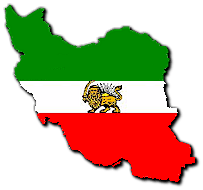


 اخبار مربوط به زندانیان سیاسی و نقض حقوق بشر


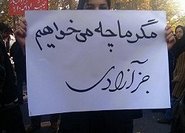


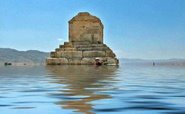



 Tulips in Holland