

Bikhabaran! - By Qoldor
Ahmadi Kharee was entertained in Baghdad! - MOLLA PARTY 2008 BY QOLDOR
کلیپ خیابان خوابها اثر علیرضا عصار
The Homeless: A persian videoclip about poverty and injustice in Islamic Regim of Iran.The song by: Alireza Assar
IMPERIAL EMBLEM

PERSIA
Iranian Freedom Fighters UNITE
Showing posts with label Baghdad. Show all posts
Showing posts with label Baghdad. Show all posts
Tuesday, March 04, 2008
Saturday, December 22, 2007
U.S. Soldiers Stage Mutiny, Refuse Orders in Iraq Fearing They Would Commit Massacre in Revenge for IED Attack
We speak with a reporter from the Army Times who gives an inside account of how an army unit committed mutiny and refused to carry out orders in Iraq. After an IED attack killed five more members of Charlie 1-26, members of 2nd Platoon gathered for a meeting and determined they could no longer function professionally. Several platoon members were afraid their anger could set loose a massacre.
By : Kelly Kennedy, medical reporter for Army Times. She is the author of the new four-part series Blood Brothers. 21 / 12 / 2007
Email to a friend
LISTENWATCH
Real Video Stream
Real Audio Stream
MP3 Download
More...
Related Links : Blood Brothers - Read the four-part series
JUAN GONZALEZ: In what has been described as one of the most remarkable stories of the entire Iraq war, a reporter from the Army Times has given perhaps the first inside account of how an Army unit committed mutiny and refused to carry out orders in Iraq.The incident occurred in Adhamiya, a district in northeastern Baghdad, where soldiers in the 2nd Platoon, Charlie Company, were stationed. The 2nd Platoon had lost many men since deploying to Iraq eleven months before. After an IED attack killed five more members of Charlie 1-26, members of 2nd Platoon gathered for a meeting and determined they could no longer function professionally. Several platoon members were afraid their anger could set loose a massacre. They decided to stage a revolt against their commanders that they viewed as a life-or-death act of defiance. READ THE FULL STORY HERE : http://tinyurl.com/yvh9y2
John Berlin: Why the Bush Turnaround on Iran ?
2007-12-22 So now the US’ official point of view is that Iran has not been striving for a nuclear arsenal over the past four years. That’s quite a break from the Administration’s established creed. After a long time of heated rhetoric from Mr Bush, even making intimations of war over the past months, suddenly the official position is that the possible nuclear threat from Iran is far, far less than expected. Has the US intelligence community, in its most recent National Intelligence Estimate , suddenly regained some of its objectivity? Or is the Bush Administration suddenly striving for better relations with Iran?
READ THE FULL ARTICLE HERE : http://www.unobserver.com/layout5.php?id=4205&blz=1
LATEST NEWS 24 Th Dec 2007
One moment, US President George W Bush was warning of the danger of World War III because of Iran's nuclear programme. In the next, peace was breaking out. It's been a strange year for Iran. By Jon Leyne Read the Article
http://iranvajahan.net/cgi-bin/news.pl?l=en&y=2007&m=12&d=24&a=2
Posted 24/12/2007 @ 11:48:23 GMTThe European View on Iran: Fallout from the New U.S. Intelligence EstimateOn December 13, 2007, Neil Crompton, Hans-Peter Hinrichsen, and Nicholas Roche addressed a Policy Forum at The Washington Institute. Mr. Crompton is a political counselor at the British embassy who served until recently as Iran coordinator and head of the Iraq Policy Unit at the British Foreign Office. Dr. Hinrichsen, first secretary for political affairs at the German embassy, has long worked on non-proliferation issues. Mr. Roche is a counselor at the French embassy who has focused extensively on the Iranian nonproliferation file. The following is a rapporteur's summary of their remarks. more By The Washington Institute for Near East Policy
Posted 24/12/2007 @ 11:42:23 GMTThe Clock Ticks: Sanction Iran Now The latest U.S. National Intelligence Estimate (NIE) on Iran's nuclear intentions and capabilities has been the subject of much analysis, most of which has been off point. The new estimate opens with the startling judgment that Tehran halted its nuclear weapons program in the fall of 2003, which has led some to conclude sanctions are no longer necessary. They are. Indeed, the estimate's more significant conclusion is that the most likely tool to successfully alter Iran's nuclear calculus is targeted political and economic pressure, not military action. more By Financial Times Deutschland
Posted 24/12/2007 @ 11:39:55 GMTAmbassador Skeptical of Iran's Plan for IraqBAGHDAD -- The U.S. ambassador expressed wariness Sunday about Iranian intentions in Iraq, saying that even if Iran-backed militias had decreased activities here, he was not yet convinced the Islamic state was committed to helping stabilize Iraq. more By Los Angeles Times
Posted 24/12/2007 @ 10:51:16 GMTThe Ayatollah Khomeini LegacyOver the last few months the Iranian political system has raged over the publication of a series of memoirs by Ali Akbar Hashemi Rafsanjani, Iran's former president, who currently serves as chairman of the regime's Assembly of Experts and of the Expediency Council of Iran. more By The Jerusalem Post
Posted 24/12/2007 @ 11:24:23 GMTAppeasement Yesterday and Appeasement TodayUntil a few days ago, Iran's nuclear ambitions appeared destined to become the hottest issue in the current American presidential campaign. A consensus, cutting across partisan divides, appeared to be taking shape that the Islamic Republic should be confronted forcefully, contained, and in time, forced to scale down its ambitions. more By Asharq Alawsat
Posted 24/12/2007 @ 10:48:25 GMTWhy Not Engage Iranian Pragmatists?BERLIN -- The recent comprehensive assessment by America's spy agencies about Iran's nuclear program and ambitions — the "National Intelligence Estimate" — has opened the door to fresh strategic discussions among the five permanent members of the United Nations Security Council and Germany. Such a strategic reconsideration is probably most necessary for those in the Bush administration (and a few elsewhere), who until recently have been prophets of imminent danger. more By The Japan Times
Posted 24/12/2007 @ 10:26:16 GMTIran to Seek Bids for 19 Atomic Power PlantsTEHRAN -- Iran will soon announce an international tender for building 19 nuclear power plants, an MP was quoted as saying, a week after Russia said it had begun fuel deliveries to the Islamic state's first such facility. more By Reuters
Thursday, July 12, 2007
How Iran paid money to the Shea insurgents in Iraq
$282 Million Stolen in Heist at Private Bank in Baghdad : By ALISSA J. RUBIN
BAGHDAD, July 11 — In an astonishing heist, guards at a bank here made off with more than a quarter-billion dollars on Wednesday, according to an official at the Interior Ministry. The robbery, of $282 million from the Dar Es Salaam bank, a private financial institution, raised more questions than it answered, and officials were tight-lipped about the crime. The local police said two guards engineered the robbery, but an official at the Interior Ministry said three guards were involved. Both confirmed that the stolen money was in American dollars, not Iraqi dinars. It was unclear why the bank had that much money on hand in dollars, or how the robbers managed to move such a large amount without being detected. Several officials speculated that the robbers had connections to the militias, because it would be difficult for them to move without being searched through many checkpoints in Baghdad.
Otherwise on Wednesday, there was only scattered violence in the city, although 18 bodies were found by the police in different neighborhoods, signaling that sectarian killing had not ebbed.
In a village just north of Falluja, however, extremists in two vehicles, possibly in an act of revenge, forced the residents of a house inside, locked the doors and blew up the building. Eleven people died, according to a report by United States marines who operate in the area. The house is owned by a member of the local provincial security forces, which are fighting Al Qaeda in Mesopotamia, a homegrown Sunni Arab insurgent group that includes some foreigners.
In Mosul, an American helicopter returned fire after being shot at, but hit civilians, according to Brig. Gen. Abd al-Kareem Khalaf Juboori of the Mosul police. Two people were killed and 14 wounded, including two children. The killing continued in Diyala Province, where American operations are under way to try to reduce the influence of Al Qaeda in Mesopotamia. Three bodies were found with signs of torture near the town of Khalis; an army checkpoint was attacked with mortars; a local police station was attacked; and a roadside bomb killed an Iraqi Army soldier and wounded four others in Khan Beni Sa’ad, about 50 miles from Baghdad.
Iraqi solders at a checkpoint near the Syrian border seized a truck carrying 200 suicide vests. While the vests had not yet been loaded with explosives, a car filled with explosives was found nearby. The police suspect that the two were traveling together, said Maj. Gen. Abdul Kareem Khalaf, an official at the checkpoint. The government announced several measures to help repair the damage from the enormous truck bomb earlier this week in Amirli in northern Diyala Province. Families who lost one or more relatives will receive a payout of $2,400, and families that had a relative wounded will be awarded $800, said Abbas al-Bayati, a member of Parliament designated by Prime Minister Nuri Kamal al-Maliki to oversee the area’s reconstruction. Mr. Maliki also allocated $10 million to rebuild the remote village. The Ministry of Trade announced it had begun a coordinated effort with the Defense and Interior Ministries to ship food to areas that insurgents had cut off, and was making Amirli a special priority, along with Rutba in western Iraq and Tal Afar in the north near Mosul. The German Foreign Ministry announced the release of Hannelore Krause, who had been held hostage for 155 days by Iraqi insurgents calling themselves the Arrows of Righteousness. But her son, who is 20, was still being held, and in an interview on the Arabiya satellite television network she asked the German government to comply with the kidnappers’ demands that her country withdraw their troops from Afghanistan. “If they do not withdraw, they will slaughter my son,” she said.
Meanwhile, the United States Committee for Refugees and Immigrants said Wednesday that the number of refugees worldwide increased by almost two million in 2006, pushing the total to nearly 14 million, the highest level since 2001, The Associated Press reported. Iraqis accounted for more than a third of the increase.The committee, a nongovernmental group in Washington, said that of the 790,000 people who left Iraq last year, 449,000 went to Syria and 250,000 to Jordan. About 80,000 went to Egypt and 202 to the United States.
Cleric Flees After Death Threats
BAGHDAD, July 11 (AP) — An Anglican vicar who may have received a cryptic warning about the recent failed car bombings in London and Glasgow has fled Iraq after threats against his life, an associate said Wednesday. The vicar, Canon Andrew White, a Briton who ran Iraq’s only Anglican church, left Tuesday and returned to Britain, the associate said on condition of anonymity, saying the British Foreign Office had asked that it be the only source of information on the case.The associate refused to elaborate on the threats. But the BBC Web site said pamphlets dropped in Shiite areas of Baghdad said Canon White was “no more than a spy.”
Canon White had been working to secure the release of five British hostages who were seized at the Iraqi Finance Ministry on May 29 by gunmen wearing police uniforms. On July 4, he told The Associated Press that he had met a man in Amman, Jordan, in April who was identified by religious leaders as a leader of Al Qaeda. The man told him, “Those who cure you will kill you.” Canon White said in retrospect that it might have been a warning of the plot to blow up car bombs in London and Glasgow. All the suspects worked in the medical professions. Canon White had been visiting Iraq regularly since 1998 and remained here after the American invasion in 2003, holding services inside the Green Zone.
Wednesday, May 23, 2007
Body of missing U.S. soldier found in Iraq river - police
HILLA, Iraq (Reuters) - The half-naked body of one of three missing U.S. soldiers was found on Wednesday in the Euphrates River in the town of Mussayab south of Baghdad, police said.The U.S. military said it was investigating reports that a body had been found in a canal in the area.Hilla police spokesman Captain Muthanna al-Maamouri said there were bullet wounds to the torso and head of the body, which was wearing U.S. Army-issue pants and boots and had a tattoo on the left arm.Maamouri said the body had been turned over to U.S. forces.Thousands of U.S. and Iraqi troops have been scouring farmlands through an area south of Baghdad known as the "Triangle of Death" since an ambush on May 12 in which four U.S soldiers and an Iraqi interpreter were killed.Three soldiers were reported missing after the attack. The al Qaeda-led Islamic State in Iraq has said it abducted them but has given no proof that they are still alive.A police officer in Mussayab, 60 km south of Baghdad, who declined to be named, said the body had been found after a tip-off from residents.A river patrol police officer in Mussayab who said he helped recover the body said the man appeared to have been killed about a week ago. His head showed signs of torture.General David Petraeus, the commander of U.S. forces in Iraq, said last Friday he believed at least two of the three missing soldiers were still alive.
Wednesday, May 02, 2007
New US Brigade Arrives in Baghdad to Bolster Security
The U.S. military says another group of 3700 American troops has arrived in the Iraqi capital, joining U.S. combat units deployed in the city to support the security crackdown launched in mid-February. A military statement Wednesday, said the new brigade, from the northwestern U.S. state of Washington, will help Iraqi security forces clear, control and retain key areas of Baghdad in order to reduce violence. This is the fourth additional combat unit being deployed in Baghdad as part of plans to add some 2800 troops there. Separately, the military said coalition forces detained 12 terrorist suspects during overnight raids in Baghdad and the western Al Anbar province. In other news, Iraqi police say at least eight people were killed when a bomb exploded inside the bus they were riding near the city of Hilla, south of Baghdad. On Tuesday, U.S. and Iraqi officials said they were trying to confirm reports that al-Qaida in Iraq leader Abu Ayyub al-Masri was killed in a clash among members of his insurgent group. An Iraqi Interior Ministry spokesman, Brig. Gen. Abdul Kareem Khalaf, said intelligence reports indicate Masri was killed in fighting north of Baghdad. But an al-Qaida-linked militant group in Iraq, The Islamic State of Iraq, says Masri has not been killed. Masri, an Egyptian, assumed the leadership of the terrorist group after Jordanian militant Abu Musab al-Zarqawi was killed in a U.S. airstrike in June 2006.
Saturday, April 28, 2007
U.S. forces destroy truck bomb in Iraq : By HAMID AHMED, Associated Press Writer
U.S. forces used fighter jets to destroy a truck bomb discovered in Anbar province, and conducted a raid south of Baghdad that netted weapons that insurgents apparently had imported from neighboring Iran, the military said Saturday. But deadly attacks by suspected insurgents continued in the capital, with a drive-by shooting killing four Iraqis, a mortar attack killing three children, and a roadside bomb killing a city street cleaner, police said. The truck loaded with explosives was found early Friday near Fallujah, a city in Anbar province, when Marines were tipped off about it by a suspected insurgent they detained during a routine combat operation in the area, the military said. Loaded with eight large barrels of an unidentified liquid, the truck contained hidden detonation wire and explosives, the statement said. After cordoning off the area and evacuating nearby citizens, the Marines called in U.S. fighter jets that destroyed the truck, causing an explosion large enough to damage some nearby buildings, the military said.
No civilian or coalition injuries were reported.
In Mahmoudiya, about 20 miles south of Baghdad, U.S. and Iraqi forces detained eight suspected insurgents and confiscated three caches of weapons during a raid on an apartment complex on April 22, including mortars, rockets and ammunition. The weapons appeared to be new and "were stamped with recent dates and Iranian markings," the military said. The United States has frequently accused Iran of allowing insurgents to enter this country carrying weapons such as roadside bombs used to attack U.S. and Iraqi convoys. Saturday's deadliest attack in Baghdad occurred when gunmen opened fire on a vehicle driving in a Sunni-Shiite neighborhood, killing four of the seven people aboard, police said. A police officer identified one of the fatalities as an employee of the Iraq Red Crescent Society, but the relief agency said it could not immediately confirm that. The gunmen traveling in two cars began their 7 a.m. attack in Baiyaa, western Baghdad, by blocking a road to stop the SUV carrying the seven people, then opened fire on it, the police officer said on condition of anonymity because he was not authorized to talk to the media. He said the victims apparently were heading to neighboring Syria. At about 11:20 a.m., two mortar shells hit another residential area in western Baghdad, killing three Iraqi children between the ages of five and seven, and wounding 10 Iraqis, including seven adults and three children, police said. Elsewhere, a roadside bomb exploded Saturday morning near city street cleaners working in Zafaraniyah, a mostly Shiite area of eastern Baghdad, killing one of them and wounding eight, police said.
Wednesday, March 21, 2007
U.S. Destroys Bomb Factory in Iraq , By THE ASSOCIATED PRESS
Filed at 10:59 a.m. ET
BAGHDAD (AP) -- U.S. troops killed five insurgents and destroyed a bomb-making factory Wednesday north of Baghdad, and dozens more were detained after fierce clashes in a Sunni-dominated province west of the capital. Scattered violence killed at least nine people, while a claim by the U.S. military that insurgents used children in a weekend suicide attack raised concerns about new tactics being adopted by insurgents as a security crackdown aimed at stopping sectarian violence enters its sixth week. Iraq's Sunni Vice President Tariq al-Hashemi, meanwhile, renewed calls for talks to be opened with insurgents in an attempt to bring peace, but he excluded al-Qaida in Iraq. ''I do believe that there is no way but to talk to everybody,'' he told the British Broadcasting Corp. Apart from al-Qaida, which he said was ''not very much willing in fact to talk to anybody,'' all parties ''should be invited, should be called to sit down around the table to discuss their fears, their reservations.'' Maj. Gen. Michael Barbero, deputy director for regional operations on the Joint Staff, said Tuesday that a vehicle used in the attack was waved through a U.S. military checkpoint because two children were visible in the back seat. He said this was the first reported use of children in a suicide car bombing in Baghdad.
''Children in the back seat lowered suspicion, (so) we let it move through, they parked the vehicle, the adults run out and detonate it with the children in the back,'' Barbero told reporters in Washington. ''The brutality and ruthless nature of this enemy hasn't changed.'' Other U.S. officials said later that three Iraqi bystanders were killed in the attack near a marketplace in the northern Baghdad neighborhood of Azamiyah, in addition to the two children, and seven people were injured. The officials had no other details, including the estimated ages of the children.
Lt. Col. Christopher Garver, a U.S. military spokesman in Baghdad, confirmed Barbero's account but said he couldn't provide more details. An Iraqi police officer, speaking on condition of anonymity because of security concern, said witnesses had reported seeing two children inside the car before it exploded. He said eight civilians were killed and 28 others wounded in the attack in the predominantly Shiite northern neighborhood of Shaab. The police officer also said three other cases had been registered since last year in which women and children were used in parked car bombings, although they reportedly got out of the cars before the explosions in those cases. The U.S. military has warned that insurgents are proving adaptable and finding new ways to bypass stepped up security measures and kill as many people as possible. A series of bombings using toxic chlorine since Jan. 28 also raised concerns. U.S. forces killed five suspected insurgents, detained three others and used an airstrike to destroy a bomb-making factory that contained large-caliber ammunition and several 50-gallon barrels of explosive material near Taji, an air base 12 miles north of Baghdad, the military said in a statement. No American troops or civilians were injured during the operation, it added. A Sadrist lawmaker, Bahaa al-Araji, also said U.S. troops raided his office Wednesday, seizing the memory card from his computer along with a gun and a rifle. The U.S. military had no immediate comment. Al-Araji, one of 30 members of parliament loyal to radical Shiite cleric Muqtada al-Sadr, called the raid a violation of Iraq's sovereignty. ''It is a message of provocation sent to the al-Sadr movement,'' he told The Associated Press in a telephone interview. ''We will not be drawn into this confrontation.''''We are with the security plan, but we think that the searches should be done by Iraqi forces,'' he added. Al-Sadr, who the military claims has gone to Iran, was said to have ordered his Mahdi Army militia to put away its weapons and not confront U.S. and Iraqi troops during a U.S.-Iraqi security sweep aimed at stopping the sectarian violence in Baghdad. The success in reining in al-Sadr's Mahdi Army militia, which fought fiercely against U.S. forces in 2004, is widely credited with the drop in execution-style killings, random shootings and rocket attacks during the five-week-old operation, but there have been indications that some factions are unhappy with being sidelined. West of Baghdad, U.S.-Iraqi troops backed by American warplanes battled al-Qaida-linked insurgents for more than five hours Tuesday in clashes in Amiriyah, near Fallujah, that left eight killed and five Iraqi policemen wounded, the military said. Iraqi police also detained 45 insurgents, confiscated propaganda material and discovered several weapons caches in house-to-house searches Tuesday in the Anbar provincial capital of Ramadi, the military said in a separate statement. A roadside bomb planted during the 10-hour operation killed one civilian and wounded five, it said. In other violence Wednesday, according to police: -- A mortar attack struck a residential area in Madain, about 14 miles southeast of Baghdad, killing three civilians and wounding 10. -- Roadside bombs targeting police patrols in eastern Baghdad, killing three people and wounded two others. -- One civilian was killed and seven were wounded when Iraqi police detonated a truck full of explosives after spotting it parked about near the Finance Ministry building in northern Baghdad. -- The bodies of two policemen, handcuffed and showing signs of torture, were found in Diwaniyah, the site of recent clashes 80 miles south of Baghdad.
Animals at work ! How can anyone still ask the Americans to leave Iraq before these animals are dealt with? By KIRK SEMPLE
BAGHDAD, March 20 — Insurgents detonated a bomb in a car with two children in it after using the children as decoys to get through a military checkpoint in Baghdad, an American general said Tuesday. Speaking at a news briefing at the Pentagon, Maj. Gen. Michael Barbaro, deputy director for regional operations at the Joint Staff, said American soldiers had stopped the car at the checkpoint but had allowed it to pass after seeing the two children in the back seat. Children in the back seat lower suspicion,” he said, according to a transcript. “We let it move through. They parked the vehicle. The adults run out and detonate it with the children in back.” General Barbaro offered no further details. Lt. Col. Christopher Garver, a top American military spokesman in Baghdad, said late Tuesday that his office had no record of the bombing but that it was researching it. “I don’t know what event he’s talking about,” Colonel Garver said. Agence France-Presse, quoting an unidentified American military official, said the incident occurred Sunday.

The bombers parked the vehicle across the street from a school then ran away, leaving the children inside, the official told the news agency. The blast killed the children and three other civilians and wounded seven, the official said. The American command on Tuesday gave its account of a disputed raid on a Shiite mosque in Baghdad late Monday that infuriated many in the Shiite community and led some to question their cooperation with the latest American-led security plan. According to an American military statement, Iraqi soldiers stormed the mosque, in the mostly Shiite neighborhood of Kadhimiya in northwestern Baghdad, in search of suspected militants. About 50 people were temporarily detained during the raid, but nobody was arrested and no bomb-making materials were discovered, military officials said. Contrary to claims made by neighbors and Shiite community leaders, the American command said its soldiers had remained outside the building during the entire operation. Past American raids of mosques have provoked bitterness among Muslims here, who resent having their sacred spaces dragged into the war. After the raid, the joint American-Iraqi force came under attack by about 20 gunmen firing rocket-propelled grenades and small arms, according to the military statement. The Americans returned fire, the statement said, killing three people it described as insurgents. Shiite community leaders and residents in the neighborhood of the raid gave a significantly different account. They said American forces had stormed not one but two mosques, both linked to Moktada al-Sadr, the anti-American Shiite cleric. As the soldiers entered one of the mosques they opened fire on worshipers who tried to flee, said Salah Abdul Qadir, the spokesman for the Shiite Endowment, a government organization that supervises all Shiite mosques in Iraq. Mr. Sadr, who commands a powerful and often unruly militia, has instructed his fighters not to resist the latest security plan. At the same time, he has publicly denounced the expanded American presence in Baghdad and demanded that American troops stay out of the neighborhoods he controls. The reaction to the raid among much of the elected Shiite leadership was muted, suggesting either that the American account held up in their view or that they were not willing to create a stir that could risk imperiling the new American-Iraqi security plan. Fierce clashes on Tuesday near Falluja, pitting Sunni Arab tribal fighters and the Iraqi police on one side and insurgents from Al Qaeda in Mesopotamia on the other, killed 32 insurgents, 10 tribesmen and 8 police officers, according to officials in the Falluja police department. The fighting, in the contested area of Amiriya near Falluja, involved members of the Anbar Salvation Council, a federation of tribes that banded together last September to resist the Sunni jihadists of Al Qaeda in Mesopotamia. Hamid al-Eesouwi, the leader of one of the tribes, said in a telephone interview that the tribal federation decided to carry out its assault on the insurgents after suicide truck bombers struck in tribal territory south of Falluja on Friday using vehicles laden with chlorine gas and explosives. A concealed bomb exploded next to an American patrol near the Jadriya Bridge in Baghdad on Tuesday, killing one American soldier, an official at the Interior Ministry said. Three car bombs in the capital — near a mosque in the Obaydie neighborhood, in an industrial area of Sheik Omar Street and near the 14th of July Bridge, leading to the Green Zone — killed at least eight people and wounded at least 28, the ministry official said. Mortar shells landed in the Dora neighborhood of southern Baghdad, killing at least six people and wounding 15, the official said, and 32 bodies were found in various locations around Baghdad. Gunmen assassinated Capt. Hussain Abdullah, an officer in the intelligence service of the Interior Ministry, the official said. The body of Taha Yassin Ramadan, Saddam Hussein’s vice president, who was hanged before dawn on Tuesday, was flown by American helicopter to an American military base outside Tikrit. Mr. Ramadan’s body, wrapped in an Iraqi flag, was buried in the village of Awja near a marble tomb where Mr. Hussein’s body was interred after he was hanged in December. Last week the bodies of Mr. Hussein’s sons, Uday and Qusay, were unearthed and reburied outside the tomb.
The Battle for Baghdad
Daily reports of violence and American and Iraqi military operations.
Saturday, March 17, 2007
Chlorine Gas Used In Anbar Attacks
(CBS/AP) Multiple suicide bombings struck the Sunni insurgent stronghold of Anbar province, and about 350 Iraqi civilians and six U.S. troops were treated for exposure to chlorine gas, the military said Saturday. At least two policemen also were killed in the attacks. The violence started Friday afternoon when a driver detonated the explosives in a pickup truck northeast of Ramadi, wounding one U.S. service member and one Iraqi civilian, the military said in a statement. That was followed by a similar explosion involving a dump truck south of Fallujah in Amiriyah that killed six people including two policemen, and left as many as 100 residents showing signs of chlorine exposure, with symptoms ranging from minor skin and lung irritations to vomiting, the military said. Another suicide bomber detonated a dump truck containing a 200-gallon chlorine tank rigged with explosives Friday evening, also south of Fallujah in the Albu Issa tribal region, the military said. U.S. forces responded to the attack and found about 250 local civilians, including seven children, suffering from symptoms related to chlorine exposure, according to the statement. Suicide car bombers have used chlorine against Iraqis in Anbar a total of five times since Jan. 28, it said. The U.S. military also said last month that they found a car bomb factory near Fallujah with about 65 propane tanks and ordinary chemicals it believed the insurgents were going to try to mix with explosives. In Other Developments:
The U.S. Army said yesterday that a 21-year-old soldier from Athens, Ga., died in Iraq of wounds when he suffered when an improvised explosive device detonated on Wednesday. Army Corporal Brian L. Chevalier was assigned to the Fifth Battalion, 20th Infantry Regiment, Third Brigade, Second Infantry Division, based in Fort Lewis, Wash. One policeman was killed and two others wounded when an explosion struck their patrol in central Hillah, a predominantly Shiite city about 60 miles south of Baghdad, local authorities said. A roadside bomb also hit a patrol in Mosul, 225 miles northwest of Baghdad, killing a policeman and wounding another, according to police in the city. The Times of London has reported that the Iraqi judge who sentenced Saddam Hussein to death has applied for asylum in Britain. Raouf Abdel-Rahman, a Kurdish judge who took over the tribunal hearings of the deposed Iraqi dictator, is believed to have traveled to England with his family shortly before Hussein was executed, and is seeking to stay, fearing for his life should he return. Dashty Jamal, of the International Federation of Iraqi Refugees, told the Times: "The fleeing of Judge Rauf to the U.K. has proved that the Iraqi Government is unable to protect anyone in Iraq and is not representing the Iraqi people." Hundreds of anti-war protesters marched through Australia's major cities on Saturday calling for the immediate withdrawal of Australian troops from Iraq and Afghanistan. Organisers of the rally said it was part of an international day of protest to mark the fourth anniversary of the invasion of Iraq by U.S.-led forces on March 19.
The U.S. Army said yesterday that a 21-year-old soldier from Athens, Ga., died in Iraq of wounds when he suffered when an improvised explosive device detonated on Wednesday. Army Corporal Brian L. Chevalier was assigned to the Fifth Battalion, 20th Infantry Regiment, Third Brigade, Second Infantry Division, based in Fort Lewis, Wash. One policeman was killed and two others wounded when an explosion struck their patrol in central Hillah, a predominantly Shiite city about 60 miles south of Baghdad, local authorities said. A roadside bomb also hit a patrol in Mosul, 225 miles northwest of Baghdad, killing a policeman and wounding another, according to police in the city. The Times of London has reported that the Iraqi judge who sentenced Saddam Hussein to death has applied for asylum in Britain. Raouf Abdel-Rahman, a Kurdish judge who took over the tribunal hearings of the deposed Iraqi dictator, is believed to have traveled to England with his family shortly before Hussein was executed, and is seeking to stay, fearing for his life should he return. Dashty Jamal, of the International Federation of Iraqi Refugees, told the Times: "The fleeing of Judge Rauf to the U.K. has proved that the Iraqi Government is unable to protect anyone in Iraq and is not representing the Iraqi people." Hundreds of anti-war protesters marched through Australia's major cities on Saturday calling for the immediate withdrawal of Australian troops from Iraq and Afghanistan. Organisers of the rally said it was part of an international day of protest to mark the fourth anniversary of the invasion of Iraq by U.S.-led forces on March 19.
Sunday, March 11, 2007
Additional Troop Increase Approved
President Agrees To Send 8,200 More To Iraq, Afghanistan
By Peter BakerWashington Post Staff WriterSunday, March 11, 2007; A01
ANCHORENA PARK, Uruguay, March 10 -- President Bush approved 8,200 more U.S. troops for Iraq and Afghanistan on top of reinforcements already ordered to those two countries, the White House said Saturday, a move that comes amid a fiery debate in Washington over the Iraq war.The president agreed to send 4,700 troops to Iraq in addition to the 21,500 he ordered to go in January, mainly to provide support for those combat forces and to handle more anticipated Iraqi prisoners. He also decided to send a 3,500-member brigade to Afghanistan to accelerate training of local forces, doubling his previous troop increase to fight a resurgent Taliban. Although officials had foreshadowed the additional forces for Iraq in recent days, the latest troop increase in Afghanistan had not been known and will bring U.S. forces there to an all-time high. The deployments underscore the challenges facing the United States in both countries and further stretch an already strained military. In Iraq particularly, the moves could fuel suspicions that a troop increase initially described as a temporary "surge" may grow larger and last longer than predicted.Bush did not comment on his decision during the second day of a six-day Latin America tour. But aides released a letter he signed Friday night aboard Air Force One as he flew to Uruguay from Brazil, asking House Speaker Nancy Pelosi (D-Calif.) for $3.2 billion in emergency funding to pay for the additional units. He proposed cuts in other spending to offset the cost."This revised request would better align resources based on the assessment of military commanders to achieve the goal of establishing Iraq and Afghanistan as democratic and secure nations that are free of terrorism," Bush said in the letter.The president's decision came as congressional Democrats are struggling to find a way to reverse direction in Iraq. Bush aides said this week that the president would veto a House Democratic spending plan that would require him to certify that the Iraqi government has met certain benchmarks by certain dates to keep U.S. forces in the country. The plan would require, under any circumstance, that troop withdrawals begin March 1, 2008, and that remaining troops be out of combat roles by Aug. 31, 2008.Pelosi blasted Bush on Saturday. "With his veto threat," she said, "the president offers only an open-ended commitment to a war without end that dangerously ignores the repeated warnings of military leaders, including the commander in Iraq, General [David H.] Petraeus, who declared in Baghdad this week that the conflict cannot be resolved militarily."The attention to Iraq and Afghanistan came as Bush tried to focus on restoring ties with Latin America. He flew by helicopter to a scenic, woodsy waterfront ranch here to have lunch and talk trade with Uruguayan President Tabare Vazquez. After sampling Uruguayan barbecue, the president headed out on a boat excursion with Vazquez. Despite days of protests around the region, Bush was largely spared any signs of hostility other than large hand-painted graffiti facing his hotel in the capital, Montevideo, that said: "Get Out Bush the Murderer."The $3.2 billion that Bush requested in his letter to Pelosi would pay for 2,400 combat support troops, 2,200 military police officers and 129 soldiers to man provincial reconstruction teams in Iraq. It would also fund additional military equipment and efforts to reopen Iraqi state factories.
For Afghanistan, it would fund Bush's decision announced last month to extend a temporary increase of 3,200 U.S. troops there "for the foreseeable future." It would also pay for an additional 3,500-member training brigade, a move that was not previously announced.
"This is part of the effort to speed up the training and expand the size of the Afghan forces, an effort the president talked about in his Afghan/GWOT speech in February," said National Security Council spokesman Gordon Johndroe, using an acronym for "global war on terror." "This request for an additional brigade for training executes that policy announcement."Officials have signaled that even more forces may yet be dispatched to Iraq. Deputy Defense Secretary Gordon England told lawmakers this week that as many as 7,000 additional support troops may be sent. And the commander for northern Iraq said he needs more troops to quell sectarian violence.Petraeus seems inclined to extend the mission beyond the six-month time frame envisioned by his predecessor, Gen. George W. Casey Jr. Casey and other officials had said they hoped to see results from the troop increase by August, when more brigades could begin to withdraw. But Petraeus said this week that he thinks it will "need to be sustained, certainly for some time well beyond the summer."
Saturday, March 10, 2007
Who is winning the Iraqi intelligence war?
Watch this video
Who is winning the Iraqi intelligence war? (4:28)
And this : http://edition.cnn.com/video/player/player.html?url=/video/world/2007/03/07/ware.losing.intel.war.iraq.ap
BAGHDAD, Iraq (CNN) -- The top U.S. envoy to Baghdad Saturday called on Iraq's neighbors to do more to halt bloodshed in the violence-ravaged country at ground breaking peace talks that united estranged American and Iranian diplomats for the first time in decades.
Zalmay Khalilzad told delegates -- including Arab nations and U.N. Security Council members -- the fate of their own nations depended on the stabilization of Iraq, echoing earlier comments by Iraqi Prime Minister Nuri al-Maliki, who warned carnage could spill across the region.
Underlining the problems still facing the country, a suicide car bomb exploded Saturday near the Baghdad militant Shiite stronghold of Sadr City, killing 20 and wounding at least 45. Two mortars also struck the Green Zone, Baghdad's fortified diplomatic compound, close to the Foreign Ministry venue of the peace talks. At the one-day conference, held to lay the groundwork for a top level meeting slated for April, Khalilzad said Iraq deserves support from its friends and neighbors to resolve its problems."No country represented at the table would benefit from a disintegrated Iraq; indeed, all would suffer badly," Khalilzad said.
Iraqi Prime Minister Nuri al-Maliki warned against the use of his nation as a proxy arena for settling global disputes. "We do not want Iraq and its lands, its streets and its cities to be the battleground to settle regional or international disputes," al-Maliki said. "We call for peaceful dialogue to settle disputes, including international, regional and inter-regional issues," al-Maliki said. The prime minister added that his government "will not interfere in the affairs of other countries nor will it use its land as a base to attack others, at the same time we are waiting for others to adapt the same position." He challenged all attending to adopt a "strong and clear stance against terrorism in Iraq" and cooperate in efforts to "stamp out the forces of terror."
Saturday's one-day conference was also seen as an ice breaker for the United States and Iran, who may use the event to bridge nearly 28-years of diplomatic estrangement.
The chief U.S. delegate, David Satterfield, said Thursday that "we are not going to turn and walk away" if approached by Iran or Syria to discuss Iraq, AP reported.

But Satterfield, the top State Department adviser on Iraq, added that the United States plans to use the meeting to reinforce its accusations against both nations. They include U.S. claims that Syria allows foreign jihadists and Sunni insurgents to cross its border into Iraq, and that weapon shipments from Iran reach Shiite militias. Both nations deny the allegations, AP said. Iran's chief envoy, Abbas Araghchi has said Iran "hopes to take more steps" to support the U.S.-backed government in Iraq -- which is led by a Shiite prime minister with close ties to Shiite heavyweight Iran.
Iran, however, has strongly denounced the U.S. military presence. The complaints grew more pointed in December after American forces detained two Iranian security agents at the compound of a major Shiite political bloc in Baghdad.
Who is winning the Iraqi intelligence war? (4:28)
And this : http://edition.cnn.com/video/player/player.html?url=/video/world/2007/03/07/ware.losing.intel.war.iraq.ap
BAGHDAD, Iraq (CNN) -- The top U.S. envoy to Baghdad Saturday called on Iraq's neighbors to do more to halt bloodshed in the violence-ravaged country at ground breaking peace talks that united estranged American and Iranian diplomats for the first time in decades.
Zalmay Khalilzad told delegates -- including Arab nations and U.N. Security Council members -- the fate of their own nations depended on the stabilization of Iraq, echoing earlier comments by Iraqi Prime Minister Nuri al-Maliki, who warned carnage could spill across the region.
Underlining the problems still facing the country, a suicide car bomb exploded Saturday near the Baghdad militant Shiite stronghold of Sadr City, killing 20 and wounding at least 45. Two mortars also struck the Green Zone, Baghdad's fortified diplomatic compound, close to the Foreign Ministry venue of the peace talks. At the one-day conference, held to lay the groundwork for a top level meeting slated for April, Khalilzad said Iraq deserves support from its friends and neighbors to resolve its problems."No country represented at the table would benefit from a disintegrated Iraq; indeed, all would suffer badly," Khalilzad said.
Iraqi Prime Minister Nuri al-Maliki warned against the use of his nation as a proxy arena for settling global disputes. "We do not want Iraq and its lands, its streets and its cities to be the battleground to settle regional or international disputes," al-Maliki said. "We call for peaceful dialogue to settle disputes, including international, regional and inter-regional issues," al-Maliki said. The prime minister added that his government "will not interfere in the affairs of other countries nor will it use its land as a base to attack others, at the same time we are waiting for others to adapt the same position." He challenged all attending to adopt a "strong and clear stance against terrorism in Iraq" and cooperate in efforts to "stamp out the forces of terror."
Saturday's one-day conference was also seen as an ice breaker for the United States and Iran, who may use the event to bridge nearly 28-years of diplomatic estrangement.
The chief U.S. delegate, David Satterfield, said Thursday that "we are not going to turn and walk away" if approached by Iran or Syria to discuss Iraq, AP reported.
But Satterfield, the top State Department adviser on Iraq, added that the United States plans to use the meeting to reinforce its accusations against both nations. They include U.S. claims that Syria allows foreign jihadists and Sunni insurgents to cross its border into Iraq, and that weapon shipments from Iran reach Shiite militias. Both nations deny the allegations, AP said. Iran's chief envoy, Abbas Araghchi has said Iran "hopes to take more steps" to support the U.S.-backed government in Iraq -- which is led by a Shiite prime minister with close ties to Shiite heavyweight Iran.
Iran, however, has strongly denounced the U.S. military presence. The complaints grew more pointed in December after American forces detained two Iranian security agents at the compound of a major Shiite political bloc in Baghdad.
Friday, March 09, 2007
Iraqis Seek Role in Rebuilding Their Nation , By DAMIEN CAVE
BAGHDAD, March 8 — When Rahim al-Daraji looks at the dusty lots just east of Sadr City where scores of bodies have been dumped in the past year, he sees a Ferris wheel, a roller coaster, coffee shops and restaurants. “We should have an amusement park,” said Mr. Daraji, one of two elected mayors in Sadr City, the sprawling Shiite neighborhood in Baghdad where American and Iraqi troops have been peacefully clearing homes since Sunday. “We want to rehabilitate the area so that families can have fun.”

In an interview at his office, Mr. Daraji said the amusement park was one of several projects that community leaders were pushing American officials to finance in negotiations about how to handle the Shiite Mahdi Army, a militia that has controlled the neighborhood for years. A concentrated makeover of Sadr City, he said, would support the plan’s goals in two important ways: by giving young Mahdi militants jobs as an alternative to lives of violence and by providing residents with proof of the government’s ability to improve their daily lives. Mr. Daraji’s requests, however, also reflect a broader effort by Iraqi leaders to dart past “clear and hold” to the more lucrative phase of the new security plan known as “build.” Even as bombings and killings here continue, Prime Minister Nuri Kamal al-Maliki has labeled the plan a success. His Shiite-led government has allotted $10 billion this year for reconstruction throughout the country, and, with billions more expected from the United States, Iraqi leaders at all levels are scrambling for a say in how the windfall might be spent. They are also pressing for veto power over contracts, blaming an unwieldy American system of subcontracting that was impossible to police for the loss or theft of billions in reconstruction dollars since the war began. Iraqi figures, political veterans and up and comers are seeking an advisory role. Ahmad Chalabi, for example, the political chameleon and advocate for the war, has re-emerged as an intermediary between Baghdad residents and the Iraqi and American security forces. At a freshly renovated compound in the Green Zone, Mr. Chalabi now regularly meets with leaders from all over Baghdad as they compete for roles in managing the expected infusion of projects and jobs. At a recent gathering, representatives from 15 neighborhoods in eastern Baghdad stood one after another to explain why they should be chosen to lead. For American officials, Sadr City’s calls for an amusement park, job training programs and other projects raise a particularly thorny question of trust. In 2004, American troops battled Mahdi militants here for days. More recently, United States military officials have accused the militia of using roadside bombs, possibly linked to Iran, that have killed at least 170 American service members. At the same time, the negotiations over the Mahdi militia, along with the arrest or flight of several commanders, appear to have led to a temporary truce. American soldiers were welcomed into people’s homes this week on streets where they once came under fire.

Gen. David H. Petraeus, at his first news conference as the top commander in Iraq, acknowledged Thursday that the Mahdi militia included a mix of violent extremists and people with more benign motivations. “The challenge,” he said, “has been to determine, how do you incorporate those who want to serve in a positive way — as neighborhood watches, let’s say, but unarmed — in our own communities, but without turning into something much more than that?”
Mr. Daraji emphasized that Sadr City as a whole “wants to open a new page in its story.” He said that Mahdi fighters had laid down their weapons to give the government a chance, and that the opportunity should not be missed. He said the prime minister’s office was already seizing the moment with an expanded job recruitment drive for neighborhood residents. As proof, Mr. Daraji — a chain-smoking tribal sheik partial to tailored suits — opened a door near his office and pointed to a pile of red, green and yellow folders that he said were job applications for every part of the government, from the Oil Ministry to the police. “We’ve collected more than 2,000 applications,” he said. “We’re classifying them according to whether people have college degrees, whether they are men or women.” He and other Baghdad government leaders said that the United States military would be smart to add hundreds of additional jobs in the neighborhood because it contained at least 1.5 million people, or about a third of the city, and had just begun to revive after decades of neglect. They said the neighborhood deserved to become a model of government effectiveness. “The plan is not only about security,” said Naeem al-Kabbi, Baghdad’s deputy mayor in charge of municipal services. “It’s about security, services and reconstruction.” Mr. Daraji said he had asked American officials for money to build small playgrounds, with tennis and volleyball courts, every few blocks — not unlike what can be found in planned communities like Levittown. He said he had pressed the Americans for money to rehabilitate a handful of lakes on the western edge of the neighborhood and for more control over the contracts so they could be assigned faster with less waste. “We need to engage people as soon as possible, get them working, make them busy,” he said. “These are quick projects. After these we will move on to medium and larger plans.” “The security process,” he added, “accelerates the economic possibilities.” Khalid al-Ansary and Abdul Razzaq al-Saiedi contributed reporting.
In an interview at his office, Mr. Daraji said the amusement park was one of several projects that community leaders were pushing American officials to finance in negotiations about how to handle the Shiite Mahdi Army, a militia that has controlled the neighborhood for years. A concentrated makeover of Sadr City, he said, would support the plan’s goals in two important ways: by giving young Mahdi militants jobs as an alternative to lives of violence and by providing residents with proof of the government’s ability to improve their daily lives. Mr. Daraji’s requests, however, also reflect a broader effort by Iraqi leaders to dart past “clear and hold” to the more lucrative phase of the new security plan known as “build.” Even as bombings and killings here continue, Prime Minister Nuri Kamal al-Maliki has labeled the plan a success. His Shiite-led government has allotted $10 billion this year for reconstruction throughout the country, and, with billions more expected from the United States, Iraqi leaders at all levels are scrambling for a say in how the windfall might be spent. They are also pressing for veto power over contracts, blaming an unwieldy American system of subcontracting that was impossible to police for the loss or theft of billions in reconstruction dollars since the war began. Iraqi figures, political veterans and up and comers are seeking an advisory role. Ahmad Chalabi, for example, the political chameleon and advocate for the war, has re-emerged as an intermediary between Baghdad residents and the Iraqi and American security forces. At a freshly renovated compound in the Green Zone, Mr. Chalabi now regularly meets with leaders from all over Baghdad as they compete for roles in managing the expected infusion of projects and jobs. At a recent gathering, representatives from 15 neighborhoods in eastern Baghdad stood one after another to explain why they should be chosen to lead. For American officials, Sadr City’s calls for an amusement park, job training programs and other projects raise a particularly thorny question of trust. In 2004, American troops battled Mahdi militants here for days. More recently, United States military officials have accused the militia of using roadside bombs, possibly linked to Iran, that have killed at least 170 American service members. At the same time, the negotiations over the Mahdi militia, along with the arrest or flight of several commanders, appear to have led to a temporary truce. American soldiers were welcomed into people’s homes this week on streets where they once came under fire.
Gen. David H. Petraeus, at his first news conference as the top commander in Iraq, acknowledged Thursday that the Mahdi militia included a mix of violent extremists and people with more benign motivations. “The challenge,” he said, “has been to determine, how do you incorporate those who want to serve in a positive way — as neighborhood watches, let’s say, but unarmed — in our own communities, but without turning into something much more than that?”
Mr. Daraji emphasized that Sadr City as a whole “wants to open a new page in its story.” He said that Mahdi fighters had laid down their weapons to give the government a chance, and that the opportunity should not be missed. He said the prime minister’s office was already seizing the moment with an expanded job recruitment drive for neighborhood residents. As proof, Mr. Daraji — a chain-smoking tribal sheik partial to tailored suits — opened a door near his office and pointed to a pile of red, green and yellow folders that he said were job applications for every part of the government, from the Oil Ministry to the police. “We’ve collected more than 2,000 applications,” he said. “We’re classifying them according to whether people have college degrees, whether they are men or women.” He and other Baghdad government leaders said that the United States military would be smart to add hundreds of additional jobs in the neighborhood because it contained at least 1.5 million people, or about a third of the city, and had just begun to revive after decades of neglect. They said the neighborhood deserved to become a model of government effectiveness. “The plan is not only about security,” said Naeem al-Kabbi, Baghdad’s deputy mayor in charge of municipal services. “It’s about security, services and reconstruction.” Mr. Daraji said he had asked American officials for money to build small playgrounds, with tennis and volleyball courts, every few blocks — not unlike what can be found in planned communities like Levittown. He said he had pressed the Americans for money to rehabilitate a handful of lakes on the western edge of the neighborhood and for more control over the contracts so they could be assigned faster with less waste. “We need to engage people as soon as possible, get them working, make them busy,” he said. “These are quick projects. After these we will move on to medium and larger plans.” “The security process,” he added, “accelerates the economic possibilities.” Khalid al-Ansary and Abdul Razzaq al-Saiedi contributed reporting.
New U.S. Commander in Iraq Won’t Rule Out Need for Added Troops
New U.S. Commander in Iraq Won’t Rule Out Need for Added Troops
By RICHARD A. OPPEL Jr. and ALISSA J. RUBIN
BAGHDAD, March 8 — The new American commander in Iraq, Gen. David H. Petraeus, warned Thursday that American troops here faced a long road ahead and left open the possibility of calling in even more soldiers as he described the difficult task of calming the country. In a broad review of the challenges he faces, General Petraeus suggested the need to be open to working with some of the groups at the center of Iraq’s security struggle. He said the future of the Mahdi Army, the ubiquitous Shiite militia that has fought battles with United States troops, should be left up to Iraqi leaders and noted that many countries had “auxiliary police.” He also suggested that political dialogue with some Sunni militants and Sunni leaders was crucial to finding a solution for problems that military action alone would never be able to fix. General Petraeus repeatedly stressed the long-term nature of the troop increase, but his assertions about the need for open-endedness in the American commitment came as Congressional Democrats in Washington worked toward a fixed date for withdrawal. He said there were no “looming” requests for additional troops and that he had not yet taken a position on an assessment by the second-ranking commander in Iraq, Lt. Gen. Raymond T. Odierno, that the greatly enlarged American force remain until February 2008. But he added, “If you’re going to achieve the kinds of effects that we probably need, it would need to be sustained certainly for some time well beyond the summer.” Military officials in Iraq have indicated that they would need a large American troop presence for at least a year and probably far longer to achieve lasting stability. For now, Congress seems persuaded to give General Petraeus’s strategy a year to yield results, setting the summer of 2008 as a deadline for the return of all troops. General Petraeus’s open-ended strategy appeared to be an effort to avoid a repeat of the pattern that has doomed past American efforts to halt the insurgency. In hot spots including Tal Afar and Diyala, United States soldiers have cracked down on insurgents and then reduced the American presence only to see insurgents retake old ground. In his first extended public comments since taking over one month ago, General Petraeus, 54, cited a handful of early favorable indicators since American and Iraqi forces began sweeping through militia- and insurgent-dominated neighborhoods and building new outposts as part of a Baghdad security plan widely seen as a last-ditch effort to stave off civil war. “While too early to discern significant trends, there have been a few encouraging signs,” General Petraeus said. “Sectarian killings, for example, have been lower in Baghdad over the past several weeks than in the previous month.” He also said that fewer families were being forced out of homes by sectarian gangs and that troops had uncovered significant illegal stashes of bombs and weapons. But he emphasized that successes had come with devastating setbacks. “Schools, health clinics and marketplaces have all been attacked,” he said. “Car bombs have targeted hundreds of innocent Iraqis,” including worshipers in Habbaniya and college students in Baghdad. He also underscored how crucial it would be to prevent the insurgents and death squad members who are believed to have fled Baghdad from exporting violence to nearby areas — like attacks in Hilla on Tuesday that killed more than 100 Shiite religious pilgrims — and to block efforts by insurgents forced to abandon Baghdad from returning. “Anyone who knows about securing Baghdad knows that you must also secure the Baghdad belts, in other words, the areas that surround Baghdad,” he said. One especially violent area, Diyala Province, is “very likely” to get more troops, he said. More American soldiers have been killed already in Diyala this year than in all of 2006 — 29 in 2007 and 20 in 2006, according to icasualties.org. The first two additional brigades coming to Iraq will work in Baghdad; military officials say a large number of troops in the remaining three brigades may have to patrol areas just outside the capital. General Petraeus repeated observations by previous commanders that there is “no military solution” to Iraq’s grave problems. The only long-run success, he said, will come after “reconciling differences with some of those who have felt that the new Iraq did not have a place for them.” According to one government official, some coalition and Iraqi officials have been holding talks with some Sunni insurgent groups who reject the more extremist approaches of groups like Al Qaeda in Mesopotamia. Similarly, General Petraeus appeared to take a softer line on the Mahdi militia led by the anti-American cleric Moktada al-Sadr, saying that many coalition countries had a “variety of auxiliary police” but that Iraqi leaders must ultimately decide the Mahdi militia’s fate. The challenge, he said, “has been to determine how do you incorporate those who want to serve in a positive way, as neighborhood watches, let’s say, but unarmed in our own communities, but without turning into something much more than that.” With barely a third of the additional American and Iraqi troops on the ground, the new security plan is only beginning to take effect. The troops are in the initial phase of clearing out insurgent bases and taking up residence in neighborhoods. Later phases will involve building trust with the communities so that the Iraqi government can undertake the repairs to infrastructure and the job creation programs that the architects of the troop increase believe are critical to the project’s success. Nonetheless for Iraqis living in Baghdad there already are some perceptible differences. Checkpoints, manned by Iraqi military or police, have sprung up all over the city and security officers appear to be more systematic in determining which cars to pull over and which to let go. In several neighborhoods, most notably Sadr City, the joint American and Iraqi forces have begun to set up operating bases from which they plan to conduct foot patrols and re-establish links with the community to improve intelligence. This is a reversal of the past practice of keeping American troops on large bases except for periodic drives through the neighborhoods or combat missions against suspected militants. Larger neighborhoods, like Sadr City, will eventually have several small, joint bases, though for the moment only a couple are in place. Foot patrols, long viewed as too dangerous for American soldiers to undertake on a regular basis, have begun again even in some of the most violent Sunni neighborhoods as a part of the counterinsurgency effort. The effect on violence in Baghdad is hard to judge, but on a daily basis it appears that the police have found fewer victims of sectarian violence in the city’s empty lots and back alleys, according to reports from the Interior Ministry. General Petraeus also noted that United States troops working with their Iraqi counterparts had tried to improve security at markets, which are especially vulnerable to suicide bombings, and had been sweeping through neighborhoods and arresting people they believed were violent militants or criminals. While military officials point to positive signs emerging from the three-week-old effort, the United States cannot point to any Arab-dominated region in Iraq where it has completely vanquished the indigenous insurgency.
Sunday, March 04, 2007
Iran and Baghdad Conference , Amir Taheri ,
Even before invitation cards were out for next weekend’s international conference in Baghdad, the issue had become another bone of contention in the acrimonious American debate on Iraq.
Those who wish the United States to fail have dismissed the plan as a belated, and thus useless, attempt by the Bush administration to implement the Baker-Hamilton recommendations of last year. Some members of the Baker-Hamilton group, appearing on the box with “I-told-you-so” grins wider than the Pacific, have echoed that view. A few pundits have suggested that US Secretary of State Condoleezza Rice’s eagerness to promote a conference where Iran would also be present amounted to a reversal of the policy not to talk to the mullahs. The so-called “neocons”, who had dismissed Baker-Hamilton as a dangerous exercise from the start, have described US participation in the conference as a “ dangerous betrayal.” The truth, however, is that the proposed conference has nothing to do with Baker-Hamilton. It is an idea, first launched by Iraqi Foreign Minister Hoshyar Zebari in 2005, and recently adopted by Prime Minister Nuri Al-Maliki. Maliki and Zebari had rejected the Baker-Hamilton recommendation that the US discuss the future of Iraq with Iran and Syria to the exclusion of the elected Iraqi government. Thus, the coming conference should be seen as a sign that the Bush administration has definitely rejected the key recommendation of the Baker-Hamilton group. However, shouldn’t one see the administration’s decision to attend as a sign that Washington is eating humble pie on Iran? The answer is no. Since 2002, US has attended several international conferences in which the Islamic republic has also been present. There was the 2001 Bonn conference on Afghanistan followed by the 2004 Madrid and Sharm Al-Sheikh conferences on Iraq and the 2005 Tokyo conference on Afghanistan. The only question pertinent to the proposed Baghdad conference is whether it contributes to containing and finally ending violence in Iraq, thus allowing political and economic reconstruction to proceed faster. The conference deserves support for a number of reasons. To start with, it is the first major diplomatic initiative launched by the new Iraqi regime. The conference will bring together envoys from all permanent members of the UN Security Council, plus Iraq’s six neighbors. The Arab League and the Organization of the Islamic Conference (OIC) will also be present. There are also talks to ensure participation by other powers, notably Japan and India. This would be the first time that envoys from some 70 nations come to Baghdad to in a show of support for new Iraq. The presence of Arab and other Islamic powers is especially significant if only because most had tried to hedge their bets about the future of Iraq by effectively ignoring the new Iraqi regime. Their attendance would end an unannounced boycott of the Maliki government. Initially, most would-be participants were cool on the idea. As late as last December, Arab leaders would tell us that they had no interest in bolstering a Shiite-dominated regime in Baghdad, and would rather wait and see whether the Americans stay or run away. The US decision to send some 27,000 more troops to Iraq, plus a second aircraft carrier in the Gulf, has helped persuade the hesitant Arabs that there would be no American cut-and-run at least for as long as George W. Bush is in the White House. That analysis helped the Arabs to create a new bloc of eight nations to oppose Tehran’s regional ambitions. (Last month that bloc was reinforced with a new Islamic bloc consisting of Indonesia, Malaysia, Pakistan, Turkey, Saudi Arabia, Jordan and Egypt; pointedly excluding Iran.) The Baghdad conference would open the way for new Iraq to join the new emerging Arab and Islamic blocs as a partner on the diplomatic scene. However, diplomatic recognition is not all that Iraq needs. It also needs the cooperation of its neighbors to stem the flow of arms and terrorists. In that context, two neighbors, Syria and Iran, may come under the spotlight at the Baghdad conference. Iraqi officials claim they have “names, addresses, and a mass of other evidence”, indicating Syria’s “extensive involvement” in the Sunni-led insurgency.
They also claim that “compelling evidence” exists of Iran’s efforts to build a network of influence in Iraq, especially in the south. The Baghdad conference provides an opportunity for developing an international plan to help new Iraq fight its enemies. In that context, it would be hard for Iran and Syria to continue investing in terrorists and/or militias in Iraq. At the same time, the so-called moderate Arab states that have acted as cheerleaders for insurgents, not to mention their turning a blind eye to the activities of anti-Iraq groups on their soil, would have to abandon such destructive tactics. New Iraq may need another three years, certainly until after the next general election at the end of 2009 or early 2010, to rebuild its security forces to levels required to end the insurgency and impose effective government presence throughout the nation. For domestic political reasons, the US may not remain committed to Iraq beyond the Bush presidency. It is, therefore, imperative for new Iraq to find new friends and partners, especially as far as training the security forces and helping protect its extensive borders are concerned. The Baghdad conference could commit the participants to a five-year plan to help rebuild Iraq’s military and economic infrastructures. The conference could play yet another useful role by enabling the Maliki government to make concessions needed on the domestic scene. Under pressure from problematic Shiite allies who keep his coalition in power, Maliki cannot impose policies needed to reassure the Arab Sunni minority and nonsectarian parties. These policies include amending the de-Baathification law to end the exclusion of more than a million people from the civil and military service. That would allow large numbers of experienced bureaucrats to help revive the civil service. Also, tens of thousands of people with experience, purged from the army because of their membership of the Baath, could be recruited by the new army and police. Other moves that should be made with support from the international community include a postponement of the referendum in Kirkuk, a mixed city contested by Kurds, Turcomans and Sunni Arabs. The proposed development of federal structures should also be slowed down, allowing the people of Iraq to understand what is at stake before they decide whether they want it or not. The Baghdad conference is expected to come up with draft proposals for submission to a conference at foreign ministers’ level, to be held in Istanbul in April. Rather that staying on the sidelines, smirking in Schadenfreude against the US, the international community must help new Iraq. But that help must be conditional on Iraqis helping themselves. And that means taking the tough decisions that Maliki and his predecessors have been unwilling and/or unable to make.
Saturday, March 03, 2007
Iraqi Leader: Cabinet Shakeup in 2 Weeks
BAGHDAD, Iraq (AP) - Iraq's prime minister said Saturday he will reshuffle his Cabinet within two weeks and pursue criminal charges against political figures linked to extremists as a sign of his government's resolve to restore stability during the U.S.-led security crackdown in Baghdad.Prime Minister Nouri al-Maliki also told The Associated Press during an interview at his Green Zone office that Iraq will work hard to ensure the success of a regional security conference. The conference in Baghdad, tentatively set for next weekend, is expected to bring together all of Iraq's neighbors, including Iran and Syria, as well as the United States and Britain to find ways to ease this country's security crisis.Iran has not announced whether it will attend, but Iraqi officials believe that Tehran will send a representative. Al-Maliki has been under pressure from the U.S. to bring order into his factious government of Shiites, Sunnis and Kurds since it took office last May. Rumors of Cabinet changes have surfaced before, only to disappear because of pressure from coalition members seeking to keep power.Nevertheless, al-Maliki said there would be a Cabinet reshuffle ``either this week or next.'' After the changes are announced, al-Maliki said he would undertake a ``change in the ministerial structure,'' presumably consolidating and streamlining the 39-member Cabinet. The prime minister did not say how many Cabinet members would be replaced. But some officials said about nine would lose their jobs, including all six Cabinet members loyal to radical anti-American Shiite cleric Muqtada al-Sadr, an al-Maliki ally.Al-Sadr also controls 30 of the 275 parliament seats, and his support for al-Maliki has been responsible for the government's reluctance to crack down on the cleric's Mahdi Army militia, blamed for much of the Shiite-Sunni slaughter of the past year. U.S. officials had been urging al-Maliki to cut his ties to al-Sadr and form a new alliance of mainstream Shiites, moderate Sunnis and Kurds. Al-Maliki had been stalling, presumably at the urging of the powerful Shiite clerical hierarchy that wants to maintain Shiite unity. But pressure for change has mounted since President Bush ordered 21,500 U.S. troops to Iraq last January despite widespread opposition in Congress and among the U.S. public - weary of the nearly five-year-long war. Last month, U.S. and Iraqi troops arrested Deputy Health Minister Hakim al-Zamili, an al-Sadr ally, for allegedly diverting millions of dollars in government funds to the Mahdi Army and allowing death squads to use ambulances and government hospitals to carry out kidnappings and killings. During the interview, al-Maliki said other top officials would face prosecution for ties to insurgents, sectarian militias and death squads - including members of parliament. ``There has been coordination between us and the Multinational Forces ... starting at the beginning of this year ... to determine who should arrested and the reasons behind arresting them,'' he said. Al-Maliki did not elaborate on the U.S.-Iraqi coordination but said Iraqi judicial authorities were reviewing case files to decide which to refer to an Iraqi investigative judge, who must decide whether there is enough evidence to order a trial. Al-Maliki said he was encouraged by Iraqi public response to the new Baghdad security operation - which has led to a sharp drop in violence in the capital. He also defended his government, saying it managed to ``achieve a lot of harmony and stability'' despite attacks by al-Qaida and Saddam Hussein loyalists. The prime minister did not say how many politicians and officials might be targeted for formal investigation, an Iraqi legal step that corresponds to a grand jury probe. But five senior Iraqis - two of them generals and three from Shiite and Sunni parties - have told the AP that up to 100 prominent figures could face legal proceedings. The five spoke on condition of anonymity because they were not authorized to talk about the subject to the media. All five had direct knowledge of the case review. U.S. officials have said privately that a number of prominent Iraqis were believed to have ties to armed groups. One Shiite parliament member, Jamal Jaafar Mohammed, is believed to have fled to Iran after U.S. authorities learned that he was convicted by a Kuwaiti court in absentia and sentenced to death in the 1983 bombing of the U.S. and French embassies in Kuwait. Mohammed fled Kuwait for Iran before he could be arrested and returned after the fall of Saddam Hussein in 2003. U.S. officials have alleged he was a conduit for Iranian weapons and supplies smuggled to Shiite militias. U.S. military officials have expressed concern over alleged Iranian weapons shipments and financial support to Shiite parties allied with al-Maliki. The Shiite-led government hopes the upcoming regional conference will ease tensions between the U.S. and Shiite-dominated Iran - and allay Washington's fears of Tehran's influence here. The U.S. also hopes the conference will encourage Syria and other Arab countries - most of them Sunni-led - to increase their support for Iraqi's leadership, despite regional unease over the Shiite-led government's ties to Iran. ``In fact the importance of the upcoming conference lies in the fact that the Iraqi government has the ability to serve as a proper venue for solving conflicts,'' al-Maliki said. ``So we will exert the utmost effort to find solutions to all pending questions, either among regional countries themselves or between them and Iraq, or between them and powers such as the U.S. and Britain and the international community.''
Tuesday, February 27, 2007
Another High Ranking IRI officer detained in Baghdad
سه شنبه، 8 اسفند ماه 1385 برابر با 2007 Tuesday 27 February
آمريكا يک فرمانده سپاه پاسداران را در عراق دستگير كرده است
آمريكا يک فرمانده سپاه پاسداران را در عراق دستگير كرده است
خبرگزاری حکومتی فارس: مقامات بلندپايه آمريكايي ادعا كردند نيروهاي ارتش اين كشور، سرهنگ "محسن شيرازي" از فرماندهان نيروي قدس سپاه پاسداران انقلاب اسلامي را در عراق دستگير كردهاند. شبكه خبري سيانان آمريكا، با بيان اين ادعا كه "محسن شيرازي" مسؤوليت ارسال اسلحه براي شبهنظاميان شيعه عراق را برعهده داشته، مدعي شد: شیرازی كه در سپاه پاسداران انقلاب اسلامي، درجه سرهنگي دارد، فرماندهي عمليات نيروي قدس و تهيه سلاح را براي گروههاي شبهنظامي شيعه عراق و آموزش نظامي آنها، برعهده داشته است.
Monday, February 26, 2007
Militant Iraqi Shiite Cleric Denounces Security Push after consulting with Khamenei in Tehran and Qom
By DAMIEN CAVE and WISAM A. HABEEB
BAGHDAD, Feb. 25 — Iraq’s most powerful Shiite militant cleric publicly repudiated the new Baghdad security plan for the first time on Sunday, according to a statement distributed by his aides that said the push to quell violence was doomed to fail as long as it was directed by the American military. The cleric, Moktada al-Sadr, controls the Mahdi Army, the largest Shiite militia in Iraq, and without his support for the stepped-up security effort, the prospects for continued sectarian violence and a direct conflict with American troops could increase. His precise whereabouts have remained unknown since Prime Minister Nuri Kamal al-Maliki announced the start of the plan two weeks ago. Until now Mr. Sadr seemed to cooperate, allowing his most unruly commanders to be arrested and ordering his organization to focus on political rather than military resistance.
It was unclear why he would turn against the joint American-Iraqi plan, but many of his followers have been losing patience with the failure of the security push to eliminate violence against Shiites. On Sunday, that violence included a suicide bombing by a woman that killed 40 people at an elite Baghdad university attended mainly by Shiite students. “There is no good that comes from a security plan controlled by our enemies, the occupiers,” the statement said. “If you stay away from them, God will protect you from horror and harm. Make sure your plans are purely Iraqi and not sectarian.” The statement attributed to Mr. Sadr was read to a crowd of several hundred supporters in Baghdad’s largest Shiite neighborhood by a top aide to his organization. The statement, which did not call on supporters to resist the plan but reiterated his longstanding demands for an immediate American withdrawal, is likely to put more pressure on Prime Minister Maliki, who recently called the security plan a “dazzling success.” In fact, since the plan started, violence in the capital has seemed to abate only marginally, with some days of relative calm and others pocked with violence that begins at dawn and continues until dark.The Americans have repeatedly asked for patience and have emphasized that the plan’s results will only become evident after several months.On Sunday, Lt. Col. Scott R. Bleichwehl, an American military spokesman, said the denunciation by Mr. Sadr — who controls 30 seats in Parliament that the prime minister relies on for power — would not deter the security push. He said Iraqis supported the effort. “The coalition is committed to working together with our Iraqi partners to reduce the violence and help protect the population,” he said. “All of our operations are being done with the full cooperation with the Baghdad operational command and the duly elected Iraqi government.”

The bombing on Sunday at Mustansiriya University’s college of economy and administration wounded at least 55 people, most of them students, many of them women. Most suicide attacks in Iraq have been conducted by men, but since the first woman exploded herself at an army recruiting station near the Syrian border in September 2005, a handful of other women have carried out attacks.The suicide bomber at Mustansiriya arrived at the busiest time of day, at about 12:40 p.m., minutes before the start of afternoon exams.Officials said she approached the campus through a middle pathway, between separate canopied entrances for men and women. When guards saw her trying to enter, they questioned her, and she moved quickly toward the building, the officials said. The blast shattered glass all the way through the surrounding academic buildings, from front to back. An hour and a half later, the walkway where the explosion occurred was covered with blood, body parts, skirts, veils, blood-stained textbooks and steel ball bearings. Inside the main room of the security building closest to the blast, where women are checked before being allowed in, a pool of water red with blood rippled at the doorway. After the attack, about 10 American Humvees, along with Iraqi Army vehicles, were deployed at the site. Iraqi police officers patrolled the scene after hearing reports that a second suicide bomber might be on the way.In a campus courtyard about 25 yards from where the explosion hit, students and neighbors dug small holes around a flower bed so they could bury some of what was left at the scene. Hussain Ali al-Mousawi, a middle-aged blacksmith who said he lived across the street from the university, collected body parts on a notebook, placing severed fingers, pieces of skull and flesh on pages covered with student notes. He said he had been carrying bodies, and the sleeves of his striped cotton shirt were soaked bright red. He walked over to the holes and placed clothing, flesh and debris into the ground. Stunned Iraqi policemen stared. All around him, students crouched or sat on the ground crying. At one point, a group of young men pulled away a wailing first-year accounting student who could not bear to leave. His arms resting on the shoulders of two friends, he shouted through tears; “I don’t want to go home, I don’t want to go home. I want to die here! I want to die here where my friends have died! How can I come back tomorrow without them?”Mr. Mousawi continued his work.

He showed a reporter the remains he sought to bury. “I don’t know what they’ve done to deserve this,” he said. “What have they done wrong?” Many of the surviving students expressed defiance. Falah Hasan, 35, a third-year management student standing nearby blamed Syria, Saudi Arabia and other countries for sowing destruction in his country. He said that Iraqis would not give up.“We are burying here the minds of our society,” he said, pointing to the ad hoc graves being filled by Mr. Mousawi, the blacksmith. “We are planting them anew. How many of our great minds have they killed? They are targeting the students who are carrying pencils — our dirty neighbors.”“We shall reconstruct the great Iraqi mind from the beginning. This land will produce more minds than ever.”The attack Sunday was the second recent assault at a branch of the university. Two car bombs and a suicide bomber killed at least 70 people at a nearby campus on Jan. 16. Other colleges throughout Iraq have been made targets in the past year, reflecting what is widely viewed as an attempt by Sunni extremist groups like Al Qaeda to drive out Iraq’s middle class, the secular and the educated.Also on Sunday, a car bomb struck near the Iranian Embassy in central Baghdad, killing one person and wounding four. Several mortars landed in Abu Dshir in southern Baghdad, and another car bomb in central Baghdad wounded four. Iraqi President in Jordan for Tests
AMMAN, Jordan, Feb. 25 (Reuters) — President Jalal Talabani of Iraq arrived in Jordan for medical tests on Sunday after suffering a drop in blood pressure, Jordanian and Iraqi officials said. A close aide to the Iraqi president, who is in his early 70s, denied news media reports that he had suffered a heart attack, saying Mr. Talabani was exhausted from a long week of meetings. Mr. Talabani’s post is largely ceremonial, but the former Kurdish guerrilla leader is an influential political figure with close links to Washington. Reporting was contributed by Ali Adeeb, Khalid al-Ansary, Qais Mizher and Diana Oliva Cave.
BAGHDAD, Feb. 25 — Iraq’s most powerful Shiite militant cleric publicly repudiated the new Baghdad security plan for the first time on Sunday, according to a statement distributed by his aides that said the push to quell violence was doomed to fail as long as it was directed by the American military. The cleric, Moktada al-Sadr, controls the Mahdi Army, the largest Shiite militia in Iraq, and without his support for the stepped-up security effort, the prospects for continued sectarian violence and a direct conflict with American troops could increase. His precise whereabouts have remained unknown since Prime Minister Nuri Kamal al-Maliki announced the start of the plan two weeks ago. Until now Mr. Sadr seemed to cooperate, allowing his most unruly commanders to be arrested and ordering his organization to focus on political rather than military resistance.
It was unclear why he would turn against the joint American-Iraqi plan, but many of his followers have been losing patience with the failure of the security push to eliminate violence against Shiites. On Sunday, that violence included a suicide bombing by a woman that killed 40 people at an elite Baghdad university attended mainly by Shiite students. “There is no good that comes from a security plan controlled by our enemies, the occupiers,” the statement said. “If you stay away from them, God will protect you from horror and harm. Make sure your plans are purely Iraqi and not sectarian.” The statement attributed to Mr. Sadr was read to a crowd of several hundred supporters in Baghdad’s largest Shiite neighborhood by a top aide to his organization. The statement, which did not call on supporters to resist the plan but reiterated his longstanding demands for an immediate American withdrawal, is likely to put more pressure on Prime Minister Maliki, who recently called the security plan a “dazzling success.” In fact, since the plan started, violence in the capital has seemed to abate only marginally, with some days of relative calm and others pocked with violence that begins at dawn and continues until dark.The Americans have repeatedly asked for patience and have emphasized that the plan’s results will only become evident after several months.On Sunday, Lt. Col. Scott R. Bleichwehl, an American military spokesman, said the denunciation by Mr. Sadr — who controls 30 seats in Parliament that the prime minister relies on for power — would not deter the security push. He said Iraqis supported the effort. “The coalition is committed to working together with our Iraqi partners to reduce the violence and help protect the population,” he said. “All of our operations are being done with the full cooperation with the Baghdad operational command and the duly elected Iraqi government.”
The bombing on Sunday at Mustansiriya University’s college of economy and administration wounded at least 55 people, most of them students, many of them women. Most suicide attacks in Iraq have been conducted by men, but since the first woman exploded herself at an army recruiting station near the Syrian border in September 2005, a handful of other women have carried out attacks.The suicide bomber at Mustansiriya arrived at the busiest time of day, at about 12:40 p.m., minutes before the start of afternoon exams.Officials said she approached the campus through a middle pathway, between separate canopied entrances for men and women. When guards saw her trying to enter, they questioned her, and she moved quickly toward the building, the officials said. The blast shattered glass all the way through the surrounding academic buildings, from front to back. An hour and a half later, the walkway where the explosion occurred was covered with blood, body parts, skirts, veils, blood-stained textbooks and steel ball bearings. Inside the main room of the security building closest to the blast, where women are checked before being allowed in, a pool of water red with blood rippled at the doorway. After the attack, about 10 American Humvees, along with Iraqi Army vehicles, were deployed at the site. Iraqi police officers patrolled the scene after hearing reports that a second suicide bomber might be on the way.In a campus courtyard about 25 yards from where the explosion hit, students and neighbors dug small holes around a flower bed so they could bury some of what was left at the scene. Hussain Ali al-Mousawi, a middle-aged blacksmith who said he lived across the street from the university, collected body parts on a notebook, placing severed fingers, pieces of skull and flesh on pages covered with student notes. He said he had been carrying bodies, and the sleeves of his striped cotton shirt were soaked bright red. He walked over to the holes and placed clothing, flesh and debris into the ground. Stunned Iraqi policemen stared. All around him, students crouched or sat on the ground crying. At one point, a group of young men pulled away a wailing first-year accounting student who could not bear to leave. His arms resting on the shoulders of two friends, he shouted through tears; “I don’t want to go home, I don’t want to go home. I want to die here! I want to die here where my friends have died! How can I come back tomorrow without them?”Mr. Mousawi continued his work.
He showed a reporter the remains he sought to bury. “I don’t know what they’ve done to deserve this,” he said. “What have they done wrong?” Many of the surviving students expressed defiance. Falah Hasan, 35, a third-year management student standing nearby blamed Syria, Saudi Arabia and other countries for sowing destruction in his country. He said that Iraqis would not give up.“We are burying here the minds of our society,” he said, pointing to the ad hoc graves being filled by Mr. Mousawi, the blacksmith. “We are planting them anew. How many of our great minds have they killed? They are targeting the students who are carrying pencils — our dirty neighbors.”“We shall reconstruct the great Iraqi mind from the beginning. This land will produce more minds than ever.”The attack Sunday was the second recent assault at a branch of the university. Two car bombs and a suicide bomber killed at least 70 people at a nearby campus on Jan. 16. Other colleges throughout Iraq have been made targets in the past year, reflecting what is widely viewed as an attempt by Sunni extremist groups like Al Qaeda to drive out Iraq’s middle class, the secular and the educated.Also on Sunday, a car bomb struck near the Iranian Embassy in central Baghdad, killing one person and wounding four. Several mortars landed in Abu Dshir in southern Baghdad, and another car bomb in central Baghdad wounded four. Iraqi President in Jordan for Tests
AMMAN, Jordan, Feb. 25 (Reuters) — President Jalal Talabani of Iraq arrived in Jordan for medical tests on Sunday after suffering a drop in blood pressure, Jordanian and Iraqi officials said. A close aide to the Iraqi president, who is in his early 70s, denied news media reports that he had suffered a heart attack, saying Mr. Talabani was exhausted from a long week of meetings. Mr. Talabani’s post is largely ceremonial, but the former Kurdish guerrilla leader is an influential political figure with close links to Washington. Reporting was contributed by Ali Adeeb, Khalid al-Ansary, Qais Mizher and Diana Oliva Cave.
0
comments

 Labels:
Baghdad,
Concern in Iran,
Iran,
Iraq,
Khamanei,
Moghtada Sader,
Qom,
USA,
war.proxy War
 Labels:
Baghdad,
Concern in Iran,
Iran,
Iraq,
Khamanei,
Moghtada Sader,
Qom,
USA,
war.proxy War
Sunday, February 25, 2007
More deadly attacks in Baghdad
At least one person has been killed and eight injured in a car bomb attack near the heavily fortified Green Zone in central Baghdad. The blast was only 50 metres from the Iranian embassy, although the authorities did not initially believe that the building was the intended target. The Green Zone also houses the US and British embassies and key offices of the Iraqi government. Soon after the attack, two rockets hit a Shia enclave in southern Baghdad, injuring a number of people. There were conflicting reports about the number of casualties with some police sources saying at least 10 people were killed and eight injured. The Reuters news agency, however, said other police sources reported that only three people had been wounded. The two Katyusha rockets slammed into the Abu Dishir district, which is surrounded by a predominantly Sunni neighbourhood.
Mosque targeted
It was not clear whether the Green Zone blast was intended as a signal to the Iranians.
The explosion ripped through the street at 08:45 am (0545 GMT) during the busiest period of the morning rush hour, when nearby roads were packed with motorists and pedestrians heading for work, many in nearby Iraqi ministries. Khalil Saadati, an Iranian diplomat, said: "It was close to the embassy, but we weren't the target." On Saturday, a fuel tanker rigged with explosives killed 40 people when it blew up near a Sunni mosque in western Iraq . The blast came a day after the mosque's imam had criticised al-Qaeda fighters, police and residents said.
The bomb exploded in a market in the town of Habaniya in the province of Anbar, where US forces are battling armed Sunni Arab groups. Local police said they believed the mosque was the target, adding that the market had been destroyed and 64 people wounded. Women and children were among the dead, they said.
Iraq Rebel Cleric Reins In Militia; Motives at Issue
BAGHDAD, Feb. 24 — Moktada al-Sadr, the radical Shiite cleric and founder of the Mahdi Army militia, discovered recently that two of his commanders had created DVDs of their men killing Sunnis in Baghdad. Documents suggested that they had received money from Iran. So he suspended them and stripped them of power, said two Mahdi leaders in Sadr City, the heart of Mr. Sadr’s support here in the capital. But did he do so as part of his cooperation with the new security plan for Baghdad, which aims to quell the sectarian violence tormenting the city? Because his men had been disloyal, taking orders from Iran, whose support he values but whose control he fights? Or was it just for show — the act of an image-conscious leader who grasped the risk of graphic videos and wanted to stave off direct American action against him?
Mr. Sadr has been the great destabilizer in Iraq since 2003, wielding power on the streets and in the ruling Shiite bloc, thwarting the Americans and playing out at least a temporary alliance with Iran.

With the new security plan for Iraq under way, every question about Mr. Sadr’s motives touches on a different facet of Iraq’s complicated struggle.He now finds himself under pressure from several sources. One is his popular Shiite base, which demands protection from devastating Sunni attacks. Another is Iran, with which he has had long but difficult ties. Then there are renegade factions of his own militia that resent his move into the political mainstream.
Finally, the Americans, who have accused Iran of supplying Shiite militias, including Mr. Sadr’s, with an especially deadly roadside bomb known as an explosively formed projectile, or E.F.P, which has killed an increasing number of American soldiers. It is not clear whether the Americans will move directly against him. The United States has demanded that the government of Prime Minister Nuri Kamal al-Maliki act forcefully against the Mahdi Army; Mr. Maliki, however, owes much of his political strength in the ruling Shiite coalition to Mr. Sadr’s backing. For now, American and Iraqi officials say Mr. Sadr seems to be cooperating with the effort to pacify Baghdad, ordering his men not to fight even as American armored vehicles roll into Mahdi strongholds in eastern Baghdad. He seems to be cleaning house of fighters who could taint him by association with Iran or with death squad killings. His aides say he has called for a sectarian truce. “Moktada al-Sadr said to protect your clerics, protect your shrines and cooperate with the government,” said Hazim al-Araji, head of the Sadr office in western Baghdad. “So no actions have been taken.”In perhaps his boldest move yet, Mr. Sadr has assisted the joint Iraqi-American campaign against parts of his militia, signaling whom to arrest and telling others to flee, said two Mahdi commanders and a Shiite politician in Baghdad. On his own, they said, Mr. Sadr has “frozen” more than 40 commanders, including about 20 with links to Iran. The moves are part of an organizational overhaul, the Sadr aides said. Though Mr. Sadr’s whereabouts are unknown — the Americans say he is in Iran, which his aides and Iran dispute — a new Mahdi general for all of Baghdad has been appointed for the first time, they said. Mr. Sadr has also selected new commanders for east and west Baghdad.

Some of the Sadr aides and commanders who described Mr. Sadr’s recent moves during separate interviews in Najaf and Baghdad refused to give their names, saying they had not been authorized to speak and feared reprisals from current or former members of the militia.
They said the cleric allowed the arrests of members of his own militia, or suspended them himself, because evidence showed that they had not obeyed his orders and because he wanted to show Iran, American officials and his militia that he was a strong leader who must be respected and feared. “He wants to prove to the people that he has full control of his militia,” said a 47-year-old Mahdi commander from Sadr City who referred to himself as Jabar Abdul al-Hahdi. “He wants to show he’s in charge.” Mr. Sadr’s conflicted relationship with Iran mirrors Iraq’s. Each country’s majority Shiites revere the other’s clerics and visit the other’s religious shrines. But they speak different languages, are dominated by different ethnic groups, and fought each other in a long war in the 1980s. Mr. Sadr’s father, Grand Ayatollah Muhammad Sadiq al-Sadr, became one of Iraq’s most popular Shiite clerics largely because he set himself up as the rebel alternative to Iran’s religious leadership, focusing on poor, oppressed Iraqis, not just theological debate. His mix of social and religious resistance led Saddam Hussein to order his assassination in 1999. Moktada al-Sadr rose to prominence after the American invasion in 2003 with anti-American speeches and echoes of his father’s populism. But he was young, not yet 30, and less educated than his clerical rivals. So even as he railed against Iranian meddling, he sought money and support from Iran’s top clerics, meeting with Ayatollah Ali Khamenei, Iran’s supreme religious leader, in June 2003. It was a dramatic reversal from family tradition.
Less than a year later, he led a revolt against American troops in Najaf, and again Iran played the role of patron. On the 11th day of the revolt, with Mr. Sadr under siege, an Iranian delegation arrived in Iraq to mediate. The Iranians were joined by Grand Ayatollah Ali al-Sistani, Iraq’s most revered Shiite cleric, who called for Shiite unity and calm. Mr. Sadr eventually agreed to stop fighting and join the political process. The Americans let him.
His popularity rose with the speed of a pop star’s, and the Mahdi Army grew like a fan club, from a few hundred young men to thousands — including some who proved hard to control.
Since then, according to some Shiite officials, Iran has funneled support to his organization. What it receives, how much and how consistently, remain a mystery, but some Shiite leaders say Mr. Sadr collects less from Iran than does a rival Shiite party: the Supreme Council for the Islamic Revolution in Iraq, which was founded in Iran by Iraqi exiles in 1984. Iran generally supports many groups simultaneously, including some Sunni ones, so that it can benefit from any eventuality, said Sami al-Askari, a Shiite member of Parliament who works closely with Prime Minister Nuri Kamal al-Maliki. “Iran intervenes in many ways, with many methods,” Mr. Askari said. In the case of the Mahdi Army, he said, Iran has recognized its diffuse nature, sprinkling support at high and low levels. Some support comes through ties to Hezbollah, the Shiite militia in Lebanon that also receives Iranian support. Beirut now has a Sadr office, and Mahdi commanders say they have been sending fighters to Hezbollah at least since last summer, when Hezbollah battled Israel. Iran also provides institutional assistance to Iraq, mainly to the Health Ministry, which is run by Mr. Sadr’s political bloc. Three days after bombs killed more than 140 people in Sadr City last fall, for example, 50 Iraqi ambulances carried some of the wounded to the Iranian border. They were transferred to Iranian ambulances and taken to Iranian hospitals, with much of the cost covered by organizations in Iran.
Qasim Allawi, a spokesman for the Health Ministry who described the process, said another 25 wounded men and women from the recent Sadriya market bombing in Baghdad were to head to Iran any day.Iran’s more potent forms of aid are direct — and some goes not to Mr. Sadr, but to underlings.
“Sometimes the aid comes for the leadership, and they get to decide where it goes,” Mr. Askari said. “Sometimes it goes to the local leadership, and this encourages them to rebel.”
“Iran puts Moktada al-Sadr between two pressing sides,” he said. “On one hand, they are helping him and they have the ability to take that away. At the same time, they’re undermining him by helping people below him.”
According to Sadr aides and Mahdi commanders, Mr. Sadr’s recent purges aim to put Iran on notice that he is in charge and independent. They said he also wanted to remind members of his militia that he would use every available tool, including Iraqi and American troops, to maintain control of the militia, the source of any political power he wields.
The goal is a top-down, tightly managed operation.
“We’re going to end the decentralized system that we had before,” said one of the aides in Najaf.
If Mr. Sadr consolidates power over his unruly militia, he could be held more responsible for the actions of its members. Until now, American and Iraqi efforts against the Mahdi Army have focused on so-called rogue elements.
The 30 members of Parliament associated with the Sadr bloc have not been arrested, keeping Mr. Sadr’s legitimate influence intact. At the same time, American, Iraqi and British officials are engaged in classified negotiations with his envoys over how to address the Mahdi Army and its Sadr City stronghold, the neighborhood named for Mr. Sadr’s father.
When asked about the talks, Maj. Gen. William B. Caldwell IV, the top military spokesman in Iraq, said the meetings represented a reasonable and appropriate attempt to avoid unnecessary bloodshed.
“Anytime you can find a political solution instead of a military solution,” he said, “it’s always better.”
But can Mr. Sadr deliver what the Americans want? Are his efforts adequate? Some American military officers remain skeptical.
“You know what their intent is,” said Maj. Kevin Hosier, an intelligence officer with the Third Stryker Brigade Combat Team, as his unit prepared for sweeps through predominantly Shiite areas near Sadr City this month. “They want Baghdad. They want to make Baghdad a Shia city.”
Peter Harling, a senior analyst with the International Crisis Group, a research organization, who wrote a thorough profile of Mr. Sadr last summer, said the impact of the Mahdi purges and command restructuring would likely be short-lived.
“He has been excommunicating some of his key commanders, that’s a fact, but he has just put them in the corner,” Mr. Harling said, relying on interviews with several Mahdi commanders cited in his July profile. “Many of them, after Sadr really accused them in the harshest terms, actually came back in the movement and carried on with their careers. All this is kind of temporary.”
According to Mr. Harling, Mr. Sadr has little choice but to trim at the edges of his organization. His hold on power remains tenuous, dependent on a loose association of clients all over the country who he knows could turn on him at any moment. “He remains in a strong position as a leader only as long as he is useful to all these smaller leaders,” Mr. Harling said. “He rules by consensus.”Vali Nasr, a professor of national security affairs at the Naval Postgraduate School and author of “The Shia Revival,” says Mr. Sadr should be viewed as a politician who was trying to preserve his power. Poor Shiites have made him an Iraqi celebrity, a national symbol whose bearded visage graces everything from wristwatches to alarm clocks and large posters. Above all else, he will be loyal to them, Mr. Nasr said. “Since the Samarra bombing last year, Moktada has received a lot of pressure to be tougher on the Sunnis,” he said, referring to the explosion in the northern city of Samarra last February that destroyed one of Shiite Islam’s holiest shrines. “He’s found that the tougher he’s been, the more his popularity has gone up.”In the long run, Mr. Nasr said, “he’s not very concerned with what the Americans think of him. What matters to him is what the Shiites think.”
Mr. Sadr has been the great destabilizer in Iraq since 2003, wielding power on the streets and in the ruling Shiite bloc, thwarting the Americans and playing out at least a temporary alliance with Iran.
With the new security plan for Iraq under way, every question about Mr. Sadr’s motives touches on a different facet of Iraq’s complicated struggle.He now finds himself under pressure from several sources. One is his popular Shiite base, which demands protection from devastating Sunni attacks. Another is Iran, with which he has had long but difficult ties. Then there are renegade factions of his own militia that resent his move into the political mainstream.
Finally, the Americans, who have accused Iran of supplying Shiite militias, including Mr. Sadr’s, with an especially deadly roadside bomb known as an explosively formed projectile, or E.F.P, which has killed an increasing number of American soldiers. It is not clear whether the Americans will move directly against him. The United States has demanded that the government of Prime Minister Nuri Kamal al-Maliki act forcefully against the Mahdi Army; Mr. Maliki, however, owes much of his political strength in the ruling Shiite coalition to Mr. Sadr’s backing. For now, American and Iraqi officials say Mr. Sadr seems to be cooperating with the effort to pacify Baghdad, ordering his men not to fight even as American armored vehicles roll into Mahdi strongholds in eastern Baghdad. He seems to be cleaning house of fighters who could taint him by association with Iran or with death squad killings. His aides say he has called for a sectarian truce. “Moktada al-Sadr said to protect your clerics, protect your shrines and cooperate with the government,” said Hazim al-Araji, head of the Sadr office in western Baghdad. “So no actions have been taken.”In perhaps his boldest move yet, Mr. Sadr has assisted the joint Iraqi-American campaign against parts of his militia, signaling whom to arrest and telling others to flee, said two Mahdi commanders and a Shiite politician in Baghdad. On his own, they said, Mr. Sadr has “frozen” more than 40 commanders, including about 20 with links to Iran. The moves are part of an organizational overhaul, the Sadr aides said. Though Mr. Sadr’s whereabouts are unknown — the Americans say he is in Iran, which his aides and Iran dispute — a new Mahdi general for all of Baghdad has been appointed for the first time, they said. Mr. Sadr has also selected new commanders for east and west Baghdad.
Some of the Sadr aides and commanders who described Mr. Sadr’s recent moves during separate interviews in Najaf and Baghdad refused to give their names, saying they had not been authorized to speak and feared reprisals from current or former members of the militia.
They said the cleric allowed the arrests of members of his own militia, or suspended them himself, because evidence showed that they had not obeyed his orders and because he wanted to show Iran, American officials and his militia that he was a strong leader who must be respected and feared. “He wants to prove to the people that he has full control of his militia,” said a 47-year-old Mahdi commander from Sadr City who referred to himself as Jabar Abdul al-Hahdi. “He wants to show he’s in charge.” Mr. Sadr’s conflicted relationship with Iran mirrors Iraq’s. Each country’s majority Shiites revere the other’s clerics and visit the other’s religious shrines. But they speak different languages, are dominated by different ethnic groups, and fought each other in a long war in the 1980s. Mr. Sadr’s father, Grand Ayatollah Muhammad Sadiq al-Sadr, became one of Iraq’s most popular Shiite clerics largely because he set himself up as the rebel alternative to Iran’s religious leadership, focusing on poor, oppressed Iraqis, not just theological debate. His mix of social and religious resistance led Saddam Hussein to order his assassination in 1999. Moktada al-Sadr rose to prominence after the American invasion in 2003 with anti-American speeches and echoes of his father’s populism. But he was young, not yet 30, and less educated than his clerical rivals. So even as he railed against Iranian meddling, he sought money and support from Iran’s top clerics, meeting with Ayatollah Ali Khamenei, Iran’s supreme religious leader, in June 2003. It was a dramatic reversal from family tradition.
Less than a year later, he led a revolt against American troops in Najaf, and again Iran played the role of patron. On the 11th day of the revolt, with Mr. Sadr under siege, an Iranian delegation arrived in Iraq to mediate. The Iranians were joined by Grand Ayatollah Ali al-Sistani, Iraq’s most revered Shiite cleric, who called for Shiite unity and calm. Mr. Sadr eventually agreed to stop fighting and join the political process. The Americans let him.
His popularity rose with the speed of a pop star’s, and the Mahdi Army grew like a fan club, from a few hundred young men to thousands — including some who proved hard to control.
Since then, according to some Shiite officials, Iran has funneled support to his organization. What it receives, how much and how consistently, remain a mystery, but some Shiite leaders say Mr. Sadr collects less from Iran than does a rival Shiite party: the Supreme Council for the Islamic Revolution in Iraq, which was founded in Iran by Iraqi exiles in 1984. Iran generally supports many groups simultaneously, including some Sunni ones, so that it can benefit from any eventuality, said Sami al-Askari, a Shiite member of Parliament who works closely with Prime Minister Nuri Kamal al-Maliki. “Iran intervenes in many ways, with many methods,” Mr. Askari said. In the case of the Mahdi Army, he said, Iran has recognized its diffuse nature, sprinkling support at high and low levels. Some support comes through ties to Hezbollah, the Shiite militia in Lebanon that also receives Iranian support. Beirut now has a Sadr office, and Mahdi commanders say they have been sending fighters to Hezbollah at least since last summer, when Hezbollah battled Israel. Iran also provides institutional assistance to Iraq, mainly to the Health Ministry, which is run by Mr. Sadr’s political bloc. Three days after bombs killed more than 140 people in Sadr City last fall, for example, 50 Iraqi ambulances carried some of the wounded to the Iranian border. They were transferred to Iranian ambulances and taken to Iranian hospitals, with much of the cost covered by organizations in Iran.
Qasim Allawi, a spokesman for the Health Ministry who described the process, said another 25 wounded men and women from the recent Sadriya market bombing in Baghdad were to head to Iran any day.Iran’s more potent forms of aid are direct — and some goes not to Mr. Sadr, but to underlings.
“Sometimes the aid comes for the leadership, and they get to decide where it goes,” Mr. Askari said. “Sometimes it goes to the local leadership, and this encourages them to rebel.”
“Iran puts Moktada al-Sadr between two pressing sides,” he said. “On one hand, they are helping him and they have the ability to take that away. At the same time, they’re undermining him by helping people below him.”
According to Sadr aides and Mahdi commanders, Mr. Sadr’s recent purges aim to put Iran on notice that he is in charge and independent. They said he also wanted to remind members of his militia that he would use every available tool, including Iraqi and American troops, to maintain control of the militia, the source of any political power he wields.
The goal is a top-down, tightly managed operation.
“We’re going to end the decentralized system that we had before,” said one of the aides in Najaf.
If Mr. Sadr consolidates power over his unruly militia, he could be held more responsible for the actions of its members. Until now, American and Iraqi efforts against the Mahdi Army have focused on so-called rogue elements.
The 30 members of Parliament associated with the Sadr bloc have not been arrested, keeping Mr. Sadr’s legitimate influence intact. At the same time, American, Iraqi and British officials are engaged in classified negotiations with his envoys over how to address the Mahdi Army and its Sadr City stronghold, the neighborhood named for Mr. Sadr’s father.
When asked about the talks, Maj. Gen. William B. Caldwell IV, the top military spokesman in Iraq, said the meetings represented a reasonable and appropriate attempt to avoid unnecessary bloodshed.
“Anytime you can find a political solution instead of a military solution,” he said, “it’s always better.”
But can Mr. Sadr deliver what the Americans want? Are his efforts adequate? Some American military officers remain skeptical.
“You know what their intent is,” said Maj. Kevin Hosier, an intelligence officer with the Third Stryker Brigade Combat Team, as his unit prepared for sweeps through predominantly Shiite areas near Sadr City this month. “They want Baghdad. They want to make Baghdad a Shia city.”
Peter Harling, a senior analyst with the International Crisis Group, a research organization, who wrote a thorough profile of Mr. Sadr last summer, said the impact of the Mahdi purges and command restructuring would likely be short-lived.
“He has been excommunicating some of his key commanders, that’s a fact, but he has just put them in the corner,” Mr. Harling said, relying on interviews with several Mahdi commanders cited in his July profile. “Many of them, after Sadr really accused them in the harshest terms, actually came back in the movement and carried on with their careers. All this is kind of temporary.”
According to Mr. Harling, Mr. Sadr has little choice but to trim at the edges of his organization. His hold on power remains tenuous, dependent on a loose association of clients all over the country who he knows could turn on him at any moment. “He remains in a strong position as a leader only as long as he is useful to all these smaller leaders,” Mr. Harling said. “He rules by consensus.”Vali Nasr, a professor of national security affairs at the Naval Postgraduate School and author of “The Shia Revival,” says Mr. Sadr should be viewed as a politician who was trying to preserve his power. Poor Shiites have made him an Iraqi celebrity, a national symbol whose bearded visage graces everything from wristwatches to alarm clocks and large posters. Above all else, he will be loyal to them, Mr. Nasr said. “Since the Samarra bombing last year, Moktada has received a lot of pressure to be tougher on the Sunnis,” he said, referring to the explosion in the northern city of Samarra last February that destroyed one of Shiite Islam’s holiest shrines. “He’s found that the tougher he’s been, the more his popularity has gone up.”In the long run, Mr. Nasr said, “he’s not very concerned with what the Americans think of him. What matters to him is what the Shiites think.”
Subscribe to:
Posts (Atom)


 Posts




 اخبار مربوط به زندانیان سیاسی و نقض حقوق بشر


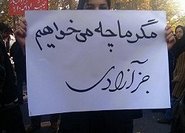




 Tulips in Holland