

THE BASRA BATTLE: SIGNS OF IRAN
By AMIR TAHERI
March 31, 2008 -- IT was bound to happen and may well be happening right now: a war between the Islamic Republic in Iran and the new Iraq. Much of the media have portrayed the latest battles for Basra, and attempts by armed groups to undermine the recently improved security in Baghdad, as a power struggle among rival Shiite factions. In this analysis, three Shiite factions - the Fadila (Virtue), the Dawa (The Call) and the Islamic Supreme Council of Iraq - that support Prime Minister Nouri al-Maliki's coalition government are trying to disarm the remnants of the Mahdi Army of the elusive mullah Muqtada Sadr. But that explanation has several problems. To start with, it is the regular Iraqi army - not any Shiite armed faction - that is doing the fighting in Basra. To underline that point, Maliki went to Basra to supervise operations personally. And the kind of fighting witnessed in Basra is different from the usual militia operations. This is a war of position, with units acting as detachments of a regular army trying to deny the Iraqi government forces control of specific territories. The fighters defying the Iraqi army may be Iraqi irregulars, even nominal members of the Mahdi Army - but those leading them are acting as textbook regular-army commanders. At least some of the officers in charge of the rebel units may be seconded from Iran's Islamic Revolutionary Guard Corps as part of a broader plan to control the Basra region, and thus the lifeline of the Iraqi economy.
This wouldn't be the first time that Guard officers and NCOs have fought at the head of native fighters outside Iran. Two years ago, Guard personnel played a crucial role in the war between the Lebanese Hezbollah and Israel. And Guard officers and NCOs led some armed Iraqi groups in operations against Saddam Hussein during the Iran-Iraq war in the 1980s. The type of weapons used in both Basra and Baghdad also suggests at least some outside involvement. The rebels in Basra are using a large number of armored vehicles to move men and materiel around - something no other Shiite militia, and certainly not the Mahdi Army, had ever done. They're also using heavy artillery, mobile rocket launchers and a sophisticated communications system unavailable to militias. Elements of the Mahdi Army may provide the visible face of the rebellion, but there is no evidence that the militia (supposing it even still exists as an organized force) is the sole star of this show. Sadr, after all, has extended the ceasefire he declared six months ago - and, in a recent letter, admitted that he had failed to "liberate" Iraq and create an "Islamic society." Last week, he issued another statement calling for a political settlement in Basra - a far cry from the bellicose noises made by these rebels with the help of Iranian state-owned media. Spending most of his time in Iran, Sadr is now preparing to claim a theological position within the Shiite hierarchy - an ambition that cannot be realized through gunfights in the streets of Basra and Baghdad. One other notable fact: Whoever is running the show on the rebel side has been able to devise a battle plan that included simultaneous attacks along a north-south axis that includes Baghdad, al-Amarah and Basra. No other Iraqi militia group, Shiite or Sunni, has had the resources to stage such a campaign before. The rebels are trying to retain areas that connect Basra, a vast urban sprawl, to the Shatt al-Arab, an estuary that forms part of the border between Iran and Iraq. If the Iraqi government is kept out of these areas, Iran would control both banks of the strategically vital waterway. Iran has already occupied several islands in the waterway facing Basra, using them as advance observation posts. Finally, the design of this operation recalls an Iranian plan, drafted in 1983-84, to seize control of Basra and parts of the Shiite-majority areas of southern Iraq. According to Ibrahim Yazdi, once a top adviser to the late Ayatollah Khomeini, the "Basra Plan" was devised as a compromise. The ayatollah wanted the war with Iraq to continue until the fall of Baghdad, after which he hoped his armies would march on Jerusalem. His advisers, including Yazdi, knew that Iran could not win such a war and tried to placate him by offering him Basra. Visitors to Basra since Saddam's fall have often been struck by the massive "Iranian" presence there. Much of this consists of large numbers of Iraqi Shiites, known as mua'aweddin (returnees), who have come home after years of exile in Iran. There are also those who hold both Iranian and Iraqi nationality. Known as muzdawajun (double nationals), they are often accused of being loyal to Shiism rather than any secular concept as a nation state. Why has Basra, a relatively calm place for the last five years, heated up now? One reason may be the British decision last year to withdraw from the city. This left a vacuum that the new Iraqi army and police were unable to fill immediately. Iran may have seized the opportunity to try to grab as much influence and presence as it could - both via Shiite militias (including the Mahdi Army) that it has financed for years and by sending large numbers of operatives across the border. The prospect of losing control of Basra may have prompted the Maliki government to act. Whoever controls Basra could influence the outcome of next year's crucial local-government elections. Basra and the Shiite south represent the backbone of support for the Maliki coalition; without them, the coalition couldn't retain control of the central government in Baghdad. At a time when US commanders in Iraq, including Gen. David Petraeus, openly accuse Iran of having joined the Iraqi imbroglio, the fate of Basra appears important for another reason. If there were a war between the United States and the Islamic Republic, one likely early US objective would be seizure of Iranian oilfields. To do that, America and its allies would need advance bases in southern Iraq - the key to which is Basra. Iran, on the other hand, could extend the defensive perimeter of its oilfields by annexing Basra.
Both sides may simply be interested in testing the waters at this stage. But the war over who will shape the future of Iraq, indeed of the Middle East as a whole, is in its early stages.
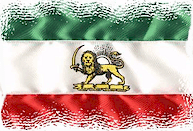
IMPERIAL EMBLEM

PERSIA
Iranian Freedom Fighters UNITE
Showing posts with label Malekie. Show all posts
Showing posts with label Malekie. Show all posts
Monday, March 31, 2008


Thursday, July 12, 2007
Hakim is in Tehran, Sader is in Tehran and Mullah's laky, Malekie is running Baghdad !
U.S. Raid on Iranian-Linked Militiamen Leaves 19 Dead in Iraq : July 12, 2007 The Associated Press FOX News
BAGHDAD -- U.S. troops raided a Shiite neighborhood of Baghdad on Thursday hunting for militiamen linked to Iran, sparking exchanges of fire and a mortar attack. Police and hospital officials said 19 people were killed. The violence in the capital's eastern Amin district began with a pre-dawn raid by U.S. forces that the military said captured two militants involved in kidnappings and planting roadside bombs against U.S. and Iraqi troops. Militants fired a rocket-propelled grenade at the troops, hitting a nearby building, the military said in a statement. In the morning, U.S. troops surrounded the neighborhood, announcing with loudspeakers to residents that they were seeking militants and that they should stay inside, said an Iraqi police official who was at the scene. As the Americans withdrew around 11 am, they came under fire, prompting troops to move back into the district, assaulting several buildings, the official said. The result was an exchange of fire that included mortars and rockets, the official said. Residents — many of them Shiites who fled to Baghdad from Baqouba, where U.S. forces have been waging a three-week-old offensive — said that during the fighting, a U.S. helicopter hit several residential buildings and a minibus. AP Television News footage showed buildings riddled with holes from heavy machine gun and rocket fire, and a heavily damaged minibus. Another police official involved in compiling casualties said 19 people were killed and 20 wounded, a toll confirmed by officials from the three hospitals where the victims were taken. The officials spoke on condition of anonymity because they were not authorize to release the information. The U.S. military had no immediate comment on the violence. U.S. and Iraqi forces have been cracking down on Shiite militants even as they wage offensives in and around the capital aimed at uprooting Sunni insurgents and Al Qaeda in Iraq extremists. The campaign seeks to reduce violence in Baghdad to boost the government as it tries to push through political reforms. The military said the two captured militants belonged to Iranian-backed "special groups" linked to the Mahdi Army, the militia loyal to anti-U.S. Shiite cleric Muqtada al-Sadr. The U.S. has accused Iran's Revolutionary Guards of organizing and arming a network of the special groups to carry out attacks on U.S. and Iraqi forces and kidnappings. In southern Iraq, clashes erupted between Shiite militants and the Iraqi army, killing a soldier and a civilian in the city of Diwaniyah, police said. The clashes came hours after the U.S. military said aircraft struck a group of militants planting a roadside bomb before dawn, killing five of the miltiants. A suicide bomber detonated an explosives belt by a wedding party in Tal Afar, a city 420 kilometers (260 miles) northwest of Baghdad that has seen frequent bombings by Sunni insurgents. A police officer in Tal Afar said five people were killed and five wounded, though the bride and groom escaped injury. The officer spoke on condition of anonymity because he was not allowed to talk to the press. On Thursday, robbers stole about $280,000 from a bank in central Baghdad, police said. The theft at the private Dar al-Salam bank was discovered by the bank manager when it opened in the morning, and suspicions fell on overnight guards, a police official said. Arrest warrants have been issued against the guards, said the official, who spoke on condition of anonymity because he was not authorized to talk to the press.
While the military presses ahead with its offensives, Iraqi politicians have been mired in divisions holding up passage of key political benchmarks sought by the United States to encourage the country's Sunni Arab minority to support the government. Sunni Arabs are boycotting the government of Prime Minister Nouri al-Maliki and the parliament because of various political disputes. Sunnis and Kurds have come out against a draft of a key oil law, the first of the benchmarks. For weeks, al-Maliki has been speaking of a Cabinet reshuffle to streamline his fragile government to a core of parties to push through log-jammed legislation. But so far, a new Cabinet has not emerged. "Work is going on to back the prime minister and to strengthen the government and stand by its side ... and work so that the government be more powerful than it is today," Abdul-Aziz al-Hakim, the leader of Iraq's largest Shiite political party, told the Associated Press. Al-Hakim, head of the Supreme Islamic Council of Iraq, said his party wanted to resolve disputes with Sunnis to keep them in the political process. "We will work as we did in the past and continue to keep them with us and participate together in the rule and serving the Iraqi people," he said. "If there are problems, then there should be serious efforts to solve them." His comments came in written answers given Thursday to AP in response to questions sent to him the previous week. Al-Hakim is in Iran for cancer treatment. Al-Hakim and aides to al-Maliki have said the reshuffle plan would involved forming a coalition of the two main Shiite and two main Kurdish parties and the Sunni Iraqi Islamic Party, which are in the current government. That could mean shedding one or more of the other Sunni parties in the coalition and the Shiite party of al-Sadr. Al-Maliki said Thursday, "the Iraq that we want is an Iraq for everyone and it is being subjected to serious conspiracies. There are some who are exploiting national causes and working on weakening it (Iraq)."
Sunday, March 04, 2007
Iran and Baghdad Conference , Amir Taheri ,
Even before invitation cards were out for next weekend’s international conference in Baghdad, the issue had become another bone of contention in the acrimonious American debate on Iraq.
Those who wish the United States to fail have dismissed the plan as a belated, and thus useless, attempt by the Bush administration to implement the Baker-Hamilton recommendations of last year. Some members of the Baker-Hamilton group, appearing on the box with “I-told-you-so” grins wider than the Pacific, have echoed that view. A few pundits have suggested that US Secretary of State Condoleezza Rice’s eagerness to promote a conference where Iran would also be present amounted to a reversal of the policy not to talk to the mullahs. The so-called “neocons”, who had dismissed Baker-Hamilton as a dangerous exercise from the start, have described US participation in the conference as a “ dangerous betrayal.” The truth, however, is that the proposed conference has nothing to do with Baker-Hamilton. It is an idea, first launched by Iraqi Foreign Minister Hoshyar Zebari in 2005, and recently adopted by Prime Minister Nuri Al-Maliki. Maliki and Zebari had rejected the Baker-Hamilton recommendation that the US discuss the future of Iraq with Iran and Syria to the exclusion of the elected Iraqi government. Thus, the coming conference should be seen as a sign that the Bush administration has definitely rejected the key recommendation of the Baker-Hamilton group. However, shouldn’t one see the administration’s decision to attend as a sign that Washington is eating humble pie on Iran? The answer is no. Since 2002, US has attended several international conferences in which the Islamic republic has also been present. There was the 2001 Bonn conference on Afghanistan followed by the 2004 Madrid and Sharm Al-Sheikh conferences on Iraq and the 2005 Tokyo conference on Afghanistan. The only question pertinent to the proposed Baghdad conference is whether it contributes to containing and finally ending violence in Iraq, thus allowing political and economic reconstruction to proceed faster. The conference deserves support for a number of reasons. To start with, it is the first major diplomatic initiative launched by the new Iraqi regime. The conference will bring together envoys from all permanent members of the UN Security Council, plus Iraq’s six neighbors. The Arab League and the Organization of the Islamic Conference (OIC) will also be present. There are also talks to ensure participation by other powers, notably Japan and India. This would be the first time that envoys from some 70 nations come to Baghdad to in a show of support for new Iraq. The presence of Arab and other Islamic powers is especially significant if only because most had tried to hedge their bets about the future of Iraq by effectively ignoring the new Iraqi regime. Their attendance would end an unannounced boycott of the Maliki government. Initially, most would-be participants were cool on the idea. As late as last December, Arab leaders would tell us that they had no interest in bolstering a Shiite-dominated regime in Baghdad, and would rather wait and see whether the Americans stay or run away. The US decision to send some 27,000 more troops to Iraq, plus a second aircraft carrier in the Gulf, has helped persuade the hesitant Arabs that there would be no American cut-and-run at least for as long as George W. Bush is in the White House. That analysis helped the Arabs to create a new bloc of eight nations to oppose Tehran’s regional ambitions. (Last month that bloc was reinforced with a new Islamic bloc consisting of Indonesia, Malaysia, Pakistan, Turkey, Saudi Arabia, Jordan and Egypt; pointedly excluding Iran.) The Baghdad conference would open the way for new Iraq to join the new emerging Arab and Islamic blocs as a partner on the diplomatic scene. However, diplomatic recognition is not all that Iraq needs. It also needs the cooperation of its neighbors to stem the flow of arms and terrorists. In that context, two neighbors, Syria and Iran, may come under the spotlight at the Baghdad conference. Iraqi officials claim they have “names, addresses, and a mass of other evidence”, indicating Syria’s “extensive involvement” in the Sunni-led insurgency.
They also claim that “compelling evidence” exists of Iran’s efforts to build a network of influence in Iraq, especially in the south. The Baghdad conference provides an opportunity for developing an international plan to help new Iraq fight its enemies. In that context, it would be hard for Iran and Syria to continue investing in terrorists and/or militias in Iraq. At the same time, the so-called moderate Arab states that have acted as cheerleaders for insurgents, not to mention their turning a blind eye to the activities of anti-Iraq groups on their soil, would have to abandon such destructive tactics. New Iraq may need another three years, certainly until after the next general election at the end of 2009 or early 2010, to rebuild its security forces to levels required to end the insurgency and impose effective government presence throughout the nation. For domestic political reasons, the US may not remain committed to Iraq beyond the Bush presidency. It is, therefore, imperative for new Iraq to find new friends and partners, especially as far as training the security forces and helping protect its extensive borders are concerned. The Baghdad conference could commit the participants to a five-year plan to help rebuild Iraq’s military and economic infrastructures. The conference could play yet another useful role by enabling the Maliki government to make concessions needed on the domestic scene. Under pressure from problematic Shiite allies who keep his coalition in power, Maliki cannot impose policies needed to reassure the Arab Sunni minority and nonsectarian parties. These policies include amending the de-Baathification law to end the exclusion of more than a million people from the civil and military service. That would allow large numbers of experienced bureaucrats to help revive the civil service. Also, tens of thousands of people with experience, purged from the army because of their membership of the Baath, could be recruited by the new army and police. Other moves that should be made with support from the international community include a postponement of the referendum in Kirkuk, a mixed city contested by Kurds, Turcomans and Sunni Arabs. The proposed development of federal structures should also be slowed down, allowing the people of Iraq to understand what is at stake before they decide whether they want it or not. The Baghdad conference is expected to come up with draft proposals for submission to a conference at foreign ministers’ level, to be held in Istanbul in April. Rather that staying on the sidelines, smirking in Schadenfreude against the US, the international community must help new Iraq. But that help must be conditional on Iraqis helping themselves. And that means taking the tough decisions that Maliki and his predecessors have been unwilling and/or unable to make.
Those who wish the United States to fail have dismissed the plan as a belated, and thus useless, attempt by the Bush administration to implement the Baker-Hamilton recommendations of last year. Some members of the Baker-Hamilton group, appearing on the box with “I-told-you-so” grins wider than the Pacific, have echoed that view. A few pundits have suggested that US Secretary of State Condoleezza Rice’s eagerness to promote a conference where Iran would also be present amounted to a reversal of the policy not to talk to the mullahs. The so-called “neocons”, who had dismissed Baker-Hamilton as a dangerous exercise from the start, have described US participation in the conference as a “ dangerous betrayal.” The truth, however, is that the proposed conference has nothing to do with Baker-Hamilton. It is an idea, first launched by Iraqi Foreign Minister Hoshyar Zebari in 2005, and recently adopted by Prime Minister Nuri Al-Maliki. Maliki and Zebari had rejected the Baker-Hamilton recommendation that the US discuss the future of Iraq with Iran and Syria to the exclusion of the elected Iraqi government. Thus, the coming conference should be seen as a sign that the Bush administration has definitely rejected the key recommendation of the Baker-Hamilton group. However, shouldn’t one see the administration’s decision to attend as a sign that Washington is eating humble pie on Iran? The answer is no. Since 2002, US has attended several international conferences in which the Islamic republic has also been present. There was the 2001 Bonn conference on Afghanistan followed by the 2004 Madrid and Sharm Al-Sheikh conferences on Iraq and the 2005 Tokyo conference on Afghanistan. The only question pertinent to the proposed Baghdad conference is whether it contributes to containing and finally ending violence in Iraq, thus allowing political and economic reconstruction to proceed faster. The conference deserves support for a number of reasons. To start with, it is the first major diplomatic initiative launched by the new Iraqi regime. The conference will bring together envoys from all permanent members of the UN Security Council, plus Iraq’s six neighbors. The Arab League and the Organization of the Islamic Conference (OIC) will also be present. There are also talks to ensure participation by other powers, notably Japan and India. This would be the first time that envoys from some 70 nations come to Baghdad to in a show of support for new Iraq. The presence of Arab and other Islamic powers is especially significant if only because most had tried to hedge their bets about the future of Iraq by effectively ignoring the new Iraqi regime. Their attendance would end an unannounced boycott of the Maliki government. Initially, most would-be participants were cool on the idea. As late as last December, Arab leaders would tell us that they had no interest in bolstering a Shiite-dominated regime in Baghdad, and would rather wait and see whether the Americans stay or run away. The US decision to send some 27,000 more troops to Iraq, plus a second aircraft carrier in the Gulf, has helped persuade the hesitant Arabs that there would be no American cut-and-run at least for as long as George W. Bush is in the White House. That analysis helped the Arabs to create a new bloc of eight nations to oppose Tehran’s regional ambitions. (Last month that bloc was reinforced with a new Islamic bloc consisting of Indonesia, Malaysia, Pakistan, Turkey, Saudi Arabia, Jordan and Egypt; pointedly excluding Iran.) The Baghdad conference would open the way for new Iraq to join the new emerging Arab and Islamic blocs as a partner on the diplomatic scene. However, diplomatic recognition is not all that Iraq needs. It also needs the cooperation of its neighbors to stem the flow of arms and terrorists. In that context, two neighbors, Syria and Iran, may come under the spotlight at the Baghdad conference. Iraqi officials claim they have “names, addresses, and a mass of other evidence”, indicating Syria’s “extensive involvement” in the Sunni-led insurgency.
They also claim that “compelling evidence” exists of Iran’s efforts to build a network of influence in Iraq, especially in the south. The Baghdad conference provides an opportunity for developing an international plan to help new Iraq fight its enemies. In that context, it would be hard for Iran and Syria to continue investing in terrorists and/or militias in Iraq. At the same time, the so-called moderate Arab states that have acted as cheerleaders for insurgents, not to mention their turning a blind eye to the activities of anti-Iraq groups on their soil, would have to abandon such destructive tactics. New Iraq may need another three years, certainly until after the next general election at the end of 2009 or early 2010, to rebuild its security forces to levels required to end the insurgency and impose effective government presence throughout the nation. For domestic political reasons, the US may not remain committed to Iraq beyond the Bush presidency. It is, therefore, imperative for new Iraq to find new friends and partners, especially as far as training the security forces and helping protect its extensive borders are concerned. The Baghdad conference could commit the participants to a five-year plan to help rebuild Iraq’s military and economic infrastructures. The conference could play yet another useful role by enabling the Maliki government to make concessions needed on the domestic scene. Under pressure from problematic Shiite allies who keep his coalition in power, Maliki cannot impose policies needed to reassure the Arab Sunni minority and nonsectarian parties. These policies include amending the de-Baathification law to end the exclusion of more than a million people from the civil and military service. That would allow large numbers of experienced bureaucrats to help revive the civil service. Also, tens of thousands of people with experience, purged from the army because of their membership of the Baath, could be recruited by the new army and police. Other moves that should be made with support from the international community include a postponement of the referendum in Kirkuk, a mixed city contested by Kurds, Turcomans and Sunni Arabs. The proposed development of federal structures should also be slowed down, allowing the people of Iraq to understand what is at stake before they decide whether they want it or not. The Baghdad conference is expected to come up with draft proposals for submission to a conference at foreign ministers’ level, to be held in Istanbul in April. Rather that staying on the sidelines, smirking in Schadenfreude against the US, the international community must help new Iraq. But that help must be conditional on Iraqis helping themselves. And that means taking the tough decisions that Maliki and his predecessors have been unwilling and/or unable to make.
Subscribe to:
Posts (Atom)


 Posts
Posts




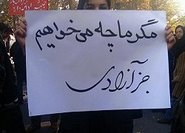
 اخبار مربوط به زندانیان سیاسی و نقض حقوق بشر







 Tulips in Holland