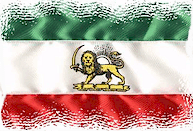

IMPERIAL EMBLEM

PERSIA
Iranian Freedom Fighters UNITE

Showing posts with label North Korea. Show all posts
Showing posts with label North Korea. Show all posts
Saturday, December 15, 2007
North Korea apparently supplying Iran-backed group
WASHINGTON — The United States believes North Korea has become a major supplier to the Iranian-sponsored Hizbullah. The U.S. Congress raised the prospect that North Korea was providing weapons, technical assistance and military training to Hizbullah. The Congressional Research Service cited reputable sources that Pyongyang equipped Hizbullah with missiles and rockets used during the war against Israel in 2006. CRS, which provides independent analysis to Congress, discussed the purported North Korean aid to Hizbullah amid plans by the Bush administration to remove Pyongyang from the State Department list of terrorist sponsors. The report, first obtained by the Reuters news agency, cast doubts on claims that North Korea has ended support for groups deemed terrorists. "Questions about the credibility of the claim are relevant in view of the appearance of reports from reputable sources that North Korea has provided arms and possibly training to Hizbullah in Lebanon and the Tamil Tigers in Sri Lanka," the CRS report said. Hizbullah has been on the State Department list of terrorist organizations. The State Department has asserted that North Korea ended its sponsorship of terrorist groups more than 20 years ago. CRS said North Korea could have become a major supplier to Hizbullah. The report cited a September 2006 report by Paris Intelligence Online that North Korea provided extensive assistance to Hizbullah. The North Korean program was said to have begun in the 1980s when Hizbullah fighters were trained in Pyongyang. In 2000, during the Israeli withdrawal from Lebanon, the cooperation expanded and North Korean engineers were sent to Lebanon to instruct Hizbullah on the construction of underground facilities to store weapons, food and medical equipment. Pyongyang was also said to have helped install hundreds of remote-controlled underground 122 mm Katyusha rocket launchers throughout southern Lebanon. The network enabled Hizbullah to elevate a Katyusha launcher from a bunker via hydraulic lift, fire a salvo of rockets and then return underground. "This significantly improved Hizbullah's ability to fight the Israelis," CRS said.


Monday, October 08, 2007
Snatched: Israeli commandos ‘nuclear’ raid :
Uzi Mahnaimi, Tel Aviv, Sarah Baxter, Washington, and Michael Sheridan :From The Sunday Times - September 23, 2007
Also from Sarah Baxter: Israelis seized nuclear material in Syrian raid Secret US air force team to perfect plan for Iran strike Israelis 'blew apart Syrian nuclear cache' Alan Greenspan: "Blair was clearly an aide to Brown"
ISRAELI commandos from the elite Sayeret Matkal unit – almost certainly dressed in Syrian uniforms – made their way stealthily towards a secret military compound near Dayr az-Zawr in northern Syria. They were looking for proof that Syria and North Korea were collaborating on a nuclear programme. Israel had been surveying the site for months, according to Washington and Israeli sources. President George W Bush was told during the summer that Israeli intelligence suggested North Korean personnel and nuclear-related material were at the Syrian site.
Suicide bombers head to Iraq
Articulate, middle-class men are leaving Damascus and preparing to die for Bin Laden
Condoleezza Rice opposed Israel’s attack on Syrian nuclear site
US Secretary of state persuaded the Israelis to delay military strike on Syria last month
Also from Sarah Baxter: Israelis seized nuclear material in Syrian raid Secret US air force team to perfect plan for Iran strike Israelis 'blew apart Syrian nuclear cache' Alan Greenspan: "Blair was clearly an aide to Brown"
ISRAELI commandos from the elite Sayeret Matkal unit – almost certainly dressed in Syrian uniforms – made their way stealthily towards a secret military compound near Dayr az-Zawr in northern Syria. They were looking for proof that Syria and North Korea were collaborating on a nuclear programme. Israel had been surveying the site for months, according to Washington and Israeli sources. President George W Bush was told during the summer that Israeli intelligence suggested North Korean personnel and nuclear-related material were at the Syrian site.
Suicide bombers head to Iraq
Articulate, middle-class men are leaving Damascus and preparing to die for Bin Laden
Condoleezza Rice opposed Israel’s attack on Syrian nuclear site
US Secretary of state persuaded the Israelis to delay military strike on Syria last month
Friday, May 11, 2007
For 28 Years, The IRI has been giving money to N. Koreans and now they wont give it back. Ha Ha Ha.
Foreign minister Motaki ' Be Dool ' : North Korea's Debt to Iran Obstacle to Better Ties
May 11, 2007 : The Associated Press
TEHRAN, Iran -- Iran's Foreign Minister Manouchehr Mottaki was quoted as saying Friday that Iran is interested in improving ties with North Korea but that the Asian nation's debt to Tehran stands in the way of closer relations. It was the first time an official of either country referred to their dealings, which are not publicly known.
The extent of North Korea's debt remains unknown and officials have not provided any figures. "It is necessary to remove some obstacles so that grounds for further cooperation between the two countries can be established," the official IRNA news agency quoted Mottaki as saying.
The comments came after Mottaki's meeting late Thursday with visiting North Korean acting Foreign Minister, Kim Yong Il. Pyongyang's "debts to Tehran is among the obstacles in the way of cooperation," Mottaki said without elaborating. "The two countries can find a formula to remove this obstacle." Mottaki added that Iran was still interested in improving ties "in the fields of politics, economics and culture" with North Korea. Kim said that his country would support Iran — under U.N. sanctions and locked in a diplomatic standoff with the West over its disputed nuclear program — on the international level, and that North Korea was ready to cooperate with Iran "in various economic fields." The U.N. Security Council in 2006 imposed sanctions on both North Korea, after it conducted its weapons test, and Iran, for refusing to halt uranium enrichment. North Korea has since refused to act on a February pledge to start dismantling its nuclear program in exchange for economic aid and political concessions. Meanwhile, Tehran faces new, stepped-up sanctions for its refusal to halt the enrichment program, which Iran insists is peaceful and not for nuclear arms making. Pyongyang has reportedly cooperated with Iran militarily since early 1980s, when Saddam Hussein waged an eight-year war against Iran. Officials of the two countries regularly meet each other.
May 11, 2007 : The Associated Press
TEHRAN, Iran -- Iran's Foreign Minister Manouchehr Mottaki was quoted as saying Friday that Iran is interested in improving ties with North Korea but that the Asian nation's debt to Tehran stands in the way of closer relations. It was the first time an official of either country referred to their dealings, which are not publicly known.
The extent of North Korea's debt remains unknown and officials have not provided any figures. "It is necessary to remove some obstacles so that grounds for further cooperation between the two countries can be established," the official IRNA news agency quoted Mottaki as saying.
The comments came after Mottaki's meeting late Thursday with visiting North Korean acting Foreign Minister, Kim Yong Il. Pyongyang's "debts to Tehran is among the obstacles in the way of cooperation," Mottaki said without elaborating. "The two countries can find a formula to remove this obstacle." Mottaki added that Iran was still interested in improving ties "in the fields of politics, economics and culture" with North Korea. Kim said that his country would support Iran — under U.N. sanctions and locked in a diplomatic standoff with the West over its disputed nuclear program — on the international level, and that North Korea was ready to cooperate with Iran "in various economic fields." The U.N. Security Council in 2006 imposed sanctions on both North Korea, after it conducted its weapons test, and Iran, for refusing to halt uranium enrichment. North Korea has since refused to act on a February pledge to start dismantling its nuclear program in exchange for economic aid and political concessions. Meanwhile, Tehran faces new, stepped-up sanctions for its refusal to halt the enrichment program, which Iran insists is peaceful and not for nuclear arms making. Pyongyang has reportedly cooperated with Iran militarily since early 1980s, when Saddam Hussein waged an eight-year war against Iran. Officials of the two countries regularly meet each other.
Wednesday, February 14, 2007
Bush: 'Preposterous' to suggest intelligence on Iran is wrong
Bush insists that Iran is providing weapons for Iraq

Text of President Bush on Wednesday, as transcribed by CQ Transcriptions : http://www.forbes.com/feeds/ap/2007/02/14/ap3427046.html
WASHINGTON (AP) — President Bush said Wednesday he's convinced that the Iranian government is supplying deadly weapons to fighters in Iraq, even if he can't prove the orders came from the highest levels in Tehran. More important, Bush said in his first news conference of the year, is protecting U.S. troops against the lethal new threat. "I'm going to do something about it," Bush said. U.S. officials have said that Iran helped on attacks on troops in Iraq, an assertion denied by Iran's president, Mahmoud Ahmadinejad.
Meanwhile, Bush shrugged off congressional debate on a resolution opposing his Iraq policy, noting that the measure was non-binding and mostly symbolic. But he said U.S. troops are counting on lawmakers to provide them the funds they need to win.
Bush spoke as the Democratic-controlled House of Representatives debated a measure opposing his decision to send some 21,500 additional troops to Iraq. "They have every right to express their opposition and it is a non-binding resolution," he said of the House members, who were continuing a marathon Iraq policy debate on Capitol Hill even as he spoke. In his first news conference since Dec. 20, Bush said he received a briefing earlier in the day from Iraq from newly-confirmed Gen. David Petraeus, the new chief commander of U.S. forces in Iraq, who is now in Baghdad. "We talked about the coordination between Iraqi and coalition forces," Bush said. For now, he said, that coordination appeared to be good, although Bush said much work remains. Meanwhile, Bush responded carefully when asked about Russian President Vladimir Putin's recent sharp criticism of U.S. foreign and military policy. Bush said he had a "complicated relationship" with the Russian leader. Bush also said that he and Putin have a lot they agree on, and that's what people in the United States need to understand. Chief among those common priorities, Bush said, is making sure that Iran does not develop nuclear weapons.

Putin slammed U.S. domination of world affairs at an international conference of security officials in Germany over the weekend, saying it was making the world more dangerous by overusing its military power. The depth of Putin's criticism surprised U.S. officials. Moscow and Washington drew closer together immediately after the Sept. 11, 2001, terror attacks, but more recently relations have been more strained.
Some highlights: 11:58 a.m.
Sitting down with Iran wouldn't work: The last question was why -- if the U.S. could negotiate with the former Soviet Union over nuclear weapons -- it can't sit down one-on-one with Iran. "If I thought we could achieve success I would sit down" with Iran, the president said. "But I don't think we could achieve success right now." The president said there is a better chance of success if "the whole world stays engaged" and he pointed to the multi-lateral talks with North Korea as an example of such a strategy working.11:47 a.m.Opponents are patriots too: Those who oppose his policies in Iraq are just as patriotic as he is, the president said. But he said again that lawmakers who disagree with what he's doing still need to vote to approve the funds that he says troops need to accomplish the mission he's set out for them. 11:42 a.m. ET. On "CIA leak;" no comment: Washington Post reporter Peter Baker tried several ways to get the president to comment on the "CIA leak" saga, which is in the news this week thanks to the trial of former White House aide Lewis "Scooter" Libby, who's accused of lying during the investigation of that leak. "Not going to talk about it Peter," Bush said. He offered to "recycle" Baker and give him a chance to ask a different question. Baker declined. 11:35 a.m. ET. Troop morale: Questioned about whether he has been told that the morale of U.S. troops in Iraq is weakening, the president said, "what I hear from commanders is that the place where there is concern is from the family members," not the troops. 11:28 a.m.Iran: Back on Iran and evidence that it is supplying weapons to terrorists and insurgents in Iraq, Bush responded forcefully to a question on why U.S. intelligence should be trusted. "The idea that we're somehow manufacturing the idea that the Iranians are providing (bombs) is preposterous," Bush said.

11:25 a.m.North Korea: Tuesday, former U.N. ambassador John Bolton slammed the deal reached this week with North Korea on its nuclear weapons program. Bush said Bolton and others who criticize the agreement are "flat wrong." "I changed the dynamic on the North Korean issue by convincing other people to be at the table with us ... (and) we had a breakthrough," Bush said. "Those who say the North Koreans have got to prove themselves by following through on the deal are right," Bush added, "and I'm one" who says that.11:20 a.m. On Iran: The president was asked about comments this week by Gen. Peter Pace, chairman of the Joint Chiefs of Staff, who said he isn't sure the government of Iran has ordered that weapons be supplied to insurgents in Iraq. "Either they knew or they didn't know," that some Iranian weapons have ended up in Iraq, Bush said. "What's worse? That the government knew or that the government didn't know?"11:13 a.m.Don't prejudge Iraq plan: Of the debate underway in Congress over non-binding resolutions that oppose his plans in Iraq, the president said "it opposes our new plan before it has a chance to work." While Congress has the right to debate the policy, Bush said, it also needs to approve funding that will give U.S. troops what they need to carry out their missions in Iraq.11:07 a.m. ET. Securing Baghdad "will take time:" In his opening remarks, the president spoke about an update he got this morning from Lt. Gen. David Petraeus, the new U.S. commander in Iraq. "The operation to secure Baghdad is going to take time," Bush said, "and there's going to be violence." He is aware, the president added, that U.S. and Iraqi forces will not be able to stop all suicide bombers and others who want to disrupt progress in Iraq. But, "to step back from the fight in Baghdad would have disastrous consequences for people in America," Bush said. If "we fail there, the enemy will follow us here."
Bush was pressed repeatedly during the nearly hour-long news conference to explain an apparent contradiction between U.S. military briefers in Baghdad and the chairman of the Joint Chiefs of Staff, Marine Gen. Peter Pace, over Iranian government involvement in the purported supply of weapons, including high-powered explosives, that have been used against U.S. forces in deadly roadside bombings in Iraq. In a weekend briefing, reporters in Baghdad were told that the "highest levels" of the Iranian government had ordered the smuggling of the weapons into Iraq. But Pace said later it was not clear "that the Iranian government per se, for sure, is directly involved in doing this." Bush said the Quds Force, a component of Iran's Revolutionary Guards, has been "instrumental in providing these deadly IEDs [improvised explosive devices] to networks inside of Iraq" and that the Quds Force "is part of the Iranian government." He added, "What we don't know is whether the head leaders in Iran ordered the Quds Force to do what they did." He then asked, "What's worse? That the government knew or that the government didn't know?" He said in reply to a subsequent question, "There are weapons in Iraq that are harming U.S. troops" because of smuggling by the Quds Force. "Whether [Iranian President Mahmoud] Ahmadinejad ordered the Quds Force to do this, I don't know." Bush asserted, "There is no contradiction that the weapons are there and they were provided by the Quds Force." Disclosing this does not mean that he is "trying to have a pretext for war" against Iran, Bush said. "This means I'm trying to protect our troops." He repeated his previous warnings that U.S. forces "will deal with" networks and agents involved in smuggling Iranian weapons into Iraq. U.S. officials have vowed to carry out such actions inside Iraq's borders.
Text of President Bush on Wednesday, as transcribed by CQ Transcriptions : http://www.forbes.com/feeds/ap/2007/02/14/ap3427046.html
WASHINGTON (AP) — President Bush said Wednesday he's convinced that the Iranian government is supplying deadly weapons to fighters in Iraq, even if he can't prove the orders came from the highest levels in Tehran. More important, Bush said in his first news conference of the year, is protecting U.S. troops against the lethal new threat. "I'm going to do something about it," Bush said. U.S. officials have said that Iran helped on attacks on troops in Iraq, an assertion denied by Iran's president, Mahmoud Ahmadinejad.
Meanwhile, Bush shrugged off congressional debate on a resolution opposing his Iraq policy, noting that the measure was non-binding and mostly symbolic. But he said U.S. troops are counting on lawmakers to provide them the funds they need to win.
Bush spoke as the Democratic-controlled House of Representatives debated a measure opposing his decision to send some 21,500 additional troops to Iraq. "They have every right to express their opposition and it is a non-binding resolution," he said of the House members, who were continuing a marathon Iraq policy debate on Capitol Hill even as he spoke. In his first news conference since Dec. 20, Bush said he received a briefing earlier in the day from Iraq from newly-confirmed Gen. David Petraeus, the new chief commander of U.S. forces in Iraq, who is now in Baghdad. "We talked about the coordination between Iraqi and coalition forces," Bush said. For now, he said, that coordination appeared to be good, although Bush said much work remains. Meanwhile, Bush responded carefully when asked about Russian President Vladimir Putin's recent sharp criticism of U.S. foreign and military policy. Bush said he had a "complicated relationship" with the Russian leader. Bush also said that he and Putin have a lot they agree on, and that's what people in the United States need to understand. Chief among those common priorities, Bush said, is making sure that Iran does not develop nuclear weapons.
Putin slammed U.S. domination of world affairs at an international conference of security officials in Germany over the weekend, saying it was making the world more dangerous by overusing its military power. The depth of Putin's criticism surprised U.S. officials. Moscow and Washington drew closer together immediately after the Sept. 11, 2001, terror attacks, but more recently relations have been more strained.
Some highlights: 11:58 a.m.
Sitting down with Iran wouldn't work: The last question was why -- if the U.S. could negotiate with the former Soviet Union over nuclear weapons -- it can't sit down one-on-one with Iran. "If I thought we could achieve success I would sit down" with Iran, the president said. "But I don't think we could achieve success right now." The president said there is a better chance of success if "the whole world stays engaged" and he pointed to the multi-lateral talks with North Korea as an example of such a strategy working.11:47 a.m.Opponents are patriots too: Those who oppose his policies in Iraq are just as patriotic as he is, the president said. But he said again that lawmakers who disagree with what he's doing still need to vote to approve the funds that he says troops need to accomplish the mission he's set out for them. 11:42 a.m. ET. On "CIA leak;" no comment: Washington Post reporter Peter Baker tried several ways to get the president to comment on the "CIA leak" saga, which is in the news this week thanks to the trial of former White House aide Lewis "Scooter" Libby, who's accused of lying during the investigation of that leak. "Not going to talk about it Peter," Bush said. He offered to "recycle" Baker and give him a chance to ask a different question. Baker declined. 11:35 a.m. ET. Troop morale: Questioned about whether he has been told that the morale of U.S. troops in Iraq is weakening, the president said, "what I hear from commanders is that the place where there is concern is from the family members," not the troops. 11:28 a.m.Iran: Back on Iran and evidence that it is supplying weapons to terrorists and insurgents in Iraq, Bush responded forcefully to a question on why U.S. intelligence should be trusted. "The idea that we're somehow manufacturing the idea that the Iranians are providing (bombs) is preposterous," Bush said.
11:25 a.m.North Korea: Tuesday, former U.N. ambassador John Bolton slammed the deal reached this week with North Korea on its nuclear weapons program. Bush said Bolton and others who criticize the agreement are "flat wrong." "I changed the dynamic on the North Korean issue by convincing other people to be at the table with us ... (and) we had a breakthrough," Bush said. "Those who say the North Koreans have got to prove themselves by following through on the deal are right," Bush added, "and I'm one" who says that.11:20 a.m. On Iran: The president was asked about comments this week by Gen. Peter Pace, chairman of the Joint Chiefs of Staff, who said he isn't sure the government of Iran has ordered that weapons be supplied to insurgents in Iraq. "Either they knew or they didn't know," that some Iranian weapons have ended up in Iraq, Bush said. "What's worse? That the government knew or that the government didn't know?"11:13 a.m.Don't prejudge Iraq plan: Of the debate underway in Congress over non-binding resolutions that oppose his plans in Iraq, the president said "it opposes our new plan before it has a chance to work." While Congress has the right to debate the policy, Bush said, it also needs to approve funding that will give U.S. troops what they need to carry out their missions in Iraq.11:07 a.m. ET. Securing Baghdad "will take time:" In his opening remarks, the president spoke about an update he got this morning from Lt. Gen. David Petraeus, the new U.S. commander in Iraq. "The operation to secure Baghdad is going to take time," Bush said, "and there's going to be violence." He is aware, the president added, that U.S. and Iraqi forces will not be able to stop all suicide bombers and others who want to disrupt progress in Iraq. But, "to step back from the fight in Baghdad would have disastrous consequences for people in America," Bush said. If "we fail there, the enemy will follow us here."
Bush was pressed repeatedly during the nearly hour-long news conference to explain an apparent contradiction between U.S. military briefers in Baghdad and the chairman of the Joint Chiefs of Staff, Marine Gen. Peter Pace, over Iranian government involvement in the purported supply of weapons, including high-powered explosives, that have been used against U.S. forces in deadly roadside bombings in Iraq. In a weekend briefing, reporters in Baghdad were told that the "highest levels" of the Iranian government had ordered the smuggling of the weapons into Iraq. But Pace said later it was not clear "that the Iranian government per se, for sure, is directly involved in doing this." Bush said the Quds Force, a component of Iran's Revolutionary Guards, has been "instrumental in providing these deadly IEDs [improvised explosive devices] to networks inside of Iraq" and that the Quds Force "is part of the Iranian government." He added, "What we don't know is whether the head leaders in Iran ordered the Quds Force to do what they did." He then asked, "What's worse? That the government knew or that the government didn't know?" He said in reply to a subsequent question, "There are weapons in Iraq that are harming U.S. troops" because of smuggling by the Quds Force. "Whether [Iranian President Mahmoud] Ahmadinejad ordered the Quds Force to do this, I don't know." Bush asserted, "There is no contradiction that the weapons are there and they were provided by the Quds Force." Disclosing this does not mean that he is "trying to have a pretext for war" against Iran, Bush said. "This means I'm trying to protect our troops." He repeated his previous warnings that U.S. forces "will deal with" networks and agents involved in smuggling Iranian weapons into Iraq. U.S. officials have vowed to carry out such actions inside Iraq's borders.
Tuesday, February 13, 2007
N. Korea agrees to nuclear disarmament
By BURT HERMAN, Associated Press Writer 4 minutes ago
North Korea agreed Tuesday after arduous talks to shut down its main nuclear reactor and eventually dismantle its atomic weapons program, just four months after the communist state shocked the world by testing a nuclear bomb. The deal marks the first concrete plan for disarmament in more than three years of six-nation negotiations, and could potentially herald a new era of cooperation in the region with the North's longtime foes — the United States and Japan — also agreeing to discuss normalizing relations with Pyongyang.
Under the deal, the North will receive initial aid equal to 50,000 tons heavy fuel oil within 60 days for shutting down and sealing its main nuclear reactor and related facilities at Yongbyon, north of the capital, to be confirmed by international inspectors. For irreversibly disabling the reactor and declaring all nuclear programs, the North will eventually receive another 950,000 tons in aid. The agreement was read to all delegates in a conference room at a Chinese state guesthouse and Chinese envoy Wu Dawei asked if there were any objections. When none were made, the officials all stood and applauded. The main U.S. nuclear envoy said Washington was satisfied with an agreement on initial steps for North Korea to disarm but called it just the start of the process. "Obviously we have a long way to go, but we're very pleased with this agreement," Assistant Secretary of State Christopher Hill told reporters. "It's a very solid step forward." Hill said that Washington had pledged to resolve financial restrictions against a bank where North Korea held accounts within a month. Washington's blacklisting of a Macau bank in September 2005 had been an obstacle to nuclear talks, leading the North to a more-than-yearlong boycott during which it tested its first nuclear bomb. "We will resolve the matter of the financial sanctions relating to (Banco Delta Asia) within 30 days," Hill said.
North Korea agreed Tuesday after arduous talks to shut down its main nuclear reactor and eventually dismantle its atomic weapons program, just four months after the communist state shocked the world by testing a nuclear bomb. The deal marks the first concrete plan for disarmament in more than three years of six-nation negotiations, and could potentially herald a new era of cooperation in the region with the North's longtime foes — the United States and Japan — also agreeing to discuss normalizing relations with Pyongyang.
Under the deal, the North will receive initial aid equal to 50,000 tons heavy fuel oil within 60 days for shutting down and sealing its main nuclear reactor and related facilities at Yongbyon, north of the capital, to be confirmed by international inspectors. For irreversibly disabling the reactor and declaring all nuclear programs, the North will eventually receive another 950,000 tons in aid. The agreement was read to all delegates in a conference room at a Chinese state guesthouse and Chinese envoy Wu Dawei asked if there were any objections. When none were made, the officials all stood and applauded. The main U.S. nuclear envoy said Washington was satisfied with an agreement on initial steps for North Korea to disarm but called it just the start of the process. "Obviously we have a long way to go, but we're very pleased with this agreement," Assistant Secretary of State Christopher Hill told reporters. "It's a very solid step forward." Hill said that Washington had pledged to resolve financial restrictions against a bank where North Korea held accounts within a month. Washington's blacklisting of a Macau bank in September 2005 had been an obstacle to nuclear talks, leading the North to a more-than-yearlong boycott during which it tested its first nuclear bomb. "We will resolve the matter of the financial sanctions relating to (Banco Delta Asia) within 30 days," Hill said.
Subscribe to:
Posts (Atom)


 Posts
Posts




 اخبار مربوط به زندانیان سیاسی و نقض حقوق بشر







 Tulips in Holland