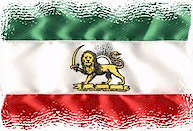
Alliance For democracy In Iran

Please have a look at my other weblog, Iran Democracy - http://irandemocray.blogspot.com/

IMPERIAL EMBLEM

IMPERIAL EMBLEM
PERSIA

Shahanshah Aryameher

S U N OF P E R S I A

Iranian Freedom Fighters UNITE

Showing posts with label Lebanon. Show all posts

Saturday, February 16, 2008

Hizbullah mastermind's true legacy! - By Caroline B. Glick

Mughniyeh personally bridged all the divisions within the world of Arab and Islamic terrorism. He showed that when it comes to attacking the West, there is no distinction between secular, nationalist, religious, Islamist, Sunni or Shiite terrorists.

PLEASE READ THIS AND PASS IT ON TO ALL YOUR FRIENDS AND CONTACTS.

It is quite possible that terror master Imad Mughniyah was not killed Tuesday night in Damascus for his past crimes, but to prevent him from carrying out additional attacks in the future. On January 30, French security services raided a Paris apartment and arrested six Arab men. Three of the men — two Lebanese and one Syrian — were travelling on diplomatic passports. According to the Italian Libero newspaper, the six were members of a Hizbullah cell. Seized documents included tourist maps of Paris, London, Madrid, Berlin and Rome marked up with red highlighter to indicate routes, addresses, parking lots and "truck stopping points." The maps pointed to several routes to Vatican back entrances. Libero's report explained that the "truck stopping points" aligned with information the French had received the week before from Beirut. There, Hizbullah chief Hassan Nasrallah convened a conference of his senior terror leaders where he ordered them to activate Hizbullah cells throughout Europe to kidnap senior European leaders. The day of the arrests, French Defense Minister Herve Morin was meeting with his American counterpart Defense Secretary Robert Gates and with Secretary of State Condoleezza Rice in Washington on a previously unannounced visit. During his public appearances, Morin criticized the US Intelligence Directorate's National Intelligence Estimate on Iran's nuclear program from November. Morin stated, "Coordinated information from a number of intelligence services leads us to believe that Iran has not given up its wish to pursue its [nuclear] program," and is "continuing to develop" it. Other recent reports relayed French concern that their embassy in Beirut is being targeted for attack by Hizbullah. On January 15 terrorists targeted a US embassy car in Beirut killing four and wounding sixteen. This week, French President Nicholas Sarkozy's chief of staff told L'Express newsweekly that the threat of terror against France "remains quite high." All of the feared terror attacks against French and European targets have the classic earmarkings of Hizbullah operations chief and Iranian Revolutionary Guards officer Imad Mughniyeh. Mughniyeh was the pioneer of embassy bombings and high-profile kidnappings. Most of the reports of his death treated Mughniyeh as a has-been. Coverage was devoted to his attacks against American, Israeli and Jewish targets in the 1980s and early 1990s. Yet at the time of his death, Mughniyeh remained one of the most dangerous and prolific terror operatives in the world.
Mughniyeh's broad-based leadership role in the global terror nexus was made clear by the reaction of seemingly unrelated terror groups to his death. Representatives of the reputedly nationalist, secularist Fatah terror group expressed their pride in his life's work. "We're very proud to have had a Palestinian holding such a high position in Hizbullah," one Fatah official who worked with Mughniyeh in the 1970s and 1980s told The Jerusalem Post. Every Palestinian terror group — from Fatah to Hamas to Islamic Jihad, the Popular Resistance Committees, the PFLP, and DFLP mourned the loss of Mughniyeh as a hero and martyr and called for revenge against Israel and the US. In Iraq, Shiite and Sunni terrorists alike bemoaned his death and called for revenge. Shiite militia leader Muqtada el Sadr whose forces were trained and organized by Mughniyeh and Iran condemned Mughniyeh's killing. Sadr's supposedly arch-foe, Abu Omar al-Baghdadi, who leads Al Qaida in Iraq and whose operational commanders are in Iran, responded to his death by calling for attacks against Israel. And of course, Hizbullah, and its state sponsors Iran and Syria all condemned Mughniyeh's death in the strongest terms and vowed to avenge his killing. These condemnations were not nostalgic pinings for a has-been. These uniform reactions from across the terror spectrum were the cries of Mughniyeh's soldiers for their commander. Through Iran, Mughniyeh was in effect the commander or godfather or both of all of these forces. His life's work embodied the growth, development and modus operandi of the forces of global terror and jihad. And understanding his life's work is a key to understanding the nature of the jihadist forces arrayed against the Western world and Israel. Mughniyeh began his terror career in the 1970s in Fatah leader Yassir Arafat's Force 17 in Lebanon. There, in addition to terrorizing Lebanese Christians, he and Arafat trained Iranian Shiite jihadists. These men arrived at PLO camps in Lebanon in the early 1970s to train to overthrow of the Shah of Iran and install their leader Ayatollah Khomeini as the head of a new Islamic state. In 1979 they became the backbone of the newly formed Iranian Revolutionary Guards Corps. When Israel forced Arafat and his Fatah terror army to flee Lebanon in 1982, Arafat gave Fatah's arsenal to Mughniyeh, who at that time, as an officer in the new IRGC was forming Hizbullah. As Fatah's terror heir, Mughniyeh and his colleagues set out to throw the US, the French and the Israelis out of Lebanon and to disenfranchise Lebanese Christians and Sunnis. They accomplished their goals through a mix of terror tactics including car bombings, suicide bombings, airline hijackings, kidnappings, assassinations, and embassy bombings; and guerilla warfare tactics like ambushes, RPG attacks on convoys, sniper fire, popular indoctrination and psychological warfare operations. Most of these operations were carried out in Lebanon. In the 1990s, Mughniyeh and Iran took their show on the road. Not only did they reenact their car bombings in South America. They also expanded their terror nexus to the then nascent Sunni Wahabist al Qaida organization. As Thomas Joscelyn documents in his short book Iran's Proxy War Against America, Iran through Mughniyeh was instrumental in the training, arming and sheltering al Qaida since the early 1990s. As an Iranian agent, in the early 1990s, Mughniyeh built operational alliances with Osama bin Laden, Ayman Zawahiri and al Qaida's military chief Saif al Adel when al Qaida was based in Sudan. Adel, along with several hundred other al Qaida operatives travelled to Lebanon to undergo training at Hizbullah camps. Hizbullah trainers also worked at al Qaida camps in Sudan and al Qaida operatives also trained at IRGC camps in Iran. >From 1996 through 1998, ten percent of bin laden's satellite phone calls were to Iran. Operational cooperation between Hizbullah and al Qaida quickly followed. In 1996, Iran ordered Hizbullah to blow up the Khobar Towers in Saudi Arabia which housed US military personnel. 19 US servicemen were killed. Although al Qaida was never officially tied to the bombing, Zahawiri phoned bin Laden to congratulate him on the attack. The al Qaida terror cell in Kenya that carried out the Kenyan arm of the twin US embassy bombings in Nairobi and Dars el Salaam in 1998 underwent training in Hizbullah camps in Lebanon. That attack had all the markings of Mughniyeh operations. Like the 1983 attacks on the US Marine barracks and French paratrooper base in Beirut, the 1998 attacks were double car bombings carried out in two disparate locations nearly simultaneously. As Joscelyn recalls, the 9/11 Commission called for further investigation of Iran's role in the September 11, 2001 attacks on America. Adel, a veteran of Hizbullah camps, was intimately aware of the bombing plans before it took place. Ramzi Binalshibh, the plot's mastermind travelled in and out of Iran several times in the months before the bombings. Then too, eight to ten of the September 11 bombers transited Iran assisted by Hizbullah and IRGC officials in late 2000. The Iranians did not stamp their passports. Several of the bombers transited Iran en route to Lebanon. Mughniyeh himself flew to Beirut from Teheran aboard the same flight as Sept. 11 hijacker Ahmad al-Ghamdi. Although Iran and the Taliban nearly went to war against one another in 2000, in the wake of the US-led invasion of Afghanistan in October 2001, according to jailed Taliban leaders, Iran pledged to assist the Taliban in their war against the US. Teheran opened its doors to fleeing Taliban leaders and senior al Qaida commanders — including Adel and bin Laden's son and heir apparent Saad and Abu Musab Zarkawi. From Iran, Adel and bin Laden Jr. planned and ordered attacks in Saudi Arabia. Moreover, from Iran, Adel and bin Laden worked with Zarkawi in planning the groups' insurgency in Iraq. Citing an extensive report from the German * Cicero* magazine, Joscelyn describes how Zarkawi set up his terror network under the protection of the IRGC. Zarkawi had no problem operating in Iran in spite of his avowed hatred of Shiite Muslims who, after entering Iraq, he massacred at every opportunity. Then too, as Al Sharq al Aswat reported Wednesday, Mughniyeh played a central role in organizing and training Shiite militia in Iraq. He worked as the head of Iran's intelligence directorate in southern Iraq, trained al Sadr's Mahdi army fighters in Iran, Iraq and Lebanon and set up shop in Basra to facilitate their entry into Iraq from Iran. After the 1993 Oslo Accord between Israel and the PLO, Iran abandoned Arafat as a traitor. Mughniyeh was responsible for mending fences. In 1999 he brought Fatah back under Iranian orbit when he acted as a middle-man in negotiating the Iranian sale of the Karine-A weapons ship to the Palestinian Authority which was intercepted by Israeli naval commandos in January 2002. After Israel withdrew from Gaza in 2005, Mughniyeh worked as a middle-man bringing Hamas under Iranian control. That control was consolidated in a meeting between Hamas leader Khaled Mashaal, Iranian President Mahmoud Ahmadinejad, Syrian President Bashar Assad and Mughniyeh in Damascus in January 2001, after Hamas's electoral victory in the PA's legislative ballot. Later in 2006, Mughniyeh returned to Lebanon to plan the kidnapping of IDF soldiers which was carried out on July 12, 2006 and precipitated that summer's war. Mughniyeh reportedly commanded Hizbullah forces during that war. Since the war, he oversaw Hizbullah's rearmament as well as the training of Hizbullah and Hamas forces in Iran. Saad bin Laden reportedly travelled to Syria to oversee weapons shipments to Hizbullah during the war. It is possible that Mughniyeh was irreplaceable. The pivotal role that he played in the nexus of global terror was unique. No one else has such wide-ranging accomplishments. But placing too much stress on Mugniyeh's uniqueness would serve to obfuscate the basic reality that his life's work embodied. Mughniyah embodied the fact that terrorists of all shapes and colors willingly collaborate with one another against their common enemies in the West. Mughniyeh personally bridged all the divisions within the world of Arab and Islamic terrorism. He showed that when it comes to attacking the West, there is no distinction between secular, nationalist, religious, Islamist, Sunni or Shiite terrorists. His work revealed the inconvenient truth so fervently denied by policymakers and politicians throughout the Western world. He showed that for the jihadists there is no distinction between terrorists who attack in Israel or Jewish targets abroad and those who attack non-Israeli and non-Jewish targets. Moreover, his work as an Iranian agent demonstrates Iran's central role in sponsoring jihad throughout the world. Mughniyeh's legacy is not simply a laundry list of massacre and torture. It is the nexus of global terror. While it is a great thing that he is dead, it must be understood that his death is insufficient. Hundreds of thousands converged in Beirut to celebrate his life's work. The West must understand the significance of that work and unite to destroy it — layer after layer.

Sunday, January 27, 2008

Latest news from the War on Islamic Republic of Idiots - IRI -

Gasoline Black Market Thrives in Iran
BANDAR ABBAS, Iran -- Each day, the boulevard in this port city derisively dubbed "OPEC Street" is lined with dozens of vendors selling plastic jugs of black-market gasoline to desperate drivers who haggle over the price of a tankful.
Iran and its Economy
Last year I wrote two articles on Iranian economy, one on the U.S. plans for economic strangulation of Iran and the second on the existing systemic problems in the Iranian economy (Ahmadinejad's Achilles Heel: The Iranian Economy).

Iran extends olive branch to Israel and U.SIrish Sun 20:08 27-Jan-08
Iran vows to retaliate against U.S. basesThe Asian Age 18:35 27-Jan-08
Kayhan Editor Close To Iran's Supreme Leader Khamenei: 'America...The Middle East Media Research Institute (MEMRI) 23:02 27-Jan-08
Iran vows to hit American bases in Gulf if...Arab Times 06:49 28-Jan-08
Russia Sidelined in U.S. CampaignMoscow Times 23:21 27-Jan-08
U.S. presence in the region, its Achilles heel: Iranian...Payvand 17:49 27-Jan-08
AP: Iran gets army gear in Pentagon saleIranMania News 08:14 28-Jan-08
Dr. Abbas Bakhtiar: Iran and its EconomyScoop 21:24 27-Jan-08
Too Easy to RefuseThe New York Times 05:47 28-Jan-08
Iran 'will attack US Gulf bases'Gulf Daily News 22:02 27-Jan-08

Lebanon's Struggle with Terror
Lebanon has suffered another in a string of political assassinations clearly meant to replace the rule of law with a shadowy rule of terror. The perpetrators of these killings remain unknown, but the clear beneficiaries are forces aligned with Syria and Iran against Lebanon's democratic political majority.
Bush Blasts Lebanon Bombing, Tells Syria, Iran to Butt Out
US President George W. Bush on Saturday bemoaned the latest assassination of a Lebanese official and told Syria and Iran to stop meddling in its neighbor's affairs. Investigators tried to determine if the killing was tied to attacks against anti-Syrian politicians
Iran Says It Could Attack US Bases
CAIRO, Egypt -- Iran's top military commander said Saturday that his forces would retaliate against American military bases in the Persian Gulf if they are involved in any possible future attack on Iran. General Mohammad Ali Jaafari, commander of the Iran's Revolutionary Guards, told Al-Jazeera television that it is Iran's "natural right to respond" if attacked by land or air
Ehud Barak Sharply Disagrees with the U.S. NIE on Iran's Nuclear Capabilities
Sitting at the world Economic Forum in Davos last week, Israel's Minister of Defense Ehud Barak was sharply critical of the recent U.S. National Intelligence Estimate on Iran. In an interview with NEWSWEEK's Lally Weymouth, Barak suggested that, contrary to the impression left by that estimate, Iran continues to develop nuclear weapons and delivery systems
Mottaki: Iran Isn't Threatening Israel and Doesn't Want Nukes- AND IS FREE TO LIE, CHEAT AND KILL THE INNOCENT IRANIANS-( Bahramerad)
"Iran is not threatening Israel and does not want nuclear weapons, Iranian Foreign Minister Manouchehr Mottaki said Saturday. Speaking to Israel Radio on the sidelines of the World Economic Forum in Davos, Switzerland, Mottaki said that it was Israel that possessed nuclear weapons and "it is threatening Teheran."
Anger in Iran After Law Student Dies in Custody
The death of a student in the custody of Iranian intelligence officers has provoked outrage among opponents of the regime, who claim it is part of a concerted crackdown on dissent in the run-up to parliamentary elections.

Iran Says It Could Attack U.S. BasesForbes 22:51 26-Jan-08
Iran says break with U.S. won't last foreverWashington Post 21:20 26-Jan-08
Iran says it could attack US basesBoston.com 23:56 26-Jan-08
Iranian Foreign Minister praises U.S. moves in IraqInternational Herald Tribune 26-Jan-08
Iran & Bush's Crisis of Truthconsortiumnews.com 15:06 26-Jan-08
Iranian commander warns US of response in case of...Viewlondon.co.uk 10:37 27-Jan-08
GC rejects US allegations on Iran''s upcoming electionsKuwait News Agency (KUNA) 26-Jan-08
Top Iranian commander warns USAljazeera.Net, Qatar 06:39 27-Jan-08
Iran vows to retaliate against U.S. bases in GulfThe Globe and Mail 02:33 27-Jan-08
Iran: Break with US won't last foreverChina Business Weekly 02:24 27-Jan-08
Chomsky on World OwnershipForeign Policy In Focus 13:06 25-Jan-08
U.S. will not attack IranRIA Novosti 15:53 25-Jan-08
Column One: Is Livni the answer?Jerusalem Post 20:30 25-Jan-08
Saddam's FBI interrogator says Iraqi dictator didn't expect a...Irish Sun 09:23 26-Jan-08
Saddam did not expect invasionLos Angeles Daily News 08:07 26-Jan-08
Iran no longer wants to talk to USIranMania News 06:12 26-Jan-08
Iranian: Normal ties to U.S. impossible (AP)Yahoo! US 00:40 26-Jan-08
Interrogator: Saddam didn't think U.S. would invade IraqHouston Chronicle 21:58 25-Jan-08
US Democrats challenge Bush to renounce waterboarding, close Guantanamo...International Herald Tribune 19:18 25-Jan-08
Iran Condemns US Criticism Of Election Process -AFP

Key excerpts from Iran sanctions proposal
FOLLOWING are key excerpts from “elements” of a third round of sanctions circulated to the UN Security Council on Friday. The proposal was agreed to by Britain, France, Germany, the United States, Russia and China and will be the basis of a formal resolution intended for the Security Council to approve in the next few weeks. Voluntary travel restrictions: “Calls upon all States to exercise vigilance and restraint regarding the entry into or transit through their territories of individuals who are engaged in, directly associated with or providing support for Iran’s proliferation sensitive nuclear activities or for the development of nuclear weapon delivery systems.” This affects people “engaged in, directly associated with or providing support for Iran’s proliferation sensitive nuclear activities or for the development of nuclear weapon delivery systems, including through the involvement in procurement of the prohibited items, goods, equipment, materials and technology specified (in an earlier resolution).” Mandatory travel bans “Decides that all States shall take the necessary measures to prevent the entry into or transit through their territories of individuals designated in Annex II to this resolution ... provided that nothing in this paragraph shall oblige a state to refuse its own nationals entry into its territory.”... Freezing of assets: The proposal calls for an expansion of earlier asset freezes, saying they “shall apply also to the persons and entities listed in Annex I and III to this resolution, and any persons acting on their behalf or at their direction, and to entities owned or controlled by them.” Export credits: “Calls upon States to exercise vigilance in entering into new commitments for public provided financial support for trade with Iran, including the granting of export credits, guarantees or insurance, to their nationals or entities involved in such trade in order to avoid such financial support contributing to the proliferation sensitive nuclear activities, or to the development of nuclear weapon delivery systems.” Monitoring financial institutions: “Calls upon States to exercise vigilance over the activities of financial institutions in their territories with all banks domiciled in Iran, in particular with Bank Melli and Bank Saderat, and their branches and subsidiaries abroad, in order to avoid such activities contributing to the proliferation sensitive nuclear activities, or to the development of nuclear weapon delivery systems.” Cargo inspection: “Calls upon all States ... to inspect the cargoes to and from Iran, of aircraft and vessels at their airports and seaports owned or operated by Iran Air Cargo and Islamic Republic of Iran Shipping Line, provided there are reasonable grounds to believe that the aircraft/vessel is transporting goods prohibited under this resolution or (earlier) resolutions.” Iran’s refusal to suspend enrichment: The proposal “(notes) with serious concern that ... Iran has not established full and sustained suspension of all enrichment related and reprocessing activities and heavy water-related projects ... nor resumed (full) cooperation with the IAEA (International Atomic Energy Agency).” Offer of diplomacy: “China, France, Germany, the Russian Federation, the United Kingdom and the United States are willing to take further concrete measures on exploring an overall strategy of resolving the Iranian nuclear issue through negotiation on the basis of their June 2006 proposals.” IAEA report: “Requests within 90 days a further report from the Director General of the IAEA on whether Iran has established full and sustained suspension of all (enrichment, reprocessing and other) activities.” reuters

Saturday, December 15, 2007

North Korea apparently supplying Iran-backed group

WASHINGTON — The United States believes North Korea has become a major supplier to the Iranian-sponsored Hizbullah. The U.S. Congress raised the prospect that North Korea was providing weapons, technical assistance and military training to Hizbullah. The Congressional Research Service cited reputable sources that Pyongyang equipped Hizbullah with missiles and rockets used during the war against Israel in 2006. CRS, which provides independent analysis to Congress, discussed the purported North Korean aid to Hizbullah amid plans by the Bush administration to remove Pyongyang from the State Department list of terrorist sponsors. The report, first obtained by the Reuters news agency, cast doubts on claims that North Korea has ended support for groups deemed terrorists. "Questions about the credibility of the claim are relevant in view of the appearance of reports from reputable sources that North Korea has provided arms and possibly training to Hizbullah in Lebanon and the Tamil Tigers in Sri Lanka," the CRS report said. Hizbullah has been on the State Department list of terrorist organizations. The State Department has asserted that North Korea ended its sponsorship of terrorist groups more than 20 years ago. CRS said North Korea could have become a major supplier to Hizbullah. The report cited a September 2006 report by Paris Intelligence Online that North Korea provided extensive assistance to Hizbullah. The North Korean program was said to have begun in the 1980s when Hizbullah fighters were trained in Pyongyang. In 2000, during the Israeli withdrawal from Lebanon, the cooperation expanded and North Korean engineers were sent to Lebanon to instruct Hizbullah on the construction of underground facilities to store weapons, food and medical equipment. Pyongyang was also said to have helped install hundreds of remote-controlled underground 122 mm Katyusha rocket launchers throughout southern Lebanon. The network enabled Hizbullah to elevate a Katyusha launcher from a bunker via hydraulic lift, fire a salvo of rockets and then return underground. "This significantly improved Hizbullah's ability to fight the Israelis," CRS said.

Sunday, September 02, 2007

The terrorist are on the run, being chased and killed where ever they are found

Saturday, September 01, 2007 -- KABUL, Afghanistan — Afghan troops backed by foreign soldiers and airpower killed about 70 suspected Taliban fighters in raids close to the Pakistan border and elsewhere in the country, authorities said Saturday. Insurgent violence in Afghanistan is running at its highest level since the 2001 ouster of the Taliban despite the presence of more than 50,000 foreign troops and 110,000 Afghan police and military officers.
U.S.-led troops and Afghan security forces raided compounds late Friday in three villages in the remote Pitigal Valley border region, where intelligence showed that top militant leaders take refuge as they travel between Pakistan and Afghanistan, the U.S.-led coalition said. More than 20 insurgents were killed and 11 others were detained, while officers also discovered a bomb-making factory, it said in a statement. In the central province of Ghazni, Afghan police attacked a group of Taliban planning to strike security forces, killing 18 and arresting six others, said provincial police Gen. Ali Shah Ahmadai. "It was a successful operation," he said. A coalition statement said the operation was targeting "a militant responsible for facilitating the movement of foreign fighters." It resulted in the seizure of mortar and artillery rounds, numerous hand grenades, rocket-propelled grenades and other ammunition, it said. It did not say if the targeted militant was among those killed or provide any other details. Taliban militants abducted 23 South Koreans in Ghazni six weeks ago. They killed two male hostages, released two women last month and freed the final 19 this past week after the Taliban held unprecedented negotiations with the Seoul government. In Musa Qala district in southern Helmand province, a combined police and coalition patrol came under attack on Friday from mortars, rocket-propelled grenades and small-arms fire, the coalition said in a statement. In the fight that ensued, almost two dozen insurgents were killed, it said. No Afghan or coalition soldiers, or civilians, were killed, it said. Also in Musa Qala, Afghan forces Saturday called in coalition airstrikes after coming under attack, the coalition said. Seven insurgents were killed, the statement said. Parts of Musa Qaka have been under the control of Taliban militants for months. The region has seen several weeks of bloody combat. It was not possible to independently verify any of the death tolls because travel to the areas is extremely dangerous. Taliban commanders were not available for comment. The Taliban ruled most of Afghanistan from the mid-1990s until 2001, imposing an extreme version of Islam and harboring al-Qaida leaders and thousands of other Muslim militants from around the world. They were ousted by a U.S.-led coalition following the Sept. 11, 2001, attacks in the United States, but are now leading an increasingly bloody campaign against the country's Western-backed government. More than 4,200 people — most of them insurgents — have been killed so far this year, according to an Associated Press count.

Lebanese army kills 15 militants ; By SAM F. GHATTAS Associated Press Writer

BEIRUT, Lebanon (AP) -- Lebanese troops fought al-Qaida-inspired militants who attempted to flee a besieged Palestinian refugee camp in northern Lebanon on Sunday, killing 15 and wounding or capturing 15 others, officials said. In a statement, the military said troops were attacking the remaining strongholds of the Fatah Islam fighters in Nahr el-Bared camp and "chasing the fugitives outside the camp" who had staged "a desperate attempt to flee."
It called on Lebanese citizens to inform the nearest army patrol of any suspected militants in their area, but gave no specifics on casualties excepting saying "a large number" had been killed or captured. But Lebanese security officials, who spoke on condition of anonymity because no official casualty figure had been released by the military, said 15 militants had been killed and 15 wounded - including seven captured.

Iranian Leader Ayatollah Khamenei Replaces Head of Revolutionary Guard who was too scared of the oncoming American forces : Saturday, September 01, 2007

TEHRAN, Iran — Iran's supreme leader Ayatollah Ali Khamenei named a new head for the elite Revolutionary Guard, an organization Washington is looking to list as a terrorist group, state media announced Saturday. Khamenei appointed Mohammed Ali Jafari, described only as a senior figure in the hardline force, to replace General Yahya Rahim Safavi who has led the Guards for the last decade. The estimated 200,000-strong Revolutionary Guards answers directly to Khamenei and is seen as a defender of the 1979 Islamic revolution that swept away a pro-U.S. regime and founded the current religious republic. Washington has accused the Guards of supporting militias and insurgent groups attacking U.S. forces in Iraq — charges Iran denies.

Tuesday, July 24, 2007

My piece is BIGER than yours....

Hezbollah Gets The Bombs From Iran

BEIRUT, Lebanon -- Hezbollah leader Sheik Hassan Nasrallah said Monday his group possesses an arsenal of rockets that can reach all of Israel, including Tel Aviv. "We could absolutely reach any corner and any point in occupied Palestine," Nasrallah said in an interview aired by Arab broadcaster Al-Jazeera and Hezbollah's Al-Manar television. Celebratory gunshots and fireworks erupted in Beirut's southern suburbs for several minutes as the interview began and after it ended. Nasrallah said last year's war between Israel and Hezbollah did not succeed in diminishing his group's military capabilities. Repeating earlier claims, the Hezbollah leader said his group could already have fired at Tel Aviv last summer during the conflict, but had avoided doing so. "In July and August 2006, there wasn't a place in occupied Palestine that the rockets of the resistance could not reach, be it Tel Aviv or other cities," he said, describing Israel and the Hezbollah guerrillas in terms usually used by the group. "We could absolutely do that now," he added. In Jerusalem, Israeli Foreign Ministry spokesman Mark Regev said Hezbollah's rearmament "is a direct and grave violation of U.N. Security Council resolution 1701," which ended last year's war. "The international community must hold accountable those governments, namely Syria and Iran, who by supplying weapons to Hezbollah are deliberately trying to undermine the United Nations, the Lebanese government and peace and stability in the region," he said.

US Air Force B-2 Stealth Bombers Will Soon Be Fitted With Newly-Developed 15-Tonne Massive Ordnance

American military sources say the gigantic new bunker-blaster is designed to hit fortified underground targets such as Iran’s uranium-enrichment facility at Natanz. It will be capable of drilling through many meters of earth or concrete. When it falls from a high altitude, the MOP – composed of 20% explosives, 80% hardened metal - will punch a hole in the toughest protective casing before exploding in depth. It is GPS guided. DEBKAfile’s military sources reveal that Israel’s RAFAEL has upgraded its US-made SPICE air-to-ground missile, adding a stand-off precision guidance kit. This kit has been cleared for the US-made BLU-109 penetrator warhead, carried by Israeli warplanes, which is rated one of the top-line US weapons capable of hitting fortified targets from the air or warship. Its effective drop range has been extended from 60km to 90km enabling Israeli warplanes to release the missile to target from outside enemy territory without being exposed to air defense fire. The Israel-made PGM cannot be jammed since it does not depend on coordinates which can be falsified. After the targets are loaded into the bomb’s computer and dropped, it navigates and guides itself without pilot intervention and cannot therefore be diverted in mid-flight. The unveiling of these super-weapons comes shortly after satellite pictures showed new digging efforts in the mountains just outside Iran’s Natanz facility. Analysts worldwide believe a tunnel complex is under development.

Thursday, July 12, 2007

Lebanese Army Pounds Islamic Militants With Artillery Fire but Final Assault Uncertain

By ZEINA KARAM Associated Press Writer

TRIPOLI, Lebanon (AP) -- Two Lebanese soldiers were killed Thursday as the army pounded a refugee camp with artillery fire, an attack the military denied was part of a final assault on the al-Qaida inspired Islamic militants barricaded inside.The firing began just before dawn and hours after more than 150 civilians fled on foot from the camp in northern Lebanon, as soldiers ringing the neighborhood moved up tanks and armored vehicles.The army said two soldiers were killed Thursday, bringing the number of military dead to 88 since fighting began at the Nahr el-Bared camp on May 20. Earlier an armored personnel carrier was seen ferrying at least two wounded soldiers out of the camp.Between five and 10 shells were slamming into the camp every minute. Thick black smoke billowed from deep inside the seaside camp and covered a large area above it. Heavy machine gun fire could be heard.In a statement denying reports that it had announced a final assault, the army said that "the ongoing military operations are still in the context of tightening the noose on the gunmen to force them to surrender."The violence came on the anniversary of the start of Israel's war with Hezbollah guerrillas in southern Lebanon last summer. In an address to mark the occasion, Prime Minister Fuad Saniora late Wednesday called for "putting a final end" to the standoff at Nahr el-Bared.The army build up came after a sniper inside Nahr el-Bared killed a soldier overnight and following repeated refusals by the al-Qaida-inspired group Fatah Islam to surrender.Lebanese officials claimed victory June 21 after soldiers seized Fatah Islam positions on the camp's edges, but the militants retreated deeper into the warren of narrow lanes of densely packed buildings and continued to engage in daily fire fights.At least 60 militants and more than 20 civilians have been reported killed in the fighting, the country's worst internal violence since the 1975-90 civil war. The camp housed more than 30,000 Palestinian refugees before the battles began.Most of the camp's residents have already fled, but a few thousand are thought to have stayed in their homes. Those fleeing Wednesday were mostly men, accompanied by some women and a few children.
The daily An-Nahar, which is close to the government, said the army may not storm the camp outright but seize some strategic positions gradually and over time.The Fatah Islam fighters have refused to surrender.Samar Kadi, an International Red Cross official, said more than 150 Palestinians fled and witnesses said those suspected of ties with Fatah Islam were taken for questioning by the army.Among those fleeing were fighters of the Palestinian Fatah movement and other factions who stayed in the camp to defend positions against attack by Fatah Islam. They were reportedly urged to leave by their leaders in Beirut in anticipation of an army assault.

Friday, June 01, 2007

جزئیات بیشتر در مورد سلاحهای کشف شده در قطار باری در ترکیه
چند روز پیش یک قطار باری بر اثر انفجار در ترکیه واژگون شد. پلیس ترکیه در واگن های این قطار محموله ای از سلاح و مهمات ارسالی جمهوری اسلامی برای حزب الله لبنان را کشف کرد که خبر آن بطور گسترده در رسانه های خبری ترکیه بازتاب یافت.
مطبوعات ترکیه در شماره روز گذشته خود به نقل از گزارش ژاندارمری این کشور فهرست سلاحهای کشف شده را منتشر کردند. به نوشته این منابع، ژاندارمری شهرک گنج (محلی که در آن قطار باری واژگون شد)، فهرستی از سلاحهای کشف شده در این قطار را به دولت آنکارا ارایه داده است.
در این گزارش آمده است: 763 قبضه سلاح تک تیرانداز دوربین دار، 115 هزار فشنگ 54 میلیمتری این نوع سلاح، 775 صندوق پر از مهمات، 1572 چاشنی توپ 88 میلیمتری، 150 گلوله توپ 120 میلیمتری، 1950 مین نامريی، 297 موشک کوتاه برد و 5 سکوی پرتاب این موشکها و قطعات راکت در واگن های قطار باری پیدا شده و این تسلیحات به انبار ژاندارمری منتقل شده است. در قسمت دیگری از این گزارش گفته شده است این تسلیحات در تهران بارگیری شده و شرکت گیرنده آن که ظاهرا یک شرکت ساختمانی است، در بندر مرسین ترکیه نیز شعبه دارد. مطبوعات ترکیه ضمن انتشار این گزارش، رژیم تهران را عامل تسلیح حزب الله و حماس معرفی کردند.

Lebanese army attacks militants at Palestinian camp : By Nazih Siddiq : Fri Jun 1, 2007 5:45AM EDT

NAHR AL-BARED, Lebanon (Reuters) - Lebanese troops assaulted positions of al Qaeda-inspired militants entrenched in a Palestinian refugee camp in northern Lebanon on Friday with some of the heaviest shelling in 13 days of fighting there. Security sources said elite forces were trying to dislodge militants from some front positions on the edge of Nahr al-Bared camp while artillery batteries were pounding the area.The military said the shelling was in retaliation for an earlier attack by the militants on army positions but did not confirm any major ground fighting. There was no immediate word on casualties. The army has been battling Fatah al-Islam militants at the camp since May 20 in Lebanon's worst internal violence since the 1975-1990 civil war. At least 84 people -- 35 soldiers, 29 militants and 20 civilians -- have been killed.
Artillery and machinegun fire rocked the camp from early morning. At times shells exploded at a rate of 10 a minute and smoke billowed from buildings inside as fires raged. "It is clear that this is the start of an army assault," said a Palestinian source with contacts in the camp. He said early reports indicated there were civilian casualties. There was no army confirmation that a large-scale offensive was imminent, though a Reuters witness said a score of tanks had assembled about 1 km (0.6 miles) from an entrance to the camp. An army statement said militants had started the fighting by attacking army positions around the camp. "The army is now retaliating in a decisive and deterrent manner," he said. The government is demanding that the militants surrender. The authorities have charged 20 captured members of the group with terrorism. The charges carry the death penalty. A 1969 Arab agreement prevents the army from entering Lebanon's 12 Palestinian camps, home to 400,000 refugees. The Lebanese government has given Palestinian leaders in Lebanon a chance to find a way out of the stand-off because it fears the fighting could spark violence in other refugee camps. But the Palestinian source said the authorities appeared to have become impatient with the lack of progress by mediators and had decided to step up military pressure on the militants. Abbas Zaki, Palestine Liberation Organisation representative in Lebanon, urged the Fatah al-Islam militants to surrender. More than 25,000 of Nahr al-Bared's 40,000 Palestinians have fled to the smaller Beddawi camp nearby. Members of Lebanon's anti-Syrian cabinet have described Fatah al-Islam as a tool of Syrian intelligence, but Damascus denies any links to the group and says its leader, Shaker al-Abssi, is on Syria's wanted list. Abssi has said he follows al Qaeda's ideology, but has no direct links to Osama bin Laden's network. Many of his estimated 300 gunmen have fought in Iraq, Palestinian sources say. Lebanese authorities say Fatah al-Islam includes Arabs from Saudi Arabia, Algeria, Tunisia, Syria and Lebanon.

Tuesday, February 13, 2007

Lebanon rocked by bus bombs

Up to 12 people were killed today when explosions tore through two buses travelling north of Beirut. Lebanon's news agency reported that the blasts occurred in the village of Ein Alaq, just south of the town of Bikfaya. Arab media quoted Lebanese civil defence sources as saying at least 20 people were injured. Television footage showed at least one bus totally destroyed and ambulances carrying away people. Blood was pooled in several places near the bus wreckage. Troops in military uniforms and army buses were also at the scene.
Image Hosted by ImageShack.usImage Hosted by ImageShack.us
The interior minister, Hassan al-Sabaa, said early information suggested that the bombs had exploded inside the minibuses. A government source told Reuters that the possibility of suicide bombings had not been ruled out. The driver of the first bus was among the dead. On seeing the explosion, the driver of the second bus was said to have got out of his vehicle and was wounded by the subsequent blast. The explosions come at a time of increased sectarian tensions in Lebanon, and one day before the second anniversary of the assassination of the former prime minister, Rafik Hariri. A mass rally had been planned for Wednesday in downtown Beirut to mark the killing of the Sunni politician. Al-Jazeera reported that the area where the explosions took place, 12 miles north-east of Beirut, was a Christian stronghold. The channel's reporter, Zeina Khodr, said the Christian community felt they were targets of sectarian attack. Bikfaya is the ancestral home of the Gemayel family, a prominent political Christian family in Lebanon. Pierre Gemayel, a cabinet member, was assassinated last November.
Image Hosted by ImageShack.us

Appeals for urgent blood donations were broadcast as ambulances rushed casualties to hospitals in the region and in Beirut. The Voice Of Lebanon radio stations said the targeted buses were driving people to work.