

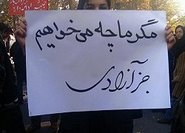
Hundreds of students, journalists and intellectuals have announced a 24-hour hunger strike on Friday to demand the release from jail of political prisoners including Ahmad Batebi, detained after the July 1999 students' protests. His father Bagher Batebi has also launched an appeal for the international public opinion demanding the release of his son which has been published by Amnesty International.Batebi was arrested in July 1999 after he became a symbol of the students' movement following the publication on the British-based Economist magazine's front page of a picture of him holding the bloodied shirt of a fellow student killed by police at a student rally. His wife Sommayah Batinat was arrested last week after disclosing to the international media, that her husband was still in detention despite his poor health. Plainclothes officials reportedly brought the woman to an undisclosed location . Batebi's parents have since Thursday morning also started a sit-in protest at Tehran's Daneshjoo( Students) park where they say they will remain until their son is freed. "For the past eight years I have been watching the famous picture of my son while waiting for his release and I have no intention to sit still," said Bagher Batebi in his appeal. "I ask the entire world to help us free Ahmad before he is handed back to us inside a coffin."
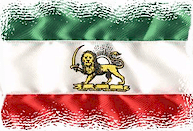
IMPERIAL EMBLEM

PERSIA
Iranian Freedom Fighters UNITE
Showing posts with label Regime change. Show all posts
Showing posts with label Regime change. Show all posts
Thursday, March 01, 2007


Bolton Calls for `Regime Change' in Iran, Chastises Europeans
By Janine Zacharia and Bill Varner
March 1 (Bloomberg) -- John Bolton, the former American envoy to the United Nations, said the U.S. should pursue ``regime change'' in Iran because European governments refuse to back sanctions tough enough to halt the suspected Iranian nuclear-bomb program. ``I believe that either regime change in Iran or, as a last resort, military action is the only thing that will stop the Iranians from getting nuclear weapons,'' Bolton said in an interview today in Washington.
Bolton, a 58-year-old former arms-control official, said the Bush administration had allowed Britain, France and Germany to ``screw around'' in nuclear talks. The diplomacy has gone on for ``three and a half years, and that allowed the Iranians to make enormous progress on their nuclear-weapons program,'' he said. President George W. Bush, who labeled Iran and North Korea part of an ``axis of evil'' in 2002, has said their nuclear programs could pose a direct threat to the U.S., and that either nation might hand over atomic weapons to terrorists. The U.S. has pursued negotiated settlements with both countries while crafting UN sanctions aimed at cutting off nuclear trade with them. Bolton left the UN in December after failing to win congressional support to extend his tenure. He has emerged as a gadfly, criticizing the administration for its strategy on nuclear proliferation. He assailed Bush and his diplomats on Iran and for a deal with North Korea to trade energy aid for the closing of nuclear-arms-related facilities. Bolton said that accord is doomed to fail because of North Korea's record of cheating on similar arrangements.
`Fruitless' Effort
Broadly, Bolton said any negotiation with either North Korea or Iran to persuade them to abandon their nuclear ambitions won't work. ``Unless you're prepared to believe that the Iranians are voluntarily going to give up the pursuit of nuclear weapons, the idea of pursuing negotiations is ultimately going to be fruitless,'' Bolton said. Iranian President Mahmoud Ahmadinejad, pronounced ah-ma- deen-ah-ZHAD, on Feb. 25 compared Iran's nuclear development to an unstoppable train and said there would be no turning back. Iran ``threw away a while ago the reverse gear and brakes of this train,'' he said, in remarks carried by the state-run Iranian Students News Agency. Iranian officials insist the nuclear push is for commercial power generation, not weapons.
Intelligence Gap
Bolton, now with the American Enterprise Institute in Washington, said one drawback of any military strike on Iran is that the Iranians may have a secret uranium-enrichment facility that weapons inspectors will never find. ``The downside of the military option is that you would incur all of the costs of having undertaken military action but potentially not gotten the benefits of decisively breaking the nuclear fuel cycle at one or more points,'' he said. ``What that says is we need better intelligence about what the Iranians are actually up to beyond what is already in the public domain.'' Because of all of this, the U.S. needs to tap the ``substantial Iranian diaspora,'' which the U.S. is ``not using as effectively as we might,'' and ``exploit'' the dissatisfaction inside Iran to topple the cleric-led government that has ruled the country since the 1979 Islamic Revolution, Bolton said. The United Nations Security Council voted 15 to 0 on Dec. 23 to impose sanctions on Iran for its nuclear program for the first time, including a ban on acquisition of materials and technology that might be used to build an atomic bomb.
The U.S. was forced to agree to a watered-down version of what it sought in negotiations in the Security Council.
Enrichment Expands
Since the resolution's passage, Iran expanded its capacity to enrich uranium, defying a Security Council demand to halt its atomic work, and plans to install 3,000 centrifuges designed to produce nuclear fuel at its underground facility in Natanz by May, according to a Feb. 22 International Atomic Energy Agency report. The Security Council's five permanent members plus Germany met in London on Feb. 26 to discuss a draft resolution that would impose further penalties on Iran for refusing to halt uranium enrichment. Germany's envoy to the UN said Feb. 23 there should be only ``modest'' expansion of UN sanctions. Bolton said European reticence reflects a core problem: that those governments are ``overcome by their economic interests'' in the Iranian market. Countries and companies from Spain to Malaysia are pursuing long-term oil and gas agreements with Iran, rebuffing Bush's campaign to turn Iran into an economic pariah.
Bolton, who blasted the agreement the U.S., China, South Korea, Japan and Russia reached with North Korea that requires the country to scrap its plutonium-based nuclear weapons program in return for energy aid, criticized scheduled talks next week.
Talks Set
Assistant Secretary of State Christopher Hill's meeting with North Korea in New York, aimed at normalizing relations between the countries, won't lead Kim Jong Il's dictatorship to abandon nuclear weapons, Bolton said. Eventually the failure of diplomacy to disarm North Korea will force the U.S. to consider a military strike, he said. Hill is set to meet March 5 and 6 with North Korean Vice Foreign Minister Kim Kye Gwan. ``This is all a part of re-legitimizing them,'' Bolton said of the North Korean dictatorship. Hill, the U.S. envoy who negotiated the North Korea deal, said Feb. 22, ``We ultimately decided that, even though North Korea does need to make a strategic decision to get out of this nuclear weapons business, to realize that decision is going to require a step-by-step process.'' Bolton expressed concern that the new deal doesn't address North Korea's chemical weapons arsenal. He said the U.S. government estimates North Korea has up to 12,000 artillery tubes along the demilitarized zone with South Korea and that an initial attack on South Korea would be with chemical weapons.
March 1 (Bloomberg) -- John Bolton, the former American envoy to the United Nations, said the U.S. should pursue ``regime change'' in Iran because European governments refuse to back sanctions tough enough to halt the suspected Iranian nuclear-bomb program. ``I believe that either regime change in Iran or, as a last resort, military action is the only thing that will stop the Iranians from getting nuclear weapons,'' Bolton said in an interview today in Washington.
Bolton, a 58-year-old former arms-control official, said the Bush administration had allowed Britain, France and Germany to ``screw around'' in nuclear talks. The diplomacy has gone on for ``three and a half years, and that allowed the Iranians to make enormous progress on their nuclear-weapons program,'' he said. President George W. Bush, who labeled Iran and North Korea part of an ``axis of evil'' in 2002, has said their nuclear programs could pose a direct threat to the U.S., and that either nation might hand over atomic weapons to terrorists. The U.S. has pursued negotiated settlements with both countries while crafting UN sanctions aimed at cutting off nuclear trade with them. Bolton left the UN in December after failing to win congressional support to extend his tenure. He has emerged as a gadfly, criticizing the administration for its strategy on nuclear proliferation. He assailed Bush and his diplomats on Iran and for a deal with North Korea to trade energy aid for the closing of nuclear-arms-related facilities. Bolton said that accord is doomed to fail because of North Korea's record of cheating on similar arrangements.
`Fruitless' Effort
Broadly, Bolton said any negotiation with either North Korea or Iran to persuade them to abandon their nuclear ambitions won't work. ``Unless you're prepared to believe that the Iranians are voluntarily going to give up the pursuit of nuclear weapons, the idea of pursuing negotiations is ultimately going to be fruitless,'' Bolton said. Iranian President Mahmoud Ahmadinejad, pronounced ah-ma- deen-ah-ZHAD, on Feb. 25 compared Iran's nuclear development to an unstoppable train and said there would be no turning back. Iran ``threw away a while ago the reverse gear and brakes of this train,'' he said, in remarks carried by the state-run Iranian Students News Agency. Iranian officials insist the nuclear push is for commercial power generation, not weapons.
Intelligence Gap
Bolton, now with the American Enterprise Institute in Washington, said one drawback of any military strike on Iran is that the Iranians may have a secret uranium-enrichment facility that weapons inspectors will never find. ``The downside of the military option is that you would incur all of the costs of having undertaken military action but potentially not gotten the benefits of decisively breaking the nuclear fuel cycle at one or more points,'' he said. ``What that says is we need better intelligence about what the Iranians are actually up to beyond what is already in the public domain.'' Because of all of this, the U.S. needs to tap the ``substantial Iranian diaspora,'' which the U.S. is ``not using as effectively as we might,'' and ``exploit'' the dissatisfaction inside Iran to topple the cleric-led government that has ruled the country since the 1979 Islamic Revolution, Bolton said. The United Nations Security Council voted 15 to 0 on Dec. 23 to impose sanctions on Iran for its nuclear program for the first time, including a ban on acquisition of materials and technology that might be used to build an atomic bomb.
The U.S. was forced to agree to a watered-down version of what it sought in negotiations in the Security Council.
Enrichment Expands
Since the resolution's passage, Iran expanded its capacity to enrich uranium, defying a Security Council demand to halt its atomic work, and plans to install 3,000 centrifuges designed to produce nuclear fuel at its underground facility in Natanz by May, according to a Feb. 22 International Atomic Energy Agency report. The Security Council's five permanent members plus Germany met in London on Feb. 26 to discuss a draft resolution that would impose further penalties on Iran for refusing to halt uranium enrichment. Germany's envoy to the UN said Feb. 23 there should be only ``modest'' expansion of UN sanctions. Bolton said European reticence reflects a core problem: that those governments are ``overcome by their economic interests'' in the Iranian market. Countries and companies from Spain to Malaysia are pursuing long-term oil and gas agreements with Iran, rebuffing Bush's campaign to turn Iran into an economic pariah.
Bolton, who blasted the agreement the U.S., China, South Korea, Japan and Russia reached with North Korea that requires the country to scrap its plutonium-based nuclear weapons program in return for energy aid, criticized scheduled talks next week.
Talks Set
Assistant Secretary of State Christopher Hill's meeting with North Korea in New York, aimed at normalizing relations between the countries, won't lead Kim Jong Il's dictatorship to abandon nuclear weapons, Bolton said. Eventually the failure of diplomacy to disarm North Korea will force the U.S. to consider a military strike, he said. Hill is set to meet March 5 and 6 with North Korean Vice Foreign Minister Kim Kye Gwan. ``This is all a part of re-legitimizing them,'' Bolton said of the North Korean dictatorship. Hill, the U.S. envoy who negotiated the North Korea deal, said Feb. 22, ``We ultimately decided that, even though North Korea does need to make a strategic decision to get out of this nuclear weapons business, to realize that decision is going to require a step-by-step process.'' Bolton expressed concern that the new deal doesn't address North Korea's chemical weapons arsenal. He said the U.S. government estimates North Korea has up to 12,000 artillery tubes along the demilitarized zone with South Korea and that an initial attack on South Korea would be with chemical weapons.
Bolton Calls for `Regime Change' in Iran, Chastises Europeans
By Janine Zacharia and Bill Varner
March 1 (Bloomberg) -- John Bolton, the former American envoy to the United Nations, said the U.S. should pursue ``regime change'' in Iran because European governments refuse to back sanctions tough enough to halt the suspected Iranian nuclear-bomb program. ``I believe that either regime change in Iran or, as a last resort, military action is the only thing that will stop the Iranians from getting nuclear weapons,'' Bolton said in an interview today in Washington.
Bolton, a 58-year-old former arms-control official, said the Bush administration had allowed Britain, France and Germany to ``screw around'' in nuclear talks. The diplomacy has gone on for ``three and a half years, and that allowed the Iranians to make enormous progress on their nuclear-weapons program,'' he said. President George W. Bush, who labeled Iran and North Korea part of an ``axis of evil'' in 2002, has said their nuclear programs could pose a direct threat to the U.S., and that either nation might hand over atomic weapons to terrorists. The U.S. has pursued negotiated settlements with both countries while crafting UN sanctions aimed at cutting off nuclear trade with them. Bolton left the UN in December after failing to win congressional support to extend his tenure. He has emerged as a gadfly, criticizing the administration for its strategy on nuclear proliferation. He assailed Bush and his diplomats on Iran and for a deal with North Korea to trade energy aid for the closing of nuclear-arms-related facilities. Bolton said that accord is doomed to fail because of North Korea's record of cheating on similar arrangements.
`Fruitless' Effort
Broadly, Bolton said any negotiation with either North Korea or Iran to persuade them to abandon their nuclear ambitions won't work. ``Unless you're prepared to believe that the Iranians are voluntarily going to give up the pursuit of nuclear weapons, the idea of pursuing negotiations is ultimately going to be fruitless,'' Bolton said. Iranian President Mahmoud Ahmadinejad, pronounced ah-ma- deen-ah-ZHAD, on Feb. 25 compared Iran's nuclear development to an unstoppable train and said there would be no turning back. Iran ``threw away a while ago the reverse gear and brakes of this train,'' he said, in remarks carried by the state-run Iranian Students News Agency. Iranian officials insist the nuclear push is for commercial power generation, not weapons.
Intelligence Gap
Bolton, now with the American Enterprise Institute in Washington, said one drawback of any military strike on Iran is that the Iranians may have a secret uranium-enrichment facility that weapons inspectors will never find. ``The downside of the military option is that you would incur all of the costs of having undertaken military action but potentially not gotten the benefits of decisively breaking the nuclear fuel cycle at one or more points,'' he said. ``What that says is we need better intelligence about what the Iranians are actually up to beyond what is already in the public domain.'' Because of all of this, the U.S. needs to tap the ``substantial Iranian diaspora,'' which the U.S. is ``not using as effectively as we might,'' and ``exploit'' the dissatisfaction inside Iran to topple the cleric-led government that has ruled the country since the 1979 Islamic Revolution, Bolton said. The United Nations Security Council voted 15 to 0 on Dec. 23 to impose sanctions on Iran for its nuclear program for the first time, including a ban on acquisition of materials and technology that might be used to build an atomic bomb.
The U.S. was forced to agree to a watered-down version of what it sought in negotiations in the Security Council.
Enrichment Expands
Since the resolution's passage, Iran expanded its capacity to enrich uranium, defying a Security Council demand to halt its atomic work, and plans to install 3,000 centrifuges designed to produce nuclear fuel at its underground facility in Natanz by May, according to a Feb. 22 International Atomic Energy Agency report. The Security Council's five permanent members plus Germany met in London on Feb. 26 to discuss a draft resolution that would impose further penalties on Iran for refusing to halt uranium enrichment. Germany's envoy to the UN said Feb. 23 there should be only ``modest'' expansion of UN sanctions. Bolton said European reticence reflects a core problem: that those governments are ``overcome by their economic interests'' in the Iranian market. Countries and companies from Spain to Malaysia are pursuing long-term oil and gas agreements with Iran, rebuffing Bush's campaign to turn Iran into an economic pariah.
Bolton, who blasted the agreement the U.S., China, South Korea, Japan and Russia reached with North Korea that requires the country to scrap its plutonium-based nuclear weapons program in return for energy aid, criticized scheduled talks next week.
Talks Set
Assistant Secretary of State Christopher Hill's meeting with North Korea in New York, aimed at normalizing relations between the countries, won't lead Kim Jong Il's dictatorship to abandon nuclear weapons, Bolton said. Eventually the failure of diplomacy to disarm North Korea will force the U.S. to consider a military strike, he said. Hill is set to meet March 5 and 6 with North Korean Vice Foreign Minister Kim Kye Gwan. ``This is all a part of re-legitimizing them,'' Bolton said of the North Korean dictatorship. Hill, the U.S. envoy who negotiated the North Korea deal, said Feb. 22, ``We ultimately decided that, even though North Korea does need to make a strategic decision to get out of this nuclear weapons business, to realize that decision is going to require a step-by-step process.'' Bolton expressed concern that the new deal doesn't address North Korea's chemical weapons arsenal. He said the U.S. government estimates North Korea has up to 12,000 artillery tubes along the demilitarized zone with South Korea and that an initial attack on South Korea would be with chemical weapons.
March 1 (Bloomberg) -- John Bolton, the former American envoy to the United Nations, said the U.S. should pursue ``regime change'' in Iran because European governments refuse to back sanctions tough enough to halt the suspected Iranian nuclear-bomb program. ``I believe that either regime change in Iran or, as a last resort, military action is the only thing that will stop the Iranians from getting nuclear weapons,'' Bolton said in an interview today in Washington.
Bolton, a 58-year-old former arms-control official, said the Bush administration had allowed Britain, France and Germany to ``screw around'' in nuclear talks. The diplomacy has gone on for ``three and a half years, and that allowed the Iranians to make enormous progress on their nuclear-weapons program,'' he said. President George W. Bush, who labeled Iran and North Korea part of an ``axis of evil'' in 2002, has said their nuclear programs could pose a direct threat to the U.S., and that either nation might hand over atomic weapons to terrorists. The U.S. has pursued negotiated settlements with both countries while crafting UN sanctions aimed at cutting off nuclear trade with them. Bolton left the UN in December after failing to win congressional support to extend his tenure. He has emerged as a gadfly, criticizing the administration for its strategy on nuclear proliferation. He assailed Bush and his diplomats on Iran and for a deal with North Korea to trade energy aid for the closing of nuclear-arms-related facilities. Bolton said that accord is doomed to fail because of North Korea's record of cheating on similar arrangements.
`Fruitless' Effort
Broadly, Bolton said any negotiation with either North Korea or Iran to persuade them to abandon their nuclear ambitions won't work. ``Unless you're prepared to believe that the Iranians are voluntarily going to give up the pursuit of nuclear weapons, the idea of pursuing negotiations is ultimately going to be fruitless,'' Bolton said. Iranian President Mahmoud Ahmadinejad, pronounced ah-ma- deen-ah-ZHAD, on Feb. 25 compared Iran's nuclear development to an unstoppable train and said there would be no turning back. Iran ``threw away a while ago the reverse gear and brakes of this train,'' he said, in remarks carried by the state-run Iranian Students News Agency. Iranian officials insist the nuclear push is for commercial power generation, not weapons.
Intelligence Gap
Bolton, now with the American Enterprise Institute in Washington, said one drawback of any military strike on Iran is that the Iranians may have a secret uranium-enrichment facility that weapons inspectors will never find. ``The downside of the military option is that you would incur all of the costs of having undertaken military action but potentially not gotten the benefits of decisively breaking the nuclear fuel cycle at one or more points,'' he said. ``What that says is we need better intelligence about what the Iranians are actually up to beyond what is already in the public domain.'' Because of all of this, the U.S. needs to tap the ``substantial Iranian diaspora,'' which the U.S. is ``not using as effectively as we might,'' and ``exploit'' the dissatisfaction inside Iran to topple the cleric-led government that has ruled the country since the 1979 Islamic Revolution, Bolton said. The United Nations Security Council voted 15 to 0 on Dec. 23 to impose sanctions on Iran for its nuclear program for the first time, including a ban on acquisition of materials and technology that might be used to build an atomic bomb.
The U.S. was forced to agree to a watered-down version of what it sought in negotiations in the Security Council.
Enrichment Expands
Since the resolution's passage, Iran expanded its capacity to enrich uranium, defying a Security Council demand to halt its atomic work, and plans to install 3,000 centrifuges designed to produce nuclear fuel at its underground facility in Natanz by May, according to a Feb. 22 International Atomic Energy Agency report. The Security Council's five permanent members plus Germany met in London on Feb. 26 to discuss a draft resolution that would impose further penalties on Iran for refusing to halt uranium enrichment. Germany's envoy to the UN said Feb. 23 there should be only ``modest'' expansion of UN sanctions. Bolton said European reticence reflects a core problem: that those governments are ``overcome by their economic interests'' in the Iranian market. Countries and companies from Spain to Malaysia are pursuing long-term oil and gas agreements with Iran, rebuffing Bush's campaign to turn Iran into an economic pariah.
Bolton, who blasted the agreement the U.S., China, South Korea, Japan and Russia reached with North Korea that requires the country to scrap its plutonium-based nuclear weapons program in return for energy aid, criticized scheduled talks next week.
Talks Set
Assistant Secretary of State Christopher Hill's meeting with North Korea in New York, aimed at normalizing relations between the countries, won't lead Kim Jong Il's dictatorship to abandon nuclear weapons, Bolton said. Eventually the failure of diplomacy to disarm North Korea will force the U.S. to consider a military strike, he said. Hill is set to meet March 5 and 6 with North Korean Vice Foreign Minister Kim Kye Gwan. ``This is all a part of re-legitimizing them,'' Bolton said of the North Korean dictatorship. Hill, the U.S. envoy who negotiated the North Korea deal, said Feb. 22, ``We ultimately decided that, even though North Korea does need to make a strategic decision to get out of this nuclear weapons business, to realize that decision is going to require a step-by-step process.'' Bolton expressed concern that the new deal doesn't address North Korea's chemical weapons arsenal. He said the U.S. government estimates North Korea has up to 12,000 artillery tubes along the demilitarized zone with South Korea and that an initial attack on South Korea would be with chemical weapons.
Thursday, February 15, 2007
Fight Iran with a war of ideas
Empowering the country's dissidents, not military action, is the best way to weaken the Islamic regime. By Azar Nafisi, AZAR NAFISI is director of the Dialogue Project at the School of International Studies at Johns Hopkins University.February 15, 2007
THOSE WHO SEE a military attack on Iran as inevitable are relying on a specific interpretation and image of that country: Iran supports terrorism and develops weapons of mass destruction. The terms "WMD" and "terror" generate panic and fear, and the images coming out of Iran seem to justify those responses. However, that is an incomplete picture, one that has been reduced to the Iran espoused by President Mahmoud Ahmadinejad and his supporters: a belligerent president, a violent rhetoric, a denial of the Holocaust. In addition, some analysts and Iran experts say that the Iranian people have given up on change, that they have left the political arena, opting for economic wellbeing, and therefore there is no longer a real resistance against the Islamic regime.Those who hold this narrow and dire view conclude that such conditions could lead to a military attack on Iran. But were we to include the full range of images and voices in Iran today in the scenario, we would see that Ahmadinejad's violent rhetoric abroad and repressive measures at home stem not from a position of strength but weakness. Since his election, there have been two demonstrations by Iranian women and a campaign to gather a million signatures against the segregationist laws in Iran. There have been workers' protests in 10 cities since January, and others at universities, which Ahmadinejad has called the bedrock of "secularism and liberalism"; students have greeted him and his projects with slogans of "death to the dictator." He has been the target of severe criticism even within the ruling hierarchy, including the conservative camp. And he has been chastised in parliament for using bluster and violent rhetoric abroad to divert attention from domestic problems, especially dire economic conditions, inflation and unemployment. Under such conditions, who would benefit from a military attack on Iran? Not the workers, students, minorities, women or the dissenters who have been trying to find nonviolent and democratic ways of resisting and changing the present system. Such an attack would provide an excuse for the most reactionary and violent elements within the ruling elite to stifle any voice of dissent not just from within the civil society, but from the divided and factional ruling elite. It would help rally factions within that elite behind Ahmadinejad, and it would provide Iran a good excuse to attempt to further isolate the United States within the international community. In other words, the main beneficiary of an attack on Iran would be the most militaristic and reactionary elements in the Iranian ruling hierarchy. As someone who has for years advocated that the best policy toward Iran is to support the Iranian people's democratic aspirations and that the only means of establishing pluralism and openness in that country is through democratic and nonviolent means, I emphasize once more that the best weapon democracies have against repressive regimes and against terror is not military but ideological and cultural. The most effective war against the tyrants in Iran is through giving voice to the workers asking for their rights, to women fighting for equality and to students, journalists, writers and intellectuals fighting for freedom of expression.To miss this opportunity not only would be disastrous for the Iranian people, it would have dire consequences for the United States and the world.
THOSE WHO SEE a military attack on Iran as inevitable are relying on a specific interpretation and image of that country: Iran supports terrorism and develops weapons of mass destruction. The terms "WMD" and "terror" generate panic and fear, and the images coming out of Iran seem to justify those responses. However, that is an incomplete picture, one that has been reduced to the Iran espoused by President Mahmoud Ahmadinejad and his supporters: a belligerent president, a violent rhetoric, a denial of the Holocaust. In addition, some analysts and Iran experts say that the Iranian people have given up on change, that they have left the political arena, opting for economic wellbeing, and therefore there is no longer a real resistance against the Islamic regime.Those who hold this narrow and dire view conclude that such conditions could lead to a military attack on Iran. But were we to include the full range of images and voices in Iran today in the scenario, we would see that Ahmadinejad's violent rhetoric abroad and repressive measures at home stem not from a position of strength but weakness. Since his election, there have been two demonstrations by Iranian women and a campaign to gather a million signatures against the segregationist laws in Iran. There have been workers' protests in 10 cities since January, and others at universities, which Ahmadinejad has called the bedrock of "secularism and liberalism"; students have greeted him and his projects with slogans of "death to the dictator." He has been the target of severe criticism even within the ruling hierarchy, including the conservative camp. And he has been chastised in parliament for using bluster and violent rhetoric abroad to divert attention from domestic problems, especially dire economic conditions, inflation and unemployment. Under such conditions, who would benefit from a military attack on Iran? Not the workers, students, minorities, women or the dissenters who have been trying to find nonviolent and democratic ways of resisting and changing the present system. Such an attack would provide an excuse for the most reactionary and violent elements within the ruling elite to stifle any voice of dissent not just from within the civil society, but from the divided and factional ruling elite. It would help rally factions within that elite behind Ahmadinejad, and it would provide Iran a good excuse to attempt to further isolate the United States within the international community. In other words, the main beneficiary of an attack on Iran would be the most militaristic and reactionary elements in the Iranian ruling hierarchy. As someone who has for years advocated that the best policy toward Iran is to support the Iranian people's democratic aspirations and that the only means of establishing pluralism and openness in that country is through democratic and nonviolent means, I emphasize once more that the best weapon democracies have against repressive regimes and against terror is not military but ideological and cultural. The most effective war against the tyrants in Iran is through giving voice to the workers asking for their rights, to women fighting for equality and to students, journalists, writers and intellectuals fighting for freedom of expression.To miss this opportunity not only would be disastrous for the Iranian people, it would have dire consequences for the United States and the world.
Subscribe to:
Posts (Atom)


 Posts
Posts




 اخبار مربوط به زندانیان سیاسی و نقض حقوق بشر







 Tulips in Holland