

U.S. Says Iran-backed Groups Using Secret Arms Stores
The U.S. military said on Sunday it had evidence Iranian- backed Shi'ite militias in Iraq were increasingly using secret weapons stores to attack U.S. and Iraqi forces. The accusation comes days after Tehran postponed talks with the United States on improving security in Iraq for "technical reasons", a move that prompted rebukes from U.S. officials.
By Mohammed Abbas
Iran Hangs 2 on Murder and Rape Charges
TEHRAN -- Iran on Sunday executed two men — one accused of murder and the other of raping children — in a prison in the northeastern province of Khorasan, the ISNA news agency reported. By The New York Times
Iran Ayatollah Drops Dead During Speech
An Iranian ayatollah died suddenly of a heart attack during an impassioned speech lashing out at insults against the family of revolutionary founder Ayatollah Ruhollah Khomeini in the run-up to elections, the press reported on Sunday. By AFP
Israel Kills Terror Chief with Headrest Bomb
Nothing seemed very remarkable about the short, bearded man who mingled with other guests on Tuesday evening at a reception in Damascus, the Syrian capital, to mark the 29th anniversary of Ayatollah Khomeini’s Iranian revolution. By The Times
Government Fights to Keep Ban on Iranian Opposition Group
The government is to appeal today against a court ruling, won by 35 MPs and peers, that it should remove the People's Mujahideen of Iran (PMOI), the main Iranian opposition organisation, from the list of banned terrorist organisations. By The Guardian
Introducing to you another traitor to the Iranian Nation ; Mr. ZABETI
http://tinyurl.com/2y42qo
While supporting the PMOI - see what eles ZABETI does : http://www.mishcon.com/about/profiles/docs/profile_284.aspx
Khamenei Says God Protects Nuclear Program
Iran -- Iran's supreme leader Ayatollah Ali Khamenei said Sunday that God would punish Iranians if they do not support the country's disputed nuclear program, state radio reported. "The Iranian people openly announce that they will defend their rights... God will reprimand them if they do not do so," state radio quoted Khamenei as saying. By The Associated Press
US Effort to Remake Ties with Iran Running Out of Steam, Time
WASHINGTON -- The Bush administration’s second-term gambit to remake the troubled U.S. relationship with Iran has run out of gas and time. By The Associated Press
Iran commander: Hezbollah will destroy 'cancerous germ' of Israel - Iran Guards urges Hezbollah to destroy Israel - Iran guards predict Israel demise
Beirut / Tehran - The head of Iran's Revolutionary Guards said on Monday Israel would soon be destroyed by the "hands of Hezbollah", the Lebanese group which is backed by the Islamic Republic, Fars News Agency reported. Guards commander-in-chief Mohammad Ali Jafari ( pictured) made the comment in a....... Iran's Revolutionary Guards leader says Hezbollah will soon destroy Israel, in a letter to Hassan Nasrallah.... Iran says Israel to be "destroyed" by Hezbollah "soon" - TEHRAN, Feb. 18 (Xinhua) -- Chief of Iran's Revolutionary Guards on Monday said Israel would be destroyed soon by the Lebanese Hezbollah militant group, the semi-official Fars news agency reported. "In the near future, we are going to see the destruction of cancerous Israel by the powerful and....... Iran predicts Hezbollah will destroy Israel (AFP) - AFP - Iran's Revolutionary Guards on Monday predicted Hezbollah would destroy Israel, in a new verbal onslaught against the Jewish state after the murder of a top commander of Lebanon's Shiite militant group.... Iran does not recognize Israel's right to exist, and its president, Mahmoud Ahmadinejad, has often predicted the imminent demise of Israel. Western analysts say the Revolutionary Guards, an ideological wing of Iran's armed forces, has given military support to Hezbollah.... Hezbollah will soon destroy Israel, says Iran Guards -TEHRAN (Reuters) - The head of Iran's Revolutionary Guards said on Monday Israel would soon be destroyed by the "hands of Hezbollah", the Lebanese group which is backed by the Islamic Republic, Fars News Agency reported.... Iran predicts 'destruction' of Israel by Hezbollah (AFP) - AFP - Iran's Revolutionary Guards on Monday predicted that Israel would be destroyed by the Lebanese Shiite militant group Hezbollah in the "near future", the Fars news agency reported.... Iran predicts Hezbollah to destroy Israel - Revolutionary Guards’ commander says Muslims’ intentions will be firmer against Israel following Mughnieh’s killing.... Iran commander: Hezbollah will destroy 'cancerous germ' of Israel - Iran does not recognize Israel's right to exist, and its President, Mahmoud Ahmadinejad, has often predicted the imminent demise of Israel. Western analysts say the Revolutionary Guards, an ideological wing of Iran's armed forces, has given military support to Hezbollah.... Iran Guards : Hezbollah Will Soon Destroy Israel -The head of Iran's Revolutionary Guards said on Monday Israel would soon be destroyed by the "hands of Hezbollah", the Lebanese group which is backed by the Islamic Republic, Fars News Agency reported. Guards commander-in-chief Mohammad Ali Jafari made the comment in a letter to Hezbollah leader.......
IMPERIAL EMBLEM

PERSIA
Iranian Freedom Fighters UNITE
Showing posts with label hangings. Show all posts
Showing posts with label hangings. Show all posts
Sunday, February 17, 2008
Latest News
0
comments

 Labels:
Atom,
Ayathollah,
Bomb,
Dead,
hangings,
Iran,
Iraq,
Islamic Republic of Idiots,
Israel,
Shi'ite militias,
Us Military,
USA
Labels:
Atom,
Ayathollah,
Bomb,
Dead,
hangings,
Iran,
Iraq,
Islamic Republic of Idiots,
Israel,
Shi'ite militias,
Us Military,
USA
Labels:
Atom,
Ayathollah,
Bomb,
Dead,
hangings,
Iran,
Iraq,
Islamic Republic of Idiots,
Israel,
Shi'ite militias,
Us Military,
USA
Tuesday, February 12, 2008
Artificial Intelligence : Using TAGHIEH against the mullahs
US Intel Links Iran With Nuke Bomb Bid
February 14, 2008 The Associated Press George Jahn
VIENNA, Austria -- The U.S. has recently shared new intelligence with the International Atomic Energy Agency on key aspects of Iran's nuclear program that Washington says shows Tehran was directly engaged in trying to make a bomb, diplomats said Thursday.One of the diplomats said Washington also gave the IAEA permission to confront Iran with at least some of the evidence in an attempt to pry details out of the Islamic republic, as part of the U.N. nuclear watchdog's attempts to investigate Iran's suspicious nuclear past.The diplomats suggested that such moves by the U.S. administration would be a reflection of Washington's' drive to pressure Iran into acknowledging that it had focused part of its nuclear efforts toward developing a weapons program.The U.S. is leading the push for a third set of U.N. sanctions against Iran. Tehran insists its program is intended only to produce energy and has refused U.N. demands that it suspend its uranium enrichment program - technology that can produce both fuel for nuclear reactors and the fissile material for a bomb.A recent U.S. intelligence assessment that Iran had a clandestine weapons program but stopped working on it four years ago has hurt Washington's attempts to have the U.N. Security Council impose a third set of sanctions.While the Americans have previously declassified and then forwarded intelligence to the IAEA to help its investigations, they do so on a selective basis.Following Israel's bombing of a Syrian site late last year, and media reports citing unidentified U.S. officials as saying the target was a nuclear installation, IAEA chief Mohamed ElBaradei turned in vain to the U.S. in asking for details on what was struck, said a diplomat who - like others - spoke on condition of anonymity in exchange for divulging confidential information.Over the past two years, the U.S. already has shared material on a laptop computer reportedly smuggled out of Iran. In 2005, U.S. intelligence assessed that information as indicating that Tehran had been working on details of nuclear weapons, including missile trajectories and ideal altitudes for exploding warheads.After declassification, U.S. intelligence also was forwarded on two other issues: the "Green Salt Project" - a plan the U.S. alleges links diverse components of a nuclear weapons program, including uranium enrichment, high explosives testing and a missile re-entry vehicle - and material in Iran's possession showing how to mold uranium metal into warhead form.Two of the diplomats said the material forwarded to the IAEA over the past two weeks expanded on the previous information from the Americans, but had no additional details.Iran is already under two sets of U.N. Security Council sanctions for refusing to suspend uranium enrichment, which it started developing during nearly two decades of covert nuclear activity built on illicit purchases and revealed only five years ago.Since then, IAEA experts have uncovered activities, experiments, and blueprints and materials that point to possible efforts by Iran to create nuclear weapons, even though Tehran insists its nuclear project is peaceful and aimed only at creating a large-scale enrichment facility to make reactor fuel.Its leaders consistently dismiss allegations that they are interested in enrichment for its other use - creating fissile material suitable for arming warheads.Instead of heeding Security Council demands to freeze enrichment, Iran has expanded its program. On Wednesday, diplomats told the AP that Iran's new generation of advanced centrifuges have begun processing small quantities of the gas that can be used to make the fissile core of nuclear warheads.
US Confirms Upcoming Talks with Iran on Iraq
WASHINGTON -- The United States confirmed Monday reports that it is planning a new round of talks with Iran on the future of war-ravaged Iraq, but that the two sides have yet to agree on a date. By AFP
Many Iranians Says Revolutionary Ideals Still Unmet
In Tehran Monday, tens of thousands celebrated the 29th anniversary of the Islamic Revolution in 1979. By The Christian Science Monitor
A Campaign to Stop Stoning
Iranian judges apparently didn't get the memo about the moratorium on stoning issued in 2002 by Ayatollah Shahroudi, head of the judiciary. According to Amnesty International, nine women and two men are currently in prison awaiting this cruel and barbaric punishment, which is usually meted out for sexual transgressions. By The Nation
Many in Iran Bear the U.S. No Ill Will
TEHRAN -- When the shah ruled Iran, the Westernized elite would enjoy Hollywood movies at a small theater in the center of the city. Today, that theater is an Islamic cultural center and a meeting place for fundamentalists. By The International Herald Tribune
Iran Parades Captured British Naval Boat
The Iranian president today attempted to humiliate Britain by parading a captured naval boat in a huge rally marking the anniversary of the 1979 Islamic revolution. Mahmoud Ahmadinejad also used the occasion to tell huge crowds in Tehran that Iran will not back down "one iota" in its nuclear dispute with Western powers. By Daily Mail
A Hard Winter in Iran
If the upcoming parliamentary elections in Iran were open and democratic, President Mahmoud Ahmadinejad and the ruling mullahs would have a lot to worry about. How would you like your allies to face an electorate when, in one of the coldest winters in recent memory, the government has left thousands of people for days or even weeks with no natural gas for heat? When even those in Tehran have suffered rolling blackouts every night for a month, robbing people of electricity and heat for hours at a time? And all this while the country's major export -- oil -- is at nearly 100 dollars a barrel? By Chicago Tribune
Iran Sets Up Banks to Sidestep US Curbs
Iran's first investment banks will start operating next month, part of Tehran's strategy of opening new banking channels but also part of its effort to circumvent US restrictions on its financial sector. more By The Financial Times
Polish Gas Monopoly Signs Preliminary Gas Deal with Iran
WARSAW -- Polish gas monopoly PGNiG signed a preliminary deal with an Iranian state-owned oil company to cooperate on managing already-discovered gas reserves, it said on Monday. more By Reuters
US Captures Militia Leader With Iran Ties
U.S. soldiers captured a suspected Shiite militia commander and one other suspect Monday, the latest of several days of raids in Shiite holy cities south of Baghdad. more By The Associated Press
Iran Sees Less Threat in Exiled MKO Militants
TEHRAN, Iran -– Gholam Reza Sadeghi felt certain of his fate if he ever returned to Iran: torture and execution, given his years as a member of the antiregime Mujahideen-e Khalq, or "People's Holy Warriors." more By The Christian Science Monitor
Iran's Old Guard Pushed Aside
TEHRAN -- After Ayatollah Ruhollah Khomeini's followers toppled a U.S.-backed autocracy in Iran, he brought to power a coterie of politically engaged clerics who sought to create the world's first Islamic republic. Nearly 30 years later, a new generation of politicians is sweeping aside those clerics, many of whom had become proponents of better relations with the West and gradual steps toward greater democracy. By The Washington Post
Thousands Rally to Mark Revolution, Defy Nuclear Pressure
TEHRAN -- Tens of thousands of Iranians rallied on Monday to mark the 29th anniversary of the Islamic revolution, in a show of defiance of Western pressure on Iran to suspend its disputed nuclear program. By Reuters
Does Iranian Government Fear Educated Women?
Who’s afraid of girls? The Iranian government, it seems. Recent years have seen a dramatic rise in the number of Iranian girls enrolling in universities and other institutions of higher education. While many governments would see this as a blessing worth boasting about, that's not the case in Iran. By Radio Free Europe/RadioLiberty
Artificial Intelligence : Using TAGHIEH against the mullahs
February 11, 2008 The Washington Institute for Near East Policy Patrick Clawson
Though the White House press release read "President Bush to travel to Middle East to follow up on progress made at Annapolis," his January trip actually centered on Iran, a country he did not visit. America's friends -- the Persian Gulf monarchs as well as Israel -- fear that the publication of the recent National Intelligence Estimate (NIE) means the United States is weakening in its resolve to confront the rising threat from Iran. President Bush made his Middle East jaunt, in part, to assure them that that assessment was premature.Since its appearance in December, the NIE has given pause to Israeli policy makers and provided succor for State Department analysts who believe the Bush administration is overestimating the case for Tehran's nuclear intentions. That is because the report implies that the threat from Iran has diminished. But in fact, a careful and close reading of the NIE does not warrant this interpretation. In the end, the report will only make it harder to address a growing threat to world peace.Indeed, Americans might believe we no longer have to worry about Iran's nuclear program. In fact, the problem is worse because diplomacy may be more complicated, though not necessarily impossible. The most troubling prospect is that the United States and Israel are headed in opposite directions, which could lead to a severe strain in their relationship.The NIE begins: "We judge with high confidence that in fall 2003, Tehran halted its nuclear weapons program." That's nice, but it does not matter very much. As the NIE states, "We assess with high confidence that Iran has the scientific, technical, and industrial capacity eventually to produce nuclear weapons if it decides to do so." The key word in that sentence is "eventually" because the most vital question is when Iran will be able to produce its first nuclear weapon. The NIE says nothing about how the reported halt of Iran's nuclear weapons program affects that date.Despite the impression given by the wording in the NIE, Iran has by no means stopped its nuclear activities. In fact, Iran proudly shows off the progress it is making with its huge uranium-enrichment facilities. The Nobel Peace Prize-winning director of the International Atomic Energy Agency (IAEA), Mohamed ElBaradei, has said that when those facilities are completed, Iran would need only "a few months" more to build a nuclear weapon. That estimate suggests that the hard part is enriching the uranium -- not making a bomb. In other words, the wording of the NIE is deceptive: building a bomb is relatively easy. Producing nuclear material is not.That is why the 40-year effort to verify and enforce the Nuclear Nonproliferation Treaty (NPT) has been based on controlling the production of fissile material -- that is, enriched uranium or plutonium. NPT enforcement is based on safeguarding nuclear material, not only looking to see if a country is building a weapon. Iran does not need to have a weapons program -- that is, a bomb-design program -- until it is close to producing fissile material. After all, Iran does not need a sophisticated warhead such as the ones that go atop missiles. It could put a bulky, heavy nuclear device into a ship container or a truck -- similar to the truck Iran's proxies used to bomb the U.S. Marine barracks in Beirut in 1983.So what does the NIE say about when Iran will be able to make sufficient fissile material for a bomb? The old estimate, made in 2005, stated this was "unlikely before early-to-mid next decade." The new NIE says, "Iran probably would be technically capable of producing enough HEU [highly enriched uranium] for a weapon sometime during the 2010-2015 time frame." The only caveat is from the State Department's intelligence arm, which "judges that Iran is unlikely to achieve this capability before 2013." How nice -- we may even have as long as five years. That is better than nothing, but it is not very good.International Pressure, U.S. Engagement or Military Force?The NIE argues that Iran can be persuaded through sticks and carrots: "We judge with high confidence that the halt [in Iran's nuclear weapons program] was directed primarily in response to increasing international scrutiny and pressure resulting from exposure of Iran's previously undeclared nuclear work."Iran's decision to suspend its nuclear weapons program, in fact, came in the fall of 2003, after the British, French and German leaders bluntly told Iran: suspend your nuclear program or suffer the consequences. Their stand was unprecedented in its forcefulness for the usually mild Europeans. And, of course, they acted in the wake of what then looked like a successful U.S. invasion of Iraq. The lesson the NIE draws is that when Iran sees a united international community, it backs down."Our assessment that the [nuclear weapons] program probably was halted primarily in response to international pressure suggests Iran may be more vulnerable to influence on the issue than we judged previously," the NIE reads.I think that is correct; a longtime theme of my work has been Iran's vulnerability to influence on the nuclear issue, so it would be comforting to think that the NIE is accurate in this regard. But honesty as an analyst compels me to report that the NIE provides little reason to come to this conclusion.The alternative, more cynical interpretation from many of my Israeli friends is that Iran understood that suspending its nuclear weapons program would have no effect on its progress toward nuclear weapons, yet would reduce the risk that IAEA inspectors would discover Iran's true intentions. In other words, the NIE displays undue confidence that the U.S. intelligence community knows not just what happened but the reasons why.That over-confidence fits a pattern. The sad reality is that the U.S. intelligence community's track record on Iran suggests that its knowledge has been not much better than it was about Iraq or North Korea. As the new NIE points out, the 2005 estimate assessed "with high confidence that Iran currently is determined to develop nuclear weapons," whereas the new estimate is that Iran halted its nuclear weapons program in fall 2003 -- well before the 2005 estimate came out.Since the intelligence community has now decided it was wrong in 2005, one might think that U.S. intelligence agencies would be more cautious about what they now purport to know. It is possible that the new information is the last word on the subject, but it is vital to remember that deciding whether or not Iran is "determined" is a matter of interpretation, not just information.According to the NIE, Iran did in fact have a covert nuclear weapons program up until 2003. If that information is correct, then Iran has been in complete violation of its obligations under the NPT, both by having a program until 2003 and then not reporting it up through the present day. Only full disclosure can provide confidence that Iran will not restart the program.What if Iran gets to the brink of a bomb?If Iran gets to the brink of a bomb, then there will be a vigorous debate about what to do. The two obvious alternatives are: stop Iran's nuclear program by force or live with it by deterring it. Military force is always a terrible choice, so we need to carefully consider whether there is a better alternative. Deterrence sounds attractive; after all, it worked during the Cold War.But deterrence is not a simple policy. Even during the Cold War, it meant accepting great risks, as evident from the Cuban missile crisis. And deterring a nuclear Iran is likely to prove much more difficult than deterrence was during the Cold War for a host of reasons: The Cold War required committing hundreds of thousands of troops and hundreds of billions of dollars a year for decades. The international community may not have the political will to assemble a broad coalition of states ready to commit forces to deter a nuclear Iran or the staying power to maintain such a military coalition over a period of decades. The Cold War saw mid-size powers like Germany and Italy reluctantly accept protection from the superpowers rather than build their own nuclear weapons. It will be no small challenge to deter the dozens of other potential proliferators who may conclude from Iran's experience that there is little price to be paid for violating the NPT or withdrawing from it. Since Iran's clandestine nuclear activities were brought to light, nine Middle East countries have announced they are rethinking their nuclear options. The Middle East security environment is much more complicated than the straightforward East-West Cold War. The Iran-Iraq war killed a half million people, at least 10 times more than have died in all Israeli-Arab fighting. Introduce nuclear weapons into this messy situation, and many more may die. The Soviet Union more or less lived up to agreements it made. The Islamic Republic of Iran has a long history of dissimulation. Iran may be tempted to try covert, deniable nuclear weapons delivery -- for instance, by terrorist groups -- which the United States would have difficulty attributing to it.For all its faults, the Soviet Union was a tightly run ship. Iran's regime is dotted with factions that seem to pay little attention to any central authority. What's worse, the Revolutionary Guards, the same radical elements that provide support to terrorists, control aspects of the nuclear program. To say that there are potential command-and-control problems is an understatement. The Soviet communist system wanted to rule the world. In Islamic Iran, some radical elements appear to be willing to destroy the world. They are so highly confident God is on their side that they are ready to risk bringing on the apocalypse.What Will Israel Do?If the United States decides to live with a nuclear-armed Iran, Israel may not accede. For the United States, Iranian nuclear capability is a big problem but by no means an existential threat. By contrast, Israel has to worry that Iran will supplement the hundreds of millions of dollars it spends each year to arm those fighting to wipe Israel off the map (Hamas and Hezbollah) with nuclear threats aimed at the same purpose.If Israel decides to use force on its own, that would have many disadvantages for U.S. interests. An Israeli strike would convert a global issue about Iran's failure to comply with its obligations under international treaties into an Iranian-Israeli dispute, where many around the world would automatically take sides against Israel.An Israeli strike could engender such international criticism that Iran would be confident it can rebuild without fearing international disapproval, much less a second round of strikes. Many around the world would assume that Washington gave Israel permission, if not assistance, so the United States would face much the same reaction as if it had carried out a raid itself. That could mean vicious Iranian responses against U.S. interests.If Israel acts against the wishes of the United States, the worst of all situations would be created if it does the job poorly. In such a case, the threat from Iran's nuclear program would be magnified, and the U.S.-Israel alliance would be damaged. Unfortunately, this case is distinctly possible. This makes it all the more urgent that we reinforce diplomacy with tough sanctions and close international coordination at the highest levels to maximize the chances, admittedly fading, that Iran agrees to a compromise.Patrick Clawson, the deputy director for research of The Washington Institute for Near East Policy, is the author of several books on Iran.
February 14, 2008 The Associated Press George Jahn
VIENNA, Austria -- The U.S. has recently shared new intelligence with the International Atomic Energy Agency on key aspects of Iran's nuclear program that Washington says shows Tehran was directly engaged in trying to make a bomb, diplomats said Thursday.One of the diplomats said Washington also gave the IAEA permission to confront Iran with at least some of the evidence in an attempt to pry details out of the Islamic republic, as part of the U.N. nuclear watchdog's attempts to investigate Iran's suspicious nuclear past.The diplomats suggested that such moves by the U.S. administration would be a reflection of Washington's' drive to pressure Iran into acknowledging that it had focused part of its nuclear efforts toward developing a weapons program.The U.S. is leading the push for a third set of U.N. sanctions against Iran. Tehran insists its program is intended only to produce energy and has refused U.N. demands that it suspend its uranium enrichment program - technology that can produce both fuel for nuclear reactors and the fissile material for a bomb.A recent U.S. intelligence assessment that Iran had a clandestine weapons program but stopped working on it four years ago has hurt Washington's attempts to have the U.N. Security Council impose a third set of sanctions.While the Americans have previously declassified and then forwarded intelligence to the IAEA to help its investigations, they do so on a selective basis.Following Israel's bombing of a Syrian site late last year, and media reports citing unidentified U.S. officials as saying the target was a nuclear installation, IAEA chief Mohamed ElBaradei turned in vain to the U.S. in asking for details on what was struck, said a diplomat who - like others - spoke on condition of anonymity in exchange for divulging confidential information.Over the past two years, the U.S. already has shared material on a laptop computer reportedly smuggled out of Iran. In 2005, U.S. intelligence assessed that information as indicating that Tehran had been working on details of nuclear weapons, including missile trajectories and ideal altitudes for exploding warheads.After declassification, U.S. intelligence also was forwarded on two other issues: the "Green Salt Project" - a plan the U.S. alleges links diverse components of a nuclear weapons program, including uranium enrichment, high explosives testing and a missile re-entry vehicle - and material in Iran's possession showing how to mold uranium metal into warhead form.Two of the diplomats said the material forwarded to the IAEA over the past two weeks expanded on the previous information from the Americans, but had no additional details.Iran is already under two sets of U.N. Security Council sanctions for refusing to suspend uranium enrichment, which it started developing during nearly two decades of covert nuclear activity built on illicit purchases and revealed only five years ago.Since then, IAEA experts have uncovered activities, experiments, and blueprints and materials that point to possible efforts by Iran to create nuclear weapons, even though Tehran insists its nuclear project is peaceful and aimed only at creating a large-scale enrichment facility to make reactor fuel.Its leaders consistently dismiss allegations that they are interested in enrichment for its other use - creating fissile material suitable for arming warheads.Instead of heeding Security Council demands to freeze enrichment, Iran has expanded its program. On Wednesday, diplomats told the AP that Iran's new generation of advanced centrifuges have begun processing small quantities of the gas that can be used to make the fissile core of nuclear warheads.
US Confirms Upcoming Talks with Iran on Iraq
WASHINGTON -- The United States confirmed Monday reports that it is planning a new round of talks with Iran on the future of war-ravaged Iraq, but that the two sides have yet to agree on a date. By AFP
Many Iranians Says Revolutionary Ideals Still Unmet
In Tehran Monday, tens of thousands celebrated the 29th anniversary of the Islamic Revolution in 1979. By The Christian Science Monitor
A Campaign to Stop Stoning
Iranian judges apparently didn't get the memo about the moratorium on stoning issued in 2002 by Ayatollah Shahroudi, head of the judiciary. According to Amnesty International, nine women and two men are currently in prison awaiting this cruel and barbaric punishment, which is usually meted out for sexual transgressions. By The Nation
Many in Iran Bear the U.S. No Ill Will
TEHRAN -- When the shah ruled Iran, the Westernized elite would enjoy Hollywood movies at a small theater in the center of the city. Today, that theater is an Islamic cultural center and a meeting place for fundamentalists. By The International Herald Tribune
Iran Parades Captured British Naval Boat
The Iranian president today attempted to humiliate Britain by parading a captured naval boat in a huge rally marking the anniversary of the 1979 Islamic revolution. Mahmoud Ahmadinejad also used the occasion to tell huge crowds in Tehran that Iran will not back down "one iota" in its nuclear dispute with Western powers. By Daily Mail
A Hard Winter in Iran
If the upcoming parliamentary elections in Iran were open and democratic, President Mahmoud Ahmadinejad and the ruling mullahs would have a lot to worry about. How would you like your allies to face an electorate when, in one of the coldest winters in recent memory, the government has left thousands of people for days or even weeks with no natural gas for heat? When even those in Tehran have suffered rolling blackouts every night for a month, robbing people of electricity and heat for hours at a time? And all this while the country's major export -- oil -- is at nearly 100 dollars a barrel? By Chicago Tribune
Iran Sets Up Banks to Sidestep US Curbs
Iran's first investment banks will start operating next month, part of Tehran's strategy of opening new banking channels but also part of its effort to circumvent US restrictions on its financial sector. more By The Financial Times
Polish Gas Monopoly Signs Preliminary Gas Deal with Iran
WARSAW -- Polish gas monopoly PGNiG signed a preliminary deal with an Iranian state-owned oil company to cooperate on managing already-discovered gas reserves, it said on Monday. more By Reuters
US Captures Militia Leader With Iran Ties
U.S. soldiers captured a suspected Shiite militia commander and one other suspect Monday, the latest of several days of raids in Shiite holy cities south of Baghdad. more By The Associated Press
Iran Sees Less Threat in Exiled MKO Militants
TEHRAN, Iran -– Gholam Reza Sadeghi felt certain of his fate if he ever returned to Iran: torture and execution, given his years as a member of the antiregime Mujahideen-e Khalq, or "People's Holy Warriors." more By The Christian Science Monitor
Iran's Old Guard Pushed Aside
TEHRAN -- After Ayatollah Ruhollah Khomeini's followers toppled a U.S.-backed autocracy in Iran, he brought to power a coterie of politically engaged clerics who sought to create the world's first Islamic republic. Nearly 30 years later, a new generation of politicians is sweeping aside those clerics, many of whom had become proponents of better relations with the West and gradual steps toward greater democracy. By The Washington Post
Thousands Rally to Mark Revolution, Defy Nuclear Pressure
TEHRAN -- Tens of thousands of Iranians rallied on Monday to mark the 29th anniversary of the Islamic revolution, in a show of defiance of Western pressure on Iran to suspend its disputed nuclear program. By Reuters
Does Iranian Government Fear Educated Women?
Who’s afraid of girls? The Iranian government, it seems. Recent years have seen a dramatic rise in the number of Iranian girls enrolling in universities and other institutions of higher education. While many governments would see this as a blessing worth boasting about, that's not the case in Iran. By Radio Free Europe/RadioLiberty
Artificial Intelligence : Using TAGHIEH against the mullahs
February 11, 2008 The Washington Institute for Near East Policy Patrick Clawson
Though the White House press release read "President Bush to travel to Middle East to follow up on progress made at Annapolis," his January trip actually centered on Iran, a country he did not visit. America's friends -- the Persian Gulf monarchs as well as Israel -- fear that the publication of the recent National Intelligence Estimate (NIE) means the United States is weakening in its resolve to confront the rising threat from Iran. President Bush made his Middle East jaunt, in part, to assure them that that assessment was premature.Since its appearance in December, the NIE has given pause to Israeli policy makers and provided succor for State Department analysts who believe the Bush administration is overestimating the case for Tehran's nuclear intentions. That is because the report implies that the threat from Iran has diminished. But in fact, a careful and close reading of the NIE does not warrant this interpretation. In the end, the report will only make it harder to address a growing threat to world peace.Indeed, Americans might believe we no longer have to worry about Iran's nuclear program. In fact, the problem is worse because diplomacy may be more complicated, though not necessarily impossible. The most troubling prospect is that the United States and Israel are headed in opposite directions, which could lead to a severe strain in their relationship.The NIE begins: "We judge with high confidence that in fall 2003, Tehran halted its nuclear weapons program." That's nice, but it does not matter very much. As the NIE states, "We assess with high confidence that Iran has the scientific, technical, and industrial capacity eventually to produce nuclear weapons if it decides to do so." The key word in that sentence is "eventually" because the most vital question is when Iran will be able to produce its first nuclear weapon. The NIE says nothing about how the reported halt of Iran's nuclear weapons program affects that date.Despite the impression given by the wording in the NIE, Iran has by no means stopped its nuclear activities. In fact, Iran proudly shows off the progress it is making with its huge uranium-enrichment facilities. The Nobel Peace Prize-winning director of the International Atomic Energy Agency (IAEA), Mohamed ElBaradei, has said that when those facilities are completed, Iran would need only "a few months" more to build a nuclear weapon. That estimate suggests that the hard part is enriching the uranium -- not making a bomb. In other words, the wording of the NIE is deceptive: building a bomb is relatively easy. Producing nuclear material is not.That is why the 40-year effort to verify and enforce the Nuclear Nonproliferation Treaty (NPT) has been based on controlling the production of fissile material -- that is, enriched uranium or plutonium. NPT enforcement is based on safeguarding nuclear material, not only looking to see if a country is building a weapon. Iran does not need to have a weapons program -- that is, a bomb-design program -- until it is close to producing fissile material. After all, Iran does not need a sophisticated warhead such as the ones that go atop missiles. It could put a bulky, heavy nuclear device into a ship container or a truck -- similar to the truck Iran's proxies used to bomb the U.S. Marine barracks in Beirut in 1983.So what does the NIE say about when Iran will be able to make sufficient fissile material for a bomb? The old estimate, made in 2005, stated this was "unlikely before early-to-mid next decade." The new NIE says, "Iran probably would be technically capable of producing enough HEU [highly enriched uranium] for a weapon sometime during the 2010-2015 time frame." The only caveat is from the State Department's intelligence arm, which "judges that Iran is unlikely to achieve this capability before 2013." How nice -- we may even have as long as five years. That is better than nothing, but it is not very good.International Pressure, U.S. Engagement or Military Force?The NIE argues that Iran can be persuaded through sticks and carrots: "We judge with high confidence that the halt [in Iran's nuclear weapons program] was directed primarily in response to increasing international scrutiny and pressure resulting from exposure of Iran's previously undeclared nuclear work."Iran's decision to suspend its nuclear weapons program, in fact, came in the fall of 2003, after the British, French and German leaders bluntly told Iran: suspend your nuclear program or suffer the consequences. Their stand was unprecedented in its forcefulness for the usually mild Europeans. And, of course, they acted in the wake of what then looked like a successful U.S. invasion of Iraq. The lesson the NIE draws is that when Iran sees a united international community, it backs down."Our assessment that the [nuclear weapons] program probably was halted primarily in response to international pressure suggests Iran may be more vulnerable to influence on the issue than we judged previously," the NIE reads.I think that is correct; a longtime theme of my work has been Iran's vulnerability to influence on the nuclear issue, so it would be comforting to think that the NIE is accurate in this regard. But honesty as an analyst compels me to report that the NIE provides little reason to come to this conclusion.The alternative, more cynical interpretation from many of my Israeli friends is that Iran understood that suspending its nuclear weapons program would have no effect on its progress toward nuclear weapons, yet would reduce the risk that IAEA inspectors would discover Iran's true intentions. In other words, the NIE displays undue confidence that the U.S. intelligence community knows not just what happened but the reasons why.That over-confidence fits a pattern. The sad reality is that the U.S. intelligence community's track record on Iran suggests that its knowledge has been not much better than it was about Iraq or North Korea. As the new NIE points out, the 2005 estimate assessed "with high confidence that Iran currently is determined to develop nuclear weapons," whereas the new estimate is that Iran halted its nuclear weapons program in fall 2003 -- well before the 2005 estimate came out.Since the intelligence community has now decided it was wrong in 2005, one might think that U.S. intelligence agencies would be more cautious about what they now purport to know. It is possible that the new information is the last word on the subject, but it is vital to remember that deciding whether or not Iran is "determined" is a matter of interpretation, not just information.According to the NIE, Iran did in fact have a covert nuclear weapons program up until 2003. If that information is correct, then Iran has been in complete violation of its obligations under the NPT, both by having a program until 2003 and then not reporting it up through the present day. Only full disclosure can provide confidence that Iran will not restart the program.What if Iran gets to the brink of a bomb?If Iran gets to the brink of a bomb, then there will be a vigorous debate about what to do. The two obvious alternatives are: stop Iran's nuclear program by force or live with it by deterring it. Military force is always a terrible choice, so we need to carefully consider whether there is a better alternative. Deterrence sounds attractive; after all, it worked during the Cold War.But deterrence is not a simple policy. Even during the Cold War, it meant accepting great risks, as evident from the Cuban missile crisis. And deterring a nuclear Iran is likely to prove much more difficult than deterrence was during the Cold War for a host of reasons: The Cold War required committing hundreds of thousands of troops and hundreds of billions of dollars a year for decades. The international community may not have the political will to assemble a broad coalition of states ready to commit forces to deter a nuclear Iran or the staying power to maintain such a military coalition over a period of decades. The Cold War saw mid-size powers like Germany and Italy reluctantly accept protection from the superpowers rather than build their own nuclear weapons. It will be no small challenge to deter the dozens of other potential proliferators who may conclude from Iran's experience that there is little price to be paid for violating the NPT or withdrawing from it. Since Iran's clandestine nuclear activities were brought to light, nine Middle East countries have announced they are rethinking their nuclear options. The Middle East security environment is much more complicated than the straightforward East-West Cold War. The Iran-Iraq war killed a half million people, at least 10 times more than have died in all Israeli-Arab fighting. Introduce nuclear weapons into this messy situation, and many more may die. The Soviet Union more or less lived up to agreements it made. The Islamic Republic of Iran has a long history of dissimulation. Iran may be tempted to try covert, deniable nuclear weapons delivery -- for instance, by terrorist groups -- which the United States would have difficulty attributing to it.For all its faults, the Soviet Union was a tightly run ship. Iran's regime is dotted with factions that seem to pay little attention to any central authority. What's worse, the Revolutionary Guards, the same radical elements that provide support to terrorists, control aspects of the nuclear program. To say that there are potential command-and-control problems is an understatement. The Soviet communist system wanted to rule the world. In Islamic Iran, some radical elements appear to be willing to destroy the world. They are so highly confident God is on their side that they are ready to risk bringing on the apocalypse.What Will Israel Do?If the United States decides to live with a nuclear-armed Iran, Israel may not accede. For the United States, Iranian nuclear capability is a big problem but by no means an existential threat. By contrast, Israel has to worry that Iran will supplement the hundreds of millions of dollars it spends each year to arm those fighting to wipe Israel off the map (Hamas and Hezbollah) with nuclear threats aimed at the same purpose.If Israel decides to use force on its own, that would have many disadvantages for U.S. interests. An Israeli strike would convert a global issue about Iran's failure to comply with its obligations under international treaties into an Iranian-Israeli dispute, where many around the world would automatically take sides against Israel.An Israeli strike could engender such international criticism that Iran would be confident it can rebuild without fearing international disapproval, much less a second round of strikes. Many around the world would assume that Washington gave Israel permission, if not assistance, so the United States would face much the same reaction as if it had carried out a raid itself. That could mean vicious Iranian responses against U.S. interests.If Israel acts against the wishes of the United States, the worst of all situations would be created if it does the job poorly. In such a case, the threat from Iran's nuclear program would be magnified, and the U.S.-Israel alliance would be damaged. Unfortunately, this case is distinctly possible. This makes it all the more urgent that we reinforce diplomacy with tough sanctions and close international coordination at the highest levels to maximize the chances, admittedly fading, that Iran agrees to a compromise.Patrick Clawson, the deputy director for research of The Washington Institute for Near East Policy, is the author of several books on Iran.
Tuesday, October 09, 2007
remeber all patriots killed by islamic-leftist terrorists
Let us not forget all our fallen comrades
No More Hanging In Iran
Persian Running Back
Friday, September 07, 2007
Domestic Genocide in Iran : Arutz Sheva Amil Imani : September 06, 2007
The world's most notorious state exponent of anti-Semitism, the Islamic Republic of Iran, is on a path to uproot not only all that are perceived as civilized, but to annihilate the greatest threat to its existence, the Iranian people. The mullahs and their mercenaries are wasting precious human life in order to maintain themselves in power through terrorizing the population. The Iranian people are simply hopeless and helpless. Even the United Nations does not come to their rescue. From its past performance, rather its absence of performance, we know that the UN watchdog is a true disgrace to dogs, since all it does is eat, sleep and look the other way. Furthermore, the dog has no teeth. The vet had to pull all its teeth before the dog became acceptable to the crafty cats that constitute the UN itself. The Islamic Republic of Iran is a unique creature - it is best described as a theocratic aristocracy. The "divinely-ordained" rulers maintain themselves in power by an elaborate system of patronage. Lucrative positions, contracts and valued privileges are distributed in this way. The result is that the ruling mullahs enjoy a significant number of supporters in all strata of society - the civil service, the military, the powerful Revolutionary Guards, and the hooligans and thugs who are ready to unleash their vicious attacks on anyone or any group that dares to challenge the in-charge men of Allah.The illegitimate government of the Islamic Republic of Iran is a quisling entity that has betrayed its people, its tradition, its glorious pre-Islamic achievements, and is incessantly working against Iran's national interest. Iran, under the stranglehold and machinations of the mullahs, has been transformed, in less than three decades, to the lead perpetrator of all that is abhorrent to humanity. The supreme leader of the Islamic Republic, Ali Khamenei, like his predecessor, Ayatollah Khomeini, whose callous disregard for human life was matched only by his consuming paranoia, allegedly has issued a decree to hang Iranian dissidents publicly in all the towns and villages with a population that exceeds 1,000 people. For Ayatollah Khamenei, dissident viewpoints represent an unacceptable threat. Anyone found questioning the Shari'a law - and many hundreds of thousands were - had to be "weeded out." The Islamic Republic is on a mission to end human life in Iran. Mass public hanging, as well as secret executions in prisons, are routine in the tyrannical Islamic Republic of Iran. Recently, Majid Kavousifar, 28, and his nephew, Hossein Kavousifar, 24, were hanged for the alleged murder of a hard-line judge, Hassan Moghaddas, who also was a deputy prosecutor and head of the "guidance" court in Tehran. Moghaddas was notorious for jailing political dissidents and condemning them to death. The victims were hanged from cranes and hoisted high above one of Tehran's busiest thoroughfares. This "judge" repeatedly bragged publicly that he often issued a death verdict without even examining the charges against the individual. The Islamic Republic of Iran has the dubious distinction of executing more children, those under the age of 18, than any other country in the world. Such is the plight of the Iranian people.Iran's ruling mullahs are clustered around major factions such as the conservatives, the moderates and the so-called reformists. Yet, the differences among these factions are tactical rather than strategic. One and all share the same overarching goal of defeating the "Crusader-Zionists" by any and all methods possible, bringing about the "end of the world" Armageddon, and thereby creating the requisite conditions for the appearance of the Hidden Imam, the Mahdi, to assume his rule of the world. "What is the likelihood that the ruling mullahs will actually use the bomb?" you may ask. "If they remain in power long enough to have it, they are very likely to use it, in one form or another," you are told. At the very least, they will use the bomb for blackmail and intimidation in the region. You may ask how you can help prevent this catastrophe. "Support the Iranian peoples' struggle for freedom by at least petitioning," you are told. (As for Majid and Hossein Kavousifar, they both left Iran for Abu Dhabi following the assassination of the murderous Judge Moghaddas. They apparently both took refuge in the US Embassy, where they applied for asylum in America. We have no information as to why they were handed over to the Islamic Republic authorities when the Americans were aware that the pair would definitely be facing execution. We hope that the US State Department can give us more information.) In order to achieve total control, the Islamic Republic and its lackeys spawned a series of immense internal purges, beginning in 1988 and known as the "Massacre of Political Prisoners of 1988." They have intensified their domestic terror in recent months and weeks. A society that is intense in its struggle for change has a flip side to its idealism: intolerance. This totalitarian regime sees enemies everywhere, enemies who want to destroy the Islamic Revolution and diminish the results of its hard work of creating an Islamic utopia in the land of Cyrus the Great.The regime seems to be panicking with hyper-suspiciousness. They have installed watchdogs in schools, universities, factories and all offices across the country, and are urged to be vigilant against sabotage, against those who crave freedom and democracy. Many innocent Iranians are being victimized, and the saying has gone around that "when you chop wood, the chips fly." As with Khamenei, it is believed that some who are innocent will have to be victimized if all of the guilty are to be apprehended.In fact, they stigmatize, victimize and murder people without any due process of law. On the slightest suspicion, they arrest, convict and execute. Few people would deny any longer that Islam and its variants mean, in practice, bloody terrorism, deadly purges, lethal actions, forced hijab, fatal deportations, extrajudicial executions, show trials and genocide. It is killing hundreds of thousands of innocent people. Today, the Islamic Republic of Iran is one of the greatest threats to the stability of the civilized world and humanity at large. It continues to impose this horrendous ideology called Islam on the Iranian population. The world must file legal charges against the leaders of the Islamic Republic for their wanton violation of the Universal Declaration of Human Rights: for their crimes against humanity and genocidal actions against religious and political groups; for support of international terrorism; for demolition of religious sites and cemeteries; for rape, torture, and summary executions of prisoners of conscience; for forgery of documents; for acts of blackmail and fraud; and for much more.To those misguided advocates of negotiation with the mullahs, beware. The mullahs are on an Allah-mandated mission. They are intoxicated with petrodollars and aim to settle for nothing less than complete domination of the world under the Islamic Ummah. It is precisely for this reason that they consider America and the West as Ofooli, a setting, dying system, while they believe their Islamism is Tolooi, a rising, living order. They are in no mood to negotiate for anything less than the total surrender of democracy, the very anathema to Islamism. This is only one reason, but perhaps one of the greatest reasons, for fostering democracy.
Amil Imani is an Iranian-born American citizen and pro-democracy activist residing in the United States of America. Imani is a columnist, literary translator, novelist and an essayist who has been writing and speaking out for the struggling people of his native land, Iran.
ALSO : Ba Dorood
Ba Dorood
Rejim Arab Bidanash Ra sabet Kard > https://iranbbb.org/12238.htm
Va Ba Dar Iran > https://iranbbb.org/12236.htm
Khodkoshi > https://iranbbb.org/12227.htm
Amil Imani is an Iranian-born American citizen and pro-democracy activist residing in the United States of America. Imani is a columnist, literary translator, novelist and an essayist who has been writing and speaking out for the struggling people of his native land, Iran.
ALSO : Ba Dorood
Ba Dorood
Rejim Arab Bidanash Ra sabet Kard > https://iranbbb.org/12238.htm
Va Ba Dar Iran > https://iranbbb.org/12236.htm
Khodkoshi > https://iranbbb.org/12227.htm
Friday, August 24, 2007
Iran's Hangmen Work Overtime to Silence Opposition : Telegraph Con Coughlin
August 24, 2007 - Stonings, hangings, floggings, purges. President Mahmoud Ahmadinejad might claim that United Nations sanctions can't hurt his country, but that is not how it feels for Iran's long-suffering population which now finds itself on the receiving end of one of the most brutal purges witnessed since the 1979 Islamic revolution.
The most visible manifestation of the new oppression sweeping Iran has been the wave of public executions and floggings carried out in Teheran and provincial capitals over recent weeks in a blatant attempt by the regime to intimidate political opponents. The official government line is that the punishments are part of its "Plan to Enforce Moral Behaviour". It's the same kind of argument that was used immediately after Ayatollah Ruhollah Khomeini took control to purge the country of its prosperous, secular middle class and secure his hold on power. Now Mr Ahmadinejad is adopting similar tactics in a desperate attempt to keep his embattled regime in power. Although Iran has one of the world's highest execution rates, until recently most of the sentences were carried out within the confines of prisons such as Teheran's notorious Evin complex. But this month diplomats at the Japanese and Australian embassies in the capital were alarmed to find the bodies of two convicted criminals hanging from cranes stationed directly outside their office windows. The location of the cranes, at a busy thoroughfare surrounded by office blocks, was chosen as much to remind the diplomatic community that Mr Ahmadinejad's hardline regime was still very much in charge as to send a message to ordinary citizens. For these public executions, together with the estimated 30 others that have taken place in other parts of the country, are nothing more than a brutal exercise in political, as opposed to religious, persecution. There have also been several public floggings carried out on men and women accused of flouting the strict morality laws. Many of the executions were shown live on Iranian television. The message the government wants to get across is clear: mess with us and this is what will happen to you. However much the authorities insist the sentences relate only to their campaign to improve public morals, Western diplomats in Teheran believe many of the victims have been singled out for their participation in the anti-government fuel riots that erupted in late June. Those disturbances, in which an estimated third of the country's petrol stations were destroyed by protesters angry at the introduction of fuel rationing (Iran, remember, boasts the world's second largest oil reserves), can be seen as a direct consequence of the sanctions imposed by the United Nations over Iran's controversial nuclear programme. It was the first serious challenge the regime encountered since setting itself on a collision course with the West following Mr Ahmadinejad's surprise election as president two years ago. So it is no coincidence that the past two months have seen a dramatic increase in the execution rate. Far from being pressured into changing tack on Iran's nuclear programme, Mr Ahmadinejad's regime remains determined to pursue the holy grail of uranium enrichment. It is even prepared to take extreme measures to silence domestic opposition, while at the same time placing loyal supporters of the regime under intense pressure to ensure the country's nuclear programme is not unduly affected by the UN sanctions. In this respect, the deal agreed this week between Teheran and the United Nations-sponsored International Atomic Energy Agency (IAEA), the Vienna-based organisation responsible for monitoring Iran's "peaceful" nuclear programme, should be taken with a pinch of salt. The official line from Teheran is that it is now prepared to readmit teams of UN nuclear experts to its top secret nuclear facilities and help clear up a number of issues relating to the development programme. This includes determining what small traces of weapons-grade uranium were doing at a facility that the Iranians insist is part of their nuclear power programme, which does not require uranium to be enriched to such a high level. But many diplomats suspect this is just another Iranian ploy to string out the UN while pressing ahead with its nuclear ambitions. Certainly there appears to have been no let-up in Iran's quest to acquire sophisticated uranium enrichment technology irrespective of the effects of sanctions. According to reports recently received by Western security sources, Iran has been concentrating its efforts on acquiring tens of thousands of highly specialised magnets that are an important component in the successful operation of the gas centrifuges that are used for uranium enrichment. Until the imposition of the UN sanctions this year Teheran had been able to buy industrial magnets from European Union countries. Now they are having to buy them on the black market, and are making intensive efforts to acquire the equipment illegally from former Soviet republics and the Far East. It's all crucial if the Iranians want to enrich uranium to a level that can be used for nuclear warheads. The Iranians' determination to get the magnets and other sophisticated industrial equipment has led Reza Tahmasebi, Iran's minister of industries and mines who was given responsibility for acquiring the magnets, to tender his resignation. When it comes to Iran's nuclear programme, Mr Ahmadinejad clearly wants results, not excuses. Mr Tahmasebi is just one of several prominent officials who have found themselves out of a job because of their failure to help Mr Ahmadinejad escape the more punitive affects of the UN economic sanctions. The governor of Iran's Central Bank, Ibrahim Shibani, is reported to have been relieved of his duties for failing to supervise adequately the return of Iranian overseas assets before they could be frozen, and dozens of other senior officials have lost their jobs as the regime seeks to tighten its grip over the entire apparatus of government. None of which is good news for those who still cling to the notion that the international dispute over Iran's nuclear programme can still be resolved by peaceful means.
The most visible manifestation of the new oppression sweeping Iran has been the wave of public executions and floggings carried out in Teheran and provincial capitals over recent weeks in a blatant attempt by the regime to intimidate political opponents. The official government line is that the punishments are part of its "Plan to Enforce Moral Behaviour". It's the same kind of argument that was used immediately after Ayatollah Ruhollah Khomeini took control to purge the country of its prosperous, secular middle class and secure his hold on power. Now Mr Ahmadinejad is adopting similar tactics in a desperate attempt to keep his embattled regime in power. Although Iran has one of the world's highest execution rates, until recently most of the sentences were carried out within the confines of prisons such as Teheran's notorious Evin complex. But this month diplomats at the Japanese and Australian embassies in the capital were alarmed to find the bodies of two convicted criminals hanging from cranes stationed directly outside their office windows. The location of the cranes, at a busy thoroughfare surrounded by office blocks, was chosen as much to remind the diplomatic community that Mr Ahmadinejad's hardline regime was still very much in charge as to send a message to ordinary citizens. For these public executions, together with the estimated 30 others that have taken place in other parts of the country, are nothing more than a brutal exercise in political, as opposed to religious, persecution. There have also been several public floggings carried out on men and women accused of flouting the strict morality laws. Many of the executions were shown live on Iranian television. The message the government wants to get across is clear: mess with us and this is what will happen to you. However much the authorities insist the sentences relate only to their campaign to improve public morals, Western diplomats in Teheran believe many of the victims have been singled out for their participation in the anti-government fuel riots that erupted in late June. Those disturbances, in which an estimated third of the country's petrol stations were destroyed by protesters angry at the introduction of fuel rationing (Iran, remember, boasts the world's second largest oil reserves), can be seen as a direct consequence of the sanctions imposed by the United Nations over Iran's controversial nuclear programme. It was the first serious challenge the regime encountered since setting itself on a collision course with the West following Mr Ahmadinejad's surprise election as president two years ago. So it is no coincidence that the past two months have seen a dramatic increase in the execution rate. Far from being pressured into changing tack on Iran's nuclear programme, Mr Ahmadinejad's regime remains determined to pursue the holy grail of uranium enrichment. It is even prepared to take extreme measures to silence domestic opposition, while at the same time placing loyal supporters of the regime under intense pressure to ensure the country's nuclear programme is not unduly affected by the UN sanctions. In this respect, the deal agreed this week between Teheran and the United Nations-sponsored International Atomic Energy Agency (IAEA), the Vienna-based organisation responsible for monitoring Iran's "peaceful" nuclear programme, should be taken with a pinch of salt. The official line from Teheran is that it is now prepared to readmit teams of UN nuclear experts to its top secret nuclear facilities and help clear up a number of issues relating to the development programme. This includes determining what small traces of weapons-grade uranium were doing at a facility that the Iranians insist is part of their nuclear power programme, which does not require uranium to be enriched to such a high level. But many diplomats suspect this is just another Iranian ploy to string out the UN while pressing ahead with its nuclear ambitions. Certainly there appears to have been no let-up in Iran's quest to acquire sophisticated uranium enrichment technology irrespective of the effects of sanctions. According to reports recently received by Western security sources, Iran has been concentrating its efforts on acquiring tens of thousands of highly specialised magnets that are an important component in the successful operation of the gas centrifuges that are used for uranium enrichment. Until the imposition of the UN sanctions this year Teheran had been able to buy industrial magnets from European Union countries. Now they are having to buy them on the black market, and are making intensive efforts to acquire the equipment illegally from former Soviet republics and the Far East. It's all crucial if the Iranians want to enrich uranium to a level that can be used for nuclear warheads. The Iranians' determination to get the magnets and other sophisticated industrial equipment has led Reza Tahmasebi, Iran's minister of industries and mines who was given responsibility for acquiring the magnets, to tender his resignation. When it comes to Iran's nuclear programme, Mr Ahmadinejad clearly wants results, not excuses. Mr Tahmasebi is just one of several prominent officials who have found themselves out of a job because of their failure to help Mr Ahmadinejad escape the more punitive affects of the UN economic sanctions. The governor of Iran's Central Bank, Ibrahim Shibani, is reported to have been relieved of his duties for failing to supervise adequately the return of Iranian overseas assets before they could be frozen, and dozens of other senior officials have lost their jobs as the regime seeks to tighten its grip over the entire apparatus of government. None of which is good news for those who still cling to the notion that the international dispute over Iran's nuclear programme can still be resolved by peaceful means.
Subscribe to:
Posts (Atom)




 Posts
Posts




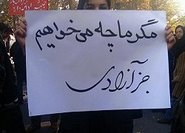
 اخبار مربوط به زندانیان سیاسی و نقض حقوق بشر







 Tulips in Holland