


By Patrick Seale, Special to Gulf News
Few observers of the international scene believe that the United States is preparing to go to war against Iran. The stakes are too high, the backlash too frightening, the consequences too unpredictable. The US Congress, in its present mood, would not allow it and no foreign government would support it, such is the international hostility to President George W. Bush.
Rather, the consensus is that the US is attempting to stop Iran from enriching uranium by using every other weapon in its armoury, short of war - by isolating Iran, subjecting it to diplomatic pressure, punishing it with sanctions, depriving it of finance to stifle its economy, starving its oil industry of investment and high tech equipment, and of course by a military build-up which is intended to intimidate, but not to be used. That, at least, is the theory. The danger, however, lies in an unplanned incident, an accident, perhaps a small-scale exchange of fire somewhere on the periphery of the US-Iranian confrontation, which could escalate into a full-blown conflict. It is this inherently unstable situation which has seriously alarmed the international community.
The reasons for acute tension remain unchanged. Iran insists on upholding its fundamental right to civilian nuclear technology under the Nuclear Non-Proliferation Treaty (NPT). Accordingly, it has ignored the deadline to suspend its uranium enrichment activities by February 21, as demanded by UN Security Council Resolution 1737 of December 23, 2006 - a document President Mahmoud Ahmadinejad has described as a "torn piece of paper".
Time and again
Iran has, however, repeated time and time again that it has no intention of building atomic weapons. Indeed, it has offered to give guarantees that it will not seek military applications of nuclear technology and has declared its readiness to enter into negotiations on this basis with the International Atomic Energy Agency (IAEA) and international partners. The United States, Israel and a number of other countries do not believe it. They suspect that Iran wants to become, if not an immediate nuclear-armed state, then a "nuclear threshold power"'. That is to say it is believed to want to master enough technology to allow it, in an emergency, to acquire nuclear weapons at short notice - like, say, Japan. Israel, in particular, has mounted a world-wide propaganda campaign against Iran, claiming its leader is a new Hitler and that Jews are threatened with another Holocaust. A more accurate reading of the situation might be to say that Israel is determined to protect the monopoly of nuclear weapons, which it has enjoyed in the Middle East for more than 40 years. Its overall military superiority - in conventional and unconventional weapons - has given it great freedom of action against its neighbours. It does not want this freedom to be circumscribed by a balance of power which Iran's rise to nuclear status would create. All these alarms - fear of an incident which might trigger a clash; concern that Israel and its friends might push the US into war, as they did against Iraq; widespread anxiety among Arab states of the consequences of a nuclear-armed Iran; anger at Ahmadinejad's verbal provocations - have caused the international community to wake up, take notice, and start considering corrective action. Several weeks ago, President Jacques Chirac of France suggested sending a high-level emissary to Tehran to calm the situation and probe Iranian intentions. The initiative was much criticised and nothing came of it. But something like it is now being revived.
Diplomatic sources report that, with French encouragement, the European Union is considering starting direct talks with Iran in the hope of defusing the situation and breaking the dangerous US-Iran deadlock. Russia, now building Iran's first nuclear power station at Bushehr and on reasonably good terms with Tehran, might join the talks in due course. Iran, in turn, is reaching out in its own way to the international community. First, it is reminding the world that Ahmadinejad is not all powerful. Command of Iran's armed forces and the final decision on matters of war and peace lie, not with the president, but with the Supreme Guide of the Islamic Republic, Ali Khamenei.
Forgotten fact
The latest reminder of this well-known, but sometimes forgotten fact, came from none other than Ali Akbat Velayati, Khomenei's diplomatic adviser for the past decade and Iran's foreign minister for 17 years. Secondly, Velayati has stressed that the Iranian official directly in charge of Iran's nuclear file is not the president but Ali Larajani, head of Iran's National Security Council. Thirdly, to allay the world's fears about Iran's nuclear intentions, Velayati has suggested that France should take the lead in setting up on Iranian territory an international consortium to enrich uranium, managed by the Europeans under full IAEA guarantees (Le Monde, February 22, 2007.) It is also significant that Saudi Arabia and its partners in the Gulf Cooperation Council are entering the scene. Anxious about a possible overspill of Iraq's Sunni-Shiite conflict into the Gulf, they have also begun a tentative dialogue with Iran.
It remains to be seen whether these measures will allow good sense and calm to prevail. Only when the interests and anxieties of Iran, the Arab states, Israel, America and the rest of the world are addressed can an acceptable settlement be reached. The immediate objective should be to reduce tension and back off from the military confrontation.
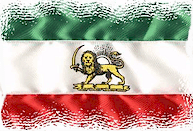
IMPERIAL EMBLEM

PERSIA
Iranian Freedom Fighters UNITE
Showing posts with label Concern in Iran. Political coalition. Show all posts
Showing posts with label Concern in Iran. Political coalition. Show all posts
Monday, February 26, 2007


Tuesday, February 20, 2007
Some propaganda Gospel according to BBC4 and Rageh Omaar
Find out what you're not supposed to know... while you still can...
Follow this link : http://www.informationliberation.com/?id=20386
Rageh Inside Iran
Rageh Omaar embarks on a unique journey inside what he describes as one of the most misunderstood countries in the world, looking at the country through the eyes of people rarely heard - ordinary Iranians.It took a year of wrangling to get permission to film inside Iran but the result is an amazing portrayal of an energetic and vibrant country that is completely different to the usual images seen in the media. A country of contrastsRageh soon discovers that Tehran is a complex place and uncovers a city of extremes of wealth and poverty, where some people survive on less than a dollar a day and others shop till they drop in glitzy shopping malls.Iran is a country that bans women from riding motorcycles but where 60 per cent of the student population is female. It is also a youthful place, with two thirds of Iran's 70 million population under the age of 30. Local storiesRageh meets with local people to hear their personal stories and feelings about the current state of affairs in Iran. There are stories of taxi drivers, wrestlers, business women, people working with drug addicts and the country's leading pop star and his manager - the 'Simon Cowell' of Iran.Rageh Inside Iran transcends images of angry demonstrations and burning flags to reveal a country that isn't without its problems but which is also fascinating, dynamic and hospitable.


 Posts
All Comments
Posts
All Comments


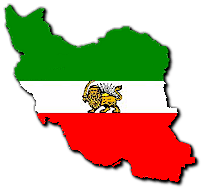
PERSIA

AHURAMAZDA

NU ROOZ E TON PEEROZE BAD

KILL THE DEMONS

SHIR O KHORSHID

STRIKE NOW
TO SHOW
SOLIDARITY
WITH THE
IMPRISONED
WOMEN, STUDENTS
AND THE
TRADE UNIONITS


نکته بیستم از پنجاه نکته اساسی مبارزه مسالمت آميزhttp://www.iranpressnews.com/javan/2008/04/3933.htm

WHO WOULD HAVE BELIEVED IT
 اخبار مربوط به زندانیان سیاسی و نقض حقوق بشر

AHMADINEJAD


The 7th Century Shrine, A symbol dedicated to the resistance of the Iranians against the invading Arabs
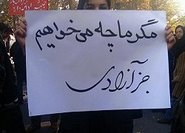
WHAT DO WE WANT OTHER THAN FREEDOM

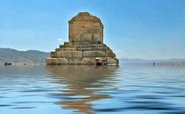
Catastrophe: http://www.savepasargad.com/european_languages.htm

UP YOURS

UP YOURS TOO !


Summer in Ibiza
 Tulips in Holland
Snow in Tehran

Autumn in Canada


 http://www.buzzinfly.com/
buzzradio.html
Podcast:http://www.audioagain.com/podcast.php?channel=buzzinfly
http://www.buzzinfly.com/
buzzradio.html
Podcast:http://www.audioagain.com/podcast.php?channel=buzzinfly


Follow this link : http://www.informationliberation.com/?id=20386
Rageh Inside Iran
Rageh Omaar embarks on a unique journey inside what he describes as one of the most misunderstood countries in the world, looking at the country through the eyes of people rarely heard - ordinary Iranians.It took a year of wrangling to get permission to film inside Iran but the result is an amazing portrayal of an energetic and vibrant country that is completely different to the usual images seen in the media. A country of contrastsRageh soon discovers that Tehran is a complex place and uncovers a city of extremes of wealth and poverty, where some people survive on less than a dollar a day and others shop till they drop in glitzy shopping malls.Iran is a country that bans women from riding motorcycles but where 60 per cent of the student population is female. It is also a youthful place, with two thirds of Iran's 70 million population under the age of 30. Local storiesRageh meets with local people to hear their personal stories and feelings about the current state of affairs in Iran. There are stories of taxi drivers, wrestlers, business women, people working with drug addicts and the country's leading pop star and his manager - the 'Simon Cowell' of Iran.Rageh Inside Iran transcends images of angry demonstrations and burning flags to reveal a country that isn't without its problems but which is also fascinating, dynamic and hospitable.
Monday, February 12, 2007
Ahmadinejad had said that the Gulf states are "gas stations, not real countries." NOW HE HAS TO EAT HUMBLE PIE !
ARABS ALLY VS. PERSIAN POWER
By AMIR TAHERI
February 12, 2007 -- A FEW weeks ago, when British Prime Minister Tony Blair evoked the idea of a bloc of moderate Arab states helping to stabilize the Middle East, many dismissed it as a pie in the sky: How, the pundits wondered, could Arabs, notorious for internecine feuds, develop a common strategy? Yet it looks as if such a bloc is taking shape. The latest sign came last week, when the rival Palestinian factions of Hamas and Fatah reached an accord to share power and stop their burgeoning civil war.

The accord, brokered by Saudi King Abdullah Ibn Abdul-Aziz, was signed in Mecca in view of the Ka'aba (the holiest place in Islam), thus enjoying special solemnity. In their speeches, Mahmoud Abbas (the Fatah leader and president of the Palestinian Authority) and Khalid al-Meshaal (Hamas' "supreme guide") vowed to implement the accord in full: "We promise here in this holy city and with the Ka'aba as our witness that we will not let the dark events of the past to be repeated." With the prospect of Palestinian harmony, revival of the peace process now looks possible for the first time in six years. And that could make a great contribution to easing regional tension. The Palestine-Israel issue is not the most important, let alone the only, cause of instability in the Middle East. But it has always been the easiest to exploit by those who wish to destabilize the region. As yet, the new bloc of moderate Arab states has no official name or structure. It is made up of the six members of the Gulf Cooperation Council, plus Jordan and Egypt, so some call it "the 6+2 group" As always with alliances, this bloc formed in response to a clear and present danger.
The perceived threat comes from the Islamic Republic of Iran - which can't decide whether it is a nation-state or a revolutionary cause.

The Mecca accord is a blow to the Islamic Republic's investment in Hamas and in Islamic Jihad in the hope of overthrowing President Abbas and extinguishing any chance of talks with Israel. Iran's president, Mahmoud Ahmadinejad, had designated the Palestinian territories as part of Iran's turf in an eventual war with Israel and the United States; with the Mecca accord, Tehran loses that part of its imagined power. Back in 2004, with the United States apparently bogged down in Iraq, the "revolutionary cause" advocates in Tehran moved onto the offensive. They argued that America would run away, first from Iraq and then from the whole region, burying dreams of a Pax Americana - so that Tehran could then impose a regional Pax Khomeinista as a first step toward claiming the leadership of Islam. The first move was to turn Syria into a client state; the next, to trigger last summer's war between Israel and Hezbollah. The perception that Israel was humiliated in that conflict enhanced Iran's prestige as a power capable of, one day, wiping "the Zionist enemy" off the map. But then Tehran overplayed its hand by ordering Hezbollah to try to seize power in Beirut. The specter of a "Shiite Crescent," first evoked by Jordan's King Abdullah II and dismissed as hyperbole, suddenly appeared real.
After some initial hesitation, the 6+2 nations decided to draw a line in the sand on Lebanon: Tehran would not be allowed to seize power in Beirut. The group's determination made it possible for the broader international community to also rally behind the government of Prime Minister Fuad Siniora. By the end of January, it had become clear that Tehran's bid in Beirut, although damaging Lebanon, had no chance of sweeping Hezbollah into power. Tehran's second mistake was to play a game of smoke and mirrors over its alleged nuclear ambitions. The leaders of the 6+2 bloc never believed that the Islamic Republic had told the truth on this issue. When Khomeinist emissaries appeared in Arab capitals to demand the use of oil as a political weapon in case the United States took military action against the Islamic Republic, suspicions rose further: Why was Iran's leadership prepared to risk war in defense of a nuclear program that it claims is entirely peaceful? The 6+2 bloc's response came in the form of a "technical statement" by Saudi Oil Minister Ali al-Nuaimi, reiterating the kingdom's 34-year-old policy of never playing politics with oil. Thus, if the Islamic Republic provoked a war, it would find itself as alone as Saddam Hussein was in 2003. Tehran's third mistake was to renew contacts with dissident Arab Shiite groups seeking the overthrow of Gulf regimes. Tehran had stopped supporting such groups in 1993, after an understanding between the Saudis' then-Crown Prince Abdullah and Hashemi Rafsanjani, then Iran's president. Tehran's fourth mistake was to set up a network of direct influence in Iraq. To do so, it bypassed its traditional Shiite allies (including Abdul-Aziz al-Hakim's Supreme Council for the Islamic Revolution in Iraq) for clients such as Muqtada al-Sadr and his Mahdi Army. In response, Hakim and the Da'awah Party of Prime Minister Nouri al-Maliki had to tone down their Shiism and emphasize their Arab-ness. That offered the 6+2 states new opportunities to develop a positive Iraq policy. Plans are under way for the bloc's next initiative, which centers on Iraq. Contact has already been established with key Iraqi leaders, Sunni and Shiite; a national reconciliation conference in Mecca could be organized within months. The expected improvement of the security situation in Baghdad under the new "surge" plan, led by Gen. David Petraeus, could help the process. Ahmadinejad may have to rethink his dismissal of the Gulf states as "gas stations, not real countries." The 6+2 is emerging as a real force. It has much scope for expansion by including such moderate Arab states as Tunisia, Algeria and Morocco. Somewhere down the road, Iraq , too, will join. Both Afghanistan and Pakistan are already undeclared allies of the 6+2, as is Turkey. The Islamic Republic, by contrast, has no allies outside Syria - and no prospect of attracting any. The 6+2 message is clear:
Even if the Americans run away post-Bush, these nations won't submit to a Pax Khomeinista dictated by Tehran.
By AMIR TAHERI
February 12, 2007 -- A FEW weeks ago, when British Prime Minister Tony Blair evoked the idea of a bloc of moderate Arab states helping to stabilize the Middle East, many dismissed it as a pie in the sky: How, the pundits wondered, could Arabs, notorious for internecine feuds, develop a common strategy? Yet it looks as if such a bloc is taking shape. The latest sign came last week, when the rival Palestinian factions of Hamas and Fatah reached an accord to share power and stop their burgeoning civil war.
The accord, brokered by Saudi King Abdullah Ibn Abdul-Aziz, was signed in Mecca in view of the Ka'aba (the holiest place in Islam), thus enjoying special solemnity. In their speeches, Mahmoud Abbas (the Fatah leader and president of the Palestinian Authority) and Khalid al-Meshaal (Hamas' "supreme guide") vowed to implement the accord in full: "We promise here in this holy city and with the Ka'aba as our witness that we will not let the dark events of the past to be repeated." With the prospect of Palestinian harmony, revival of the peace process now looks possible for the first time in six years. And that could make a great contribution to easing regional tension. The Palestine-Israel issue is not the most important, let alone the only, cause of instability in the Middle East. But it has always been the easiest to exploit by those who wish to destabilize the region. As yet, the new bloc of moderate Arab states has no official name or structure. It is made up of the six members of the Gulf Cooperation Council, plus Jordan and Egypt, so some call it "the 6+2 group" As always with alliances, this bloc formed in response to a clear and present danger.
The perceived threat comes from the Islamic Republic of Iran - which can't decide whether it is a nation-state or a revolutionary cause.
The Mecca accord is a blow to the Islamic Republic's investment in Hamas and in Islamic Jihad in the hope of overthrowing President Abbas and extinguishing any chance of talks with Israel. Iran's president, Mahmoud Ahmadinejad, had designated the Palestinian territories as part of Iran's turf in an eventual war with Israel and the United States; with the Mecca accord, Tehran loses that part of its imagined power. Back in 2004, with the United States apparently bogged down in Iraq, the "revolutionary cause" advocates in Tehran moved onto the offensive. They argued that America would run away, first from Iraq and then from the whole region, burying dreams of a Pax Americana - so that Tehran could then impose a regional Pax Khomeinista as a first step toward claiming the leadership of Islam. The first move was to turn Syria into a client state; the next, to trigger last summer's war between Israel and Hezbollah. The perception that Israel was humiliated in that conflict enhanced Iran's prestige as a power capable of, one day, wiping "the Zionist enemy" off the map. But then Tehran overplayed its hand by ordering Hezbollah to try to seize power in Beirut. The specter of a "Shiite Crescent," first evoked by Jordan's King Abdullah II and dismissed as hyperbole, suddenly appeared real.
After some initial hesitation, the 6+2 nations decided to draw a line in the sand on Lebanon: Tehran would not be allowed to seize power in Beirut. The group's determination made it possible for the broader international community to also rally behind the government of Prime Minister Fuad Siniora. By the end of January, it had become clear that Tehran's bid in Beirut, although damaging Lebanon, had no chance of sweeping Hezbollah into power. Tehran's second mistake was to play a game of smoke and mirrors over its alleged nuclear ambitions. The leaders of the 6+2 bloc never believed that the Islamic Republic had told the truth on this issue. When Khomeinist emissaries appeared in Arab capitals to demand the use of oil as a political weapon in case the United States took military action against the Islamic Republic, suspicions rose further: Why was Iran's leadership prepared to risk war in defense of a nuclear program that it claims is entirely peaceful? The 6+2 bloc's response came in the form of a "technical statement" by Saudi Oil Minister Ali al-Nuaimi, reiterating the kingdom's 34-year-old policy of never playing politics with oil. Thus, if the Islamic Republic provoked a war, it would find itself as alone as Saddam Hussein was in 2003. Tehran's third mistake was to renew contacts with dissident Arab Shiite groups seeking the overthrow of Gulf regimes. Tehran had stopped supporting such groups in 1993, after an understanding between the Saudis' then-Crown Prince Abdullah and Hashemi Rafsanjani, then Iran's president. Tehran's fourth mistake was to set up a network of direct influence in Iraq. To do so, it bypassed its traditional Shiite allies (including Abdul-Aziz al-Hakim's Supreme Council for the Islamic Revolution in Iraq) for clients such as Muqtada al-Sadr and his Mahdi Army. In response, Hakim and the Da'awah Party of Prime Minister Nouri al-Maliki had to tone down their Shiism and emphasize their Arab-ness. That offered the 6+2 states new opportunities to develop a positive Iraq policy. Plans are under way for the bloc's next initiative, which centers on Iraq. Contact has already been established with key Iraqi leaders, Sunni and Shiite; a national reconciliation conference in Mecca could be organized within months. The expected improvement of the security situation in Baghdad under the new "surge" plan, led by Gen. David Petraeus, could help the process. Ahmadinejad may have to rethink his dismissal of the Gulf states as "gas stations, not real countries." The 6+2 is emerging as a real force. It has much scope for expansion by including such moderate Arab states as Tunisia, Algeria and Morocco. Somewhere down the road, Iraq , too, will join. Both Afghanistan and Pakistan are already undeclared allies of the 6+2, as is Turkey. The Islamic Republic, by contrast, has no allies outside Syria - and no prospect of attracting any. The 6+2 message is clear:
Even if the Americans run away post-Bush, these nations won't submit to a Pax Khomeinista dictated by Tehran.
Saturday, February 03, 2007
Another nonsense Article by The Guardian
As US Power Fades, it Can't Find Friends to Take on Iran
February 02, 2007 / The Guardian
A REPLY TO THIS ARTICLE.
Mr. Jonathan Steele
In your article, http://www.guardian.co.uk/comment/story/0,,2004169,00.html , you say that "The dispute with Iran (IRI) is not as monumental as Washington claims". I assure you that the dispute of the Iranian Nation with the Fascist mullah Mafias ruling Iran is MONUMENTAL. its a case of life and death. Their survival and the slow death of a great nation. You obviously have been paid off handsomely by the IRI to write this drivel. YOU WILL BE FOUND OUT IN THE END LIKE SO MANY OTHERS WHO WERE IN THE PAYROLL OF SADDAM HUSSEIN.
Read the full article by following this link.
http://www.guardian.co.uk/comment/story/0,,2004169,00.html
February 02, 2007 / The Guardian
A REPLY TO THIS ARTICLE.
Mr. Jonathan Steele
In your article, http://www.guardian.co.uk/comment/story/0,,2004169,00.html , you say that "The dispute with Iran (IRI) is not as monumental as Washington claims". I assure you that the dispute of the Iranian Nation with the Fascist mullah Mafias ruling Iran is MONUMENTAL. its a case of life and death. Their survival and the slow death of a great nation. You obviously have been paid off handsomely by the IRI to write this drivel. YOU WILL BE FOUND OUT IN THE END LIKE SO MANY OTHERS WHO WERE IN THE PAYROLL OF SADDAM HUSSEIN.
Read the full article by following this link.
http://www.guardian.co.uk/comment/story/0,,2004169,00.html
Thursday, February 01, 2007
US warns Iran on Iraq insurgents
The US says Iran is providing more lethal bombs to insurgents . The US has issued the latest in a series of warnings to Iran, telling Tehran to stop helping Iraqi militants make lethal bombs to attack US troops. see : http://news.bbc.co.uk/1/hi/world/americas/6319451.stm
Wednesday, January 24, 2007
Minister: Iranian Forces Prepared "At the Highest Levels"
Xinhua / Mu Xuequan
TEHRAN -- Iranian Defense Minister Mostafa Mohammad Najjar said on Wednesday that Iranian forces are prepared "at the highest levels," the local Fars news agency reported. "Our armed forces are in a state of readiness at the highest levels and they are monitoring all enemy moves vigilantly," Najjar was quoted as saying on the sidelines of an open session of the parliament. The Iranian forces will give the most devastating response possible to even the smallest aggressive moves by the enemies, he said. The Iranian defense minister also dismissed the current U.S. build-up in the region, saying it is a display of power by the "enemy" to affect Iran through increased psychological pressure.
He also urged the administration of U.S. President George W. Bush to take "rational" actions when dealing with Iran. "If you are wise, you must contemplate and take an action which is rational and serves the interests of your nation," Najjar said. "During the past 27 years, whatever action the enemies have taken against us has ended up in their own detriment," he warned. Najjar's defiant remarks came amid reports that the United States is increasingly flexing its muscles to counter Iran's growing regional assertiveness and put more pressure on Tehran over its controversial nuclear program. A second U.S. aircraft carrier, the USS John C. Stennis, will arrive in the Middle East in about one month, the first time since the U.S.-led Iraq war in 2003 that the United States will have two carrier battle groups in the region. U.S. Defense Secretary Robert Gates has warned Iran that its perception of U.S. vulnerability in the region was part of the reason the Pentagon sent the aircraft carrier to the region.
TEHRAN -- Iranian Defense Minister Mostafa Mohammad Najjar said on Wednesday that Iranian forces are prepared "at the highest levels," the local Fars news agency reported. "Our armed forces are in a state of readiness at the highest levels and they are monitoring all enemy moves vigilantly," Najjar was quoted as saying on the sidelines of an open session of the parliament. The Iranian forces will give the most devastating response possible to even the smallest aggressive moves by the enemies, he said. The Iranian defense minister also dismissed the current U.S. build-up in the region, saying it is a display of power by the "enemy" to affect Iran through increased psychological pressure.
He also urged the administration of U.S. President George W. Bush to take "rational" actions when dealing with Iran. "If you are wise, you must contemplate and take an action which is rational and serves the interests of your nation," Najjar said. "During the past 27 years, whatever action the enemies have taken against us has ended up in their own detriment," he warned. Najjar's defiant remarks came amid reports that the United States is increasingly flexing its muscles to counter Iran's growing regional assertiveness and put more pressure on Tehran over its controversial nuclear program. A second U.S. aircraft carrier, the USS John C. Stennis, will arrive in the Middle East in about one month, the first time since the U.S.-led Iraq war in 2003 that the United States will have two carrier battle groups in the region. U.S. Defense Secretary Robert Gates has warned Iran that its perception of U.S. vulnerability in the region was part of the reason the Pentagon sent the aircraft carrier to the region.
A World Without Ahmadinejad?
OhmyNews / Ludwig De Braeckeleer
The Iranian president's defiant stance is putting the existence of the regime at risk. http://iranvajahan.net/cgi-bin/news.pl?l=en&y=2007&m=01&d=24&a=5
excerpts
Intervention From the Supreme Leader
Ayatollah Khamenei, Iran's supreme leader, seems eager to defuse current tensions with the international community. Through the media that he personally owns or directly controls, he has sent a clear message that the time has come for Ahmadinejad to keep quiet on the nuclear issue. The supreme leader has the final word over Iran's foreign policy, security and armed forces. As Khamenei believes that Washington's aim is to overthrow his regime, he has much to worry about. The White House has ignored the Iraq report recommendations to engage Iran. Richard Perle has recently declared that Bush would order a military strike on Iran's nuclear facilities if they attempt to acquire nuclear weapons and recent top military appointments as well as sea power reinforcements in the Persian Gulf would seem to indicate that the White House might indeed order such an attack. Officials close to Khamenei have said that he will favour a new team of negotiators that would possibly be led by Mohammad Moussavian, a former senior nuclear negotiator and an ally of Ali Akhbar Hashemi Rafsanjani, the former president of Iran who was defeated by Ahmadinejad in 2005. A few days ago, Moussavian accused Ahmadinejad of lying to the people about the grave consequences of the penalties voted for by the Security Council. "Our advice to the president is to speak about the nuclear issue only during important national occasions, stop provoking aggressive powers like the United States and concentrate more on the daily needs of the people, those who voted for you on your promises," wrote the Islamic Republic, a newspaper owned by Khamenei.
In recent weeks, a radio program has allowed open debate on the controversial issue of Iran's nuclear program. In Iran, the state-owned broadcasting monopoly is not controlled by the government. Instead, the agency responds directly to the supreme leader, Ayatollah Khamenei. The current director of the agency, Ezzatollah Zarghami, who took over in mid-2005, is a former general of the conservative Revolutionary Guards. Zarghami is believed to be close to Khamenei. It is not entirely clear why Khamenei has allowed this debate. What is clear is that some of the guests have fiercely criticised the nuclear program. "Why have the officials linked the country's development to the nuclear program? Why have they tried to convince people with the wrong notion that if we suspend our program we lose our national identity and our independence?" asked Sadeq Zibakalam, a professor of political science at Tehran University. Zibakalam said that a developing country such as Iran would be better off investing in schools and hospitals. He argued that the sanctions, let alone a military confrontation, would destroy Iran.
Is the Regime in Danger?
In recent months, allies and critics of Ahmadinejad have agreed on one premise: there is not much the Western powers can do to Iran for the country holds all the cards. The local and traditional rival has been eliminated. The U.S. military is bogged downed in a disastrous civil war in Iraq. The Israeli army lost its aura of invincibility in the Lebanon war. Russia is eager to protect its business interests and China needs energy. Last but not least, oil prices are high. No wonder Tehran feels confident. Still, the confidence of Iranian leaders could be misplaced as they may soon find out that they are not operating from a position of strength.
About 70 per cent of the Iranian government revenue comes from oil profit. Yet, due to a lack of investment and modernisation of their installations, Iran fails to meet the quota set by OPEC. This year, the loss may amount to about $6 billion. According to a recent study, the oil exports revenue will continue to decline at a rate of 10-12 percentage annually and may completely dry up by 2015. For sure, the study relies on some hypotheses that are difficult to test. For instance, it assumes that due to current geopolitical uncertainties in the region countries such as China and Japan will refrain from investing the funds necessary to offset the current decline in oil production. Recent events confirm this assumption. For instance, Japan has greatly reduced its anticipated investments in Iranian oil fields. The mere possibility of such a scenario is certainly giving top Iranian officials a pause. To the conservative establishment, Ahmadinejad has become a liability. His defiant stance is now putting the existence of the regime at risk. At the same time, he has lost his power base as he failed to deliver on his promised domestic reforms. His departure would at least provide a short-term cosmetic solution to a dangerously escalating crisis. The parliament could impeach him. The supreme leader could simply remove him.
Or maybe, the regime will just find another way to push him aside, quiet his rhetoric and remind him that under the constitution, he is indeed answerable to people, yet enjoys very limited powers to achieve his goals.
Short of a military strike against Iran, one may expect Ahmadinejad to fade away in a much less visible role. But should the United States or Israel opt for that solution, it is a safe bet to expect all Iranians, including his most outspoken critics, to close ranks behind him.
The Iranian president's defiant stance is putting the existence of the regime at risk. http://iranvajahan.net/cgi-bin/news.pl?l=en&y=2007&m=01&d=24&a=5
excerpts
Intervention From the Supreme Leader
Ayatollah Khamenei, Iran's supreme leader, seems eager to defuse current tensions with the international community. Through the media that he personally owns or directly controls, he has sent a clear message that the time has come for Ahmadinejad to keep quiet on the nuclear issue. The supreme leader has the final word over Iran's foreign policy, security and armed forces. As Khamenei believes that Washington's aim is to overthrow his regime, he has much to worry about. The White House has ignored the Iraq report recommendations to engage Iran. Richard Perle has recently declared that Bush would order a military strike on Iran's nuclear facilities if they attempt to acquire nuclear weapons and recent top military appointments as well as sea power reinforcements in the Persian Gulf would seem to indicate that the White House might indeed order such an attack. Officials close to Khamenei have said that he will favour a new team of negotiators that would possibly be led by Mohammad Moussavian, a former senior nuclear negotiator and an ally of Ali Akhbar Hashemi Rafsanjani, the former president of Iran who was defeated by Ahmadinejad in 2005. A few days ago, Moussavian accused Ahmadinejad of lying to the people about the grave consequences of the penalties voted for by the Security Council. "Our advice to the president is to speak about the nuclear issue only during important national occasions, stop provoking aggressive powers like the United States and concentrate more on the daily needs of the people, those who voted for you on your promises," wrote the Islamic Republic, a newspaper owned by Khamenei.
In recent weeks, a radio program has allowed open debate on the controversial issue of Iran's nuclear program. In Iran, the state-owned broadcasting monopoly is not controlled by the government. Instead, the agency responds directly to the supreme leader, Ayatollah Khamenei. The current director of the agency, Ezzatollah Zarghami, who took over in mid-2005, is a former general of the conservative Revolutionary Guards. Zarghami is believed to be close to Khamenei. It is not entirely clear why Khamenei has allowed this debate. What is clear is that some of the guests have fiercely criticised the nuclear program. "Why have the officials linked the country's development to the nuclear program? Why have they tried to convince people with the wrong notion that if we suspend our program we lose our national identity and our independence?" asked Sadeq Zibakalam, a professor of political science at Tehran University. Zibakalam said that a developing country such as Iran would be better off investing in schools and hospitals. He argued that the sanctions, let alone a military confrontation, would destroy Iran.
Is the Regime in Danger?
In recent months, allies and critics of Ahmadinejad have agreed on one premise: there is not much the Western powers can do to Iran for the country holds all the cards. The local and traditional rival has been eliminated. The U.S. military is bogged downed in a disastrous civil war in Iraq. The Israeli army lost its aura of invincibility in the Lebanon war. Russia is eager to protect its business interests and China needs energy. Last but not least, oil prices are high. No wonder Tehran feels confident. Still, the confidence of Iranian leaders could be misplaced as they may soon find out that they are not operating from a position of strength.
About 70 per cent of the Iranian government revenue comes from oil profit. Yet, due to a lack of investment and modernisation of their installations, Iran fails to meet the quota set by OPEC. This year, the loss may amount to about $6 billion. According to a recent study, the oil exports revenue will continue to decline at a rate of 10-12 percentage annually and may completely dry up by 2015. For sure, the study relies on some hypotheses that are difficult to test. For instance, it assumes that due to current geopolitical uncertainties in the region countries such as China and Japan will refrain from investing the funds necessary to offset the current decline in oil production. Recent events confirm this assumption. For instance, Japan has greatly reduced its anticipated investments in Iranian oil fields. The mere possibility of such a scenario is certainly giving top Iranian officials a pause. To the conservative establishment, Ahmadinejad has become a liability. His defiant stance is now putting the existence of the regime at risk. At the same time, he has lost his power base as he failed to deliver on his promised domestic reforms. His departure would at least provide a short-term cosmetic solution to a dangerously escalating crisis. The parliament could impeach him. The supreme leader could simply remove him.
Or maybe, the regime will just find another way to push him aside, quiet his rhetoric and remind him that under the constitution, he is indeed answerable to people, yet enjoys very limited powers to achieve his goals.
Short of a military strike against Iran, one may expect Ahmadinejad to fade away in a much less visible role. But should the United States or Israel opt for that solution, it is a safe bet to expect all Iranians, including his most outspoken critics, to close ranks behind him.
Tuesday, January 23, 2007
Grand Ayatollah Hossein-Ali Montazeri,
Iranian cleric attacks president
The grand ayatollah said Iran's tone could provoke enemies .Iran's senior dissident cleric, Grand Ayatollah Hossein-Ali Montazeri, has attacked President Mahmoud Ahmadinejad over nuclear issues and the economy. The bold remarks came in a written statement by the 85-year-old, who was once in line to succeed Ruhollah Khomeini as supreme leader. He spent years under house arrest after falling out with Ayatollah Khomeini. He said nuclear energy was Iran's right, but questioned the way President Ahmadinejad had pursued it. Using harsh and provocative language would provoke the enemy, Grand Ayatollah Montazeri said, calling instead for negotiations.
[We] don't think of our own people's problems and the price of basic commodities goes higher and higher every day
His comments came as a report by Iran's Isna news agency suggested that 38 inspectors working for the United Nations nuclear agency had been barred from entering Iran. In a separate development, the European Union criticised Iran for not co-operating with the UN over demands that it curbs its nuclear programme.Iran's Revolutionary Guards also announced several days of exercises in the centre of the country. Two new types of Iranian-produced missile would be tested, one said to have a range of 75km (47 miles), the other 350km, state radio said.
Scathing attack
The grand ayatollah spoke out against Mr Ahmadinejad in remarks to reformists and opponents of the president in the religious city of Qom last Friday, the Associated Press news agency reported. Mr Ahmadinejad's handling of natural resources was attacked .Grand Ayatollah Montazeri compared Iran's natural resources favourably to those of other countries.
"Some countries don't have oil and gas. Yet, they run their country and stand on their own," he said, according to a copy of his words seen by AP.
"We have so much oil and gas but make useless expenditures work for others and don't think of our own people's problems and the price of basic commodities goes higher and higher every day." He complained that people kept on shouting slogans about nuclear rights, but he asked: "Don't we have other rights too?" It was a pointed reference to concerns about diminishing freedom of speech in Iran under Mr Ahmadinejad, says the BBC's Frances Harrison in Tehran. Grand Ayatollah Montazeri also launched a scathing attack on the president's handling of the economy. He said some claimed inflation was only 13% in Iran, but everyone knew the cost of housing had risen more than 50%. He asked why the government went on what he called useless trips and spent money on others abroad, seemingly a reference to President Ahmadinejad's recent tour of Latin America and Iranian aid to Palestinian groups like Hamas.
The grand ayatollah said Iran's tone could provoke enemies .Iran's senior dissident cleric, Grand Ayatollah Hossein-Ali Montazeri, has attacked President Mahmoud Ahmadinejad over nuclear issues and the economy. The bold remarks came in a written statement by the 85-year-old, who was once in line to succeed Ruhollah Khomeini as supreme leader. He spent years under house arrest after falling out with Ayatollah Khomeini. He said nuclear energy was Iran's right, but questioned the way President Ahmadinejad had pursued it. Using harsh and provocative language would provoke the enemy, Grand Ayatollah Montazeri said, calling instead for negotiations.
[We] don't think of our own people's problems and the price of basic commodities goes higher and higher every day
His comments came as a report by Iran's Isna news agency suggested that 38 inspectors working for the United Nations nuclear agency had been barred from entering Iran. In a separate development, the European Union criticised Iran for not co-operating with the UN over demands that it curbs its nuclear programme.Iran's Revolutionary Guards also announced several days of exercises in the centre of the country. Two new types of Iranian-produced missile would be tested, one said to have a range of 75km (47 miles), the other 350km, state radio said.
Scathing attack
The grand ayatollah spoke out against Mr Ahmadinejad in remarks to reformists and opponents of the president in the religious city of Qom last Friday, the Associated Press news agency reported. Mr Ahmadinejad's handling of natural resources was attacked .Grand Ayatollah Montazeri compared Iran's natural resources favourably to those of other countries.
"Some countries don't have oil and gas. Yet, they run their country and stand on their own," he said, according to a copy of his words seen by AP.
"We have so much oil and gas but make useless expenditures work for others and don't think of our own people's problems and the price of basic commodities goes higher and higher every day." He complained that people kept on shouting slogans about nuclear rights, but he asked: "Don't we have other rights too?" It was a pointed reference to concerns about diminishing freedom of speech in Iran under Mr Ahmadinejad, says the BBC's Frances Harrison in Tehran. Grand Ayatollah Montazeri also launched a scathing attack on the president's handling of the economy. He said some claimed inflation was only 13% in Iran, but everyone knew the cost of housing had risen more than 50%. He asked why the government went on what he called useless trips and spent money on others abroad, seemingly a reference to President Ahmadinejad's recent tour of Latin America and Iranian aid to Palestinian groups like Hamas.
US Attacks Iran in April, Bulgaria Involved .
23 January 2007, Tuesday.
The United States plans a hard-power attack on Iran's nuclear and oil industries, the Arab Times reported, citing un-named sources. The timing has been fixed to suit George Bush's major ally, UK Prime Minister Tony Blair, who is to step down from his office at Number Ten Downing Street this May.The White House hopes that a military attack against Iranian targets will weaken the regime and lead to the toppling of the government of Syria, as well, The Arab Times comments."As one of the last steps before a strike, we'll see USAF tankers moved to unusual places, like Bulgaria," respected US security expert, Col. Sam Gardiner, predicts.
According to him these will be used to refuel the US-based B-2 bombers on their strike missions into Iran. "When that happens, we'll only be days away from a strike," he said.
Bulgaria's Foreign Minister Ivaylo Kalfin and Secretary of State Condoleezza Rice signed at the end of April last year the agreement for the location of US military bases on the territory of the Black Sea country.Bulgaria and the US reached an agreement on the defence cooperation accord, including the conditions of the shared use of several military facilities on Bulgarian territory, at the end of March.
As many as 3,000 soldiers can be deployed on short rotation in Bulgaria, which at some point may overlap and reach 5,000. The first US troops will arrive in 2007 and 2008.
The United States plans a hard-power attack on Iran's nuclear and oil industries, the Arab Times reported, citing un-named sources. The timing has been fixed to suit George Bush's major ally, UK Prime Minister Tony Blair, who is to step down from his office at Number Ten Downing Street this May.The White House hopes that a military attack against Iranian targets will weaken the regime and lead to the toppling of the government of Syria, as well, The Arab Times comments."As one of the last steps before a strike, we'll see USAF tankers moved to unusual places, like Bulgaria," respected US security expert, Col. Sam Gardiner, predicts.
According to him these will be used to refuel the US-based B-2 bombers on their strike missions into Iran. "When that happens, we'll only be days away from a strike," he said.
Bulgaria's Foreign Minister Ivaylo Kalfin and Secretary of State Condoleezza Rice signed at the end of April last year the agreement for the location of US military bases on the territory of the Black Sea country.Bulgaria and the US reached an agreement on the defence cooperation accord, including the conditions of the shared use of several military facilities on Bulgarian territory, at the end of March.
As many as 3,000 soldiers can be deployed on short rotation in Bulgaria, which at some point may overlap and reach 5,000. The first US troops will arrive in 2007 and 2008.
Subscribe to:
Posts (Atom)


O P E N O F F I C E - Free softwere -
Subscribe To - BAHRAMERAD -

 Posts
All Comments
Posts
All Comments
S E A S O N S
A u t u m n 2 0 0 8

MYSPACE ADD ON

Map of Iran's Neighbours
MAP OF PERSIA
PERSIA
FARAVAHAR
AHURAMAZDA
Happy Nu Rooz
NU ROOZ E TON PEEROZE BAD
Sassanid King
KILL THE DEMONS
Nuclear Disaster فاجعه هسته ای

Free Iran Petition


SHIR O KHORSHID
SHIR O KHORSHID
PROTEST NOW !
STRIKE NOW
TO SHOW
SOLIDARITY
WITH THE
IMPRISONED
WOMEN, STUDENTS
AND THE
TRADE UNIONITS
R A H _ E _A Z A D I

Peaceful Revolution

نکته بیستم از پنجاه نکته اساسی مبارزه مسالمت آميزhttp://www.iranpressnews.com/javan/2008/04/3933.htm
REPRESSION
WHO WOULD HAVE BELIEVED IT
HANGINGS OF THE INNOCENTS
اخبار مربوط به زندانیان سیاسی و نقض حقوق بشر
Ahmad
AHMADINEJAD

Earthly Angles Weep With Sorrow

T o m b o f F I R U Z A N
The 7th Century Shrine, A symbol dedicated to the resistance of the Iranians against the invading Arabs
Freedom
WHAT DO WE WANT OTHER THAN FREEDOM

Women's Symble


Threat to Passargad
Catastrophe: http://www.savepasargad.com/european_languages.htm
Khamanei
UP YOURS
Georg W Bush
UP YOURS TOO !
I N F O : N e o w o r x .n e t
Visitors : World
A D : N E O W O R X . N E T
Visitor counter
Visitores Counter
Internet Speed Test

W I N T E R 2 0 0 7 / 2 0 0 8
S U M M E R
Summer in Ibiza
S P R I N G
Tulips in Holland
W i n t e r
Snow in Tehran
A U T U M N
Autumn in Canada
I B I Z A S U M M E R 2 0 0 8
TEHRAN BURNING MUSIC
 |
| NIGHT FEVER extra.... |
| Hosted by eSnips |
BEN WATT AT GALEXY RADIO
 http://www.buzzinfly.com/
buzzradio.html
Podcast:http://www.audioagain.com/podcast.php?channel=buzzinfly
http://www.buzzinfly.com/
buzzradio.html
Podcast:http://www.audioagain.com/podcast.php?channel=buzzinfly

Neoworx.net
New YOUTUBE Video Juke Box
For your listening pleasure and where to buy this music
FOR THE LOVE OF PERSIA , I R A N

I n f o - N e o w o r x . n e t