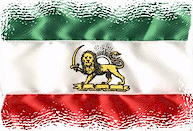

IMPERIAL EMBLEM

PERSIA
Iranian Freedom Fighters UNITE

Showing posts with label US Naval Vessel. Show all posts
Showing posts with label US Naval Vessel. Show all posts
Wednesday, June 13, 2007
IRAN EXPANDS HORMUZ FLEET
WASHINGTON [MENL] -- Iran has expanded its naval fleet in the Straits of Hormuz, the passage for an estimated 40 percent of global crude oil shipments. The U.S. Navy has determined that Iran has amassed a huge fleet of fast patrol boats in the 43-kilometer straits. The navy said the effort was led by Iran's Islamic Revolutionary Guard Corps, responsible for strategic programs. "This marks the implementation of Iran's swarm program, where dozens of armed speed boats attack much larger naval vessels from all sides," an official said. At this point, officials said, IRGC has deployed more than 1,000 FPBs in and around the straits. The vessels, armed with cruise missiles, mines, torpedoes and rocket-propelled grenades, were described as measuring up to 23 meters and could reach a speed of 100 kilometers per hour.
Sunday, February 25, 2007
Fears Grow over Iran
February 23, 2007 The Times : Tom Baldwin in Washington and Philip Webster, Political Editor
Tony Blair has declared himself at odds with hawks in the US Administration by saying publicly for the first time that it would be wrong to take military action against Iran. The Prime Minister’s comments came hours before the UN’s nuclear watchdog raised the stakes in the West’s showdown with Tehran. The International Atomic Energy Agency concluded that Iran had expanded its nuclear programme, defying UN demands for it to be suspended.
Hundreds of uranium-spinning centrifuges in an underground hall are expected to be increased to thousands by May when Iran moves to “industrial-scale production”.
Senior British government sources have told The Times that they fear President Bush will seek to “settle the Iranian question through military means” next year, before the end of his second term if he concludes that diplomacy has failed. “He will not want to leave it unresolved for his successor,” said one. But there are deep fissures within the US Administration. Robert Gates, the Defence Secretary, who has previously called for direct talks with Tehran, is said to be totally opposed to military action. Although he has dispatched a second US aircraft carrier to the Gulf, he is understood to believe that airstrikes would inflame Iranian public opinion and hamper American efforts in Iraq and Afghanistan. One senior adviser to Mr Gates has even stated privately that military action could lead to Congress impeaching Mr Bush.
Condoleeza Rice, the Secretary of State, is also opposed to using force, while Steve Hadley, the President’s National Security Adviser, is said to be deeply sceptical. The hawks are led by Dick Cheney, the Vice-President, who is urging Mr Bush to keep the military option “on the table”. He is also pressing the Pentagon to examine specific war plans — including, it is rumoured, covert action.
But Mr Blair, in a BBC interview yesterday, said: “I can’t think that it would be right to take military action against Iran . . . What is important is to pursue the political, diplomatic channel. I think it is the only way that we are going to get a sensible solution to the Iranian issue.”
The diplomatic options will be on the table on Monday when representatives of the five permanent members of the UN Security Council and Germany meet in London to begin drafting a new resolution. It was notable that Mr Blair’s remarks yesterday closely resembled those of Jack Straw last year, who said that an attack on Iran was “inconceivable”, angering Washington and perhaps contributing to his removal as Foreign Secretary. The Prime Minister’s comments reflect what British officials have been saying privately for some time, but also show a growing streak of independence from Mr Bush. The White House was unhappy with the timing of Mr Blair’s announcement this week on withdrawing 1,600 British troops, concerned that it undercut Mr Bush’s efforts to shore up support for his troop surge on Capitol Hill while sending out “mixed messages” to the Iranians. Britain has also privately expressed concern over the handling of the US military briefing last week which alleged that the “highest levels” of the Iranian Government were behind the supply of weapons to Iraqi militias. - Mr Straw, the Leader of the Commons, did break ranks yesterday by declaring that the Government was committed to a full inquiry into mistakes made in the invasion of Iraq and its aftermath. He said that he was ready “in due course” for a wider inquiry than those held to date. However a Downing Street spokesman said yesterday that there would come a time to “look at these issues”.
Tony Blair has declared himself at odds with hawks in the US Administration by saying publicly for the first time that it would be wrong to take military action against Iran. The Prime Minister’s comments came hours before the UN’s nuclear watchdog raised the stakes in the West’s showdown with Tehran. The International Atomic Energy Agency concluded that Iran had expanded its nuclear programme, defying UN demands for it to be suspended.
Hundreds of uranium-spinning centrifuges in an underground hall are expected to be increased to thousands by May when Iran moves to “industrial-scale production”.
Senior British government sources have told The Times that they fear President Bush will seek to “settle the Iranian question through military means” next year, before the end of his second term if he concludes that diplomacy has failed. “He will not want to leave it unresolved for his successor,” said one. But there are deep fissures within the US Administration. Robert Gates, the Defence Secretary, who has previously called for direct talks with Tehran, is said to be totally opposed to military action. Although he has dispatched a second US aircraft carrier to the Gulf, he is understood to believe that airstrikes would inflame Iranian public opinion and hamper American efforts in Iraq and Afghanistan. One senior adviser to Mr Gates has even stated privately that military action could lead to Congress impeaching Mr Bush.
Condoleeza Rice, the Secretary of State, is also opposed to using force, while Steve Hadley, the President’s National Security Adviser, is said to be deeply sceptical. The hawks are led by Dick Cheney, the Vice-President, who is urging Mr Bush to keep the military option “on the table”. He is also pressing the Pentagon to examine specific war plans — including, it is rumoured, covert action.
But Mr Blair, in a BBC interview yesterday, said: “I can’t think that it would be right to take military action against Iran . . . What is important is to pursue the political, diplomatic channel. I think it is the only way that we are going to get a sensible solution to the Iranian issue.”
The diplomatic options will be on the table on Monday when representatives of the five permanent members of the UN Security Council and Germany meet in London to begin drafting a new resolution. It was notable that Mr Blair’s remarks yesterday closely resembled those of Jack Straw last year, who said that an attack on Iran was “inconceivable”, angering Washington and perhaps contributing to his removal as Foreign Secretary. The Prime Minister’s comments reflect what British officials have been saying privately for some time, but also show a growing streak of independence from Mr Bush. The White House was unhappy with the timing of Mr Blair’s announcement this week on withdrawing 1,600 British troops, concerned that it undercut Mr Bush’s efforts to shore up support for his troop surge on Capitol Hill while sending out “mixed messages” to the Iranians. Britain has also privately expressed concern over the handling of the US military briefing last week which alleged that the “highest levels” of the Iranian Government were behind the supply of weapons to Iraqi militias. - Mr Straw, the Leader of the Commons, did break ranks yesterday by declaring that the Government was committed to a full inquiry into mistakes made in the invasion of Iraq and its aftermath. He said that he was ready “in due course” for a wider inquiry than those held to date. However a Downing Street spokesman said yesterday that there would come a time to “look at these issues”.
Thursday, February 22, 2007
Iran's Revolutionary Guards ARE the Regime , By Clare M. Lopez
When President Bush recently answered a reporter's question about Iranian shipments to Iraq of lethal explosive devices, he was very careful to avoid assigning direct responsibility to the highest levels of the clerical regime. He needn't have been. Asked what made him so certain that "the highest levels of Tehran's government" are responsible for supplying the deadly IEDs called Explosively Formed Penetrators to Iraq, the president answered, "We don't know...Whether the head leaders of Iran ordered" the shipment of lethal explosive devices to Iraq for use against American troops. Undersecretary of State Nicholas Burns also tip-toed tentatively around the question in a 14 Feb 07 appearance at the Brookings Institute, where he, too, declined to charge the Iranian regime with direct responsibility for the presence of these weapons in the hands of Iraqi terrorist militias. This kind of misplaced deference to a regime dedicated to the defeat of democracy in Iraq serves only to embolden the aggressive, repressive, and extremist Shi'ite clerics who run Iran today. Let us be very clear about what is really happening: the emergence of a democratic, prosperous, and secure Iraq on its western border poses a direct and unbearable threat to the totalitarian theocratic police state that Iran has become since its 1979 Revolution. While its clerical leadership does not want Iraq to descend into complete chaos, neither is it prepared to permit it to develop peacefully into a modern democracy allied with the United States. That is why its policy since the initiation of Operation Iraqi Freedom in March 2003 has been to flood the country with agents from its Ministry of Intelligence and Security (MOIS, otherwise known by its Farsi acronym, VEVAK) and Islamic Revolutionary Guards Corps (IRGC). The task of Iran's VEVAK and IRGC operatives is to infiltrate the Iraqi government at every level and manage the liaison relationship with terrorist militias wreaking havoc across Iraq. Iran seeks to export its Islamic Revolution and ideology, known as the Velayat-e Faqih (Rule of the Jurisprudent), to Iraq and other regional neighbors, such as Lebanon. Iran wants to create Islamic regimes ruled by Shari'a (Islamic law) and headed by Shi'ite clergy in as many places as it can; this is the menacing vision that Jordan's King Abdullah referred to as the spreading "Shi'ite crescent". It does not include concepts of democracy, civil society, equal opportunity for all, or rule of man-made law.

Iran really has a dual objective: the ideological leadership of the radical Islamist movement and regional geo-strategic expansion. To achieve this, it deploys its assets, including the IRGC, irregular Bassij forces, and VEVAK. Each of these is an integral element of the Iranian regime and comes under the direct control of the Supreme Leader, the Ayatollah Ali Khamenei. The current IRGC commander, Major General Yahya Rahim-Safavi, does not report to Iran's Minister of Defense, but rather to the Supreme Leader. The IRGC was formed in the early days of the Iranian Revolution specifically to guard and preserve the Revolution at home and export it abroad; the national armed forces were assigned the defense of the country's borders and sovereignty, but the IRGC was to ensure the survival of the Revolution itself. It was the threat of just such action in Iraq that helped precipitate Saddam Hussein's invasion of Iran in September 1980. The Marine Barracks were blown up in Lebanon in 1983 under the command of IRGC Brigadier General Hussein Moslehi, commander of the Lebanon Brigade. Another IRGC commander, Brigadier General Muhammad-Ja'afar Sahraroudi, was the field commander assigned to the 1989 assassination of Kurdish Democratic Party leader, Abdul-Rahman Qassemlou, in Vienna, Austria. Today, the IRGC is assigned responsibility for both Iran's Shahab missile program and its nuclear weapons program. The Qods Force (Jerusalem Force) is an integral unit of the IRGC. Formed in 1990, the secretive Qods force is responsible for commanding, planning, and executing the extra-territorial operations of the IRGC. Its commander and General Staff report directly to the Supreme Leader. In effect, this makes the Qods Force the terrorist wing of the Iranian regime. The Qods Force deploys its terrorist operatives across the world to equip, train, and support terrorist operations and cells in Bosnia, Chechnya, Lebanon, North and South America, Europe, Northern Africa, the Horn of Africa, the Palestinian Territories, Saudi Arabia, and elsewhere. The Qods Force is the unit charged with liaison with Al-Qa'eda; it is under their "supervision" that Usama bin Laden's two sons and military operations chief have enjoyed safe haven inside Iran for the last five years. In addition to its military mission, the Qods force also deploys a political staff charged with export of the Iranian regime's radical ideology to neighboring regions, such as Iraq.In Iraq, the IRGC Qods Force has been heavily involved for over three years to build, arm, finance, and train an extensive network of terrorist groups, including both Sunnis and Shi'ites, to ensure the perpetration of vicious sectarian violence and a never-ending situation of instability that will bleed American forces and prevent the emergence of a secure democracy there. The IRGC Qods Force was the principal sponsor of Abu Musab al-Zarqawi and continues to provide the same kind of support to Moqtada al-Sadr, the Shi'ite rabble rouser. Brigadier General Abtahi is the Qods Force theatre commander in Iraq and operates from a tactical command center called the Fajr Base, located in southwestern Iran in the city of Ahwaz. Within Iraq itself, the Qods Force base of operations is centered in Najaf. A chain of factories strung out along the Iranian side of the border with Iraq, and under the sole control of the IRGC Qods Force, is the verified source of those deadly IEDs, about which President Bush spoke so carefully; markings on fragments of Explosively Formed Penetrators used against American troops in Iraq identify them irrefutably as of Iranian manufacture. When U.S. forces raided Iran's "consulate" in the northern Iraqi city of Irbil in January 2007, one of those detained there was the Qods Force operations chief, Hassan Abasi, who is a ranking strategic advisor to Iranian President Mahmoud Ahmadinejad (himself a former IRGC commander). In early February 2007, it became known that hundreds of Austrian Steyr H550 sniper rifles exported legally to Iran in 2006 have been discovered in the hands of Iraqi terrorists.It is time to state clearly to the American people what our military commanders in Iraq have known for years now: the Iranian regime directly deploys its IRGC Qods Force operatives inside Iraq to support terrorist attacks that kill American soldiers. There is no question that they are there-our forces have been capturing, killing, and deporting them back to Iran by the dozens. There is also no question that these forces operate under the direct command and control of the Iranian regime. There is zero possibility that IRGC Qods Force "rogue" elements either exist or operate outside of the strict control of Supreme Leader Ayatollah Ali Khamenei and the clerical clique that forms the top echelon of the Iranian regime. In this hierarchy, the "democratic" administration of President Ahmadinejad wields only incidental authority and is used primarily as the mouthpiece and public "face" of the regime where real power resides with the unelected clergy.We must face facts squarely: the Iranian regime is at war with the United States. Stating the obvious doesn't make it any more or less so, but recognizing and dealing with reality is the only way to defend American national security and the only way to achieve a victory for democratic civilization in Iraq. Clare Lopez is the former Executive Director of the Iran Policy Committee who served 20 years as a CIA operations officer. Currently she is a private consultant who speaks and publishes widely on Middle East and WMD issues.
http://www.americanthinker.com/2007/02/irans_revolutionary_guards_are.html at February 22, 2007 -
Iran really has a dual objective: the ideological leadership of the radical Islamist movement and regional geo-strategic expansion. To achieve this, it deploys its assets, including the IRGC, irregular Bassij forces, and VEVAK. Each of these is an integral element of the Iranian regime and comes under the direct control of the Supreme Leader, the Ayatollah Ali Khamenei. The current IRGC commander, Major General Yahya Rahim-Safavi, does not report to Iran's Minister of Defense, but rather to the Supreme Leader. The IRGC was formed in the early days of the Iranian Revolution specifically to guard and preserve the Revolution at home and export it abroad; the national armed forces were assigned the defense of the country's borders and sovereignty, but the IRGC was to ensure the survival of the Revolution itself. It was the threat of just such action in Iraq that helped precipitate Saddam Hussein's invasion of Iran in September 1980. The Marine Barracks were blown up in Lebanon in 1983 under the command of IRGC Brigadier General Hussein Moslehi, commander of the Lebanon Brigade. Another IRGC commander, Brigadier General Muhammad-Ja'afar Sahraroudi, was the field commander assigned to the 1989 assassination of Kurdish Democratic Party leader, Abdul-Rahman Qassemlou, in Vienna, Austria. Today, the IRGC is assigned responsibility for both Iran's Shahab missile program and its nuclear weapons program. The Qods Force (Jerusalem Force) is an integral unit of the IRGC. Formed in 1990, the secretive Qods force is responsible for commanding, planning, and executing the extra-territorial operations of the IRGC. Its commander and General Staff report directly to the Supreme Leader. In effect, this makes the Qods Force the terrorist wing of the Iranian regime. The Qods Force deploys its terrorist operatives across the world to equip, train, and support terrorist operations and cells in Bosnia, Chechnya, Lebanon, North and South America, Europe, Northern Africa, the Horn of Africa, the Palestinian Territories, Saudi Arabia, and elsewhere. The Qods Force is the unit charged with liaison with Al-Qa'eda; it is under their "supervision" that Usama bin Laden's two sons and military operations chief have enjoyed safe haven inside Iran for the last five years. In addition to its military mission, the Qods force also deploys a political staff charged with export of the Iranian regime's radical ideology to neighboring regions, such as Iraq.In Iraq, the IRGC Qods Force has been heavily involved for over three years to build, arm, finance, and train an extensive network of terrorist groups, including both Sunnis and Shi'ites, to ensure the perpetration of vicious sectarian violence and a never-ending situation of instability that will bleed American forces and prevent the emergence of a secure democracy there. The IRGC Qods Force was the principal sponsor of Abu Musab al-Zarqawi and continues to provide the same kind of support to Moqtada al-Sadr, the Shi'ite rabble rouser. Brigadier General Abtahi is the Qods Force theatre commander in Iraq and operates from a tactical command center called the Fajr Base, located in southwestern Iran in the city of Ahwaz. Within Iraq itself, the Qods Force base of operations is centered in Najaf. A chain of factories strung out along the Iranian side of the border with Iraq, and under the sole control of the IRGC Qods Force, is the verified source of those deadly IEDs, about which President Bush spoke so carefully; markings on fragments of Explosively Formed Penetrators used against American troops in Iraq identify them irrefutably as of Iranian manufacture. When U.S. forces raided Iran's "consulate" in the northern Iraqi city of Irbil in January 2007, one of those detained there was the Qods Force operations chief, Hassan Abasi, who is a ranking strategic advisor to Iranian President Mahmoud Ahmadinejad (himself a former IRGC commander). In early February 2007, it became known that hundreds of Austrian Steyr H550 sniper rifles exported legally to Iran in 2006 have been discovered in the hands of Iraqi terrorists.It is time to state clearly to the American people what our military commanders in Iraq have known for years now: the Iranian regime directly deploys its IRGC Qods Force operatives inside Iraq to support terrorist attacks that kill American soldiers. There is no question that they are there-our forces have been capturing, killing, and deporting them back to Iran by the dozens. There is also no question that these forces operate under the direct command and control of the Iranian regime. There is zero possibility that IRGC Qods Force "rogue" elements either exist or operate outside of the strict control of Supreme Leader Ayatollah Ali Khamenei and the clerical clique that forms the top echelon of the Iranian regime. In this hierarchy, the "democratic" administration of President Ahmadinejad wields only incidental authority and is used primarily as the mouthpiece and public "face" of the regime where real power resides with the unelected clergy.We must face facts squarely: the Iranian regime is at war with the United States. Stating the obvious doesn't make it any more or less so, but recognizing and dealing with reality is the only way to defend American national security and the only way to achieve a victory for democratic civilization in Iraq. Clare Lopez is the former Executive Director of the Iran Policy Committee who served 20 years as a CIA operations officer. Currently she is a private consultant who speaks and publishes widely on Middle East and WMD issues.
http://www.americanthinker.com/2007/02/irans_revolutionary_guards_are.html at February 22, 2007 -
Thursday, February 08, 2007
A warning to Iran From Wesley Clark.The democratic party`s 2008 presidential hopfull
"Good Morning. I'm Wes Clark. I'm a soldier, and I'm fighting for my country." And although he didn't quite come out and say it, Wes Clark could just as well have added, "And I want to be the next president of the United States."
Retired Gen. Wesley Clark is concerned by Iran's nuclear ambitions and cautioned the Islamic republic to take U.S. warnings "very, very seriously." the former warrior-turned-politician at the same time admitted being worried by the Bush administration's strong-arm policies in the Middle East. "I'm concerned,"and worried that the rising tension between the United States and Iran could escalate to a point of no return. As a former soldier who has seen his share of action from Vietnam to Kosovo, Mr. Clark does not scare easily.
But the Iranians, too, have reason to be concerned, says Mr. Clark. Speaking to United Press International Friday after addressing a meeting of the Democratic National Committee in Washington, Mr. Clark said that the Iranians should take "very, very seriously the prospect of air strikes and missile strikes as well as other operations directed against Iran's nuclear capacities and all other elements of their military power." When it comes to war, Mr. Clark has an advantage over other presidential candidates. He has tasted the ugliness of war; he knows firsthand what it means seeing men -- sometimes boys hardly old enough to shave -- killed in battle.
"I know what it is to plan and prepare for war and to send the cream of our youth on a mission from which they may not return," Mr. Clark told the group of assembled Democrats a short while earlier. "I know firsthand the struggles of domestic politics and international diplomacy to accomplish a difficult peace after the shooting stops." For many people who have lived through the hell called combat, war is the last resort they want to turn to. So how would Wes Clark's policies be different were he elected president? How would he stop the war in Iraq, for example? "I would use diplomacy first... I would find common ground," said the former soldier. Isn't this a tad oversimplifying an overcomplicated issue? What if the political track fails?
Mr. Clark insists the political track will not fail. "You have to force them or induce them into the political track," said Mr. Clark. "You have to use 'carrots and sticks.' " And how do you accomplish this? By including all countries in the region in accepting a "statement of principles" that would guarantee the security of each, taking into account their needs for secure borders, while promoting and opening the region to commerce, trade and tourism. Does "all countries" in the region include Syria and Iran? Would Mr. Clark, as president, establish dialogue with Damascus and Tehran? "Yes," he says. "As I look at the discussions ongoing inside Iran as best I can follow them from here, it's clear that there are different sectors of opinion in the leadership and I think the leadership needs to understand that it is seriously at risk," said Mr. Clark.
Mr. Clark also said that : "I speak to you today as the only person who will take this podium before you having actually done the things we need to do to succeed in Iraq, Afghanistan and throughout the world.
looking at it from another angle
"Don't be fooled by the appearance of dissent or disunity inside Iran's super-sophisticated, apparently disjointed political system," cautioned Clare Lopez, a former CIA operations officer who worked briefly with the Iran Policy Committee. "Iran's democratic facade is just that, a veneer and nothing more," said Miss Lopez. "The Majlis or local and municipal councils can do or say what they like, it matters not to the Shi'ite clergy and IRGC that actually run the country. "The diplomatic track that is now the flavor of the week is just checking the box, one last-ditch effort to make this work, maybe with Sunni Arab support," says Miss Lopez. "Iran will blow that off, just like they've blown off the IAEA [International Atomic Energy Agency] and the [United Nations] Security Council. These mullahs know that their window of opportunity is closing fast and that without a nuclear weapon, they cannot possibly hope to hang on to power for very much longer, much less expand throughout the region as they wish to."
Also In reply to those who say that there are two schools of thought in dealing with Iran -- diplomacy and force -- Raymond Tanter, a professor at Georgetown and an active IPC member says: "Please recall a third option. Removing the main Iranian opposition from Western terrorist lists to threaten the Iranian regime's survival and provide it an incentive to negotiate on the nuclear file, subversion of Iraq, and the destabilization of Lebanon," . By "main opposition" Mr. Tanter means the MeK, or Mujahedeen-e-Khalq. "Opening up a third option not only reinforces diplomacy, the third alternative also keeps the U.S. military strike option available for future contingencies," Mr. Tanter added. ( there are other anti IRI forces that the US can relay on).
Retired Gen. Wesley Clark is concerned by Iran's nuclear ambitions and cautioned the Islamic republic to take U.S. warnings "very, very seriously." the former warrior-turned-politician at the same time admitted being worried by the Bush administration's strong-arm policies in the Middle East. "I'm concerned,"and worried that the rising tension between the United States and Iran could escalate to a point of no return. As a former soldier who has seen his share of action from Vietnam to Kosovo, Mr. Clark does not scare easily.
But the Iranians, too, have reason to be concerned, says Mr. Clark. Speaking to United Press International Friday after addressing a meeting of the Democratic National Committee in Washington, Mr. Clark said that the Iranians should take "very, very seriously the prospect of air strikes and missile strikes as well as other operations directed against Iran's nuclear capacities and all other elements of their military power." When it comes to war, Mr. Clark has an advantage over other presidential candidates. He has tasted the ugliness of war; he knows firsthand what it means seeing men -- sometimes boys hardly old enough to shave -- killed in battle.
"I know what it is to plan and prepare for war and to send the cream of our youth on a mission from which they may not return," Mr. Clark told the group of assembled Democrats a short while earlier. "I know firsthand the struggles of domestic politics and international diplomacy to accomplish a difficult peace after the shooting stops." For many people who have lived through the hell called combat, war is the last resort they want to turn to. So how would Wes Clark's policies be different were he elected president? How would he stop the war in Iraq, for example? "I would use diplomacy first... I would find common ground," said the former soldier. Isn't this a tad oversimplifying an overcomplicated issue? What if the political track fails?
Mr. Clark insists the political track will not fail. "You have to force them or induce them into the political track," said Mr. Clark. "You have to use 'carrots and sticks.' " And how do you accomplish this? By including all countries in the region in accepting a "statement of principles" that would guarantee the security of each, taking into account their needs for secure borders, while promoting and opening the region to commerce, trade and tourism. Does "all countries" in the region include Syria and Iran? Would Mr. Clark, as president, establish dialogue with Damascus and Tehran? "Yes," he says. "As I look at the discussions ongoing inside Iran as best I can follow them from here, it's clear that there are different sectors of opinion in the leadership and I think the leadership needs to understand that it is seriously at risk," said Mr. Clark.
Mr. Clark also said that : "I speak to you today as the only person who will take this podium before you having actually done the things we need to do to succeed in Iraq, Afghanistan and throughout the world.
looking at it from another angle
"Don't be fooled by the appearance of dissent or disunity inside Iran's super-sophisticated, apparently disjointed political system," cautioned Clare Lopez, a former CIA operations officer who worked briefly with the Iran Policy Committee. "Iran's democratic facade is just that, a veneer and nothing more," said Miss Lopez. "The Majlis or local and municipal councils can do or say what they like, it matters not to the Shi'ite clergy and IRGC that actually run the country. "The diplomatic track that is now the flavor of the week is just checking the box, one last-ditch effort to make this work, maybe with Sunni Arab support," says Miss Lopez. "Iran will blow that off, just like they've blown off the IAEA [International Atomic Energy Agency] and the [United Nations] Security Council. These mullahs know that their window of opportunity is closing fast and that without a nuclear weapon, they cannot possibly hope to hang on to power for very much longer, much less expand throughout the region as they wish to."
Also In reply to those who say that there are two schools of thought in dealing with Iran -- diplomacy and force -- Raymond Tanter, a professor at Georgetown and an active IPC member says: "Please recall a third option. Removing the main Iranian opposition from Western terrorist lists to threaten the Iranian regime's survival and provide it an incentive to negotiate on the nuclear file, subversion of Iraq, and the destabilization of Lebanon," . By "main opposition" Mr. Tanter means the MeK, or Mujahedeen-e-Khalq. "Opening up a third option not only reinforces diplomacy, the third alternative also keeps the U.S. military strike option available for future contingencies," Mr. Tanter added. ( there are other anti IRI forces that the US can relay on).
0
comments

 Labels:
Concern in Iran,
Iran,
Iranian Missile,
Khamanei,
Middle East,
Military engagment,
Shia,
suni,
US,
US Naval Vessel,
Us pressure,
W.Clark,
War
Labels:
Concern in Iran,
Iran,
Iranian Missile,
Khamanei,
Middle East,
Military engagment,
Shia,
suni,
US,
US Naval Vessel,
Us pressure,
W.Clark,
War
Labels:
Concern in Iran,
Iran,
Iranian Missile,
Khamanei,
Middle East,
Military engagment,
Shia,
suni,
US,
US Naval Vessel,
Us pressure,
W.Clark,
War
Saturday, February 03, 2007
Iran Clock Is Ticking
Consortiumnews.com / Robert Parry
While congressional Democrats test how far they should go in challenging George W. Bush’s war powers, the time may be running out to stop Bush from ordering a major escalation of the Middle East conflict by attacking Iran. Military and intelligence sources continue to tell me that preparations are advancing for a war with Iran starting possibly as early as mid-to-late February. The sources offer some differences of opinion over whether Bush might cite a provocation from Iran or whether Israel will take the lead in launching air strikes against Iran’s nuclear facilities. Read the rest by following this link.
http://iranvajahan.net/cgi-bin/news.pl?l=en&y=2007&m=02&d=03&a=8
While congressional Democrats test how far they should go in challenging George W. Bush’s war powers, the time may be running out to stop Bush from ordering a major escalation of the Middle East conflict by attacking Iran. Military and intelligence sources continue to tell me that preparations are advancing for a war with Iran starting possibly as early as mid-to-late February. The sources offer some differences of opinion over whether Bush might cite a provocation from Iran or whether Israel will take the lead in launching air strikes against Iran’s nuclear facilities. Read the rest by following this link.
http://iranvajahan.net/cgi-bin/news.pl?l=en&y=2007&m=02&d=03&a=8
Tuesday, January 23, 2007
Official
U.S. Sending Warning to Iran With Second Aircraft Carrier
Tuesday , January 23, 2007
DUBAI, United Arab Emirates — A second U.S. aircraft carrier strike Group now steaming toward the Middle East is Washington's way of warning Iran to back down in its attempts to dominate the region, a top U.S. diplomat said here Tuesday.Nicholas Burns, the U.S. undersecretary of state for political affairs, ruled out direct U.S. negotiations with Iran and said a rapprochement between Washington and Tehran was "not possible" until Iran halts its enrichment of uranium.
"The Middle East isn't a region to be dominated by Iran. The Gulf isn't a body of water to be controlled by Iran. That's why we've seen the United States station two carrier battle groups in the region," Burns said in an address to the Dubai-based Gulf Research Center, an influential think-tank."Iran is going to have to understand that the United States will protect its interests if Iran seeks to confront us," Burns continued. "We will defend our interests if we are challenged. That might be a message Iran must understand."
The American aircraft carrier USS John C. Stennis and several accompanying ships are heading toward the Gulf to join an aircraft carrier group already in the region, the USS Dwight D. Eisenhower. The Stennis is expected to arrive in late February.The Stennis' arrival in the Middle East will mark the first time since the U.S.-led Iraq invasion in 2003 that the United States has had two carrier battle groups in the region.
Tuesday , January 23, 2007
DUBAI, United Arab Emirates — A second U.S. aircraft carrier strike Group now steaming toward the Middle East is Washington's way of warning Iran to back down in its attempts to dominate the region, a top U.S. diplomat said here Tuesday.Nicholas Burns, the U.S. undersecretary of state for political affairs, ruled out direct U.S. negotiations with Iran and said a rapprochement between Washington and Tehran was "not possible" until Iran halts its enrichment of uranium.
"The Middle East isn't a region to be dominated by Iran. The Gulf isn't a body of water to be controlled by Iran. That's why we've seen the United States station two carrier battle groups in the region," Burns said in an address to the Dubai-based Gulf Research Center, an influential think-tank."Iran is going to have to understand that the United States will protect its interests if Iran seeks to confront us," Burns continued. "We will defend our interests if we are challenged. That might be a message Iran must understand."
The American aircraft carrier USS John C. Stennis and several accompanying ships are heading toward the Gulf to join an aircraft carrier group already in the region, the USS Dwight D. Eisenhower. The Stennis is expected to arrive in late February.The Stennis' arrival in the Middle East will mark the first time since the U.S.-led Iraq invasion in 2003 that the United States has had two carrier battle groups in the region.
JEFFERSON'S KORAN
KEITH ELLISON & JEFFERSON'S KORAN: what the world doesn't knowBy J. Grant Swank, Jr./MichNews.com /Jan 22, 2007
Keith Ellison (D-MN) used Thomas Jefferson�s Koran for his pledge into the US Congress.Why did Thomas Jefferson have a copy of the Koran? He was studying everything he could about Islam. Why? He was proposing war against Islamic "barbary" states of Morocco, Algeria, Tunisia and Tripoli.Islamic pirate slavers caged in millions of Africans and untold numbers of Christian Europeans and Americans in the Islamic "Barbary" states. These pirates meandered about the African and Mediterranean coasts, "pillaging villages and seizing slaves," per Ted Sampley of US Veteran Dispatch."It was typical of Muslim raiders to kill off as many of the �non-Muslim� older men and women as possible so the preferred �booty� of only young women and children could be collected."Young non-Muslim women were targeted because of their value as concubines in Islamic markets. Islamic law provides for the sexual interests of Muslim men by allowing them to take as many as four wives at one time and to have as many concubines as their fortunes allow."Boys, as young as 9 or 10 years old, were often mutilated to create eunuchs who would bring higher prices in the slave markets of the Middle East. Muslim slave traders created �eunuch stations� along major African slave routes so the necessary surgery could be performed. It was estimated that only a small number of the boys subjected to the mutilation survived after the surgery."Congress appointed a special commission consisting of John Adams, Thomas Jefferson, and Benjamin Franklin to oversee the negotiations. Because American commerce in the Mediterranean was being destroyed by the pirates, the continental Congress agreed in 1784 to negotiate treaties with the four Barbary States," hence Jefferson having a copy of the Koran.Adams and Jefferson reported to their peers that Islam "was founded on the Laws of their Prophet, that it was written in their Quran, that all nations who should not have acknowledged their authority were sinners, that it was their right and duty to make war upon them wherever they could be found, and to make slaves of all they could take as Prisoners, and that every Musselman (Muslim) who should be slain in Battle was sure to go to Paradise." So what�s new? Copyright � 2006 by J. Grant Swank, Jr.
Keith Ellison (D-MN) used Thomas Jefferson�s Koran for his pledge into the US Congress.Why did Thomas Jefferson have a copy of the Koran? He was studying everything he could about Islam. Why? He was proposing war against Islamic "barbary" states of Morocco, Algeria, Tunisia and Tripoli.Islamic pirate slavers caged in millions of Africans and untold numbers of Christian Europeans and Americans in the Islamic "Barbary" states. These pirates meandered about the African and Mediterranean coasts, "pillaging villages and seizing slaves," per Ted Sampley of US Veteran Dispatch."It was typical of Muslim raiders to kill off as many of the �non-Muslim� older men and women as possible so the preferred �booty� of only young women and children could be collected."Young non-Muslim women were targeted because of their value as concubines in Islamic markets. Islamic law provides for the sexual interests of Muslim men by allowing them to take as many as four wives at one time and to have as many concubines as their fortunes allow."Boys, as young as 9 or 10 years old, were often mutilated to create eunuchs who would bring higher prices in the slave markets of the Middle East. Muslim slave traders created �eunuch stations� along major African slave routes so the necessary surgery could be performed. It was estimated that only a small number of the boys subjected to the mutilation survived after the surgery."Congress appointed a special commission consisting of John Adams, Thomas Jefferson, and Benjamin Franklin to oversee the negotiations. Because American commerce in the Mediterranean was being destroyed by the pirates, the continental Congress agreed in 1784 to negotiate treaties with the four Barbary States," hence Jefferson having a copy of the Koran.Adams and Jefferson reported to their peers that Islam "was founded on the Laws of their Prophet, that it was written in their Quran, that all nations who should not have acknowledged their authority were sinners, that it was their right and duty to make war upon them wherever they could be found, and to make slaves of all they could take as Prisoners, and that every Musselman (Muslim) who should be slain in Battle was sure to go to Paradise." So what�s new? Copyright � 2006 by J. Grant Swank, Jr.
Grand Ayatollah Hossein-Ali Montazeri,
Iranian cleric attacks president
The grand ayatollah said Iran's tone could provoke enemies .Iran's senior dissident cleric, Grand Ayatollah Hossein-Ali Montazeri, has attacked President Mahmoud Ahmadinejad over nuclear issues and the economy. The bold remarks came in a written statement by the 85-year-old, who was once in line to succeed Ruhollah Khomeini as supreme leader. He spent years under house arrest after falling out with Ayatollah Khomeini. He said nuclear energy was Iran's right, but questioned the way President Ahmadinejad had pursued it. Using harsh and provocative language would provoke the enemy, Grand Ayatollah Montazeri said, calling instead for negotiations.
[We] don't think of our own people's problems and the price of basic commodities goes higher and higher every day
His comments came as a report by Iran's Isna news agency suggested that 38 inspectors working for the United Nations nuclear agency had been barred from entering Iran. In a separate development, the European Union criticised Iran for not co-operating with the UN over demands that it curbs its nuclear programme.Iran's Revolutionary Guards also announced several days of exercises in the centre of the country. Two new types of Iranian-produced missile would be tested, one said to have a range of 75km (47 miles), the other 350km, state radio said.
Scathing attack
The grand ayatollah spoke out against Mr Ahmadinejad in remarks to reformists and opponents of the president in the religious city of Qom last Friday, the Associated Press news agency reported. Mr Ahmadinejad's handling of natural resources was attacked .Grand Ayatollah Montazeri compared Iran's natural resources favourably to those of other countries.
"Some countries don't have oil and gas. Yet, they run their country and stand on their own," he said, according to a copy of his words seen by AP.
"We have so much oil and gas but make useless expenditures work for others and don't think of our own people's problems and the price of basic commodities goes higher and higher every day." He complained that people kept on shouting slogans about nuclear rights, but he asked: "Don't we have other rights too?" It was a pointed reference to concerns about diminishing freedom of speech in Iran under Mr Ahmadinejad, says the BBC's Frances Harrison in Tehran. Grand Ayatollah Montazeri also launched a scathing attack on the president's handling of the economy. He said some claimed inflation was only 13% in Iran, but everyone knew the cost of housing had risen more than 50%. He asked why the government went on what he called useless trips and spent money on others abroad, seemingly a reference to President Ahmadinejad's recent tour of Latin America and Iranian aid to Palestinian groups like Hamas.
The grand ayatollah said Iran's tone could provoke enemies .Iran's senior dissident cleric, Grand Ayatollah Hossein-Ali Montazeri, has attacked President Mahmoud Ahmadinejad over nuclear issues and the economy. The bold remarks came in a written statement by the 85-year-old, who was once in line to succeed Ruhollah Khomeini as supreme leader. He spent years under house arrest after falling out with Ayatollah Khomeini. He said nuclear energy was Iran's right, but questioned the way President Ahmadinejad had pursued it. Using harsh and provocative language would provoke the enemy, Grand Ayatollah Montazeri said, calling instead for negotiations.
[We] don't think of our own people's problems and the price of basic commodities goes higher and higher every day
His comments came as a report by Iran's Isna news agency suggested that 38 inspectors working for the United Nations nuclear agency had been barred from entering Iran. In a separate development, the European Union criticised Iran for not co-operating with the UN over demands that it curbs its nuclear programme.Iran's Revolutionary Guards also announced several days of exercises in the centre of the country. Two new types of Iranian-produced missile would be tested, one said to have a range of 75km (47 miles), the other 350km, state radio said.
Scathing attack
The grand ayatollah spoke out against Mr Ahmadinejad in remarks to reformists and opponents of the president in the religious city of Qom last Friday, the Associated Press news agency reported. Mr Ahmadinejad's handling of natural resources was attacked .Grand Ayatollah Montazeri compared Iran's natural resources favourably to those of other countries.
"Some countries don't have oil and gas. Yet, they run their country and stand on their own," he said, according to a copy of his words seen by AP.
"We have so much oil and gas but make useless expenditures work for others and don't think of our own people's problems and the price of basic commodities goes higher and higher every day." He complained that people kept on shouting slogans about nuclear rights, but he asked: "Don't we have other rights too?" It was a pointed reference to concerns about diminishing freedom of speech in Iran under Mr Ahmadinejad, says the BBC's Frances Harrison in Tehran. Grand Ayatollah Montazeri also launched a scathing attack on the president's handling of the economy. He said some claimed inflation was only 13% in Iran, but everyone knew the cost of housing had risen more than 50%. He asked why the government went on what he called useless trips and spent money on others abroad, seemingly a reference to President Ahmadinejad's recent tour of Latin America and Iranian aid to Palestinian groups like Hamas.
US Attacks Iran in April, Bulgaria Involved .
23 January 2007, Tuesday.
The United States plans a hard-power attack on Iran's nuclear and oil industries, the Arab Times reported, citing un-named sources. The timing has been fixed to suit George Bush's major ally, UK Prime Minister Tony Blair, who is to step down from his office at Number Ten Downing Street this May.The White House hopes that a military attack against Iranian targets will weaken the regime and lead to the toppling of the government of Syria, as well, The Arab Times comments."As one of the last steps before a strike, we'll see USAF tankers moved to unusual places, like Bulgaria," respected US security expert, Col. Sam Gardiner, predicts.
According to him these will be used to refuel the US-based B-2 bombers on their strike missions into Iran. "When that happens, we'll only be days away from a strike," he said.
Bulgaria's Foreign Minister Ivaylo Kalfin and Secretary of State Condoleezza Rice signed at the end of April last year the agreement for the location of US military bases on the territory of the Black Sea country.Bulgaria and the US reached an agreement on the defence cooperation accord, including the conditions of the shared use of several military facilities on Bulgarian territory, at the end of March.
As many as 3,000 soldiers can be deployed on short rotation in Bulgaria, which at some point may overlap and reach 5,000. The first US troops will arrive in 2007 and 2008.
The United States plans a hard-power attack on Iran's nuclear and oil industries, the Arab Times reported, citing un-named sources. The timing has been fixed to suit George Bush's major ally, UK Prime Minister Tony Blair, who is to step down from his office at Number Ten Downing Street this May.The White House hopes that a military attack against Iranian targets will weaken the regime and lead to the toppling of the government of Syria, as well, The Arab Times comments."As one of the last steps before a strike, we'll see USAF tankers moved to unusual places, like Bulgaria," respected US security expert, Col. Sam Gardiner, predicts.
According to him these will be used to refuel the US-based B-2 bombers on their strike missions into Iran. "When that happens, we'll only be days away from a strike," he said.
Bulgaria's Foreign Minister Ivaylo Kalfin and Secretary of State Condoleezza Rice signed at the end of April last year the agreement for the location of US military bases on the territory of the Black Sea country.Bulgaria and the US reached an agreement on the defence cooperation accord, including the conditions of the shared use of several military facilities on Bulgarian territory, at the end of March.
As many as 3,000 soldiers can be deployed on short rotation in Bulgaria, which at some point may overlap and reach 5,000. The first US troops will arrive in 2007 and 2008.
Subscribe to:
Posts (Atom)




 Posts
Posts




 اخبار مربوط به زندانیان سیاسی و نقض حقوق بشر







 Tulips in Holland