Alliance For democracy In Iran

Please have a look at my other weblog, Iran Democracy - http://irandemocray.blogspot.com/

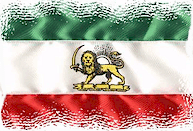
IMPERIAL EMBLEM

IMPERIAL EMBLEM
PERSIA

Shahanshah Aryameher

S U N OF P E R S I A

Iranian Freedom Fighters UNITE

Showing posts with label Ahh maghi nejad. Show all posts

Sunday, May 04, 2008

Holding Back Imperial Iranian Theocracy : Paulo Casaca


Holding Back Imperial Iranian Theocracy

While extreme nationalist and political passions are far from dissipated, religious fanaticism, Islamic fanaticism in particular has became the driving force of much of the intolerance found around the world.A perpetual source of conflict with Islam itself has been between fundamentalist and evolutionist readings of the Koran, greater perhaps than any theological dispute within that faith. But the new brand of fanaticism born towards the end of the 20th century is of a totally different nature.The theocratic doctrine that came to light in the second half of the 20th century in the main Shi'ite school of Najaf in Iraq, later to be put in practice by Ayatollah Khomeini in 1979 in Iran, introduced three devastating elements: (1) the principle of the rule of the religious authority; (2) suicidal terrorism as a major political-religious-military tool; and (3) world domination, the first step being "through Karbala to al-Quds [Jerusalem]," with the ultimate goal of "introducing the Islamic revolution to all of mankind" (President Ahmadinejad to the Assembly of Experts, IRNA, February 25, 2008 - translation by MEMRI).THE IRANIAN clergy's traditional weapon of manipulation and dissimulation has so far proved more successful than any other in winning its first strategic objective: to dominate Karbala, the Shi'ite holy city located in Iraq.On the other hand, Ayatollah Khonmeini's strategic decision to develop a nuclear weapon, made at the time he drunk from the "glass of the poison of peace" with Iraq, has been hampered by sheer incompetence and, even more so, by the resilience of the Iranian resistance, which revealed to the world the regime's nuclear plans despite decades of ferocious persecution by Iranian authorities in cooperation with Western governments.Western diplomacy has been busy searching for the reasonable, peace-loving Iranian cleric who will reject embarrassing human rights abuses, imperial aims and, last but not least, Holocaust denial and threats to wipe Israel off the map as made Ayatollah Khomeini and recently reaffirmed by President Ahmadinejad.The loose interpretation of United Nations resolutions 1737, 1747 and 1803 on sanctions against Iran given by some EU member states - Austria conspicuous among them - is astonishingly enough supported by the European Commission. This demands a firm response from clear-thinking, anti-fascist EU politicians. In addition, closer analysis of possible judicial action is called for.Although the European Court of Justice jurisprudence has a historical bias against what might be considered class-action suits, recent developments and the special life-threatening characteristics of the Iranian imperial threat should make us carefully consider this option.We have to think of smart alternatives to avoid being squeezed between "business as usual" and war.AN INTELLIGENT strategy to face theocratic imperialism must begin by supporting a realistic political and popular opposition instead of betting on fake reformist alternatives.Europe has been unable to act as a united force in facing Teheran, not even through economic strategy. Yet the Iranian regime badly needs Western technology which it will not find easily in the rest of the world.An intelligent combination of economic and diplomatic sanctions is an essential piece of any reliable strategy to stop the nuclear bomb of fanaticism.The writer is a Portuguese Socialist member of the European parliament. He will be attending the international conference The Iranian Threat, organized by the STOP THE BOMB coalition, that takes place today in Vienna.

The Bloody lier Says that : Ex-Iranian President: Fomenting Violence Abroad 'Treason' - May 03, 2008 The Associated Press Ali Akbar Dareini

TEHRAN, Iran -- A former Iranian president has said that exporting violence to other countries is "treason" against Islam and Iran's 1979 revolution, an apparent accusation that the country's hard-line rulers are engineering unrest abroad.Mohammad Khatami, a reformist and popular intellectual, made no mention of U.S. and Iraqi accusations that Iran is arming and training Shiite extremists in neighboring Iraq. But he said Iran should avoid actions that give it a bad image.

HERE IS THE BIG LIE : Engineering violence in other countries would be contrary to the goals of the 1979 Islamic revolution led by Ayatollah Ruhollah Khomeini, Khatami said. "What did Imam (Khomeini) want and what did he mean by 'exporting the revolution'? Taking up arms and causing explosions in other countries and establishing groups to carry out sabotage in other countries? Imam was strongly opposed to these behaviors," Khatami told students in northern Iran on Friday."This is the biggest treason to Islam and the revolution."

Khatami's remarks were published by the daily Kargozaran Saturday and also posted on the Web site of a pro-democracy foundation he heads.Iraqi and U.S. officials accuse Iran of arming and training Shiite militias in Iraq but Tehran denies it. Senior Shiite Iraqi politicians are in Iran to confront authorities with evidence of Iran's involvement.On Thursday, the Iraqi delegates met with Gen. Ghassem Soleimani, commander of the Quds Force, an elite unit of Iran's Revolutionary Guard Corps that has been accused of training and funneling weapons to Shiite extremists in Iraq.The Guards chief is appointed by Iran's top leader Ayatollah Ali Khamenei and Guards' commanders have openly supported the country's hard-line leaders.Iraqi officials said the delegation had documents and other material implicating the Quds Force in supplying weapons and training fighters.U.S. military officials have said the evidence includes caches of weapons that have date stamps showing they were produced in Iran this year — including mortars, rockets and armor-piercing roadside bombs known as explosively formed penetrators, or EFPs.

Wednesday, March 05, 2008

NEWS CENTRAL

Iranian Official Slams Ahmadinejad
TEHRAN, Iran, Feb. 27, 2008
(AP) Iran's former chief nuclear negotiator rebuked President Mahmoud Ahmadinejad in a sharp attack on Wednesday, saying the hardline president's "bombastic slogans" are hampering Iran's development and harming national interests. Hasan Rowhani's remarks were some of the harshest criticism yet of Ahmadinejad by a prominent member of Iran's ruling Islamic establishment. Rowhani was replaced as top nuclear negotiator when Ahmadinejad came to office in 2005, but remains a member of the Supreme National Security Council, which handles nuclear issues. He also sits on two powerful cleric-run bodies, the Experts Assembly and the Expediency Council. "Does foreign policy mean bombastic slogans? Harsh speech? Remarks that end in loud slogans? These things won't build foreign policy," Rowhani told the opening session of a conference in Tehran. "Foreign policy doesn't mean fiery slogans. Foreign policy means a way of dealing with the world that reduces threats." Iran's supreme leader, Ayatollah Ali Khamenei, praised Ahmadinejad Tuesday for standing up to the West and refusing to halt the country's uranium enrichment. Ahmadinejad said a report released by the U.N. nuclear watchdog on Friday had vindicated Iran's nuclear program and left no justification for any U.N. Security Council sanctions. The 11-page report by International Atomic Energy Agency chief Mohamed ElBaradei said all major past issues surrounding Iran's nuclear activities had been resolved or are "no longer outstanding at this stage." The IAEA investigation's findings were consistent with explanations provided by Iran, the report also said. The U.S., however, said the report actually strengthened the case for additional sanctions because it said Iran refused to heed Security Council demands to halt enrichment. The IAEA also said Tehran had dismissed as "baseless" information provided by Western intelligence agencies that Iran's alleged missile and explosives experiments are part of a nuclear weapons program. The U.S. is now pushing for a third round of sanctions against Iran and is hoping for a Security Council vote later this week. Rowhani's criticism is partly shared by conservative supporters of Ahmadinejad, who contend his rhetoric needlessly antagonizes the West and increases divisions at home. The hardline president often harshly denounced the U.S. in his speeches, has angered the West with vows that Israel will one day be eliminated and has sharply criticized domestic rivals, branding some as "traitors." The president is also under fire for failing to reform Iran's failing economy. Rowhani said Ahmadinejad's policies were undermining Iran's plans to become a regional superpower and a base for high technology and scientific know-how by 2025. The plan, Rowhani said, won't materialize as long as the government excludes moderates and experts who disagree with Ahmadinejad's politics and as long as inflation and unemployment are not controlled. "My fear is that the plan is being turned into a slogan. This is the main danger ... If we want to achieve the goals defined in the document, we need a national resolve ... one group and faction alone, can't bring development," he said. Rowhani called for a "competent government ... a government that is competent and responsible" in order to turn Iran into the industrial powerhouse of western Asia. "We are not yet disappointed, but the experience in the past two or three years has not been a good experience," the official said. "If a nation gets into the field of slogans, it will suffer. We need to be realistic," he said, in clear reference to Ahmadinejad. He pressed the government to be "ready for flexibility and bargaining."


Dangerous fungus on the move from East Africa to the Middle East
5 March 2008,

Rome - A new and virulent wheat fungus, previously found in East Africa and Yemen, has moved to major wheat growing areas in Iran, FAO reported today. The fungus is capable of wreaking havoc to wheat production by destroying entire fields.Countries east of Iran, like Afghanistan, India, Pakistan, Turkmenistan, Uzbekistan and Kazakhstan, all major wheat producers, are most threatened by the fungus and should be on high alert, FAO said.It is estimated that as much as 80 percent of all wheat varieties planted in Asia and Africa are susceptible to the wheat stem rust (Puccinia graminis). The spores of wheat rust are mostly carried by wind over long distances and across continents.“The detection of the wheat rust fungus in Iran is very worrisome,” said Shivaji Pandey, Director of FAO’s Plant Production and Protection Division. “The fungus is spreading rapidly and could seriously lower wheat production in countries at direct risk. Affected countries and the international community have to ensure that the spread of the disease gets under control in order to reduce the risk to countries that are already hit by high food prices.”
The government of the Islamic Republic of Iran has informed FAO that the fungus has been detected in some localities in Broujerd and Hamedan in western Iran. Laboratory tests have confirmed the presence of the fungus. Iran said it will enhance its research capacity to face the new infection and develop new wheat varieties resistant to the disease.
The wheat fungus first emerged in Uganda in 1999 and is therefore called Ug99. The wind-borne transboundary pest subsequently spread to Kenya and Ethiopia. In 2007, an FAO mission confirmed for the first time that Ug99 has affected wheat fields in Yemen. The Ug99 strain found in Yemen was already more virulent than the one found in East Africa. Ethiopia and Kenya had serious wheat rust epidemics in 2007 with considerable yield losses. The Borlaug Global Rust Initiative (BGRI), established to combat wheat rusts around the world, will support countries in developing resistant varieties, producing their clean quality seeds, upgrading national plant protection and plant breeding services and developing contingency plans. The BGRI was founded by Norman Borlaug (known as "the father of the Green Revolution"), Cornell University, the International Center for Agricultural Research in the Dry areas (ICARDA), the International Maize and Wheat Improvement Center (CIMMYT) and FAO.Disease surveillance and wheat breeding is already underway to monitor the fungus and to develop Ug99 resistant varieties. However, more efforts are required to develop long term durable resistant varieties that can be made available to farmers in affected countries and countries at risk. FAO urged countries to increase disease surveillance and intensify efforts to control the disease.

Contact:Erwin Northoff - Media Relations, FAO - erwin.northoff@fao.org
(+39) 06 570 53105 - (+39) 348 252 3616


UPDATE: Iran Official: Iran, US To Hold Iraq Talks Thursday - AFP Nasdaq - Global Markets 11:31
Iran team seen in Iraq for security talks with U.S. Reuters - World News 11:30
The US, Russia and the Spinoff from Iran Middle East Online - Opinion 11:23
Iran team in Iraq for security talks with U.S.: report Washington Post - MiddleEast 11:18
Iran says to hold talks with US on Iraq Thursday Middle East Online 10:27
Iranian Official Says Iran, US To Hold Iraq Talks Thursday - AFP Nasdaq - Global Markets 10:18
U.S. military says Iran still aiding Iraq insurgents Monterey County Herald, California - Breaking News 10:06
'Isolated' Iran more engaged than ever Mercury News, California - Opinion 09:41
Russia Urges Iran Ally to Halt Nuke Plans ABCNEWS.com 09:29
Russia: US supports Iran's Bushehr reactor IranMania News - News & Current Affairs 08:54
US tries to stop Iran, IAEA coop: Soltaniyeh IranMania News - News & Current Affairs 08:54
Military: Iran supporting Iraq militias ... IranMania News - News & Current Affairs 08:54
No answers from Iran on US man's fate ... IranMania News - News & Current Affairs 08:54
Iraq gesture to Iran stings U.S. Atlanta Journal-Constitution, Georgia - Print Edition 08:41
Russia advises Iran to study incentives from major powers and suspend enrichment Santa Barbara News Press, California - World 08:27
Russia Tells Iran to Suspend Enrichment The Associated Press - Top News 08:18
U.S.: Iran still training, arming insurgents in Iraq The Rutland Herald, Vermont 08:07
Iran still fuels Iraq violence, U.S. says LA Times - World News 08:07

Monday, December 17, 2007

Inflation and the causes of...by an Idiot_ YOU PAYS YA PEANUT- YA GETS YA MONKEY!

رئيس جمهور تصريح كرد :
يكسري هزينه هاي جنبي مانند بيمه ها نيز اضافه شد و برخي كشورهاي غربي يك بازي را با اضافه كردن هزينه بيمه و فاينانس شروع كردند كه به طور واقعي تاثير چنداني ندارد اما به لحاظ رواني اثر خود را دارد.

احمدي نژاد با بيان اينكه يكسري عوامل داخلي نيز بر تورم تاثير گذار بود گفت: افزايش شديد نقدينگي يكي از آن است كه بخشي از آن از هزينه هاي دولت به وجود آمد ، آن بخشي از درآمد نفت كه دولت به بانك مركزي مي دهد ، ريال دريافت و وارد بازار مي كند.

وي اضافه كرد: بخش ديگر خلق پولي است كه توسط نهادهاي پولي و مالي انجام مي شود مثل بانكها و موسسات مالي و اعتباري، در سال گذشته 13 و 6 دهم درصد تورم داشتيم، يك سوم آن ناشي از نقد كردن ارز به ريال از طرف دولت بود و حدود 4 و نيم درصد به خاطر اين فعاليت دولت بود اما 9 درصد بقيه ناشي از فعاليتهاي موسسات مالي و اعتباري و پولي كشور از جمله بانكها بود.

رئيس جمهور يادآور شد: بر اين اساس پارسال تصميم گرفتيم دولت سهم خود را كاهش دهد و موسسات مالي و اعتباري هم كاهش بدهند، منابعي را كه افزايش تورم را كنترل كنند و آن را به سمت توليد و سرمايه گذاري سوق دهند و اجازه ندهند منابع خارج از محل خودش مصرف شود و يا خلق پولي كه مي كنند با دارائي ها و ضوابطشان متناسب باشد.
احمدي نژاد با تاكيد بر اينكه دولت كار خودش را انجام داد گفت: در بودجه سال 86 مصرف ارز را كاهش داديم در سقفي كه بانك مركزي بتواند از ما دريافت كند، ريال تحويل دهد و نقدينگي را ايجاد نكند در مقابل ارزي كه براي واردات مي فروشد.
رئيس جمهوري افزود: اما متاسفانه در بخشهاي پولي و مالي آن كاري كه بايد انجام مي شد، نشد و اتفاق ديگري افتاد، دو گروه خلق پول كردند و بانكهاي دولتي با استفاده از فرصت تغيير رئيس بانك مركزي و تضعيف نهاد نظارتي، چك پولهاي وسيعي چاپ كردند و همه منابع به سمت بازرگاني و خدمات رفت كه سهم بازرگاني از خدمات بيشتر شد.
رييس جمهور در ادامه اين مصاحبه تلويزيوني گفت : چك پول هاي زيادي بر خلاف قانون چاپ شد در حالي كه بر اساس قانون ، بانك ها فقط مي توانند 40 درصد دارايي هاي نقدي و جاري خود را در قالب چك پول چاپ كنند كه در برخي بانك ها اين ميزان به 200 درصد رسيد .
اقاي احمدي نژاد افزود : در شش ماه نخست بانك ها مي توانستند 24 هزار ميليارد تومان قدرت خريد با چك پول ايجادكنند اما در عمل 120 هزار ميليارد تومان شد در حالي كه كل معاملات 270 هزار ميليارد تومان است و اين به اين معنا است كه حدود 70 درصد قدرت خريد توليد شده بر خلاف قانون اجرا شده است.
وي با بيان اينكه اين موضوع را از مدتها قبل پي برده بودم گفت:‌ زماني كه موضوع را با اقاي مظاهري مطرح كردم ابتدا وي ان را رد كرد اما با بررسي بيشتر متوجه شد كه اين اتفاق افتاده است.
رئيس جمهور گفت :‌ كل اسكناس و مسكوكات ما 6900 ميليارد تومان است اما رسوب چك پولي كه پايان مهر ماه گرفتيم 12 هزار و 300 ميليون تومان در بازار بود كه به نوعي اين اقدام خيانت محسوب مي شود .
احمدي نژاد افزود : با اين اتفاق بانكهاي دولتي پولهايي خلق كردند كه به سپرده و منابع تبديل شد و بيش از 48 درصد منابع به سمت بازرگاني و خدمات رفت كه اين موضوع نقدينگي سنگيني را در بازار ما تحميل كرد .
رئيس جمهور با اشاره به اين كه برخي بنگاه هاي غير رسمي موسسات پولي و اعتباري نيز مشكلاتي ايجاد كردند گفت : اين بنگاه ها مجوزي از بانك مركزي نداشتند و براي مثال يكي از اين موسسات با سرمايه 50 ميليون تومان ، 3 هزار ميليارد تومان مانده تسهيلاتش است كه براساس قانون فقط 12 برابر كل سرمايه مي توانست وام دهد .
احمدي نژاد در ادامه اين مصاحبه كه به طور زنده از شبكه اول سيما پخش مي شد گفت:‌ يكي ديگر از اين شركتها با سرمايه 32 ميليون توماني 650 ميليون تومان وام داد كه بانك مركزي زماني كه متوجه اين موضوع شد به انها اخطار داد و هم اكنون در حال رفع اين مشكل هستند . رئيس جمهور برخي قوانين و مقررات خارج از اراده و تصميم دولت را علت ديگري براي افزايش نرخ تورم دانست .
آقاي احمدي نژاد درخواست افزايش 25 درصدي ماليات براي سال قبل و افزايش آن در مجلس شوراي اسلامي به 45 درصد را يكي از اين قوانين اعلام كرد و افزود : البته ما مطمئن بوديم كه اين مساله محقق نخواهد شد ، اما در مقابل افزايش برخي حقوق ها و دستمزد ها و فروش شركت ها را تعريف كرده بوديم .
رئيس جمهور اضافه كرد : فروش شركت ها به ارزش 1500 ميليارد تومان براي سال قبل و 3000 ميليارد تومان براي امسال پيش بيني شده بود اما بايد زير ساخت هاي اقتصادي و زير بناها آماده اين كار شود .
Iran President Blames Rising Inflation On Critics, Global Economy : Dow Jones Newswires AFP

TEHRAN -- Iranian President Mahmoud Ahmadinejad Sunday blamed his political rivals and the global economy for stoking inflation in Iran, amid increasing domestic criticism of his economic policies. In a prime-time interview with state television, Ahmadinejad defended the government's economic record against accusations that his expansionary policies were directly responsible for the surge in prices in recent months. Ahmadinejad denounced his critics for "carrying out an organised psychological war against the government, which makes the prices rise." He complained that rival political factions were "constantly sniping" against the government's economic policy, fuelling expectations of future inflation. It was the conservative president's latest assault against his reformist and moderate political opponents, whom he had previously accused of being traitors for pressuring the government in the nuclear crisis with the West. Inflation - which reached 19.1% in the month to end-November - has become a major political issue in Iran ahead of crucial March 14 legislative elections. Ahmadinejad's critics have accused him of fuelling inflation by injecting huge amounts of cash into the economy to fund local infrastructure projects promised on provincial trips and loans for the poor. But while acknowledging the existence of inflation in Iran, Ahmadinejad made no mention of his provincial promises and also said the increase in crude oil prices and the fall in the dollar were responsible. "Over the last 18 months, the rise in oil prices has increased national revenues but in the same period world prices have increased. And our economy is greatly dependent on imports," he said in the interview. Ahmadinejad said the price of goods imported into Iran had risen by 16% and noted that money supply growth had reached high levels of around 40%. "Also the external value of the dollar has fallen while within the country the value of the dollar is maintained artificially," he added. The two-hour television interview, given just hours before Ahmadinejad left for Saudi Arabia to attend the hajj pilgrimage, appeared aimed at showing the president's concern for the inflation problems in Iran. Ahmadinejad was elected in 2005 on a platform of making the poor feel the benefits of Iran's massive oil wealth and made implementation of economic " justice" the main government slogan. But the inflation has hit the poor hardest, and it remains to be seen whether his televised intervention will end the accusations against the government. "The daily rises in prices are making all the disinherited howl," conservative lawmaker Ahmad Nateq Nouri said on Sunday. "The figures announced by the central bank do not correspond to the truth." Prominent moderates such as reformist ex-president Mohammad Khatami have publicly lambasted Ahmadinejad for his handling of the economy in recent weeks.

Friday, December 14, 2007

New American Pie cooked specially for Ah_maghi_nea_Jes


Persecuting the living and the Dead Bahaies by the Fascist Mullah's of Islamic Republic of Idiots in the name of their false made up sheia relegion

Rare footage and commentary in Farsi of a Baha'i cemetery in Iran before and after it was bulldozed by the authorities

Friday, October 26, 2007

A Song for Ahh Maghi Nejad

Please play this music while looking at the picture.


Get your own playlist at snapdrive.net!


Image Hosted by ImageShack.usImage Hosted by ImageShack.us

Thursday, October 25, 2007

Ahh maghi Nejad- What happend to $120,000,000,000 -? you Idiot !

Image Hosted by ImageShack.us
نماينده مجلس در تذکري به رييس جمهور
120 ميليارد دلار کجا رفته است
‏‏‏‏حميد احدي ‏
همزمان با انتقادهائي که از بي عملي مجلس در برابر تخلفات متعدد دولت صورت مي گيرد 23 نماينده ‏مجلس با ابراز نگراني از خالي بودن حساب ذخيره ارزي خواستار آن شدند که دولت ريز هزينه هاي 120 ‏ميليارد دلاري را به مجلس ارائه دهد. ‏نمايندگان مجلس در تذکر مکتوبي که روزنامه هاي هوادار دولت علاقه اي به انعکاس آن نشان نداده اند بر ‏اساس گزارش سازمان بازرسي اعلام داشته اند که حساب ذخيره ارزي خالي است.

Tuesday, October 23, 2007

Khamenie is in his death bed

Latest news from Tehran

Khamenei is in hospital and some say he is allready dead.

Iran's Ahmadinejad Cuts Visit to Armenia Short

Why Did Iran's Ahmadinejad Cut Short Armenia Visit?

October 23, 2007 (RFE/RL) -- Amid speculation over why Iranian President Mahmud Ahmadinejad suddenly cut short a visit to Armenia today, senior Armenian officials have told RFE/RL that it may have been due to the "deteriorating health" of Iran’s Supreme Leader Ayatollah Ali Khamenei.
Ahmadinejad had arrived in Yerevan on October 22 for two days of talks with President Robert Kocharian and other Armenian officials on joint energy and transportation projects. But today, the hard-line president suddenly skipped a planned visit to a memorial for the victims of the Ottoman Turkish massacre of Armenians some 90 years ago -- an event that Yerevan wants the world to recognize as genocide. Armenian officials have said Ahmadinejad told them that he had to leave early due to unexpected developments in Iran. But upon his arrival in Tehran, the president told Iranian journalists that he had stayed even longer than planned. Senior Armenian officials say Ahmadinejad may have left early because the health of Khamenei, long believed to be poor, had taken a turn for the worse. "There are different suggestions that some problems have arisen inside Iran connected to the health of Khamenei," leading parliamentarian Victor Dalakian told RFE/RL’s Armenian Service in Yerevan. Another Armenian official, speaking to RFE/RL on the condition of anonymity, also cited Khamanei’s "deteriorating health" as a possible reason for Ahmadinejad’s sudden return home. The Iranian Foreign Ministry insisted earlier this year that the supreme leader is doing fine, despite persisent reports to the contrary. Reports in Armenia and elsewhere have also speculated that Ahmadinejad's early departure may have been connected to an internal Iranian power struggle tied to the recent resignation of Iranian nuclear negotiator Ali Larijani, who was seen as close to Khamanei.He was replaced by Said Jalili, who is reportedly close to Ahmadinejad. Both Jalili and Larijani were in Rome today for nuclear talks with European Union officials.
There's also has been speculation that Ahmadinejad cut short his visit to avoid planting a tree at a memorial to victims of the Ottoman massacre of Armenians -- a move that some believe would have angered Turkey.The issue made headlines after the House Foreign Affairs Committee in the U.S. Senate recently passed a nonbinding resolution that would recognize the killings as genocide."With this step, [Ahmadinejad] showed that Turkey, and relations with Turkey, are more important for Iran than Armenian sensitivities," Rasim Musabekov, a Baku-based political analyst, told RFE/RL’s Azerbaijani Service. "It's a rational move, and he's done it in a smart way."But other have noted that Turkish-Iranian ties suffered no obvious damage in September 2004, after then-Iranian President Mohammad Khatami laid flowers at the same memorial in Yerevan.And on his trip, Ahmadinejad commented directly on the massacre, saying on October 22 that he was "against the brutality" waged on Armenians during the waning days of the Ottoman Empire. He also said that Iranian Armenians, who constitute one of Iran’s main ethnic groups, are free every year to commemorate the mass killings on April 24. He did not use the word genocide, but ethnic Armenians in Iran have a monument in Tehran which commemorates the tragedy as genocide.

Iran's Ahmadinejad Cuts Visit to Armenia Short

October 23, 2007 Thomson Financial News AFX UK Focus
YEREVAN, Armenia -- Iranian President Mahmoud Ahmadinejad has cut short a two-day visit to Armenia due to the domestic political situation and key talks on the Iranian nuclear issue in Rome, a diplomatic source here told Agence France-Presse, the French news agency. "He shortened his visit and is returning to Iran because of the internal political situation in the country," the source said. "Also this is linked with the discussion of the question of Iran which is happening today in Rome." "Today we are expecting strong criticism addressed to Iran." Iran's new nuclear negotiator, Saeed Jalili, left Tehran for Rome today to hold his first talks over the atomic crisis with EU foreign policy chief Javier Solana. Jalili, a hardliner close to Ahmadinejad, was accompanied by his predecessor Ali Larijani, the ISNA news agency reported. The presence of Larijani, who quit on Saturday after falling out with Ahmadinejad over the handling of Iran's nuclear policy, has raised eyebrows among observers. Larijani is officially attending as the representative of Iran's supreme leader Ayatollah Ali Khamenei on the Supreme National Security Council, a position he retained after his resignation. The Armenian presidential administration had previously announced that Ahmadinejad would visit today a memorial to victims of the Ottoman massacres of Armenians between 1915 and 1917, a regular stop for visiting dignitaries. He had also been scheduled to visit Yerevan's Blue Mosque and to meet with members of the Iranian community here. Armenian presidential spokesman Viktor Sogomonian said Ahmadinejad had returned to Tehran "for urgent reasons" but did not elaborate. "During meetings yesterday both presidents agreed that the president of Iran would go back to Iran earlier than expected for urgent reasons. The early end of the visit won't affect Armenian-Iranian relations," Sogomonian said. Ahmadinejad's senior advisor Mojtaba Samareh Hashemi denied the visit had been cut short, saying "the Iranian delegation is returning to Tehran at the planned time." "All of the Iranian president's programme was realized as planned during the visit to Armenia," he said. tf.TFN-Europe_newsdesk@thomson.com

Thursday, October 18, 2007

No warmth or trust behind the handshake : By David Blair

Nothing could be more deceptive than the warmth of Iran's welcome for President Vladimir Putin in Teheran yesterday.
Putin favours Iran with military warning to US

Deceptive warmth: Like America, Russia views a nuclear-armed Iran as a strategic threat
Thrust together by their shared antipathy towards America, the Russian leader and President Mahmoud Ahmadinejad have formed a classic alliance of convenience. Like all such alignments, however, the Putin-Ahmadinejad double-act is underpinned by deep and mutual mistrust.
Iran's revolutionary leaders glory in their defiance of the imperial powers, which have dominated their country at crucial points in recent history. Britain occupies pride of place in this pantheon of wickedness — but Russia is not far behind.In 1941, Britain and the Soviet Union jointly occupied Iran and toppled a pro-Nazi shah. They installed a friendly government which immediately signed an agreement allowing Russian and British troops to stay until victory over Germany. Britain withdrew shortly after VE day — in accordance with the deal — but the Soviet army continued to occupy northern Iran until late 1946.Moscow's refusal to withdraw its troops caused the first major crisis of the Cold War. Not only did Soviet forces stay, they also stirred up Kurdish and Azeri separatists, encouraging them to form Communist puppet states inside Iran. They collapsed soon after the Soviet army finally withdrew. But this incident left a legacy of bitterness. Ayatollah Khomeini, the leader of the Islamic Revolution, placed the Soviet Union's atheist Communist regime in the same category of infamy as America. Mr Putin has opposed America's efforts to impose more sanctions on Iran — and ruled out supporting military strikes on Teheran's nuclear installations. Yet Russia has quietly obstructed Iran's nuclear programme. Moscow's experts designed Iran's nuclear power station at Bushehr, but they have recently prevented the reactor from becoming active by delaying technical help. Like America, Russia views a nuclear-armed Iran as a strategic threat. Despite the handshakes, Mr Putin and Mr Ahmadinejad do not trust one another an inch.


US CENTCOM Press Releases
72-YEAR-OLD CONCERNED CITIZEN TAKES DOWN SUICIDE BOMBER

Wednesday, October 10, 2007

LIER LIER ,PANTS ON FIRE - A definite reason to worry about Iran

Shortly before he left Iran for New York, Mahmoud Ahmadinejad attended a military parade featuring army trucks emblazoned with the slogans "Death to America" and "Death to Israel." The Iranian president also told a U.S. interviewer who met him in his garden in Tehran: "I cannot tell a lie."Less than 24 hours after the interview was broadcast he was telling an audience at Columbia University that "we do not have homosexuals like in your country" and that Iranian women, who in recent months have been detained in large numbers for failing to cover themselves in public, were "the freest in the world." On his theatrical – and ultimately illuminating – visit to America, Ahmadinejad has provided evidence of nothing so much as sheer mendacity. It is to be hoped that his audience at the UN bore this firmly in mind as he lectured them, once again, on Iran's "peaceful" nuclear intentions. Ahmadinejad is no more truthful on his nuclear plans than on homosexuality, women's rights or the Holocaust, which he has called a myth. Even his claim to have a right to develop peaceful nuclear reactors is false. Under the terms of the Nuclear Non-Proliferation Treaty, which Iran has signed, it has forfeited that right by building the plant for highly enriched uranium production that has triggered two sets of UN sanctions in the past year. Neither set has had any significant effect. Iran has refused to cease its enrichment program or accept the "intrusive inspections" that the International Atomic Energy Agency (IAEA) is required to carry out in the circumstances. Iran has no compelling economic need for civilian nuclear reactors. In a perfect world this would not constitute an argument against building them, but power generation is not the purpose of the cascade of 3,000 uranium centrifuges being built at Natanz. Acquiring nuclear weapons is a central aim of Ahmadinejad's blinkered brand of nationalism, which aims to assert influence far beyond Iran's borders. When President Nicolas Sarkozy of France called a nuclear-armed Iran "an unacceptable risk for regional and world stability," he was merely articulating common sense. It is not too late to avoid that risk through diplomacy, but time is running out. Ahmadinejad has shown why the world should be more concerned about his intentions for Iran. He has condemned himself in his own words.

Sunday, September 30, 2007

AHMAGHI nejad IN NEW YORK


Ahmadinehattan
video Iranian president Mahmoud Ahmadinejad set up a storm of controversy during his visit to New York earlier this week. In this exclusive video, PJM’s Andrew Marcus looks back at the mood on the streets and what people had to say. It includes comments from Claudia Rosett; a young German tourist at Ground Zero blaming America for the war and defending sharia law, and an Ahmadinejad supporter on the Columbia campus who claims that Mahmoud was “only kidding” about the whole gay thing.
view ►

Tuesday, September 25, 2007

Who is Mahmoud Ahmadinejad? ( A Nobody )

By Amil Imani
To understand Iranian President Mahmoud Ahmadinejad's mindset and behavior require close scrutiny of the elaborate and intricate theology of Hujetieh Shiism, perhaps the most fundamentalist of the numerous Shiite sects. Reed the truth here: http://www.americanthinker.com/2007/09/who_is_mahmoud_ahmadinejad.html
And what did he say and do in Columbia University : http://www.cnn.com/video/#/video/us/2007/09/23/dnt.iran.pres.columbia.ap
Image Hosted by ImageShack.us

The full text of ( and translations) of the debate at Columbia University.
Click here for National Press Club transcript
Click here for Columbia University transcript

President Lee C. Bollinger's Introductory Remarks at SIPA-World Leaders Forum with President of Iran Mahmoud Ahmadinejad : http://www.columbia.edu/cu/news/07/09/lcbopeningremarks.html

PRESIDENT AHMADINEJAD: In Iran, we don't have homosexuals like in your country. (Laughter.) We don't have that in our country. (Booing.) In Iran, we do not have this phenomenon. I don't know who's told you that we have it. Laughter.) What an idiot !

Read Scott Pelley's report on Iranian President Mahmoud Ahmadinejad.
Watch the full interview.
Read part one of the interview transcript.
Read part two of the interview transcript.
Watch the full interview

Live From New York, Mahmoud Ahmadinejad's Unreality Show :
http://iranvajahan.net/cgi-bin/news.pl?l=en&y=2007&m=09&d=25&a=4

Secret US air force team plan for Iran strike
THE United States Air Force has set up a highly confidential strategic planning group tasked with “fighting the next war” as tensions rise with Iran.
U.S. Military Goes After Iran-Backed Militants : Posted 24/9/2007 @ 9:56:27 GMT
Argentina-Iran Row Over Terrorist Bombings
Iran Smuggling Missiles Into Iraq, Says U.S. Military

SEE THE PART OF THE VIDEO PUBLISHED BY MSNBC HERE :

Saturday, September 08, 2007

ONCE A FOOL ALWAYS A FOOL.Ahh maghi nejad is side lined...

Ahmadinezhad's Power Slipping in Iran : September 07, 2007 - The Washington Institute for Near East Policy Patrick Clawson and Mehdi Khalaji

Image Hosted by ImageShack.usImage Hosted by ImageShack.usImage Hosted by ImageShack.us

Two intriguing developments have unfolded in Iran over the past week: the election of a new Assembly of Experts Speaker on September 4 and the appointment of a new Islamic Revolutionary Guard Corps (IRGC) commander in chief on September 1. Both suggest the growing power of former president Ali Akbar Rafsanjani, a powerful politician who is openly critical of President Mahmoud Ahmadinezhad and his policies.

http://iranvajahan.net/cgi-bin/news.pl?l=en&y=2007&m=09&d=07&a=14