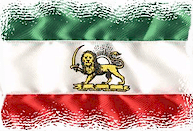

IMPERIAL EMBLEM

PERSIA
Iranian Freedom Fighters UNITE

Tuesday, August 26, 2008
Russian is Back. But Which Russia?


Saturday, August 02, 2008
Iran: between the anvil of sanctions and the hammer of war
 | |||||
Iran: between the anvil of sanctions and the hammer of war | |||||
|

MOSCOW. (RIA Novosti political commentator Pyotr Goncharov) - Tehran has once again been offered a choice between accepting the terms of the "Iranian six" or suffering inevitable sanctions with the possibility of a "small" war, proposed by Israel and the United States. The six powers involved are the United States, Russia, China, France, Britain and Germany. The Western powers gave Iran two weeks from July 19 to respond to their offer to hold off more UN sanctions on Iran if Tehran freezes expansion of its nuclear program. Israeli Defense Minister Ehud Barak said during a two-day visit to the U.S. earlier this week that his country does not rule out the possibility of delivering a military strike against Iran. After discussing the Iranian problem in the State Department and the Pentagon, Barak said tough sanctions should be used to prevent Iran from developing nuclear weapons but added that no options should be excluded. Following his visit to Jerusalem, Democratic presidential candidate Senator Barack Obama told a Democratic caucus this week, "Nobody said this to me directly, but I get the feeling from my talks that if the sanctions don't work, Israel is going to strike Iran." The timing of Barak Obama's remarks is alarming, especially since they come after Russian Foreign Minister Sergei Lavrov said there could be no "artificial deadlines" or "drawing out" of the process in the search for a compromise between the six nations and Iran. Lavrov was apparently referring to the two weeks given to Iran by U.S. Secretary of State Condoleezza Rice to reconsider its decision. Speaking on Monday after the meeting between EU High Commissioner for Foreign and Defense Policy Javier Solana and Iran's nuclear negotiator Saeed Jalili in Geneva on July 26, Rice dismissed Iran's response to a proposed solution on Tehran's nuclear program as "small talk" meant to buy time. "It's time for the Iranians to give a serious answer," she said. "They can't go and stall and make small talk about culture, they have to make a decision. ... We will see what Iran does in two weeks." The deadline is therefore August 2. Rice apparently exceeded her authority when making a statement none of the six nations has empowered her to make. On the other hand, the story of Iran's nuclear dossier and the UN Security Council's binding resolutions has become a boring soap opera. Over the past two years, the Security Council has adopted four resolutions on Iran, three of them with sanctions. But the more concessions the six nations make, the more capricious Tehran becomes. President Mahmoud Ahmadinejad has actually made Iran's nuclear program a hostage of his campaign for the 2009 presidential elections. This time the United States and Israel have gone further than ever before. The U.S. Congress has instructed the Pentagon to immediately start talks with the Israeli government on the placement of a missile defense radar in Israel "to defend against threats from Iran and Syria." Congressmen sent a letter to President George W. Bush strongly urging him to deploy the early-warning AN/TPY-2 radar to Israel as soon as possible and reminding him that Iran has tested "nine long- and medium-range missiles, including an upgraded Shabab-3 capable of reaching Israel." The radar will ensure the destruction of Iranian Shabab missiles by Israeli interceptors. Israel intends to buy the Vulcan Phalanx missile defense system from the United States, which can down short-range missiles such as the Qassam, which Hamas and Hizbollah have used to shell Israel. Tehran will most likely ignore this new "freeze-for-freeze" proposal under which Iran would not increase its enrichment efforts and the Iran Six would freeze the movement towards tougher sanctions against Iran. Ali Khamenei, the spiritual leader of Iran, said on July 30 that Tehran would continue to develop its nuclear program, whose peaceful nature the International Atomic Energy Agency and the UN Security Council are questioning.
What will happen next?
Unless Iran decides to suspend uranium enrichment, it can expect more and harsher sanctions to be imposed by the United States and the European Union as early as late August or September, Rice said. There is still time for Israel and the Pentagon to deploy missile defense radars and systems in Israel, and for Iran to carefully weigh the pros and cons of its continued confrontation with the rest of the world. But time is running out fast, because Israel and the United States have never before seemed so serious.
Saturday, May 03, 2008
Modern Day "TUDEHIES" At Work Again In Tehran and Qom
|


Sadrist MPs hit back at PM''s remarks (KUNA)
Iraqi MPs Call Maliki Depraved (BBC)
 | Breaking News |
 | Will Sadr declare open war? |
 | Did Petraeus part ways with the neocons? |
 | Candidates jockey for position on Iraq Thursday April 10th, 2008 01:00:00 Tom Hayden: Iran is Washington's scapegoat for failure of surge |
 | Ex-CIA analyst on Petraeus and Cheney Friday April 11th, 2008 05:53:42 Ray McGovern: Was Cheney behind Iraqi army's failed Basra offensive? |
Ex-CIA analyst on Petraeus and Cheney
Ray McGovern: Was Cheney behind Iraqi army's failed Basra offensive?
Friday April 11th, 2008
Raymond McGovern is a retired CIA officer turned political activist. McGovern was a Federal employee under seven US presidents for over 27 years, presenting the morning intelligence briefings at the White House for many of them. McGovern was born and raised in Bronx, graduated summa cum laude from Fordham University, received an M.A. in Russian Studies from Fordham, a certificate in Theological Studies from Georgetown University, and graduated from Harvard Business School's Advanced Management Program.
Transcript:Does Sen. Kennedy know something we don't?MATTHEW PALEVSKY,PRESENTER: Here on Capitol Hill, both General Petraeus and Ambassador Crocker had testified to Iraq several times over the last couple of days. To better understand their testimonies, I spoke with former CIA official Ray McGovern. McGovern worked for the federal government for over 27 years and under seven different presidents, presenting the morning intelligence briefing at the White House for several of them.RAY MCGOVERN, RETIRED CIA OFFICER AND POLITICAL ACTIVIST: Mostly it was entirely predictable. What shocked me was how Senator Kennedy, at the very end of his remarks, apropos of nothing, asked Petraeus and Crocker, "Tell me, General, and Ambassador Crocker, when the vice president was in Baghdad, were you in any meetings where the offensive against Basra was discussed with the vice president?"(CLIP BEGINS)TED KENNEDY, US SENATOR (D-MA): Were you at any meetings with the vice president or Ambassador Crocker where the issue of the Basra invasion took place?RYAN CROCKER, US AMBASSADOR TO IRAQ: It was not discussed.KENNEDY: It was not discussed at all during the vice president's visit to Baghdad? The possibility of Maliki going into Basra was not discussed? You were not at any meetings where the vice president was present or where this was discussed in his presence?CROCKER: It was not discussed in any meeting I attended. No, sir.KENNEDY: General?DAVID PETRAEUS, COMMANDING GENERAL, MULTINATIONAL FORCE IRAQ: Same, Senator.KENNEDY: Thank you. My time's up.PETRAEUS: Thank you, sir.(CLIP ENDS)Well, I thought Petraeus was going to have a little conniptionary. He turned a little bit white and looked at Crocker, and Crocker, ashen as he was for the whole time, even paled the more, and he thought really quick, and his eyes sort of went like this, and he said, "No, sir. I was at no meetings, no meetings where Basra was discussed with the vice president." "And you, General Petraeus?" "Same." I think Kennedy knows more than the rest of us know. I think it's very clear that if you're looking for why Maliki went off half-cocked for a big offensive down against Muqtada al-Sadr in southern Iraq, it was because Cheney told him to. And I would be shocked if Cheney didn't tell Petraeus and Crocker what he was going to tell Maliki—not only Cheney, but McCain. They were both there just days before. Petraeus has hundreds of troops there embedded with the Iraqi forces. He had to know exactly what was going on. He just couldn't stop it. Why? Well, he didn't want to stop it, because Cheney is running things. The plan was to get down there into the south, to (A) show that this fellow could take the initiative and be—well, the president was instructed two days later to say this is a defining moment, a defining moment in the leadership of Prime Minister Maliki. Oh, yeah, it sure was, but not the way they meant. And so Petraeus and Crocker could come before Congress and say, "Look, you told us," you know, "you told us last time that the Iraqis had to take more initiative so that we're not doing the fighting." Well, look—just what happened. You cleaned out the whole of southern Iraq. And they still played that theme, bring several changes on that theme. Here Maliki finally took the initiative, "Iraqis are doing—you know, we supported them." But that was only an half-truth. The other truth was he lost miserably. Muqtada al-Sadr has 70,000 people under arms with better arms than Maliki had. And if it weren't for the US air force and US ground troops to bail them out, not only down there in Basra but out from Sadr City, you know, he would have had even a bloodier nose. Right after it became clear that, you know, it's a great initiative, but it was going to lose, you know, they distanced themselves from it and they told all the press people, you know, "We didn't know anything about [inaudible]." I mean, Hayden, the head of the CIA, goes on Meet the Press and says, you know, "I didn't know anything about it, and neither did Petraeus or Crocker."(CLIP BEGINS)TIM RUSSERT, HOST, MEET THE PRESS: The United States was not informed by the Iraqis that he was going to do this?GEN. VINCENT HAYDEN, CIA DIRECTOR: I don't know what went on on the ground in Baghdad prior to the operation. I do know that this was a decision of the Iraqi government by the prime minister, and personally by the prime minister, and that he's relying on Iraqi forces, by and large, to take this action.RUSSERT: Were you aware of it?HAYDEN: I was—. In terms of being pre-briefed or having, you know, the normal planning process, in which you build up to this days or weeks ahead of time, no, no, I was not.RUSSERT: You didn't know it was going to happen?HAYDEN: No more so than Dave Petraeus or Ambassador Crocker did.(CLIP ENDS)Well, you know, that's a crock. And in the Bronx, where I come from, we say "that's a crock," okay? Because [inaudible] Petraeus has got people all over that Iraqi army, and there's no way that he could not have known. And I'm sure that Cheney told him, included him as well. Maliki can't scratch his nose without asking Petraeus to make sure there are some bodyguards around. So it was very much a joint operation. Ironically, they wanted to give the initiative to Maliki because they thought it might succeed, and then they wanted to give the initiative to Maliki because it failed so miserably. You know. This is a great crew, you know. Those of us who are old enough to have been through Vietnam, you know, this is an old tactic. You can construct a concept out of language: "special group" can be brought to mean whatever you want it to mean, okay? And so in this case it's always Iranian-influenced, nefarious influence from Iran, and all these adjectives that were used yesterday to blame what's happening on—you know. I mean, you really need to be able to blame somebody. And as has been pointed out ad nauseam, the Iranians are indeed involved with all these groups, including Maliki, including the other part of the government, so to speak. And so to the degree things are going a-¬shambles, well, it must be the Iranians. How do we say the Iranians if they're involved with everybody? Ah! How about "special groups"? Do you think that will work? Well, it seemed to work yesterday, because some of the congress people were using the same thing. And so, you know, those who were more perspicacious or could see through this stuff [were] saying, "Wow, this is really quite a dog and pony show." Petraeus talked about battlefield geometry; I'll talk about arithmetic. Okay? Look at his own manual about insurgency. There's no ratio that can ever cope with a country. He talked about 27 million. There aren't 27 million Iraqis anymore, only 23 million, 'cause four [million] are outside in diaspora, four [million] refugees, okay? But you can't occupy a country that doesn't want to be occupied with the ratio of troops that we have. And the reason we don't have more troops is because there are no more troops. And so what you have is very similar to Vietnam. We have even US colonels—at the very end of Vietnam, Colonel Harry Summers, who was the army colonel who was sent to Hanoi to negotiate the final withdrawal of US and other troops—okay? So he goes there and he makes the big mistake of saying, "Colonel Tu"—that was his opposite number—"Colonel Tu, you have to admit that you never beat us at a pitched battle." And Tu looks at him. He says, "That is correct. It is also irrelevant." Pitched battles don't happen in insurgencies. And so, as somebody pointed out yesterday—I guess it was said at a Web—here we have taken the most sophisticated, maneuverable forces that have ever been created in the world, and wasted them, squandered them on an enterprise that has no chance of being won. And I have been saying that, personally, for four and a half years.
Iran Opens War Avoidance Flank : by Muriel Mirak-Weissbachhttp://www.globalresearch.ca/ - Saturday, 3 May 2008, Global Research
As threats of military action against Iran continue to issue from various spokesmen of the war party in the U.S., the Islamic Republic has launched an ambitious initiative aimed at preventing war, based on a comprehensive package of economic, political and security measures on a vast regional plane. The package includes proposals to settle remaining questions related to Iran's nuclear energy program, but is not limited to that.
It was Saeed Jalili, the new head of the Supreme National Security Council and chief nuclear negotiator, who first announced the initiative. As Acting Secretary of the Russian Security Council Valentin Sobolev arrived in Tehran, April 28, Jalili declared that his government was presenting the Russian delegation a package of proposals aimed at solving the problems of the world. "The package is about the great questions of the world," he said, "and the nuclear question could be the subject of discussion" While declining to give details, he added, "We spoke in detail with our Russian friend and we explained our vision. Our approach could be a good basis for negotiation between the influential powers of the world," according to AFP. Talks continued in the Iranian capital for three days, including with Gholamreza Aghazadeh, head of Iran's Atomic Energy Organization, Foreign Minister Manouchehr Mottaki, and President Mahmoud Ahmadinejad, on return from his South Asian tour. Although both sides said the package would not be made public yet, remarks made by Sobolev at a joint press conference April 28, indicated that Russia had listened to Iran's proposals with keen interest. He praised the expansion of relations with Iran "in all areas." After their second round of talks on April 29, Jalili said of the package that it "has provided a new opportunity for constructive cooperation for restoration of regional and international peace and stability and those who have adopted positive stands on the issue should welcome it." Ahmadinejad, following his talks with the Russian envoy, indicated that the discussions aimed at introducing a new international order. "The might of the United States and some other countries speaking the language of force that used to dictate international relations after the Second World War is now rapidly vanishing," The same day, the Iranian student news agency ISNA reported that, following that meeting, Sobolev, "said his country hails Iran's package of proposals covering a wide range of issues including Iran's nuclear program." TASS said Sobolev explicitly ruled out any Iranian weapons program. "We believe," he said, "that Iran is not engaged in any military nuclear research, but we are confident that not only Russia should think so but all countries that are involved in the settlement of the situation [revolving around the Iranian nuclear program]." Further confirmation of Russia's positive response, came, albeit indirectly, from the top. Sobolev announced to RIA , "An oral message from Russian President Vladimir Putin was conveyed to Iranian President Mahmoud Ahmadinejad at a meeting. The substance of it is that Russia confirms the principles of mutual relations (with Iran) and her policy will not depend on who is in power," a reference to the new president Dmitry Medvedev. While talks were going on with the Russian delegation, Jalili informed Swiss Foreign Minister Micheline Calmy-Rey of the initiative by telephone, saying it should be considered at the next meeting of the five permanent memers of the U.N. Security Council plus Germany.
The Mystery Package
The content of the Iranian package has remained shrouded in secrecy, but certain features have emerged. Alaeddin Borujerdi, head of Iran's parliamentary commission on national security and foreign policy, spoke of the fact that it would guarantee the country's enrichment rights. According to well-informed Iranian sources, the initiative develops the idea of an international consortium for the enrichment of uranium, on Iranian territory. This idea had been floated by Tehran earlier, when the President issued an invitation to international partners to participate. Most important, it has also been under consideration by a group of U.S. figures opposed to the war policy of the administration, led by former diplomat Thomas R. Pickering. Together with William Luers and Jim Walsh, Pickering outlined the idea in an article, "A Solution for the US-Iran Nuclear Standoff," published in The New York Review of Books in its March 20 issue. (www.nybooks.com/articles/21112) The paper stated that the authors had been part of "a group of former American diplomats and regional experts" who "have been meeting directly and privately with a group of Iranian academics and policy advisers." The article stated: "We propose that Iran's efforts to produce enriched uranium and other related nuclear activities be conducted on a multilateral basis, that is to say jointly managed and operated on Iranian soil by a consortium including Iran and other governments." This approach reflected a similar idea worked out by the International Crisis Group, of which Pickering is a member, and presented to an international conference in Berlin in March 2006. (1) In a section entitled, "Turning Iran's Enrichment Activities into a Multilateral Program," the article goes on to suggest that "the Iranian government would allow two or more additional governments (for example, France and Germany) to participate in the management and operation of those activities within Iran." It notes that, of course, several Iranian officials, including Ahmadinejad, had "already publicly endorsed a multilateral solution." However, as Iranian sources pointed out to this author, Tehran, significantly, did {not} address Paris or Berlin, but rather Moscow Russia is considered the priority interlocutor due to the special relationship that exists between the two countries, epitomized by Russia's participation in building the Bushehr nuclear plant, but also because the Russians, unlike the Germans and French, have refused to let the nuclear issue become a casus belli. Russia and China have succeeded in blocking more hostile sanctions through the Security Council, and are both fully aware of the danger that the issue might be exploited by the war party in London and Washington, to justify military aggression. For this reason, the Russian government has been insisting that Iran return to the negotiating table with the 5+1 group. On March 31, Ambassador to the U.N. Vitaly Churkin urged Tehran to restart such talks. That was just prior to Sobolev's visit. And China had taken the unprecedented initiative of convening a meeting of the permanent five in Shanghai in mid-April, to seek a solution; although the meeting yielded no solution, it underlined Beijing's concern that war could be on the agenda otherwise.
Iran expressed its readiness to settle all remaining questions related to the controversial program, just a week prior to Sobolev's mission. On April 21-22, a delegation of the International Atomic Energy Agency led by Oli Heinonen met with Iran's leading nuclear officials, including Mohammed Saeedi, Iran's IAEA envoy Ali-Asghar Soltanieh, and several AEOI and foriegn ministry representatives. Iran announced it would cooperate in clarifying anything that had to be settled. IAEA chied Mohammad ElBaradei did not hesitate to praise the move. "That is certainly a milestone," he said, "and hopefully by the end of May we will be in a position to get the explanation and clarification from Iran as to these alleged studies," referring to studies that allegedly Iran had made regarding nuclear weapons. He said this was "the only remaining topic for us to investigate about past and present Iran nuclear activities."
But, the nuclear issue is merely one aspect of Tehran's global package. The rest is of a strategic nature. As noted above, Ahmadinejad was visiting South Asia when Sobolev landed in Tehran, and his mission involved other components of the package. The main focus of his talks was the Iran-Pakistan-India gas pipeline project (IPI), which has been held up for various reasons, some more real than others. Aside from bickering about the price India would have to pay Pakistan, the main glitch was pressure that certain U.S. officials were placing on New Delhi, to sabotage the agreement. Once it had been announced that Ahmadinejad would visit India, the Bush administration moved into high gear. Tom Casey, State Department spokesman, came out somewhat undiplomatically suggesting that India should "use its influence" with Iran, to persuade it to give up its uranium enrichment program. The Indian government was not amused. External Affairs Ministry spokesman Navtej Sarna was quoted by Tehran Times April 23, saying, "Neither country needs any guidance on the future conduct of bilateral relations as both countries believe that engagement and dialogue alone lead to peace." He went on to develop the concept, saying, "Both nations are perfectly capable of managing all aspects of their relationship with the appropriate degree of care and attention." The foreign ministry issued a statement which must have been somewhat embarassing for youthful Washington: "India and Iran," it read, "are ancient civilizations whose relations span centuries." Ahmadinejad's visit was a resounding success. In an April 29 press conference, he said that progreess was being made on the IPI. "Ministers from the three countries," he was quoted by Arab News as saying, "hope to reach a tripartite agreement in the next 45 days." Construction on the pipeline is to begin in 2009, and should be completed by 2012. The 2,600 km pipeline is to transport Iranian gas to Pakistan and India. Prior to his visit to India, Ahmadinejad had been in Pakistan, where he fine-tuned details of the project with President Parvaz Musharraf. He also committed Iran to providing 1,100 MW of electricity to Pakistan, to help it overcome energy shortages. Talks between Pakistan and India had also taken place at the end of April, after which Indian Petroleum and Natural Gas Minister Murli Deora announced that the deal would be "clinched soon." At an Islamabad press conference on April 25, IRNA reported that the oil ministers of the two countries said they had reached agreement on "fundamental issues," and that a final agreement could be signed in weeks, if not days. One factor which may have nudged India in the direction of a deal, is that China was showing interest in the project. In his meeting with Pakistani Prime Minister Yousaf Raza Gilani, Ahmadinejad said that the IPI deal would soon be finalized "and my government will also welcome the inclusion of China in the project." The crucial question of financing for the $7.4 billion project, was being hammered out in the Asian Development Bank. According to sources in the Pakistani Petroleum Ministry cited by the Tehran Times on April 23, the ADB was ready to foot the bill. The ADB is also sponsoring the Turkmenistan-Afghanistan-Pakistan-India (TAPI) gas pipeline project, in which Pakistan would import 3.2 billion cubic feet of gas, to be shared with India. So much for pipelines. But Iran's "package" contains much more. As Iranian sources have indicated, India is also committed to invest in Iran's oil industry. And Sri Lanka, another stop on Ahmadinejad's Asian tour, is looking forward to Iranian participation in $1.5 billion worth of infrastructure projects, including the $450-million Uma Oya hydro power project slated to produce 100 MW electricity, and an upgrading of the country's oil refinery. In addiiton, Iran is ready to offer credits for military equipment to be brought in from China and Pakistan, as well as training. Beyond energy agreements, the Iranian package also deals with developing transportation infrastructure. As reported in the Tehran Times April 16, Iran and India signed an MoU for starting work on the India-Iran-Russia railway line. When one puts all these bits and pieces together, then a rather wonderful mosaic image emerges. As confirmed by Iranian sources, what the Iranians are proposing in their new package is nothing less than a blueprint for a new correlation of nations in Eurasia, whose collaboration in developing continental infrastucture--nuclear energy, gas and oil pipelines, and transportation--should establish the economic, and therefore political, basis for true independence. Iran's Foreign Minister Mottaki made clear, during his visit to Dushanbe on March 24, that his country wanted to become a full-fledged member of the Shanghai Cooperation Organization, a grouping which includes Russia and China, along with the leading nations of Central Asia, Kyrgyzstan, Tajikistan, Kazakhstan and Uzbekistan. Not only: the Iranians are also moving in their more immediate regional environment, to erect this alternative economic, political and security structure. Most significant in this context, is the meeting that took place in Tehran April 30, between Iranian Interior Minister Mostafa Pourmohamadi and Saudi Arabian Deputy Interior Minister for Security Affairs Ahmed bin Mohammad Al-Salem. The aim of this 2nd joint Iran-Saudi security committee meeting was to implement the agreements the two countries had reached in groundbreaking talks in October 2001, when they signed a joint security agreement. At the same time, Iran had been engaged in talks with Turkey on security. Iran's deputy interior minister for security and political affairs, Abbas Mohtaj, had said that Iran, Turkey and Saudi Arabia had reached some form of agreement on regional security. Add to this the ongoing process of discussions between Iran and the members of the Gulf Cooperation Council for establishment of a free trade zone, as well as for a regional nuclear energy agreement, and it becomes clear that what is on the agenda is nothing less than a regional economic-security arrangement. The Iranian leadership has understood that, in order to face the continuing threat of militrary aggression by the war party, it must not only mobilize its military capabilities, as a defensive measure, but, more importantly, that it must move in a positive direction, to build the economic-strategic alliances in the immediate Persian Gulf region, and in the broader regional context -- Russia, Central Asia, India, China. This is precisely what Tehran is doing. This is the signifance of the "package." NOTE1. The ICG proposal was the most far-reaching and detailed. The Iranian participants at the conference signalled their overall approval. See EIR, April 7,2006 for a report on the conference and interviews with the Iranian representatives as well as with Tim Guldimann, former Swiss ambassador to Tehran.
Iran mum on ‘names’ confrontation
TEHRAN, Iran (Agencies): An Iraqi delegation was in Tehran on Friday for discussions on the recent upsurge in violence in Iraq, Iran’s official news agency reported, but made no mention that the visit sought to pressure Iran to stop arming and training Iraq’s Shiite extremists — a claim backed by Washington but denied by Tehran. In Baghdad, an Iraqi lawmaker said the Iranians admitted nothing when confronted with documents carried by the Iraqi delegation, and claimed they were not meddling in Iraq in any way. Iran’s IRNA news agency said the Iraqis were here to discuss “security issues” related to clashes between Shiite extremists and the Iraqi government and US forces. It quoted Foreign Ministry spokesman Mohammad Ali Hosseini as saying that the five-member Iraqi team was to “discuss latest developments” in Iraq.“Iranian officials will hold talks with this delegation in line with helping settle differences and ongoing clashes in Iraq,” Hosseini said. Senior Shiite Iraqi politicians from the ruling United Iraqi Alliance arrived Wednesday to confront Iranian authorities with what Baghdad officials described as “sufficient evidence” of Iran’s support for Iraq’s militias and outlaws. Haider al-Ibadi, a lawmaker from Iraqi prime minister’s Dawa party, said Friday that the delegation visiting Tehran presented a “list of names, training camps and cells linked to Iran” but that “Iranians did not admit anything.” “They claim they are not intervening in Iraq and they promised to exert efforts to support the Iraqi government in containing the lawbreakers and to prevent the flow of weapons to Iraq,” al-Ibadi told The Associated Press in Baghdad. On Thursday, the Iraqi delegates met with the commander of the Quds Force, an elite unit of Iran’s Revolutionary Guard Corps that has been accused of training and funneling weapons to the Shiite extremists in Iraq. A second meeting with the commander, Ghassem Soleimani, was expected Friday.The Quds Force is believed to operate overseas, and is said to have helped create the militant group Hezbollah in Lebanon in 1982 and armed Bosnian Muslims during the Balkan wars of the 1990s.The Iraqi delegation was said to have documents and other material implicating the Quds Force in supplying weapons and training fighters. US military officials have said the evidence includes caches of weapons that have date stamps showing they were produced in Iran this year — including mortars, rockets and armor-piercing roadside bombs known as explosively formed penetrators, or EFPs.The Bush administration has been raising its anti-Iran rhetoric as American troops in Iraq face daily clashes with Shiite militiamen. The combat helped push the US military death toll in Iraq to at least 50 in April, the highest monthly toll since 65 were killed in September.Hosseini said Iran supports its neighbor’s stability and that hosting the delegation from Baghdad was “in line with the goal ... of providing stability and security in Iraq.”He blamed Washington for the violence in Iraq, saying Iraq’s “main problem is the presence of occupiers and terrorists.” Iran has repeatedly called for the withdrawal of US-led forces from Iraq, saying their presence is the root cause of instability there.Iraqi Prime Minister Nouri al-Maliki’s Shiite-dominated government faces a delicate challenges as it tries to maintain a relationship with its US backers and neighboring Iran, a predominantly Shiite nation that has close ties to Iraq’s leaders.But al-Maliki has shown a recent willingness to crackdown on Shiite militias led by the Mahdi Army as he seeks to gain political support from rival Shiite groups and minority Sunnis.Defense Secretary Robert Gates said Thursday that the Iraqi visit was “a very important step” and that it may prompt Iranians choose whether they “want to work with the government of Iraq or subvert” it.
A CounterPunch Exclusive
Democrats Okay Funds for Covert Ops
Secret Bush "Finding" Widens War on Iran
By ANDREW COCKBURN
Six weeks ago, President Bush signed a secret finding authorizing a covert offensive against the Iranian regime that, according to those familiar with its contents, "unprecedented in its scope."
Bush’s secret directive covers actions across a huge geographic area – from Lebanon to Afghanistan – but is also far more sweeping in the type of actions permitted under its guidelines – up to and including the assassination of targeted officials. This widened scope clears the way, for example, for full support for the military arm of Mujahedin-e Khalq, the cultish Iranian opposition group, despite its enduring position on the State Department's list of terrorist groups.
Similarly, covert funds can now flow without restriction to Jundullah, or "army of god," the militant Sunni group in Iranian Baluchistan – just across the Afghan border -- whose leader was featured not long ago on Dan Rather Reports cutting his brother in law's throat. Other elements that will benefit from U.S. largesse and advice include Iranian Kurdish nationalists, as well the Ahwazi arabs of south west Iran. Further afield, operations against Iran's Hezbollah allies in Lebanon will be stepped up, along with efforts to destabilize the Syrian regime. All this costs money, which in turn must be authorized by Congress, or at least a by few witting members of the intelligence committees. That has not proved a problem. An initial outlay of $300 million to finance implementation of the finding has been swiftly approved with bipartisan support, apparently regardless of the unpopularity of the current war and the perilous condition of the U.S. economy. Until recently, the administration faced a serious obstacle to action against Iran in the form of Centcom commander Admiral William Fallon, who made no secret of his contempt for official determination to take us to war. In a widely publicized incident last January, Iranian patrol boats approached a U.S. ship in what the Pentagon described as a "taunting" manner. According to Centcom staff officers, the American commander on the spot was about to open fire. At that point, the U.S. was close to war. He desisted only when Fallon personally and explicitly ordered him not to shoot. The White House, according to the staff officers, was "absolutely furious" with Fallon for defusing the incident. Fallon has since departed. His abrupt resignation in early March followed the publication of his unvarnished views on our policy of confrontation with Iran, something that is unlikely to happen to his replacement, George Bush's favorite general, David Petraeus. Though Petraeus is not due to take formal command at Centcom until late summer, there are abundant signs that something may happen before then. A Marine amphibious force, originally due to leave San Diego for the Persian Gulf in mid June, has had its sailing date abruptly moved up to May 4. A scheduled meeting in Europe between French diplomats acting as intermediaries for the U.S. and Iranian representatives has been abruptly cancelled in the last two weeks. Petraeus is said to be at work on a master briefing for congress to demonstrate conclusively that the Iranians are the source of our current troubles in Iraq, thanks to their support for the Shia militia currently under attack by U.S. forces in Baghdad. Interestingly, despite the bellicose complaints, Petraeus has made little effort to seal the Iran-Iraq border, and in any case two thirds of U.S. casualties still come from Sunni insurgents. "The Shia account for less than one third," a recently returned member of the command staff in Baghdad familiar with the relevant intelligence told me, "but if you want a war you have to sell it."Even without the covert initiatives described above, the huge and growing armada currently on station in the Gulf is an impressive symbol of American power.
Armed Might of US Marred By Begging Bowl to Arabs
Sometime in the next two weeks, fleet radar operator may notice a blip on their screens that represents something rather more profound: America's growing financial weakness. The blip will be former Treasury Secretary Robert Rubin's plane commencing its descent into Abu Dhabi. Rubin's responsibility these days is to help keep Citigroup afloat despite a balance sheet still waterlogged, despite frantic bail out efforts by the Federal Reserve and others, by staggering losses in mortgage bonds. The Abu Dhabi Sovereign Wealth Fund injected $7.5 billion last November (albeit at a sub-prime interest rate of eleven percent,) but the bank's urgent need for fresh capital persists, and Abu Dhabi is where the money is. Even if those radar operators pay no attention to Mr. Rubin's flight, and the ironic contrast it illustrates between American military power and financial weakness, others will, and not just in Tehran. There's not much a finding can do about that.Andrew Cockburn is a regular CounterPunch contributor. He lives in Washington DC. His most recent book is Rumsfeld: His Rise, Fall and Catastrophic Legacy.
Tuesday, December 25, 2007
Russia sees no need for Iran to continue with uranium enrichment
MOSCOW, December 26/ 2007 (RIA Novosti) - Russia's foreign minister said on Wednesday that Moscow saw no economic necessity for Iran to continue its controversial program to enrich uranium. Iran's nuclear program has been at the center of an international dispute, with Western countries suspecting Tehran of covering up a weapons program and Iran saying it needs nuclear fuel for energy.
"We are attempting to persuade the Iranians that the freezing of this program would be beneficial for Iran in as much as it would lead to immediate negotiations with the six [international negotiators], including the United States," Sergei Lavrov said.
Russia, which is helping the Iranians build the country's first nuclear power plant in Bushehr, southern Iran, announced the start of nuclear fuel deliveries to the plant on December 17.
If Iran were to agree to freeze its uranium enrichment program, then, said Lavrov, subsequent negotiations with the Iran Six - Russia, the U.S. China, Britain, France and Germany - would help lift, "once and for all, the suspicions that the Iranian nuclear program possesses any other kind of component than a peaceful one." The U.S. National Intelligence Estimate (NIE), published on December 3, stated that Tehran had put a stop to weapons production in 2003, although it was continuing to enrich uranium. The report contradicted a previous U.S. intelligence assessment in 2005, which said that the Islamic Republic was actively pursuing a nuclear bomb. Iranian Foreign Minister Manouchehr Mottaki said on Tuesday that Iran had turned down demands by the U.S. to halt its uranium enrichment program as a precondition for direct negotiations with Washington. Lavrov said Russia was fulfilling its obligations to build the $1-billion Bushehr nuclear power plant. "In the course of the project, certain problems have arisen. But these problems were of a technical and financial nature, not a political one. They have now been settled," he said. The completion of Bushehr, being built under a 1995 contract, came under threat in February when Russia cited payment delays. Iran denied any funding problems and accused Russia of deliberately stalling on the project in response to pressure from Western powers. Lavrov also commented that the Bushehr project was being carried out under the complete control of the UN's nuclear watchdog, the International Atomic Energy Agency (IAEA). "Our Iranian partners know that in the case of even the smallest deviation from the principle of 100% IAEA control, we will put a halt to our cooperation. But nothing of the sort is happening. The sides are fulfilling their obligations, and the project will be realized," he said.
Lavrov added that the international community was unanimous on its ultimate goal with regard to Iran, which is to prevent proliferation of weapons of mass destruction and reach an agreement that would recognize Iran's right to the peaceful use of nuclear energy. When asked if the U.S. had set itself the aim of achieving regime change in Iran, Lavrov answered that this was an "incidental goal." "We are being assured [by the U.S.] that they have no hidden goals. However, we would like to be convinced of this in practice. It is important to recognize the positive shift Iran has made in its cooperation with the IAEA." He also said that Russia would be firmly against any U.S. attempt to use the issue of the Iranian nuclear program to secure regime change in Iran.
AND HERE IS YOUR ANSWERE MR. BL***Y LAVROV
Iran to continue uranium enrichment despite Russian fuel supplies : Tuesday, December 25, 2007 6:53:00 AM CET : Atomic Energy[1]; Mohammad al-Hosseini[1]; TEHRAN, December 24 (RIA Novosti) - Iran will carry on with uranium enrichment operations despite nuclear fuel supplies from Russia, a spokesman for the Iranian Foreign Ministry said on Monday....
Sunni, Shia March Together in Baghdad for Peace : Sunday, 23 December 2007
BAGHDAD — Approximately 1,000 Iraqi citizens, of both Shia and Sunni religions, joined together on the sectarian fault line in Rawaniyah, the Karkh District of Baghdad, to march with one another in what they called a “Peace March”, Dec. 19. It was an Iraqi initiative to ease sectarian tensions, solely driven by Iraqi Neighborhood Council (NAC) and District Advisory Council (DAC) leaders and Sheiks from both religious sects in the area, said Capt. Marcus Melton, commander of Pale Horse Troop, 4th Squadron, 2nd Stryker Cavalry Regiment, attached to the 2nd Brigade Combat Team, 101st Airborne Division (Air Assault).With Iraqi Army and Iraqi policemen maintaining the security on the streets and within the crowd during the event, they were able to successfully complete the march for united peace among all Iraqis. Drums beat, children ran, silly string littered the air and one man nearly wept. It was an exciting, yet emotional day for the Iraqis who participated.
A local Sheik came over a loud speaker during the march to talk with his local comrades. He expressed his joy for their wanted peace, but nearly wept in the thought of those who have lost their lives in the battle for sectarian dominance. Many families, friends and sons have lost their lives during this time. “But dominance by one religious group is just a mindset, filed in the heads of the Iraqis”, said Melton, a native of Atlanta, Ga. This area is relatively calm today, but in January of this year violence raged through the streets, especially on Haifa.“The mindset that Shias stay on this side of the fence and Sunnis stay on the other carried over from the violence which once plagued the area,” Melton said. “There is only a street, Sheik Murah Street, which separates these men. To the west of this street is a Shia neighborhood. To the east is a Sunni neighborhood.“So it’s a sectarian line dividing the two,” he said. “They are working really hard within themselves to kind of get over this (sectarian mindset).”If they continue their quest for peace among all, Melton said the area will stabilize and move things forward in several areas.
“If the neighborhoods come together and start really working together at the NAC and DAC levels without sectarian issues, the government will become much more efficient and more self-sustaining,” Melton said. “Same thing on the security front in terms of the Iraqi Army and the Iraqi Police being trusted by the community and being able to secure the community--both of which are positive things for us, which will allow us to transition out of a more direct role into more of an over-watch role.”Melton, who is in his second tour in Baghdad, said “I know they are moving forward and making progress. Certainly they have issues and problems and growing pains, but they have made a tremendous amount of progress.”One Iraqi boy, Omar, 11, said because of the continued peace in his homeland, he came to celebrate with his fellow Iraqis.
Awass, with the Iraqi flag draped over his body, carried himself with much enthusiasm and excitement in his journey in Karkh.He said the flag—one he is very proud to display— describes his great country. “Red is for the blood shed. White is for our handshake. Green is for their land, and Black is for their oil,” he said.“We thank our God, our families and our friends that our neighborhood is safe and free of Violence,” an Iraqi man who participated in the march said.
They marched for their peace, for their friends and for their brothers, said the Sheik. “Today we march for us being brothers forever.”
(Story by Sgt. James P. Hunter, 101st Airborne Division Public Affairs)
In Other Recent Developments Here:
BAGHDAD — Multi-National Division - Baghdad Soldiers arrested an alleged terrorist technical advisor and an improvised explosive device cell leader during two raids in the Doura neighborhoods in the Rashid District, Dec. 17.
BAGHDAD — Coalition forces captured two suspected Special Groups leaders and detained three other suspects during operations to disrupt criminal element networks early this morning in the Al Mashru area, south of Baghdad, and the Kadhimiyah area, west of Baghdad.
Never Mind the Bomb, Beware of IslamofascismBy Amil Imani MichNews.com Dec 24, 2007
The National Intelligence Estimate regarding Iran’s bomb project has stirred a great deal of controversy. Some say that there is now reason to abandon the war posturing and start negotiating a live-and-let-live deal with the Mullahs, since they have “abandoned” their quest for the bomb. At least that is what the not-so-reliable report seems to imply. Others, with good reason, remain skeptical of both the validity of the report and the ever-cheating, conniving Mullahs. This controversy aside, the irrefutable fact is that the Jihadist belief of Islam itself poses existential danger to the world. Beliefs energize and direct actions. Beliefs are as indispensable as the air we breathe. Even an atheist is a believer, with his own system of disbelief. Not believing in anything is mental breakdown. There is something about humans that demands a belief. A belief can be anything or a combination of many things; it can be well-defined and even rigid, or a loosely put together hodge-podge with considerable latitude. It can be magnificent or the most abhorrent. But, it has to be there. Beliefs steer our vehicles in the journey of life. Please read more: Click Here
Saturday, December 22, 2007
Iran and what to do with this Rouge Fascist State
Bush backs Moscow's fueling of Bushehr.
The Costs of Containing Iran - Washington's Misguided New Middle East Policy
The Bush administration wants to contain Iran by rallying the support of Sunni Arab states and now sees Iran's containment as the heart of its Middle East policy: a way to stabilize Iraq, declaw Hezbollah, and restart the Arab-Israeli peace process. But the strategy is unsound and impractical, and it will probably further destabilize an already volatile region. Vali Nasr, Professor of International Politics at the Fletcher School of Law and Diplomacy and Adjunct Senior Fellow for the Middle East at the Council on Foreign Relations, is the author of "The Shia Revival: How Conflicts Within Islam Will Shape the Future." Ray Takeyh is a Senior Fellow at the Council on Foreign Relations and the author of "Hidden Iran: Paradox and Power in the Islamic Republic."
Europe Will Become a Muslim Continent, Says Khamenei's Spokesman
Tehran -- Europe will eventually become a Muslim continent, according to a representative of Iran's supreme leader, Ayatollah Seyyed Ali Khamenei. "In a dozen years, Europe will be an Islamic continent," said Rasul Jalilzadeh on Friday as he was speaking to the basiji, a voluntary organisation in the capital Tehran.
Senior US Envoy: Iran Needs to Admit to Past Weapons Program
VIENNA, Austria -- Iran needs to "confess" to running a past nuclear weapons program or its claims of cooperating with a U.N. investigation of its past clandestine activities will be a sham, the chief U.S. envoy to the International Atomic Energy Agency said Friday. In Washington, meanwhile, U.S. Secretary of State Condoleezza Rice said Tehran must do even more to end present U.N. sanctions and avoid new ones — halt uranium enrichment and related activities that could make the ingredients for a bomb.
The Report on Iran: Straight or Bent?
On December 3 of this year, the Directorate of National Intelligence, an agency attached to the White House that centralizes intelligence supplied by the ensemble of American intelligence agencies, made public a report (National Intelligence Estimate, NIE) deeming that Iran had suspended its nuclear program since autumn of 2003. That document, issued in mid-2007, asserts that Iran is no longer an immediate nuclear threat and that the Iranian regime is less determined to develop nuclear weapons than the United States thought in 2005. It still emphasizes that Tehran is continuing to enrich uranium for civilian purposes and judges that if the Iranian military effort were relaunched, the country could produce nuclear warheads between 2010 and 2015.
What Will Israel Do?
December 21, 2007 Newsweek Web Exclusive Michael Hirsh
A unilateral military strike against Iran is much more likely following the latest intel report about Tehran's nuke program.Ehud Olmert, like George W. Bush, is trying hard to make it seem that nothing has changed, and that the international diplomatic coalition against Iran is still intact. "The state of Israel is not the main flag-bearer against the quirks of the regime in Tehran," the Israeli prime minister declared testily last week, after officials in his own government seemed to suggest that Israel had been left on its own by Washington. Olmert said that the recent U.S. National Intelligence Estimate (NIE) on Iran--which stunned leaders around the world by concluding, after years of bellicose rhetoric from Bush officials about Iran's nuclear ambitions, that Tehran had halted its weapons program in 2003--has "generated an exaggerated debate" in Israel. "Some of us even interpreted the report as an American retreat from its support of Israel," Olmert said. "This is groundless … I trust and am confident that the United States will continue to lead the international campaign to stop the development of a nuclear Iran."But Olmert is not Moses; he can't hold back elemental forces all by himself. And a rising tide of opinion in Israel's intelligence and national-security circles believes that the NIE does signal American retreat--and, more profoundly, renewed Israeli isolation over what is deemed an existential threat out of Tehran. Gen. Ephraim Sneh, a former deputy defense minister who has warned for years that Israel would eventually have to confront Iran alone, told me that "today we are closer to this situation than we were three weeks ago ... we have to be prepared to forestall this threat on our own." Some prominent American experts think that the NIE all but assures Israeli military action at some point. "I came back from a trip to Israel in November convinced that Israel would attack Iran," Bruce Riedel, a former career CIA official and senior adviser to three U.S. presidents--including Bush--on Middle East and South Asian issues, told me Thursday, citing conversations he had with Mossad and defense officials. "And that was before the NIE. This makes it even more likely. Israel is not going to allow its nuclear monopoly to be threatened."Riedel said the Bush administration compounded the problem by failing to signal to the Israelis that the NIE assessment was coming. "Something like this should have been presented to the Israelis through professional intelligence channels," he said. Yuval Steinitz, a member of the right-wing Likud Party, told me that he had led a delegation of Knesset members to Washington a few weeks before the NIE was made public Dec. 3. Steinitz said he met with Vice President Dick Cheney, national-security adviser Stephen Hadley and other administration officials, but not even they seemed aware that their 2005 estimate that Iran was definitely pursuing nuclear weapons was about to be repudiated. Even though Iran was discussed, he said, "no one seemed to have any sign this was forthcoming," he says.Many Israeli experts are appalled by the tone of the report, which concludes with "high confidence" that Iran halted its "nuclear weapons program." The NIE arrived at this finding even though it also asserted that Washington now had concrete evidence of that program, and despite Tehran's brazen pursuit of uranium enrichment. Even formerly moderate European and Russian officials suggest that the report went too far, especially in concluding that the U.S. intel community still has "moderate confidence" that the suspension of the program continues. Uzi Arad, a former Mossad official and adviser to Benjamin Netanyahu, the former Likud prime minister, said that on a recent trip he made to Moscow, a Russian general poked fun at the naiveté of the NIE, commenting that if the Iranians had halted weapons development in 2003 it was partly because they were satisfied with progress there and wanted to devote investment to harder parts of the nuclear equation, like enrichment. In the end, these critics say, Iran is likely to be further emboldened by the report (Iranian President Mahmoud Ahmadinejad lost no time in boasting of America's "surrender"). "The irony is that the effect of this report may be self-negating--by itself it will accelerate Iranian acquisition of nuclear weapons," Arad said.Some experts question whether the Israelis have the capability to seriously damage Iran's nuclear program, which is secured in secret, hardened facilities around the country. But others point out that the new NIE gives evidence of far better intelligence on Iran--possibly including the whereabouts of its facilities. "It did state for first time that a military nuclear program was in motion until 2003," said Sneh. "That was a major revelation that should have been picked up, and it was very damaging incriminating evidence, justifying much harsher action against Iran."A few experts, such as David Albright of the Institute for Science and International Security in Washington, say the intel still seems scant on the location of Iran's secret centrifuge development and manufacturing complex. Still, Albright points out that the Israelis are likely encouraged by the nonreaction to their September airstrike on what is reported to have been a Syrian nuclear facility, which may have been a test run for Iran, or at least a warning directed at Tehran. "Israel has gotten away with it in a sense," says Albright. He suggests that any Israeli pre-emptive action might not be a "traditional strike" but could involve more "sabotage of equipment." The Israelis also know that the Arab states are terrified of an Iranian nuclear power, possibly to the point of looking the other way at another such strike.Sneh, like others, isn't conceding failure yet on the official Israeli and U.S. approach, which involves isolating Iran diplomatically and economically. A third U.N. Security Council resolution authorizing economic sanctions against Iran is expected to pass next year, but it is likely to be fairly hollow because of Russian and Chinese opposition. One reason for Bush's abruptly announced nine-day visit to the region in mid-January is to deal with the fallout from the NIE, which includes not only the possibility that Israel will act unilaterally but also that Bush's prized Annapolis peace process will stall. The Bush trip is, in part, an implicit concession to U.S. hawks that the NIE went too far in absolving Iran. It is also a conscious effort to reassure both Israel and the Arab states that Washington will stand up to Iran's increasing intrusiveness and hegemonic tendencies. A dominant conspiracy theory in Arab capitals in the wake of the NIE is that Washington is seeking to cut a deal with Tehran--one that would effectively allow it to keep its nascent uranium-enrichment capability--in exchange for Iranian help in stabilizing Iraq.Bush may also reassure the Israelis and Arab allies that the NIE overstated things in letting Iran off the hook. In yet another briefing to angry congressmen Wednesday, Director of National Intelligence Mike McConnell conceded that "we could have written parts of it more clearly," according to a senior congressman who was there. The ranking Republican member of the Permanent Select Committee on Intelligence, Rep. Peter Hoekstra, says he's calling for an independent commission to probe the report. "Most of the world looks at it and says it's an embarrassment to the United States because once again the U.S. intelligence community has dramatically changed its position," Hoekstra told NEWSWEEK. And it may well be that Washington must take back its words one more time to prevent the Israelis from acting on their own.
Saturday, November 10, 2007
MAD MULLAHS PUZZLED PUTIN : By AMIR TAHERI
Thursday, November 01, 2007
Why did Lavrov visit Ahmadinejad? 31/ 10/ 2007
Russia opposes unilateral sanctions against Teheran and is still advocating a collective solution to the problem, said the Russian Foreign Minister after meeting the Iranian President Mahmoud Ahmadinejad. The otherwise standard sentence has one important detail. Moscow, unlike Teheran, does not deny the existence of the Iranian nuclear problem and urges the need to solve it. True, it makes no difference whatsoever to the collectively developed scenario. The scenario, to which Russia has signed on, would toughen UN Security Council's sanctions against Iran if it refuses to stop uranium enrichment.
The most likely aim of Sergei Lavrov's flying visit to Teheran was to bring home to Ahmadinejad the simple truth that if Iran fails to comply with the Security Council demand to stop uranium enrichment by the end of November, Moscow will have no grounds for protecting it. That sanctions (in the event of non-compliance with the UN demand) would become inevitable was recently stressed by the European Union's Foreign Policy and Security Chief Xavier Solana. Solana, along with IAEA head Muhammed el-Baradei, are to prepare a report on the Iranian nuclear program by November 15. Judging from his remarks, Solana is in a very resolute mood.
Lavrov's visit to Iran was a departure from standard practice. It had not been planned. A force majeure move had to have weighty reasons. Perhaps it was prompted by another round of unilateral U.S. actions against Iran. The specific targets were elite units of the Iranian Revolutionary Guards and its special Qods Force as well as three Iranian state banks and their foreign branches. One of these was the Moscow branch of Bank Melli which handles the payments for Russian military hardware supplied to Iran (29 Tor-M1 anti-aircraft missiles worth a total of $700 million). There may be some more intriguing motives. The U.S. Assistant Secretary of State Daniel Fried recently said that the U.S. would certainly come to certain conclusions regarding the deployment of the missile defense elements in Europe if Iran stopped all uranium enrichment work and began cooperating with the international community. Needless to say, it was a deal the White House proposed to the Kremlin. The tempting proposal was made almost simultaneously with Putin's visit to Teheran. It is believed in the White House that Moscow - especially after that visit - is in a position to influence some aspects of Iran's foreign policy. So, why not ask it to persuade the Ayatollahs to renounce uranium enrichment and change their tone in dealing with the West? Lastly, The International Herald Tribune has reported, citing American diplomatic sources, that the U.S. was ready to offer Moscow concessions on the CFE Treaty in exchange for a softening of its stance on Kosovo and a toughening of its stance on Iran. Most likely the prospect of multiple concessions (on missile defense and CFE) prompted Moscow to try to persuade Teheran to announce a moratorium on all uranium enrichment. But what can Russia offer in exchange? Teheran is unlikely to be moved by the mere readiness of Washington to sit down at the negotiating table or even resume direct bilateral contacts. The more likely explanation lies elsewhere. Teheran has long wanted to position itself as Russia's "strategic ally". So, there is no reason why Moscow should not make use of partnership relations. It could well act as a guarantor of the peaceful character of the Iranian nuclear program in exchange for the U.S. renunciation of military actions. Russia, of course, has something to offer Iran. And judging from the reception accorded in the Iranian capital to Sergei Lavrov, Teheran finds these proposals interesting.
The opinions expressed in this article are the author's and do not necessarily represent those of RIA Novosti.
Thursday, October 18, 2007
Every Picture Tells a Story
First, remember that Allah permits Muslims to lie to further the Muslim cause of Islam World Rule. Therefore, Muslims will reach out in an appearance of peace in order to lull the enemy into thinking that Muslims are telling the truth. The enemy buys into that reach out and then is taken in by the Allah condoned lie.


Last Tango in Tehran
Russia has no wish to alienate Iran .
Iran has kept out of Russia's military conflict in Chechnya and has not intervened in either the Caucasus or Central Asia.
Russia wants to keep it that way, and also to protect its own commercial interests in Iran.
On this basis, to be seen to back even a hypothetical attack on Iran by the Americans would be suicidal.
Which is not to say that Russia would side with Iran in any military conflict. “An American pilot hit by a Russian-made rocket would not be in Russia's interest,” comments Dmitri Trenin, deputy director of the Carnegie Centre in Moscow.
This is also why, for all his apparent friendliness, Mr Putin trod carefully in Tehran. He went out of his way to explain that his visit was planned five years ago as part of a five-country summit, not a bilateral trip. He did not pledge Russian support for Iran in case of a military attack, and he refused to set a date for the delivery of the nuclear fuel for the Bushehr nuclear reactor complex that Russia has helped Iran complete. “I only gave promises to my mother when I was a little boy,” Mr Putin sneered in answer to an Iranian journalist.
Mr Putin's visit to Tehran is an example of the sort of independent foreign policy that the Kremlin favours these days. When Mr Putin telephoned George Bush immediately after the September 11th, 2001 attacks he made the choice to ally Russia's interests with those of America.
That alliance no longer holds. Russia may not be with Iran, but it is not with America and Europe either.
It continues to oppose missile defences in Poland and the Czech Republic , not because they threaten Russia's own nuclear capacity, but because they do not sit with the Kremlin's world view.
“What Russia craves is respect. It does not want to be a junior partner—it wants to be an equal,” says Mr Trenin.
That makes Russia less ready than it once was to cede to Western pressures.
Russia is, of course, entitled to pursue its own interests. What is less clear is whether it will serve these in the longer term by distancing itself from the West.
An aggressive energy policy in Europe has backfired as the Europeans look for ways to protect themselves from Gazprom, Russia's state-owned gas giant. Mr Putin's independent foreign policy thus carries its own risks.
Read the full article here:
http://iranvajahan.net/cgi-bin/news.pl?l=en&y=2007&m=10&d=18&a=8
Air Cav Crews See Higher-Tech Attacks, Weapons from Iran
WASHINGTON - Air cavalry helicopter pilots have had to change their tactics to adapt to newer and higher-tech surface-to-air missile systems that officials believe are coming in from Iran, a senior official in Iraq said today.
Afghan, Coalition Forces Kill, Detain Taliban Militants
WASHINGTON - Afghan and coalition forces today killed more than 12 Taliban fighters in Helmand province and captured five suspected militants in Zabul province, military officials reported.
Five Terrorists Killed, Two Detained During Iraq Operations
WASHINGTON - Coalition forces killed five terrorists and detained two suspects today during operations targeting al Qaeda networks throughout Iraq, military officials reported.
Coalition Forces Capture 15 Terrorists in Iraq Operations
WASHINGTON - Coalition forces detained 15 suspected terrorists today during a series of operations targeting al Qaeda networks throughout Iraq.
Coalition Troops Net 17 Terrorists During Iraq Operations
WASHINGTON - Coalition forces detained 17 suspected terrorists today during a series of operations that targeted al Qaeda networks in central and northern Iraq.
Coalition Forces Finish Terror-Fighting Operations Southeast of Baghdad
WASHINGTON - Iraqi communities, once lawless and infested with terrorists, are safer today thanks to a just-completed mission, a coalition commander said today.
Coalition Forces Pummel Taliban, Support Afghans as Winter Approaches
WASHINGTON - Taliban fighters are facing overwhelming coalition firepower and abject rejection from Afghan citizens, a U.S. Army commander said today.Oct 17, 2007, 18:41 ETNewswireCoalition Forces Detain 10 Suspected Terrorists in Iraq
WASHINGTON - Coalition forces captured four wanted individuals and detained six suspected terrorists today during operations to disrupt al Qaeda networks in central Iraq.
Former Mossad chief downplays Iranian threat : By Yair Ettinger
Halevy's lecture presented a less-disturbing picture from the one offered by President George W. Bush. "Israel cannot be destroyed for many reasons, some of which are known and others you can presume, Halevy said. "There is a chance that something serious will happen here, but I tend to say the following when I am abroad: Israel cannot be destroyed. If you do not believe this, the don't, but I suggest that you do not try it." According to Halevy, during the Second Lebanon War, Israel managed to strike at the Iranian efforts that started about 25 years ago, to establish a "foothold" from which to aim not only against Israel but also against Europe. "Iran was on the verge of a strategic gain of the first degree, and with one sweep, the Iranian foothold in Lebanon suffered a very serious blow," he said. "One of the great achievements of the war was the destruction of the [Hezbollah's long range] missile arsenal and of Iran's strategic capabilities [there]. It was one of the more successful operations of the air force and of Israeli intelligence." Halevy says that the inability of Iran to respond to a blow "right between their eyes" shows that "they are no giants." As for Russia's ties with Iran, Halevy suggested that President Vladimir Putin "is very much aware of the implications of a nuclear Iran and I am certain he does not want this." The former Mossad head said that in spite the strategic partnership between them, Moscow is becoming increasingly concerned about the domestic implications of a more powerful Iran. Halevy discussed the change in American policy toward Iran, as expressed by Secretary of State Condoleezza Rice in March 2006. According to Rice, the U.S. would be willing to hold talks with Tehran if it froze its nuclear program. "We must deal with Iran in parallel ways," he said. "Do everything possible to make it harder on them, undermine their efforts through economic measures and international sanctions, and on the other hand come to them and say 'if you change your ways - there are things we can talk about,'" Halevy said


 Posts
Posts




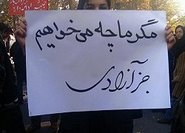
 اخبار مربوط به زندانیان سیاسی و نقض حقوق بشر







 Tulips in Holland