

Becouse it is called Kingdom of Bahrain and has a KING - stupid!
Bahrain, officially the Kingdom of Bahrain (Arabic: مملكة البحرين Mamlakat al-Baḥrayn), is a borderless island country in the Persian Gulf and is the smallest Arab state. Saudi Arabia lies to the west and is connected to Bahrain by the King Fahd Causeway (officially opened on November 25, 1986), and Qatar is to the south across the Gulf of Bahrain. The Qatar–Bahrain Friendship Bridge being planned will link Bahrain to Qatar as the longest fixed link in the world.
IMPERIAL EMBLEM

PERSIA
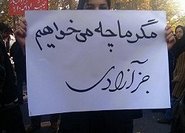
Iranian Freedom Fighters UNITE
Showing posts with label Bahrain. Show all posts
Showing posts with label Bahrain. Show all posts
Tuesday, October 23, 2007


Friday, September 07, 2007
Bahrain Minister Warns Iran
September 07, 2007 ;Gulf News Online ;Habib Toumi, Bureau Chief
Manama -- Bahrain's foreign minister Shaikh Khalid Bin Ahmad Al Khalifa has warned that "anomalous voices" emanating from Iran against his country were unacceptable. "Every now and then we hear peculiar voices from Iran uttered by some parties. This is unacceptable and does not serve the relations between our two countries," Shaikh Khalid said in a statement on Wednesday. The minister did not name the voices, but he was most likely referring to Hossein Shariatmadari, the editor of the Iranian daily Kayhan, who wrote on July 9 that Bahrain was an integral part of Iran that was taken from it in a Western plot with the Shah's collusion. The Iranian hardliner reiterated his claim on Tuesday, blasting the foreign ministers of the Gulf Cooperation Council (GCC) for advocating a peaceful solution to the dispute over the three UAE islands of Greater Tunb, Lesser Tunb, and Abu Mousa through negotiations with Iran. Addressing reporters on the sideline of the Arab foreign ministers' meeting in Cairo, Shaikh Khalid said the Gulf countries were keen on developing economic cooperation with Iran, but added there was a need "to put an end to the threats undermining relations between the GCC states and Iran. "The GCC states have responded positively to the letter from Iranian Foreign Minister Manouchehr Mottaki to enter into negotiations to create a free-trade zone. The Gulf states have been positive towards Iran, and we often get positive views from Iran. But, there are anomalous voices that do not serve common interests," he said. Relations between Bahrain and Iran suffered a drawback following the publication of the editorial in July. But the two sides said that they eased the tension during a visit by Mottaki to the kingdom. The foreign ministers of Bahrain and Iran met again in Tehran on Monday at the Non-Aligned Movement (NAM) summit. Arab League backs UN re-election .Bahrain's bid to get re-elected to the United Nations Human Rights Council was backed by the Arab League at the meeting of the Arab foreign ministers, Bahrain News Agency reported on Wednesday. The elections will be held next year.
Suspected Shi'ite Militant Brigade Commander Captured in Iraq
By VOA News 07 September 2007
The U.S. military says U.S. and Iraqi forces have detained a suspected Shi'ite militant leader who led a group of around 750 fighters in southwestern Baghdad. The military said the alleged insurgent brigade commander and another suspect were detained Thursday. The two allegedly cooperated with foreign fighters and assisted other militants in acquiring sniper training in Iran.
Tehran has denied U.S. charges that it is supporting Shi'ite militants in Iraq. The U.S. military also says seven more American troops were killed in combat in Iraq Thursday. In other news, Iraqi President Jalal Talabani said he does not support the execution of a former aide to Saddam Hussein for the mass killings of Kurds in the late 1980s. Jalal Talabani (file photo)Mr. Talabani, who is a Kurd, said former defense minister Sultan Hashim al-Tai deserves to be spared because he was carrying out orders and threatened with death if he refused. Mr. Talabani also told a news conference in the northern Iraqi city of Sulaimaniyah that Tai engaged in official contact with the Kurdish community under the ousted Saddam government.
Earlier this week, an Iraqi appeals court upheld the death sentences imposed against Tai and two other former officials for the killing of 180,000 Kurds in the so-called Anfal campaign.
Tuesday, July 17, 2007
A fatwa has been issued against Hossein Shariatmadari
Bahrain: Tension mounts with Tehran
Tehran, 16 July (Aki) – The hasty visit to Bahrain by the Iranian foreign minister, Manouchehr Mottaki, to try to defuse a diplomatic crisis between the two countries appears to have had little effect. Mottaki's weekend visit came after a newspaper article by the editor of a hardline Iranian newspaper, Kayhan, claimed that Bahrain is part of Iran and should be returned. This comment has provoked uproar in the Gulf Arab kingdom. Bahrain gained its independence from Iran in 1975 wutg a referendum overseen by the United Nations. The Bahraini press and the wider Arab media continue to accuse the Islamic Republic of "expansionist aims" and "continuing interference in the internal affairs of Muslim nations."For the daily al-Ayyam, "with the absurd pretext on Bahrain, the Islamic Republic has overstepped the red line." while Al Watan noted "Iran treats the Arabs worse than it does the Israelis." In Manama a fatwa, or religious edict, has been issued against Hossein Shariatmadari, the editor of Kayhan. The fatwa, issued by Jassem Saiidi, a Salafite cleric who also sits in the Bahraini parliament, condemns to death the newspaper's editor and anyone who approves and shares his claim on the tiny emirate.
Tehran, 16 July (Aki) – The hasty visit to Bahrain by the Iranian foreign minister, Manouchehr Mottaki, to try to defuse a diplomatic crisis between the two countries appears to have had little effect. Mottaki's weekend visit came after a newspaper article by the editor of a hardline Iranian newspaper, Kayhan, claimed that Bahrain is part of Iran and should be returned. This comment has provoked uproar in the Gulf Arab kingdom. Bahrain gained its independence from Iran in 1975 wutg a referendum overseen by the United Nations. The Bahraini press and the wider Arab media continue to accuse the Islamic Republic of "expansionist aims" and "continuing interference in the internal affairs of Muslim nations."For the daily al-Ayyam, "with the absurd pretext on Bahrain, the Islamic Republic has overstepped the red line." while Al Watan noted "Iran treats the Arabs worse than it does the Israelis." In Manama a fatwa, or religious edict, has been issued against Hossein Shariatmadari, the editor of Kayhan. The fatwa, issued by Jassem Saiidi, a Salafite cleric who also sits in the Bahraini parliament, condemns to death the newspaper's editor and anyone who approves and shares his claim on the tiny emirate.
Thursday, February 15, 2007
Tiny Bahrain Firmly in Tehran's Orbit
February 12, 2007 Globe and Mail Mark Mackinnon
AL-DAIH, BAHRAIN -- They're unarmed, but march like an army though the streets of this tiny country -- tens of thousands of black-clad men beating their chests in unison to a slow, mournful rhythm. With each violent thump of their fists, they recall the first in a long line of grievances Shia Muslims hold against their Sunni brethren. Oblivious to the drizzling rain, an estimated 250,000 marchers, a third of all the people who live on this Persian Gulf island, hit themselves and cry the name of Imam Hussein, the Shia leader who fell under Sunni swords in the year 680. In Bahrain, the annual Ashura festival of mourning is part religious ceremony, part demonstration of political power. With sectarian tensions high across the region, it's a reminder to Bahrain's elites that, although the Shiites are poor and disenfranchised, they dwarf the ruling Sunnis in number, and hold an angry grudge. Situated across the Persian Gulf from Iran, Bahrain's Sunni rulers are as sensitive as anyone in the region to the apparent extraterritorial aspirations of Iran's ayatollahs and their influence on the kingdom's Shia majority. The precursors of today's royal family invaded from neighbouring Qatar in 1780 and drove out the Persians. But Iran didn't extinguish its claim to the island until 1970, and today, the Bahraini government still perceives an existential threat emanating from Tehran. Iran is playing in many Middle East backyards, most notably in Iraq (through the various Shia political parties and militias that take their orders from Tehran), Lebanon (through the Iranian-funded Hezbollah movement) and the Palestinian territories (through Hamas, a Sunni group that turned to Iran for help when faced by a crippling Western boycott). But it's tiny Bahrain where Iran arguably wields the most influence, and where Tehran might first try to demonstrate its new clout if a showdown with the United States and its Arab allies becomes inevitable
Read the rest here: http://www.theglobeandmail.com/servlet/story/RTGAM.20070212.wxiranbahrain12/BNStory/specialComment?pageRequested=all&print=true
Tuesday, February 13, 2007
Bahrain cracks down on Iran agents buying land
ABU DHABI , Bahrain has launched an effort to block an Iranian takeover of the Gulf Arab kingdom.
Officials have drafted a series of regulations meant to prevent Iranian agents from spreading Teheran's influence in the Gulf Cooperation Council state. They said the regulations were designed to block Iran from purchasing property through Shi'ite supporters in Bahrain.
The focus of the Bahraini effort has been the province of Muharraq. Officials said Iranian agents have been purchasing property from the minority Sunni community in a trend that has alarmed the government. Sixty percent of Bahrain's population is comprised of Shi'ites, Middle East Newsline reported. During elections in November 2006, Sunnis and other loyal to King Hamad managed to retain nominal control of parliament. Muharraq Gov. Salman Bin Hindi has ordered a halt to all land and property transfers in his province. Bin Hindi said all such transactions would require his approval. Another regulation stipulated that only families deemed indigenous would be allowed to purchase property in Muharraq, Bahrain's second largest city. Officials said the reference was mostly to Sunni families. "No one can accuse me of sectarian discrimination because I am closer to the Shi'ites in Muharraq than the Al Wefaq Society," Bin Hindi, referring to the Shi'ite opposition group, said in a statement. The Iranian embassy in Manama has denied that it was seeking to buy property in Muharraq. Shi'ite politicians said the new government policy was discriminatory. "The government has allowed non-Bahrainis to own property in Bahrain, but Bahrainis are denied such rights," Abdul Nabi Al Ekri, a prominent Shi'ite opposition member, said. "Such a policy is totally wrong and would have grave implications for national unity." Shi'ite groups said they would protest the new policy to international human rights organizations. They said the policy violated international law as well as Bahrain's constitution. "The decision violates fundamental rights and we might take up the case with the competent international human rights commissions," Bahrain Human Rights Society leader Abdullah Al Durazi said.
Subscribe to:
Posts (Atom)


 Posts




 اخبار مربوط به زندانیان سیاسی و نقض حقوق بشر






 Tulips in Holland