Alliance For democracy In Iran

Please have a look at my other weblog, Iran Democracy - http://irandemocray.blogspot.com/

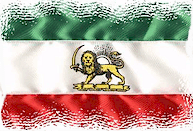
IMPERIAL EMBLEM

IMPERIAL EMBLEM
PERSIA

Shahanshah Aryameher

S U N OF P E R S I A

Iranian Freedom Fighters UNITE

Showing posts with label Palestine. Show all posts

Saturday, February 16, 2008

Hizbullah mastermind's true legacy! - By Caroline B. Glick

Mughniyeh personally bridged all the divisions within the world of Arab and Islamic terrorism. He showed that when it comes to attacking the West, there is no distinction between secular, nationalist, religious, Islamist, Sunni or Shiite terrorists.

PLEASE READ THIS AND PASS IT ON TO ALL YOUR FRIENDS AND CONTACTS.

It is quite possible that terror master Imad Mughniyah was not killed Tuesday night in Damascus for his past crimes, but to prevent him from carrying out additional attacks in the future. On January 30, French security services raided a Paris apartment and arrested six Arab men. Three of the men — two Lebanese and one Syrian — were travelling on diplomatic passports. According to the Italian Libero newspaper, the six were members of a Hizbullah cell. Seized documents included tourist maps of Paris, London, Madrid, Berlin and Rome marked up with red highlighter to indicate routes, addresses, parking lots and "truck stopping points." The maps pointed to several routes to Vatican back entrances. Libero's report explained that the "truck stopping points" aligned with information the French had received the week before from Beirut. There, Hizbullah chief Hassan Nasrallah convened a conference of his senior terror leaders where he ordered them to activate Hizbullah cells throughout Europe to kidnap senior European leaders. The day of the arrests, French Defense Minister Herve Morin was meeting with his American counterpart Defense Secretary Robert Gates and with Secretary of State Condoleezza Rice in Washington on a previously unannounced visit. During his public appearances, Morin criticized the US Intelligence Directorate's National Intelligence Estimate on Iran's nuclear program from November. Morin stated, "Coordinated information from a number of intelligence services leads us to believe that Iran has not given up its wish to pursue its [nuclear] program," and is "continuing to develop" it. Other recent reports relayed French concern that their embassy in Beirut is being targeted for attack by Hizbullah. On January 15 terrorists targeted a US embassy car in Beirut killing four and wounding sixteen. This week, French President Nicholas Sarkozy's chief of staff told L'Express newsweekly that the threat of terror against France "remains quite high." All of the feared terror attacks against French and European targets have the classic earmarkings of Hizbullah operations chief and Iranian Revolutionary Guards officer Imad Mughniyeh. Mughniyeh was the pioneer of embassy bombings and high-profile kidnappings. Most of the reports of his death treated Mughniyeh as a has-been. Coverage was devoted to his attacks against American, Israeli and Jewish targets in the 1980s and early 1990s. Yet at the time of his death, Mughniyeh remained one of the most dangerous and prolific terror operatives in the world.
Mughniyeh's broad-based leadership role in the global terror nexus was made clear by the reaction of seemingly unrelated terror groups to his death. Representatives of the reputedly nationalist, secularist Fatah terror group expressed their pride in his life's work. "We're very proud to have had a Palestinian holding such a high position in Hizbullah," one Fatah official who worked with Mughniyeh in the 1970s and 1980s told The Jerusalem Post. Every Palestinian terror group — from Fatah to Hamas to Islamic Jihad, the Popular Resistance Committees, the PFLP, and DFLP mourned the loss of Mughniyeh as a hero and martyr and called for revenge against Israel and the US. In Iraq, Shiite and Sunni terrorists alike bemoaned his death and called for revenge. Shiite militia leader Muqtada el Sadr whose forces were trained and organized by Mughniyeh and Iran condemned Mughniyeh's killing. Sadr's supposedly arch-foe, Abu Omar al-Baghdadi, who leads Al Qaida in Iraq and whose operational commanders are in Iran, responded to his death by calling for attacks against Israel. And of course, Hizbullah, and its state sponsors Iran and Syria all condemned Mughniyeh's death in the strongest terms and vowed to avenge his killing. These condemnations were not nostalgic pinings for a has-been. These uniform reactions from across the terror spectrum were the cries of Mughniyeh's soldiers for their commander. Through Iran, Mughniyeh was in effect the commander or godfather or both of all of these forces. His life's work embodied the growth, development and modus operandi of the forces of global terror and jihad. And understanding his life's work is a key to understanding the nature of the jihadist forces arrayed against the Western world and Israel. Mughniyeh began his terror career in the 1970s in Fatah leader Yassir Arafat's Force 17 in Lebanon. There, in addition to terrorizing Lebanese Christians, he and Arafat trained Iranian Shiite jihadists. These men arrived at PLO camps in Lebanon in the early 1970s to train to overthrow of the Shah of Iran and install their leader Ayatollah Khomeini as the head of a new Islamic state. In 1979 they became the backbone of the newly formed Iranian Revolutionary Guards Corps. When Israel forced Arafat and his Fatah terror army to flee Lebanon in 1982, Arafat gave Fatah's arsenal to Mughniyeh, who at that time, as an officer in the new IRGC was forming Hizbullah. As Fatah's terror heir, Mughniyeh and his colleagues set out to throw the US, the French and the Israelis out of Lebanon and to disenfranchise Lebanese Christians and Sunnis. They accomplished their goals through a mix of terror tactics including car bombings, suicide bombings, airline hijackings, kidnappings, assassinations, and embassy bombings; and guerilla warfare tactics like ambushes, RPG attacks on convoys, sniper fire, popular indoctrination and psychological warfare operations. Most of these operations were carried out in Lebanon. In the 1990s, Mughniyeh and Iran took their show on the road. Not only did they reenact their car bombings in South America. They also expanded their terror nexus to the then nascent Sunni Wahabist al Qaida organization. As Thomas Joscelyn documents in his short book Iran's Proxy War Against America, Iran through Mughniyeh was instrumental in the training, arming and sheltering al Qaida since the early 1990s. As an Iranian agent, in the early 1990s, Mughniyeh built operational alliances with Osama bin Laden, Ayman Zawahiri and al Qaida's military chief Saif al Adel when al Qaida was based in Sudan. Adel, along with several hundred other al Qaida operatives travelled to Lebanon to undergo training at Hizbullah camps. Hizbullah trainers also worked at al Qaida camps in Sudan and al Qaida operatives also trained at IRGC camps in Iran. >From 1996 through 1998, ten percent of bin laden's satellite phone calls were to Iran. Operational cooperation between Hizbullah and al Qaida quickly followed. In 1996, Iran ordered Hizbullah to blow up the Khobar Towers in Saudi Arabia which housed US military personnel. 19 US servicemen were killed. Although al Qaida was never officially tied to the bombing, Zahawiri phoned bin Laden to congratulate him on the attack. The al Qaida terror cell in Kenya that carried out the Kenyan arm of the twin US embassy bombings in Nairobi and Dars el Salaam in 1998 underwent training in Hizbullah camps in Lebanon. That attack had all the markings of Mughniyeh operations. Like the 1983 attacks on the US Marine barracks and French paratrooper base in Beirut, the 1998 attacks were double car bombings carried out in two disparate locations nearly simultaneously. As Joscelyn recalls, the 9/11 Commission called for further investigation of Iran's role in the September 11, 2001 attacks on America. Adel, a veteran of Hizbullah camps, was intimately aware of the bombing plans before it took place. Ramzi Binalshibh, the plot's mastermind travelled in and out of Iran several times in the months before the bombings. Then too, eight to ten of the September 11 bombers transited Iran assisted by Hizbullah and IRGC officials in late 2000. The Iranians did not stamp their passports. Several of the bombers transited Iran en route to Lebanon. Mughniyeh himself flew to Beirut from Teheran aboard the same flight as Sept. 11 hijacker Ahmad al-Ghamdi. Although Iran and the Taliban nearly went to war against one another in 2000, in the wake of the US-led invasion of Afghanistan in October 2001, according to jailed Taliban leaders, Iran pledged to assist the Taliban in their war against the US. Teheran opened its doors to fleeing Taliban leaders and senior al Qaida commanders — including Adel and bin Laden's son and heir apparent Saad and Abu Musab Zarkawi. From Iran, Adel and bin Laden Jr. planned and ordered attacks in Saudi Arabia. Moreover, from Iran, Adel and bin Laden worked with Zarkawi in planning the groups' insurgency in Iraq. Citing an extensive report from the German * Cicero* magazine, Joscelyn describes how Zarkawi set up his terror network under the protection of the IRGC. Zarkawi had no problem operating in Iran in spite of his avowed hatred of Shiite Muslims who, after entering Iraq, he massacred at every opportunity. Then too, as Al Sharq al Aswat reported Wednesday, Mughniyeh played a central role in organizing and training Shiite militia in Iraq. He worked as the head of Iran's intelligence directorate in southern Iraq, trained al Sadr's Mahdi army fighters in Iran, Iraq and Lebanon and set up shop in Basra to facilitate their entry into Iraq from Iran. After the 1993 Oslo Accord between Israel and the PLO, Iran abandoned Arafat as a traitor. Mughniyeh was responsible for mending fences. In 1999 he brought Fatah back under Iranian orbit when he acted as a middle-man in negotiating the Iranian sale of the Karine-A weapons ship to the Palestinian Authority which was intercepted by Israeli naval commandos in January 2002. After Israel withdrew from Gaza in 2005, Mughniyeh worked as a middle-man bringing Hamas under Iranian control. That control was consolidated in a meeting between Hamas leader Khaled Mashaal, Iranian President Mahmoud Ahmadinejad, Syrian President Bashar Assad and Mughniyeh in Damascus in January 2001, after Hamas's electoral victory in the PA's legislative ballot. Later in 2006, Mughniyeh returned to Lebanon to plan the kidnapping of IDF soldiers which was carried out on July 12, 2006 and precipitated that summer's war. Mughniyeh reportedly commanded Hizbullah forces during that war. Since the war, he oversaw Hizbullah's rearmament as well as the training of Hizbullah and Hamas forces in Iran. Saad bin Laden reportedly travelled to Syria to oversee weapons shipments to Hizbullah during the war. It is possible that Mughniyeh was irreplaceable. The pivotal role that he played in the nexus of global terror was unique. No one else has such wide-ranging accomplishments. But placing too much stress on Mugniyeh's uniqueness would serve to obfuscate the basic reality that his life's work embodied. Mughniyah embodied the fact that terrorists of all shapes and colors willingly collaborate with one another against their common enemies in the West. Mughniyeh personally bridged all the divisions within the world of Arab and Islamic terrorism. He showed that when it comes to attacking the West, there is no distinction between secular, nationalist, religious, Islamist, Sunni or Shiite terrorists. His work revealed the inconvenient truth so fervently denied by policymakers and politicians throughout the Western world. He showed that for the jihadists there is no distinction between terrorists who attack in Israel or Jewish targets abroad and those who attack non-Israeli and non-Jewish targets. Moreover, his work as an Iranian agent demonstrates Iran's central role in sponsoring jihad throughout the world. Mughniyeh's legacy is not simply a laundry list of massacre and torture. It is the nexus of global terror. While it is a great thing that he is dead, it must be understood that his death is insufficient. Hundreds of thousands converged in Beirut to celebrate his life's work. The West must understand the significance of that work and unite to destroy it — layer after layer.

Monday, November 26, 2007

Annapolis: Peace In Someone Else's Time : November 26, 2007 It's all about who shows up...

On the face of it, the Annapolis peace parley that starts today looks like a colossal waste of time, says Jules Crittenden. Neither Ehud Olmert nor Mahmoud Abbas are currently in a political position to make real concessions or deliver on them. Still, this gathering will make clear who in the Middle East seeks peace and who does not - and that’s worth something.
Please read the rest of this article here: http://tinyurl.com/2w8qcl


IRAQI SECURITY FORCES, U.S. SPECIAL FORCES DETAIN 3, UNCOVER 18 IEDS IN SEPARATE OPERATIONS
COALITION FORCES CAPTURE CRIMINAL ELEMENT LEADER, TWO OTHERS DETAINED

Iranian Regime Fears Its People : 23 November 2007

Iranian Regime Fears Its People (MP3)
Listen to Iranian Regime Fears Its People (MP3)
Iranian Regime Fears Its People (Real Player) - Download
Listen to Iranian Regime Fears Its People (Real Player)

Vice President Dick Cheney says that the Iranian people “are living in a climate of fear and intimidation”: “With secret police, arbitrary detentions, and a hint of violence in the air. In the space of a generation, the regime has solidified its grip on the country and grown ever more arrogant and brutal toward the Iranian people. Journalists are intimidated. Religious minorities are persecuted. A good many dissidents and freedom advocates have been murdered, or have simply disappeared. Visiting scholars who’ve done nothing wrong have been seized and jailed.” Consider the case of French-Iranian filmmaker Mehrnoushe Solouki. Ms. Solouki went to Iran in December 2006 to make a film about the burial traditions of Iran’s religious minorities. In a telephone interview with Radio Farda, Ms. Solouki said that in the course of her work, she happened upon a section of Khavaran cemetery south of Tehran which was “totally different” from other parts she had seen. It was the section where some of the thousands of political prisoners summarily executed by the Iranian clerical regime in 1988 were interred in a mass grave. In February of this year, police stormed Ms. Solouki’s Tehran apartment. She was arrested and thrown into Evin prison. After a month in Evin, Ms. Solouki was released, but she has not been allowed to leave Iran. On November 17 she was questioned by a judge at a closed-door hearing. A trial was postponed to a yet-to-be determined date. Reportedly she is being charged with the so-called crime of intending to spread propaganda against the Iranian government. Ms. Solouki says she feels as if she is in limbo, “between life and death.” Others who have gone to Khavaran cemetery have also been arrested. They include six people who took part in an August ceremony marking the nineteenth anniversary of the “prison massacres” of 1988. A seventh person, twenty-two-year-old Masoumeh Mansouri was arrested after making inquiries about her father, who had attended the commemoration ceremony. All seven are being held in Evin prison.The Iranian clerical regime seems frightened of both the dead and the living. But as Vice President Cheney says, “The Iranian people have every right to be free from oppression. . .and tyranny in their own country.”

ONCE A TERRORIST - ALWAYS A TERRORIST

Iran May Seek to Lure Europe with Gas - Iran wants to use its massive gas reserves to wield influence over Europe. But if offering to supply Europe with gas via a pipeline through Turkey doesn't work, then the Revolutionary Guards may resort to plan B.

Iran's huge gas reserves, Europe's energy needs and the US's hard line on Iran's nuclear program all add up to an explosive mixture.Iran is planning to leverage its massive gas reserves to increase its influence in Western Europe -- by fair means or foul. If selling gas to Europe doesn't work, then Iran's Revolutionary Guards may resort to violence in the worst-case scenario. According to intelligence sources in the Middle East, Iranian leaders are considering making an unusual offer to supply Europe with large quantities of natural gas. The gas would be supplied via the planned Nabucco pipeline, which will run from Azerbaijan to Austria via Turkey. The offer would be attractive to European leaders as it would allow Europe to reduce its dependence on Russian natural gas. Germany currently gets about a third of its natural gas requirements from Russia, and demand is expected to increase in the coming years. There are major concerns in Europe about the continent relying too heavily on Russia for its natural gas, particularly after a series of recent disputes in which Russia cut off energy supplies to Ukraine and Belarus.According to minutes of a meeting obtained by SPIEGEL, a representative of Iran's Revolutionary Guard presented the proposal to Iran's National Security Council. The order to prepare the plan apparently came directly from Iran's supreme leader, Ayatollah Ali Khamenei, according to the intelligence sources. Construction work on the Nabucco pipeline is expected to begin in 2009 and to be finished by 2011. The pipeline, which is being built by a consortium headed by the Austrian company OMV, will have a total length of 3,300 kilometers and cost around €5 billion. However the pipeline is controversial within the European Union and Moscow has already made its opposition to the project clear.The planned Nabucco pipeline could be used to pipe Iranian natural gas to Europe.The project only makes economic sense if the pipeline is used to full capacity -- and Azerbaijan's natural gas reserves are not sufficient to guarantee that. Hence Iran, which has the world's second largest natural gas reserves after Russia, is the obvious natural partner for the project. Tehran has yet to make an official offer, however. And any overture could cause political friction between the US and Europe: The US government has demanded that Berlin and Paris take clear diplomatic and economic action against Tehran over its suspected nuclear weapons program. German Chancellor Angela Merkel recently assured US President George W. Bush that Germany would apply strong economic pressure on Tehran (more...). Increased sanctions could make Iran's economy vulnerable.

However if a carrot doesn't work, then Iran might resort to a stick. Other alternatives were apparently also discussed at the meeting in Tehran. Iran's elite Quds force, a branch of the Revolutionary Guards, are reported to be charged with looking into possible ways to disrupt Berlin's energy partnership with Russia -- for example through terrorist actions against the planned Baltic Sea pipeline (more...) between Russia and Germany.

Iran's Response to Western Warnings: 'First Strike,' 'Preemptive Attack,' Long-Range Ballistic Missiles, 'Asymmetric [Guerilla] Warfare' : By: Y. Mansharof and A. Savyon

Introduction
As the Iranian nuclear crisis escalates, Iranian officials have stepped up their threats against the West. Although regime spokesmen have stressed that Iran's security doctrine is defensive,(1) the threats issued by senior Iranian leaders and officials indicate that Iran's actual strategy for responding to a Western attack is taking on increasingly offensive and deterrent characteristics.
While in February 2003, then-defense minister Ali Shamkhani stated, "Iran has a deterrent defensive doctrine, which means that it will in no way take an offensive measure... Iran's objectives are of a defensive nature,"(2) - the new strategy is gradually revealed in both deeds and statements by regime spokesmen.(3) .The offensive elements of this doctrine include a "first strike" and "preemptive attack"; the development of long-range ballistic missiles (the Qadr and the Ashura(4)) with ranges of up to 2,000 km; and the development of an "asymmetrical [guerilla] warfare" tactic – that is, suicide bombings in the Persian Gulf, whether to close off the Strait of Hormuz or to hit targets in the Gulf countries.
Please read the full article here: http://tinyurl.com/38cmpv

Sunday, October 14, 2007

Iran’s Top Cleric Khamanei - Calls for Boycott of Peace Talks - October 14, 2007 - By STEVEN ERLANGER

IRI - STOP INTERFEREING IN OTHER PEOPLES BUISNESS !

JERUSALEM, Oct. 13 — Iran’s supreme leader, Ayatollah Ali Khamenei, called Saturday for all Muslim countries to boycott an American-sponsored meeting for Middle East peace that is planned for late November.“Efforts are being made to once again make an imposition on the Palestinian people in the name of peace,” said Ayatollah Khamenei in a sermon marking the end of the Muslim holy month of Ramadan, giving it special significance. “The result of all conferences held in the name of peace so far have been to the detriment of the Palestinian nation.” The ayatollah is Iran’s supreme authority, outranking President Mahmoud Ahmadinejad in power and credibility. But both share the view that the state of Israel has no right to exist, and Iran has consistently opposed all Palestinian-Israeli peace accords.
Iran is also the main sponsor of Hezbollah, the radical Islamic Shiite group in southern Lebanon that fought a war with Israel last summer. Furthermore, Iran is a major sponsor of Hamas, the radical Palestinian Sunni group that runs Gaza, and the prime sponsor of Islamic Jihad, a smaller radical grouping that has opposed any cease-fire with Israel.On Friday, Hamas leaders in Gaza and in Damascus also called on the Palestinian president, Mahmoud Abbas of Fatah, to boycott the meeting.Talks between Mr. Abbas and the Israeli prime minister, Ehud Olmert, are expected to intensify Sunday with the arrival in Israel of the American secretary of state, Condoleezza Rice. The international meeting to bless the results of those talks was Ms. Rice’s idea, and the American intention is to invite Arab nations that support a two-state solution between Israel and the Palestinians.Washington is also expected to invite Sunni Syria, which is considered in a loose alliance with Iran. But Syria has said it will not attend the meeting, reportedly to be held at the Naval Academy in Annapolis, Md., beginning on Nov. 26, unless there is a substantive document that embodies concrete decisions leading toward a Palestinian state.

Thursday, July 12, 2007

Lebanese Army Pounds Islamic Militants With Artillery Fire but Final Assault Uncertain

By ZEINA KARAM Associated Press Writer

TRIPOLI, Lebanon (AP) -- Two Lebanese soldiers were killed Thursday as the army pounded a refugee camp with artillery fire, an attack the military denied was part of a final assault on the al-Qaida inspired Islamic militants barricaded inside.The firing began just before dawn and hours after more than 150 civilians fled on foot from the camp in northern Lebanon, as soldiers ringing the neighborhood moved up tanks and armored vehicles.The army said two soldiers were killed Thursday, bringing the number of military dead to 88 since fighting began at the Nahr el-Bared camp on May 20. Earlier an armored personnel carrier was seen ferrying at least two wounded soldiers out of the camp.Between five and 10 shells were slamming into the camp every minute. Thick black smoke billowed from deep inside the seaside camp and covered a large area above it. Heavy machine gun fire could be heard.In a statement denying reports that it had announced a final assault, the army said that "the ongoing military operations are still in the context of tightening the noose on the gunmen to force them to surrender."The violence came on the anniversary of the start of Israel's war with Hezbollah guerrillas in southern Lebanon last summer. In an address to mark the occasion, Prime Minister Fuad Saniora late Wednesday called for "putting a final end" to the standoff at Nahr el-Bared.The army build up came after a sniper inside Nahr el-Bared killed a soldier overnight and following repeated refusals by the al-Qaida-inspired group Fatah Islam to surrender.Lebanese officials claimed victory June 21 after soldiers seized Fatah Islam positions on the camp's edges, but the militants retreated deeper into the warren of narrow lanes of densely packed buildings and continued to engage in daily fire fights.At least 60 militants and more than 20 civilians have been reported killed in the fighting, the country's worst internal violence since the 1975-90 civil war. The camp housed more than 30,000 Palestinian refugees before the battles began.Most of the camp's residents have already fled, but a few thousand are thought to have stayed in their homes. Those fleeing Wednesday were mostly men, accompanied by some women and a few children.
The daily An-Nahar, which is close to the government, said the army may not storm the camp outright but seize some strategic positions gradually and over time.The Fatah Islam fighters have refused to surrender.Samar Kadi, an International Red Cross official, said more than 150 Palestinians fled and witnesses said those suspected of ties with Fatah Islam were taken for questioning by the army.Among those fleeing were fighters of the Palestinian Fatah movement and other factions who stayed in the camp to defend positions against attack by Fatah Islam. They were reportedly urged to leave by their leaders in Beirut in anticipation of an army assault.

Friday, June 01, 2007

Lebanese army attacks militants at Palestinian camp : By Nazih Siddiq : Fri Jun 1, 2007 5:45AM EDT

NAHR AL-BARED, Lebanon (Reuters) - Lebanese troops assaulted positions of al Qaeda-inspired militants entrenched in a Palestinian refugee camp in northern Lebanon on Friday with some of the heaviest shelling in 13 days of fighting there. Security sources said elite forces were trying to dislodge militants from some front positions on the edge of Nahr al-Bared camp while artillery batteries were pounding the area.The military said the shelling was in retaliation for an earlier attack by the militants on army positions but did not confirm any major ground fighting. There was no immediate word on casualties. The army has been battling Fatah al-Islam militants at the camp since May 20 in Lebanon's worst internal violence since the 1975-1990 civil war. At least 84 people -- 35 soldiers, 29 militants and 20 civilians -- have been killed.
Artillery and machinegun fire rocked the camp from early morning. At times shells exploded at a rate of 10 a minute and smoke billowed from buildings inside as fires raged. "It is clear that this is the start of an army assault," said a Palestinian source with contacts in the camp. He said early reports indicated there were civilian casualties. There was no army confirmation that a large-scale offensive was imminent, though a Reuters witness said a score of tanks had assembled about 1 km (0.6 miles) from an entrance to the camp. An army statement said militants had started the fighting by attacking army positions around the camp. "The army is now retaliating in a decisive and deterrent manner," he said. The government is demanding that the militants surrender. The authorities have charged 20 captured members of the group with terrorism. The charges carry the death penalty. A 1969 Arab agreement prevents the army from entering Lebanon's 12 Palestinian camps, home to 400,000 refugees. The Lebanese government has given Palestinian leaders in Lebanon a chance to find a way out of the stand-off because it fears the fighting could spark violence in other refugee camps. But the Palestinian source said the authorities appeared to have become impatient with the lack of progress by mediators and had decided to step up military pressure on the militants. Abbas Zaki, Palestine Liberation Organisation representative in Lebanon, urged the Fatah al-Islam militants to surrender. More than 25,000 of Nahr al-Bared's 40,000 Palestinians have fled to the smaller Beddawi camp nearby. Members of Lebanon's anti-Syrian cabinet have described Fatah al-Islam as a tool of Syrian intelligence, but Damascus denies any links to the group and says its leader, Shaker al-Abssi, is on Syria's wanted list. Abssi has said he follows al Qaeda's ideology, but has no direct links to Osama bin Laden's network. Many of his estimated 300 gunmen have fought in Iraq, Palestinian sources say. Lebanese authorities say Fatah al-Islam includes Arabs from Saudi Arabia, Algeria, Tunisia, Syria and Lebanon.