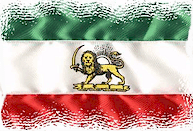

IMPERIAL EMBLEM

PERSIA
Iranian Freedom Fighters UNITE

Friday, February 29, 2008
Monday, October 08, 2007
Counter Demo to Al-Quds Rally - In London

For the last three decades, Islamic Republic has organised Al-Quds rallies across the European cities on the last Sunday of Ramadan. In London, except on one occasion three years ago, the Al-Quds march has taken place completely unopposed. On that rare occasion three years ago, there were only seven of us then but we still managed to persuade a UK Left wing group not to join the rally.The whole purpose behind the carnival is nothing but propaganda for the Islamic Republic of Iran. By arranging this annual rally, the Islamic Republic wants to pretend to be a friend of the Palestinian people and attempt to recruit from those gullible individuals who would believe such Islamic Republic misinformation.The truth is of course very different. The clerical theocracy ruling Iran has brought nothing but misery, poverty, corruption, drug addiction, crisis and instability for the iranian people and it sure won't bring prosperity and happiness for the Palestinians or any other people.The Al-Quds rally in London this year was different for two reasons however. There were much fewer participants in the Islamic government sponsored march. In fact the marchers were more than two hours behind the schedule, desperately applying their rent a crowd expertise before they could begin their march. More significantly, the rally did not go unopposed today. Not only it did not go unopposed, but this time we were joined by other British groups and individuals who felt it was time to stand up to supporters of Islamic terrorism marching in the streets of London.Kudos to all the hard organising by Harry's Place in particular and the signatories to the Euston Manifesto, as well as Worker's Liberty and Class War who made it possible to finally show an opposition to the IRI lackeys in London. Today, thousands of people passing the Eros statue in Piccaddilly, realised that there are many who are prepared to stand up to the onslaught of Islamic fundamentalism in this country.Hopefully we can now build on this.A Che Guevara fan at the Al-Qods march. So many Iraniankids of his age were executed in the 80s for admiringnon-Islamic Che and the infidel Fidel!Does she realise what will happen to herif she walks in the streets of Tehran like that??Probably not, I imagine she only watches the BBC.
"Counter Demo to Al-Quds Rally"
Anonymous said...
There were relatively few Iranians that took part in the march. The rest were mostly hired for the sake of free food handouts at the end.
3:54 PM

Winston said...
I am speechless... but thanks for that opposing gathering. good job!
4:24 AM
Bahramerad said...

I am Glad that I went to this Anti Ghods day demonstrations and saw with my own eyes how the people of England (from all walks of life and political persuasions-from hard left to hard right) despised these Poor Ugly Creatures supporting the indefensible ideas and philosophies of the murdering Mahdi's army.
This rag tag bunch of Idiots who were following a few turbaned paid mercenaries of Islamic Republic of Idiots (IRA) could not even feed themselves and their children for one day by working and earning a decent wage in this country.
They are all scroungers from the Social Services and get their benefits and health care paid for from the taxes paid by the hard working classes in this country.
They can STUFF their Sharia Law. It will never take hold in this country.
Death to the Fascist Mullah's of Ghom who are supporting these poor ignorant people by sending them over here and giving them free food and back handers in the mosques in order to bring them out and parade them for their own political games.
NO ONE IN THIS COUNTRY BELIEVES THAT THE MULLAHS REALLY SUPPORT THE PALESTINIANS-EVEN THE PALESTINIANS HAVE SAID MANY TIMES THAT IT IS BECAUSE OF THESE IDIOT'S INTERFERENCE IN THEIR AFFAIRS THAT THEY LIVE IN SUCH MISERABLE CIRCUMSTANCES.
Enough is Enough. Stop Interfering in other people's affairs-let them live in peace NOW.
Tatchell abused at march for Palestine
Human rights campaigner Peter Tatchell was threatened and slandered as a paedophile.10th October 2007 - PinkNews.co.uk -
writer and Human rights campaigner Peter Tatchell was threatened and slandered as a paedophile when he attended the Al Quds pro-Palestinian march and rally in London last Sunday, 7 October 2007.
Read this article here:http://www.pinknews.co.uk/news/articles/2005-5695.html
Petraeus Puts Heat on Iran Over Iraq Violence - October 07, 2007 Reuters
Reed the rest here - http://iranvajahan.net/cgi-bin/news.pl?l=en&y=2007&m=10&d=07&a=1
STATEMENT FROM MULTI-NATIONAL FORCE – IRAQ: COALITION FORCES ENGAGED TERRORISTS NEAR BAQUBAH
Iran Envoy is Denounced for 'Terrorist' Links
Gordon Brown 'Will Back Air Strikes on Iran'
Iran Protests France's Anti-Iran Stance
Iran Says Oilfields 'Too Attractive' for France to Quit
Spiegel Interview with French Foreign Minister Bernard Kouchner: 'I Am Not a Warmonger'
Iran Students Call President "Dictator" During Scuffle
Iran Welcomes Bush Call For Talks, Won't Suspend Nuclear Operations
Ahmadinejad: Iran-US Talks Possible if US Makes Fundamental Overhaul in its Approach Toward Iran
Wednesday, July 18, 2007
Iran Is Found To Be a Lair of Al Qaeda : Eli Lake
One of two known Al Qaeda leadership councils meets regularly in eastern Iran, where the American intelligence community believes dozens of senior Al Qaeda leaders have reconstituted a good part of the terror conglomerate's senior leadership structure. That is a consensus judgment from a final working draft of a new National Intelligence Estimate, titled "The Terrorist Threat to the U.S. Homeland," on the organization that attacked the World Trade Center on September 11, 2001. The estimate, which represents the opinion of America's intelligence agencies, is now finished, and unclassified conclusions will be shared today with the public. The classified document includes four main sections, examining how Al Qaeda in recent years has increased its capacity to stage another attack on American soil; how the organization has replenished the ranks of its top leaders; nations where Al Qaeda operates, and the status of its training camps and physical infrastructure. The judgment that Iran has hosted Al Qaeda's senior leadership council is likely to draw some criticism from those outside the government who doubt Iran plays a significant role in bolstering Sunni jihadist terrorism. Iran's Shiite Muslims are considered infidels by the Salafi sect of Sunnis that comprise Al Qaeda. While there is little disagreement that a branch of Al Qaeda's leadership operates in Iran, the intelligence community diverges on the extent to which the hosting of the senior leaders represents a policy of the regime in Tehran or the rogue actions of Iran's Quds Force, the terrorist support units that report directly to Iran's supreme leader. In the estimate's chapter on Al Qaeda's replenished senior leadership, three American intelligence sources said, there is a discussion of the eastern Iran-based Shura Majlis, a kind of consensus-building organization of top Al Qaeda figures that meets regularly to make policy and plan attacks. The New York Sun first reported in October that one of the Shura Majlis for Al Qaeda meets in the federally administered tribal areas of Pakistan, one of the areas the Pakistani army this week re-engaged after a yearlong cease-fire. Both Osama bin Laden and his deputy, Ayman al-Zawahri, participate in those meetings. The other Shura Majlis is believed to meet in eastern Iran in the network established after Al Qaeda was driven from Afghanistan in 2001. Following that battle, a military planner trained in the Egyptian special forces, Saif al-Adel, fled to Iran. Mr. Zawahri then arranged with the then commander of Iran's Quds Force, Ahmad Vahidi, for safe harbor for senior leaders. The three main Al Qaeda leaders in Iran include Mr. Adel; the organization's minister of propaganda, Suleiman Abu Ghaith, and the man who some analysts believe is the heir apparent to Mr. bin Laden — one of his sons, Saad bin Laden. The locations of the senior leaders include a military base near Tehran called Lavizan; a northern suburb of Tehran, Chalous; an important holy city, Mashod, and a border town near Afghanistan, Zabul, the draft intelligence estimate says. In 2003, Iran offered a swap of the senior leaders in exchange for members of an Iranian opposition group on America's list of foreign terrorist organizations, the People's Mujahadin. That deal was scuttled after signal intercepts proved, according to American intelligence officials, that Mr. Adel was in contact with an Al Qaeda cell in Saudi Arabia. In the aftermath of the failed deal, Al Qaeda's Iran branch has worked closely in helping to establish the group in Iraq. The late founder of Al Qaeda in Iraq, Abu Musab al-Zarqawi, had multiple meetings with Mr. Adel after 2001. In the past year, the multinational Iraq command force has intercepted at least 10 couriers with instructions from the Iran-based Shura Majlis. In addition, two senior leaders of Al Qaeda captured in 2006 have shared details of the Shura Majlis in Iran. "We know that there were two Al Qaeda centers of gravity. After the Taliban fell, one went to Pakistan, the other fled to Iran," Roger Cressey, a former deputy to a counterterrorism tsar, Richard Clarke, said in an interview yesterday. "The question for several years has been: What type of operational capability did each of these centers have?" A senior fellow at the Council on Foreign Relations and Iran expert, Vali Nasr, said he did not know that the Shura Majlis had reconstituted in eastern Iran, but he did say his Iranian contacts had confirmed recent NATO intelligence that Iran had begun shipping arms to Al Qaeda's old Afghan hosts, the Taliban in Afghanistan. Mr. Nasr, however, said Iran's recent entente with Al Qaeda could be simply a matter of statecraft. "Iran and Al Qaeda do not have to like one another," he said. "They can hate each other, they can kill each other, their ultimate goals may be against one another, but for the short term Iran can unleash Al Qaeda on the United States." Mr. Cressey said the Iranian regime's relationship with Al Qaeda is one of tolerance as opposed to command and control. "I think the Iranians are giving these guys enough latitude to operate to give them another chit in the game of U.S.-Iranian relations," he said. An intelligence official sympathetic to the view that it is a matter of Iranian policy to cooperate with Al Qaeda disputed the CIA and State Department view that the Quds Force is operating as a rogue force. "It is just impossible to believe that what the Quds Force does with Al Qaeda does not represent a decision of the government," the official, who asked not to be identified, said. "It's a bit like saying the directorate of operations for the CIA is not really carrying out U.S. policy." Some intelligence reporting suggests, the source said, that the current chief of the Quds Force, General Qassem Sulamani, has met with Saad bin Laden, Mr. Adel, and Mr. Abu Ghaith. The link between Iran and Al Qaeda is not new, in some cases. The bipartisan September 11 commission report, for example, concluded: "There is strong evidence that Iran facilitated the transit of Al Qaeda members into and out of Afghanistan before 9/11, and that some of these were future 9/11 hijackers." According to the commission, a senior Al Qaeda coordinator, Ramzi bin al-Shibh, said eight of the September 11 hijackers went through Iran on their way to and from Afghanistan.
In 2005, both Undersecretary of State Nicholas Burns and the then ambassador at large for counterterrorism, Cofer Black, disclosed that America believes that senior Al Qaeda leaders reside in Iran.
U.S. Says Iran Knows its Weapons Reaching Taliban : Jon Hemming
July 17, 2007 Reuters
KABUL -- Iranian arms are entering Afghanistan and reaching Taliban insurgents in such quality and quantity that the Tehran government must know about it, the U.S. ambassador to Kabul said on Tuesday. The charge is similar to that made by U.S. Defense Secretary Robert Gates a month ago, rejected by Tehran as "baseless and illogical". But it comes as Iran signaled on Tuesday there was a "high possibility" it would hold a second round of talks with the United States on Iraqi security in the "near future". "There are clearly some munitions coming out of Iran going into the hands of the Taliban," said Ambassador William Wood. "We believe that the quantity and quality of those munitions are such that the Iranian government must know about it," he told reporters. "Beyond that we really can't go." The United States accuses Iran of stoking instability in the Middle East by arming insurgents in Iraq, aiding militants in Lebanon and Gaza and trying to build a nuclear arsenal. Iran denies the charges and says the U.S. military presence in Iraq and Afghanistan, and Washington's support for Israel is the source of instability in the Middle East. U.S. officials said for several months this year they had evidence of Iranian weapons entering Afghanistan, but until Gates spoke a month ago, stopped short of linking the arms to the Iranian government. Afghan President Hamid Karzai has said relations with Iran have never been better and said his government does not have any evidence of Iranian arms reaching the Taliban. Afghanistan has seen a rise in Taliban suicide and roadside bombs in the last two years, but the 50,000 NATO and U.S.-led forces say they have largely thwarted a much-heralded Taliban spring offensive. "For the most part what we have seen has been terroristic violence rather than insurgent violence," said Wood. "The security situation is better, but it doesn't feel better." Iran was at odds with the Taliban government for most of the time it held sway in neighboring Afghanistan from 1996 to 2001 and massed troops on the Afghan border on 1998 after 11 of its diplomats were killed there. It then armed Northern Alliance factions that helped U.S.-led forces overthrow the Taliban after the September 11, 2001 attacks. But political and security analysts based in Kabul say Iran may have an interest in destabilizing Afghanistan so as to discredit U.S. attempts to foster democracy there.
Saturday, July 14, 2007
U.S. troops kill 6 Iraqi police AFTER THEY SHOOT AT US ARMY
http://video.msn.com/v/us/msnbc.htm?g=9c1c0145-cbe5-4172-b1d3-26014a23a033&f=00&fg=copy
BAGHDAD - U.S. troops battled Iraqi police suspected of links to Iranian-backed Shiite militiamen, killing six in a rare firefight between American soldiers and their Iraqi partners. Friday’s clash underscored the deep infiltration of militants in the country’s security forces.
The battle came a day after the Bush administration acknowledged that the Iraqi government was making “unsatisfactory” progress in its efforts to purge the police force of Shiite militia — among the elusive benchmarks Washington believes are needed to stabilize the country.
Shiite militias have considerable power within police ranks, prompting many Sunni Arabs to shun the force. Sunnis accuse the police of helping — or participating in — death squads that have slain thousands of members of their sect. In addition to the six police officers, seven gunmen were also killed in Friday’s clash in eastern Baghdad, sparked when U.S. troops arrested a police lieutenant, the American military said in a statement. It said the lieutenant was believed to be helping Iran organize Shiite militants and leading a cell involved in bomb and mortar attacks on U.S. and Iraqi troops.The U.S. military has accused Iran of arming Shiite extremists drawn from the ranks of militias and organizing them into a network to carry out attacks on the troops. Friday’s statement, however, was the first time the military has spoken of the Iranian efforts extending into the Iraqi police. It was unclear whether the lieutenant was a militiaman who joined the police or a policeman who later joined the militia.American forces have arrested police in the past for Shiite militia links — but rarely have the Americans and the uniformed police fallen into an open street battle, particularly one as fierce as Friday’s.It began before dawn when U.S. troops launched a raid and captured the lieutenant, according to a military statement. The troops quickly came under heavy fire from multiple directions, including nearby rooftops and a church. “Heavy and accurate” fire was also coming from a nearby police checkpoint.As the Americans fought back, U.S. warplanes struck in front of the police position, without hitting it directly, “to prevent further escalation” of the battle. There were no casualties among the U.S. troops, but seven gunmen and six of the policemen firing on the Americans were killed, the statement said.A spokesman for the Iraqi Interior Ministry, which controls the police, said he had no immediate information on the clash and refused to comment.'A danger to everyone'Over the past year, the government has removed several thousand policemen accused of militia links and has tightened the vetting process for recruits.Still, its efforts have been insufficient, according to Thursday’s report by the Bush administration, which acknowledged only spotty progress on the 18 benchmarks Washington is seeking.Top Sunni politician Adnan al-Dulaimi said the government has not taken the purging of police seriously enough. “We hope that they will be sincere in cleansing the police force and the army of those who work for Iran’s interests. They are a danger to everyone, the political process and the Americans,” he said.The captured lieutenant was a “high-ranking” leader of a cell suspected of helping coordinate Iranian support for Shiite extremists, the military said. He was also believed to be linked to the Quds Force, a branch of Iran’s elite Revolutionary Guards that the U.S. military says it funneling help to the networks, a charge Tehran denies.The double loyalties of many policemen weaken the force because it undermines public trust in them. The U.S. military is counting on the police — along with the Iraqi army — to provide security in areas which American troops clear of militants. Despite four years of efforts to train the force, U.S. commanders acknowledge it is often outmatched by insurgents.Attacks easeU.S. forces have been waging a nearly month-old security crackdown in Baghdad and in areas to the north and south of the capital, seeking to uproot Shiite militias and Sunni insurgents. The sweeps have dislodged militants from a section of the city of Baqouba, to the northwest, and have brought a relative easing of attacks in the capital.Still, Baghdad remains far from calm.On Friday, gunmen with automatic weapons and rocket-propelled grenades blasted guard towers outside the Interior Ministry in central Baghdad, killing five guards and wounding nine, a police official said.A volley of at least four mortars were also fired from the city’s dangerous southern districts at the Green Zone, the heavily fortified district where government offices and the U.S. Embassy are located. The mortars hit near the home of a senior Iraqi military official, killing two Iraqi soldiers, an Iraqi army official said.Police found the bodies of six people — three men and two women in their late 20s and an 11-year-old girl — dumped in an empty lot in the Sadiyah district of southwestern Baghdad, another police official said. They were all blindfolded and bound, with gunshots to the head.They were not immediately identified but appeared to be victims of sectarian slayings that still leave 20 to 30 bodies a day around the city. The army and police officials spoke on condition of anonymity because they were not authorized to release the information to the press.New York Times journalist slainAlso in Sadiyah, gunmen shot to death an Iraqi journalist from The New York Times as he was driving to work in the morning, the third employee of a Western news outlet to be killed in two days. Khalid W. Hassan, 23, had called less than an hour earlier to say a checkpoint had blocked his normal route — then after the attack, he was able to call his mother on his cell phone, telling her, “I’ve been shot,” according to the Times.Hassan, who had worked for the paper for four years, was the second Times employee to be killed in Iraq, following the 2005 slaying of a stringer for the paper in the southern city of Basra. Hassan’s death came a day after two Iraqi staffers of the London-based Reuters news agency — a photographer and a driver — were killed in clashes between U.S. forces and Shiite militiamen in east Baghdad.At least 110 journalists and 40 media support staffers have been killed in Iraq since the U.S.-led invasion in March 2003, according to the U.S.-based Committee to Protect Journalists. More than 80 percent of them were Iraqis.
Monday, February 12, 2007
IF YOU DO NOTHING ELSE TONIGHT WATCH THIS VIDEO
U.S. outlines its evidence of Iranian meddling in Iraq. CNN's Michael Ware reports. (February 11)
http://edition.cnn.com/video/player/player.html?url=/video/world/2007/02/11/ware.iraq.iran.weapons.cnn&source=money&wm=11

 Labels:
Ahmadinejad,
Ghods,
hezbolah,
Iran,
Iranian Missile,
Khamanei,
Military engagment,
Shia,
Sunni,
US,
US ARMY,
US.,
War
Labels:
Ahmadinejad,
Ghods,
hezbolah,
Iran,
Iranian Missile,
Khamanei,
Military engagment,
Shia,
Sunni,
US,
US ARMY,
US.,
War
The United States has been used by the pro-Iranian government in Baghdad to carry out attacks against Shia tribes in southern Iraq
As the United States heads for a confrontation with Iran over allegations of Iranian involvement in bombings, the massacre in Najaf last month indicates that Iran could be working also through the Iraqi government, local leaders in Najaf say.The people killed were mostly Shias from the Hawatim tribe that opposes the Supreme Council for Islamic Revolution in Iraq as well as the Dawa Party. These two pro-Iranian groups control the local government in Najaf and the government in Baghdad.The Najaf attack has provoked strong reactions among members of the Hawatim tribe and among other Shia groups who are not loyal to Iran - and who became the target in those killings.An attack on a local tribal leader led to an assault on members of the tribe by U.S., British and Iraqi forces. The tribe was described by government officials as a "messianic cult."Abid Ali who witnessed the Najaf fighting told IPS that a procession of roughly 200 pilgrims from the Hawatim tribe had arrived in the Zarqa area near Najaf to celebrate the Ashura festival. Following a confrontation over the procession, Iraqi army soldiers at a checkpoint shot dead Hajj Sa'ad Sa'ad Nayif al-Hatemi, chief of the tribe, as he and his wife sat in their car.Members of the tribe then attacked the checkpoint to avenge the death of their chief."It was after this that the Iraqi army called in the Americans, and the planes began bombing civilians," Ali said. "It was a massacre. Now I believe the internal Shia fighting has entered a very dangerous phase."Ali added that most people in the area believe the U.S. military was told by Iraqi security forces loyal to the pro-Iranian government in Baghdad that "terrorists" or the "messianic cult" was attacking Najaf. They say the misinformation was intended to mislead occupation forces into attacking the tribe.Many Shias in the southern parts of the country and in Baghdad now say they had been fooled earlier by U.S. promises to help them, but that the Najaf massacre has dramatically changed their views.Significantly, the Association of Muslim Scholars, a group of Sunni Muslims headed by Dr. Harith al-Dhari, issued a statement condemning the Iraqi-U.S. military attack in Najaf against the Hawatim tribe. The statement, which seeks to bridge a Shia-Sunni divide, denounced the killing of dozens of women and children and added, "It was an act of vengeance and political termination.""They (the United States) were misled, and their last move in Najaf shows how the smart Iranians are leading the Americans deeper into Iraqi sands," Jaafar al-Jawadi, a political analyst from Baghdad told IPS."I really admire the way Iranians are dealing with the situation in a professional way while the Americans are walking with their eyes closed. They are losing the last Iraqi fort they were hiding behind, and that was the peaceful way Arab Shias were dealing with occupation."Jawadi who is also a former Shia politician says he once believed in U.S. promises of liberation for Iraqis, particularly the Shia population. Like many other Iraqis, he now believes that the United States has been used by the pro-Iranian government in Baghdad to carry out attacks against Shia tribes in southern Iraq who have recently become more and more anti-occupation."I do not really understand what those Americans are doing because now they are just like an elephant in a china shop, and everything they do is terribly wrong as if they are committing suicide," Talib Ahmad, a lawyer and human rights activist in Najaf told IPS."Iran is benefiting from that for sure. Americans are simply fighting for Iran who appears to be the winner in Iraq after all."Many Iraqis are amazed at the unlimited support the U.S. administration has been presenting to what many now call an Iranian-Iraqi government. The new U.S. condemnation of Iran could be a first sign that the United States is getting wise to the fact that it is being fooled by Iran.The U.S. administration is, however, pointing the finger at Iran, and not at the government in Baghdad that it props up.
U.S. Says Arms Link Iranians to Iraqi Shiites

Never before displayed in public, the weapons included squat canisters designed to explode and spit out molten balls of copper that cut through armor. The canisters, called explosively formed penetrators or E.F.P.s, are perhaps the most feared weapon faced by American and Iraqi troops here. In a news briefing held under strict security, the officials spread out on two small tables an E.F.P. and an array of mortar shells and rocket-propelled grenades with visible serial numbers that the officials said link the weapons directly to Iranian arms factories. The officials also asserted, without providing direct evidence, that Iranian leaders had authorized smuggling those weapons into Iraq for use against the Americans. The officials said such an assertion was an inference based on general intelligence assessments. That inference, and the anonymity of the officials who made it, seemed likely to generate skepticism among those suspicious that the Bush administration is trying to find a scapegoat for its problems in Iraq, and perhaps even trying to lay the groundwork for war with Iran. Officials at the Iranian Embassy in Baghdad said they had no comment on the American accusations, the latest in a back-and-forth between the countries as tension has escalated over Tehran’s rising influence in Iraq and elsewhere in the Middle East and suspicions about its nuclear energy program. And while the Americans displayed what they said was the physical evidence of their claims about Iran’s role in Iraq, they also left many questions unanswered, including proof that the Iranian government was directing the delivery of weapons. The officials were repeatedly pressed on why they insisted on anonymity in such an important matter affecting the security of American and Iraqi troops. A senior United States military official gave a partial answer, saying that without anonymity, a senior Defense Department analyst who participated in the briefing could not have contributed.
The officials also were defensive about the timing of disclosing such incriminating evidence, since they had known about it as early as 2004. They said E.F.P. attacks had nearly doubled in 2006 compared with the previous year and a half. “The reason we’re talking about this right now is the vast increase in the number of E.F.P.s being found,” one official said. American-led forces in Iraq, the official said, “are not trying to hype this up to be more than it is.”Whatever doubts were created about the timing and circumstances of the weapons disclosures, the direct physical evidence presented on Sunday was extraordinary.The officials said the E.F.P. weapons arrived in Iraq in the form of what they described as a “kit” containing high-grade metals and highly machined parts — like a shaped, concave lid that folds into a molten ball while hurtling toward its target.

For the first time, American officials provided a specific casualty total from these weapons, saying they had killed more than 170 Americans and wounded 620 since June 2004, when one of the devices first killed a service member.But then the officials went much further, asserting without specific evidence that the Iranian security apparatus, called the Islamic Revolutionary Guard Corps - Quds Force controlled delivery of the materials to Iraq. And in a further inference, the officials asserted that the Quds Force, sometimes called the I.R.G.C. - Quds, could be involved only with Iranian government complicity. “We have been able to determine that this material, especially on the E.F.P. level, is coming from the I.R.G.C. - Quds Force,” said the senior defense analyst. That, the analyst said, meant direction for the operation was “coming from the highest levels of the Iranian government.” At least one shipment of E.F.P.s was captured as it was smuggled from Iran into southern Iraq in 2005, the officials said. Caches and arrays of E.F.P.s, as well as mortars and other weapons traceable to Iran, have been repeatedly found inside Iraq in areas dominated by militias known to have ties to Iran, the officials said. One cache of antitank rocket-propelled grenades and other items was seized as recently as Jan. 23, the officials said. The precise machining of E.F.P. components, the officials said, also links the weapons to Iran. “We have no evidence that this has ever been done in Iraq,” the senior military official said. The officials also gave fresh details on recent American raids in Baghdad and the northern city of Erbil in which Quds Force members were picked up and accused of working with extremist groups to plan attacks on American and Iraqi forces. Some of the five Iranians still being detained after they were picked up in Erbil on Jan. 11 had been flushing documents down a toilet when they were found, the defense analyst said, and they had recently been engaged in “changing their appearance” — apparently shaving their heads, though for what reason the analyst did not know. An earlier raid in Baghdad was carried out, the officials said, after American forces received word that the No. 2 Quds Force official, whom they identified as Mohsin Chizari, was unexpectedly in Iraq. When Mr. Chizari was picked up in a raid in December, he was carrying false identification, the officials said. He was later released to the Iraqi government with another Iranian official who was picked up at the same time. The Iraqis asked both Iranians to leave the country. The senior defense analyst said there was no direct link between the detained Iranians and the physical evidence presented on Sunday. But the analyst said, “the overall tenor” of the evidence was that Mr. Chizari was implicated in bringing E.F.P.s into Iraq. The briefing also presented new information on what the Americans call the smuggling routes. There are three main routes, officials said: the Mandelli border crossing, east of Baghdad; the Mehran crossing, in the marshes to the south; and in the southern city of Basra.
Paid Iraqis, rather than Iranians themselves, carry the materials across the border, the officials said. The senior military official blamed recent press reports for, he said, overstating the importance of the weapons presentation, which had been delayed. Part of the delay reflected a view among officials in Washington that the original presentation was insufficiently strong. Officials here did not address that element of the internal debate. The senior American military official did make it clear that declassifying the material took place only after weeks of analysis on what information could be useful to hostile forces — information that has mostly been kept out of the public eye since the E.F.P.s began turning up in Iraq. “We publicly have not acknowledged E.F.P.s for the past two years,” the senior military official said. Laid out on the tables themselves were the tailfins of dozens of apparently used mortar shells, as well as intact mortar shells, rocket-propelled grenades, cases for some of the weaponry, the E.F.P., and two identification cards the officials said were taken in the Erbil raid. The shells had serial numbers in English in order to comply with international standards for arms, the officials said. One grenade, for instance, was marked with the serial number P.G.7-AT-1 followed by LOT:5-31-2006. The officials said that the serial numbers clearly identified the grenade as being of Iranian manufacture and the date showed that it had been made in 2006. Commanders in Baghdad are acutely aware of the deadly E.F.P.s. Col. Steve Townsend, commander of the Third Stryker Brigade Combat Team in Baghdad, said his unit has encountered about a dozen E.F.P.s in the past two months. Iran’s role in Iraq has been discussed in recent months in public and private testimony by senior intelligence officials.
http://video.ap.org/v/en-ap/v.htm?g=2737E9D9-A77D-4C91-848D-1F78711FB35A&f=ncagw&fg=email
In testimony last month, Gen. Michael V. Hayden, director of the Central Intelligence Agency, said “there’s a clear line of evidence that points out the Iranians want to punish the United States, hurt the United States in Iraq, tie down the United States in Iraq, so that our other options in the region, against other activities the Iranians might have, would be limited.” Senator John D. Rockefeller IV, the West Virginia Democrat who chairs the Senate Intelligence Committee, said last month that he believed that Iranian operatives inside Iraq were supporting Shiite militias and working against American troops. But he also asserted that the White House had a poor understanding of Iranian calculations and added that he was concerned that the Bush administration was building a case for a more confrontational policy toward Tehran.




 Posts
Posts




 اخبار مربوط به زندانیان سیاسی و نقض حقوق بشر







 Tulips in Holland