

Listen Now [4 min 37 sec]
All Things Considered, October 18, 2008 · Scholars who study the Iranian Revolution of 1979 have paid a lot of attention to the internal factors that precipitated revolt. Now, a new study argues that the United States secretly helped create the conditions that led to the overthrow of its ally, the Shah. Andrew Scott Cooper, who wrote the report using previously classified information, talks about the mistakes that led to the demise of the Shah.
IMPERIAL EMBLEM

PERSIA
Iranian Freedom Fighters UNITE
Showing posts with label Aryamehr. Show all posts
Showing posts with label Aryamehr. Show all posts
Wednesday, October 22, 2008
Monday, May 12, 2008
I AM A RAINDROP - Ghatre Baranam
قطره بارانم
ZENDEH BAAD PRINCE REZA PAHLAVI- PAYANDEH BAAD IRAN _E_ AZAD
قطره بارانم
من یکی هستم ولی یک از هزارانم
در پی پیوستن به جمع یارانم
قطره بارانم
قطره بارانم
فکر همراهی با سیل خروشانم
فکر تشنگی گلها در گلستانم
قطره بارانم
قطره بارانم
میتوانم چشمه های خشک را از نو بجوشانم
میتوانم سرزمین خشک را از نو برویانم
از گل بپوشانم
از نو برویانم
کوچکم اما دست دریا را همیشه پشت سر دارم
من به صبح روشن فردا امیدوارم
من به صبح روشن فردا امیدوارم
قطره بارانم
از تبار نو رس امیدوارانم
عاشق هر ذره ای از خاک ایرانم
قطره بارانم
قطره بارانم
میتوانم چشمه های خشک را از نو بجوشانم
میتوانم سرزمین خشک را از نو برویانم
از گل بپوشانم
از نو برویانم
کوچکم اما دست دریا را همیشه پشت سر دارم
من به صبح روشن فردا امیدوارم
من به صبح روشن فردا امیدوارم
قطره بارانم
از تبار نو رس امیدوارانم
عاشق هر ذره ای از خاک ایرانم
قطره بارانم
Who Are They ? ( JEM ) A New Video By Bahramerad
0
comments

 Labels:
Aryamehr,
Azari,
esfhan,
Farsi,
ghatre baran,
Iran,
Iranian,
mashhad,
pouya,
Prince,
Prince_Reza_Pahlavi,
Reza Shah Pahlavi,
shahzadeh,
shiraz,
tabriz,
Tehran
 Labels:
Aryamehr,
Azari,
esfhan,
Farsi,
ghatre baran,
Iran,
Iranian,
mashhad,
pouya,
Prince,
Prince_Reza_Pahlavi,
Reza Shah Pahlavi,
shahzadeh,
shiraz,
tabriz,
Tehran
Saturday, May 10, 2008
WE WILL NEVER FORGET OUR SHAHANSHAH
THE SHAH'S LAST WILL and testement-BY MANI TURKZADEH
IRAN - Invaded by ISLAM 1400 years ago - see the crimes - From: Fravahar
Iran -since the old ages of Zoroaster we call us Aryan, but Aryan mean to be free, gentle and respectful to all humanbeings. What islam did in the last 1400 years after bloody occupation of iran by islamic camelriders was bringing darkness in the heart of The light. I hope the children of Zoroaster, cyrus the Great and Ardeshir Babakan will rise again like the mythical age against ZAHAK the tyran, and i wish the day that the flag of Kaveh (derafshe kaviyan) overrule the darkness of those jihad-ists of islam. Iran is not arabia,We iranians belong to one of the eldest civilizations of the our Planet, we gave so much to the world but what did world to us? JIMMY CARTER the president of USA supported massively khomeini in 1978 and 1979, Europe hated shah and pahlavi dynasty because they have ended europeans specially british influence in IRAN, so EUROPE supported khomeini specially as khomeini arrived Paris 1978 by giving all publicity khomeini needed, BBC sended every night a persian radio programm to IRAN calling khomeini as MESSIAS of freedom and humanity ,Europe started an ugly campaign against shah that stil today goes on. They are making till now huge Propagnda for one of the most nasty personalities in iranian history called mosadegh, a prince of backwarded ghajar dynasty, just to challenge all progress and achievment during pahlavi dynasty. BUT as the same arabs or mongolians could not annihilate our history and culture, the same JIMMY CARTERS and BBC's and all others will fail to change our history.
Sun of Persia : From: ComeonMan123abc
How we miss you Shahnshan Aryameher.
Dorood beh Prince Reza Pahlavi and Queen Farah Pahlavi va Khanedan e Azizz e Pahlavi.
IRAN - Invaded by ISLAM 1400 years ago - see the crimes - From: Fravahar
Iran -since the old ages of Zoroaster we call us Aryan, but Aryan mean to be free, gentle and respectful to all humanbeings. What islam did in the last 1400 years after bloody occupation of iran by islamic camelriders was bringing darkness in the heart of The light. I hope the children of Zoroaster, cyrus the Great and Ardeshir Babakan will rise again like the mythical age against ZAHAK the tyran, and i wish the day that the flag of Kaveh (derafshe kaviyan) overrule the darkness of those jihad-ists of islam. Iran is not arabia,We iranians belong to one of the eldest civilizations of the our Planet, we gave so much to the world but what did world to us? JIMMY CARTER the president of USA supported massively khomeini in 1978 and 1979, Europe hated shah and pahlavi dynasty because they have ended europeans specially british influence in IRAN, so EUROPE supported khomeini specially as khomeini arrived Paris 1978 by giving all publicity khomeini needed, BBC sended every night a persian radio programm to IRAN calling khomeini as MESSIAS of freedom and humanity ,Europe started an ugly campaign against shah that stil today goes on. They are making till now huge Propagnda for one of the most nasty personalities in iranian history called mosadegh, a prince of backwarded ghajar dynasty, just to challenge all progress and achievment during pahlavi dynasty. BUT as the same arabs or mongolians could not annihilate our history and culture, the same JIMMY CARTERS and BBC's and all others will fail to change our history.
Sun of Persia : From: ComeonMan123abc
0
comments
Labels:
Aryamehr,
Iran,
Isalm,
Mohamad Reza,
Pahlavi,
Persia,
Persian,
Prince Reza Pahlavi,
Queen Farah Pahlavi,
Shah,
Shahanshah
Labels:
Aryamehr,
Iran,
Isalm,
Mohamad Reza,
Pahlavi,
Persia,
Persian,
Prince Reza Pahlavi,
Queen Farah Pahlavi,
Shah,
Shahanshah
Sunday, April 20, 2008
Ghatre Baranam - Rain Drop
قطره بارانم
ZENDEH BAAD PRINCE REZA PAHLAVI- PAYANDEH BAAD IRAN _E_ AZAD
قطره بارانم
من یکی هستم ولی یک از هزارانم
در پی پیوستن به جمع یارانم
قطره بارانم
قطره بارانم
فکر همراهی با سیل خروشانم
فکر تشنگی گلها در گلستانم
قطره بارانم
قطره بارانم
میتوانم چشمه های خشک را از نو بجوشانم
میتوانم سرزمین خشک را از نو برویانم
از گل بپوشانم
از نو برویانم
کوچکم اما دست دریا را همیشه پشت سر دارم
من به صبح روشن فردا امیدوارم
من به صبح روشن فردا امیدوارم
قطره بارانم
از تبار نو رس امیدوارانم
عاشق هر ذره ای از خاک ایرانم
قطره بارانم
قطره بارانم
میتوانم چشمه های خشک را از نو بجوشانم
میتوانم سرزمین خشک را از نو برویانم
از گل بپوشانم
از نو برویانم
کوچکم اما دست دریا را همیشه پشت سر دارم
من به صبح روشن فردا امیدوارم
من به صبح روشن فردا امیدوارم
قطره بارانم
از تبار نو رس امیدوارانم
عاشق هر ذره ای از خاک ایرانم
قطره بارانم
Who Are They ? ( JEM ) A New Video By Bahramerad

Iranian crown prince brought a taste of royalty to Lubbock
By Doug Hensley | for the AVALANCHE-JOURNAL -Sunday, April 20, 2008
Once upon a time.Wait a minute. That's no way to start a news story.Except, perhaps, in the case of this story, which is the tale of a West Texas city and its all-too-brief brush with royalty.In the summer of 1978, before the words "political unrest" and "Iran" regularly occupied the same sentence, Reese Air Force Base officials learned a special pilot was about to join the ranks of military trainees.Reza Pahlavi, eldest son of the Shah of Iran, already was an accomplished pilot when he arrived at Reese. According to news accounts, Pahlavi recorded his first solo flight at age 11 and earned his pilot's license a year later. His $180,000 tuition was paid by his home country's government, which also purchased a home for him in the Tanglewood addition on the city's west side.The crown prince, not yet 18 years old, was suddenly Lubbock's most well-known resident."My focus at that time was on my Air Force training," Pahlavi said during a telephone interview from his office in the Washington, D.C., area earlier this week, where he serves as an advocate for human rights around the world. "Most of my time I spent at Reese itself. I had a separate residence that I also stayed at outside of the base."Pahlavi used the West Lubbock home as a weekend retreat. Toward the end of his stay in the city, the heavily guarded estate played host to other members of the royal family."A lot of people there were concerned about myself, and they were a tremendous boost to my morale," Pahlavi said, "especially because I was so far away from home. I haveencountered many Americans in my life who have been kind and offered hospitality, but the people of West Texas stand apart in my experience. I will always be grateful for that hospitality and will never forget how warm and kind everyone was."Dean Shuman, a Lubbock attorney, lived across the alley from Pahlavi during that time and said having the prince as a weekend neighbor was nothing unusual - most of the time."We had one occasion that caught our attention," he recalled. "We had a gathering at our home one weekend evening, and my young son was home at that time. He and one of his friends were taking the trash out to the Dumpster, and they were accosted by guards. They actually had a guard station in the backyard on stilts."Despite the security, Shuman had fond memories of his famous neighbor."He was very personable and charming," he said. "I met him on one occasion when we had lunch at the old University City Club."Pahlavi indeed was the prince of the city. His every move made news, including a clandestine visit to Rush Elementary, where he gave autographs to students and told them, among other things, that one of his favorite television programs was "Gunsmoke," according to an A-J article."Back then, I was 18," Pahlavi said. "I am 47 today. At that age, I wanted people to understand it is the person they have to know as opposed to what they represent. That has always been my nature, regardless of circumstances."Still, Pahlavi was no ordinary citizen. According to A-J accounts, former President Jimmy Carter called to wish him a happy 18th birthday, and former Secretary of State Henry Kissinger was among those who visited his home.Pahlavi, who has lived in the Washington, D.C., area since 1986, said the eight months he spent in Lubbock were enjoyable, although his personal life took a sudden turn in 1979 when his father's government was overthrown, forcing the royal family to flee."You must realize those were quite trying and difficult times for myself and my family because of what was going on," he said.As Iran's monarchy disintegrated, Pahlavi's pilot training was accelerated. He finished four months sooner than normal. Reese officials said part of the reason was his proficiency as a pilot upon his arrival. Nevertheless, his life and the lives of his family members were in jeopardy. He and others in the royal party left West Texas for good in mid-March 1979.Even in this stressful moment, Pahlavi's regal manner came through. His final act before boarding the plane was to hand an A-J reporter an open letter to the city, thanking citizens for the treatment he received here."I remember how people were concerned for me," Pahlavi said. "They were beyond concerned; they were even protective. People in the neighborhood wanted to stand in line and create a barricade for me. They adopted me as one of their own. It is one of many things I am grateful for and will never forget."Pahlavi lived in Morocco and Egypt and has lived in the U.S. since 1984. He earned a political science degree from the University of Southern California, according to his biography.The home, meanwhile, became a source of dispute. When the prince left town, it was official property of the Iranian government. It stayed in legal limbo for years before coming back on the market."Those are memories and moments that are etched in stone, a part of my life," Pahlavi said. "Becoming a pilot was something I was very much focused on. It was a unique and special experience for me. The individuals there in Lubbock were very cordial, very warm, very friendly. What can I say? True Texans."
0
comments
Labels:
Aryamehr,
Azari,
esfhan,
Farsi,
ghatre baran,
Iran,
Iranian,
mashhad,
pouya,
Reza Shah Pahlavi,
shahzadeh,
shiraz,
tabriz,
Tehran
Labels:
Aryamehr,
Azari,
esfhan,
Farsi,
ghatre baran,
Iran,
Iranian,
mashhad,
pouya,
Reza Shah Pahlavi,
shahzadeh,
shiraz,
tabriz,
Tehran
Sunday, April 06, 2008
Time is a great healer
Mossadegh plays with fire : Source: The New York Times, Editorial : August 15, 1953
The world has so many trouble spots these days that one is apt to pass over the odd one here and there to preserve a little peace of mind. It would be well, however, to keep an eye, on Iran, where matters are going from bad to worse, thanks to the machinations of Premier Mossadegh.Some of us used to ascribe our inability to persuade Dr. Mossadegh of the validity of our ideas to the impossibility of making him understand or see things our way. We thought of him as a sincere, well-meaning, patriotic Iranian, who had a different point of view and made different deductions from the same set of facts. We now know that he is a power-hungry, personally ambitious, ruthless demagogue who is trampling upon the liberties of his own people. We have seen this onetime chamption of liberty maintain martial law, curb freedom of the press, radio, speech and assembly, resort to illegal arrests and torture, dismiss the Senate, destroy the power of the Shah, take over control of the army, and now he is about to destroy the Majlis, which is the lower house of Parliament.
His power would seem to be complete, but he has alientated the traditional ruling classes — the aristocrats, landlords, financiers and tribal leaders. These elements are anti-Communist. So is the Shah and so are the army leaders and the urban middle classes. There is a traditional, historic fear, suspicion and dislike of Russian and the Russians. The peasants, who make up the overwhelming mass of the population, are illiterate and nonpolitical. Finally, there is still no evidence that the Tudeh (Communist) party is strong enough or well enough organized, financed and led to take power.All this simply means that there is no immediate danger of a Communist coup or Russian intervention. On the other hand, Dr. Mossadegh is encouraging the Tudeh and is following policies which will make the Communists more and more dangerous. He is a sorcerer’s apprentice, calling up forces he will not be able to control.Iran is a weak, divided, poverty-stricken country which possesses an immense latent wealth in oil and a crucial strategic position. This is very different from neighboring Turkey, a strong, united, determined and advanced nation, which can afford to deal with the Russians because she has nothing to fear — and there the West has nothing to fear. Thanks largely to Dr. Mossadegh, there is much to fear in Iran.
Thursday, July 26, 2007
Iranian Pay Respect to Late Shah
Iranian Pay Respect to Late Shah : July 26, 2007 - Borzou Dargahi
CAIRO, EGYPT -- Stylish in tiny black dresses and tailored suits, the mourners gathered at an upscale downtown hotel. They filled the air with expensive perfume and cologne, their handbags and sunglasses gilded with the logos of Coco Chanel and Dolce & Gabbana. On Wednesday, as they do every year, scores of Iranian monarchists were visiting the Egyptian capital to pay homage to the late Shah Mohammad Reza Pahlavi and dreamily recall the long-lost Middle Eastern belle epoque he represented — to them. Before al-Qaida and the Taliban and Saddam Hussein, at a time when Sunnis and Shiites intermarried and no U.S. warplanes were scouring the region, the shah and his wife reigned over a land in which, for the well-to-do, local currencies traded as high as skirt lines and the future shined brightly. "It was the greatest era of my life," said Shahareh Shirvani, a Houston real estate agent who left Iran as a teenager but comes to the memorial each year. Most historians don't share the same view of the shah's reign. He inherited his post from his father but left the country after a democratic and nationalist groundswell in the early 1950s. A U.S.-funded coup restored him to his throne in 1953. He surrounded himself with American advisers and military hardware. Flush with oil money, he became Washington's enforcer in the Middle East. The SAVAK, his secret police, became notorious for torture and domestic espionage targeting the Islamic activists who ultimately took over the country. The shah's rule was extinguished in the flames of a 1979 revolution that set in motion Islamic movements throughout the Middle East and contributed to the start of several wars that changed the region forever. "There was stability and peace," said Farah Diba, the late shah's widow, who joins the procession annually, resting her head on her husband's tomb inside the 19th century Rifai mosque. "Unfortunately, I can say that after what happened 28 years ago in Iran, everything moved in the opposite direction." Those gathered here wistfully remember the days before the shah's fall. Before Islamic enforcers shut down Iran's nightclubs and forbid unmarried couples from canoodling in public, young Iranian men and women partied until dawn in Iranian cities. The procession of fans left the hotel and boarded buses. They headed first to the tomb of Anwar Sadat, the Egyptian president who offered the ailing shah sanctuary when President Carter refused to allow him to remain in the United States. The shah died of cancer while in Egypt in June 1980. On Wednesday, Diba and Sadat's widow, Jehan Sadat, led the procession to the monument where Sadat is buried, and placed flowers at his grave. Then they boarded the buses again to make the trip across town to the shah's tomb, where Diba knelt before her late husband's final resting place. "We can lose a lot of things," she said later. "We can lose our country, our loved ones, our positions, our belongings, but we can never lose hope. One day, I am sure, this nightmare will be over."
CAIRO, EGYPT -- Stylish in tiny black dresses and tailored suits, the mourners gathered at an upscale downtown hotel. They filled the air with expensive perfume and cologne, their handbags and sunglasses gilded with the logos of Coco Chanel and Dolce & Gabbana. On Wednesday, as they do every year, scores of Iranian monarchists were visiting the Egyptian capital to pay homage to the late Shah Mohammad Reza Pahlavi and dreamily recall the long-lost Middle Eastern belle epoque he represented — to them. Before al-Qaida and the Taliban and Saddam Hussein, at a time when Sunnis and Shiites intermarried and no U.S. warplanes were scouring the region, the shah and his wife reigned over a land in which, for the well-to-do, local currencies traded as high as skirt lines and the future shined brightly. "It was the greatest era of my life," said Shahareh Shirvani, a Houston real estate agent who left Iran as a teenager but comes to the memorial each year. Most historians don't share the same view of the shah's reign. He inherited his post from his father but left the country after a democratic and nationalist groundswell in the early 1950s. A U.S.-funded coup restored him to his throne in 1953. He surrounded himself with American advisers and military hardware. Flush with oil money, he became Washington's enforcer in the Middle East. The SAVAK, his secret police, became notorious for torture and domestic espionage targeting the Islamic activists who ultimately took over the country. The shah's rule was extinguished in the flames of a 1979 revolution that set in motion Islamic movements throughout the Middle East and contributed to the start of several wars that changed the region forever. "There was stability and peace," said Farah Diba, the late shah's widow, who joins the procession annually, resting her head on her husband's tomb inside the 19th century Rifai mosque. "Unfortunately, I can say that after what happened 28 years ago in Iran, everything moved in the opposite direction." Those gathered here wistfully remember the days before the shah's fall. Before Islamic enforcers shut down Iran's nightclubs and forbid unmarried couples from canoodling in public, young Iranian men and women partied until dawn in Iranian cities. The procession of fans left the hotel and boarded buses. They headed first to the tomb of Anwar Sadat, the Egyptian president who offered the ailing shah sanctuary when President Carter refused to allow him to remain in the United States. The shah died of cancer while in Egypt in June 1980. On Wednesday, Diba and Sadat's widow, Jehan Sadat, led the procession to the monument where Sadat is buried, and placed flowers at his grave. Then they boarded the buses again to make the trip across town to the shah's tomb, where Diba knelt before her late husband's final resting place. "We can lose a lot of things," she said later. "We can lose our country, our loved ones, our positions, our belongings, but we can never lose hope. One day, I am sure, this nightmare will be over."
Subscribe to:
Posts (Atom)


 Posts




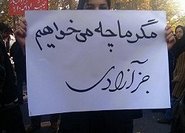
 اخبار مربوط به زندانیان سیاسی و نقض حقوق بشر







 Tulips in Holland