
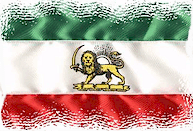


OhmyNews / Ludwig De Braeckeleer
The Iranian president's defiant stance is putting the existence of the regime at risk. http://iranvajahan.net/cgi-bin/news.pl?l=en&y=2007&m=01&d=24&a=5
excerpts
Intervention From the Supreme Leader
Ayatollah Khamenei, Iran's supreme leader, seems eager to defuse current tensions with the international community. Through the media that he personally owns or directly controls, he has sent a clear message that the time has come for Ahmadinejad to keep quiet on the nuclear issue. The supreme leader has the final word over Iran's foreign policy, security and armed forces. As Khamenei believes that Washington's aim is to overthrow his regime, he has much to worry about. The White House has ignored the Iraq report recommendations to engage Iran. Richard Perle has recently declared that Bush would order a military strike on Iran's nuclear facilities if they attempt to acquire nuclear weapons and recent top military appointments as well as sea power reinforcements in the Persian Gulf would seem to indicate that the White House might indeed order such an attack. Officials close to Khamenei have said that he will favour a new team of negotiators that would possibly be led by Mohammad Moussavian, a former senior nuclear negotiator and an ally of Ali Akhbar Hashemi Rafsanjani, the former president of Iran who was defeated by Ahmadinejad in 2005. A few days ago, Moussavian accused Ahmadinejad of lying to the people about the grave consequences of the penalties voted for by the Security Council. "Our advice to the president is to speak about the nuclear issue only during important national occasions, stop provoking aggressive powers like the United States and concentrate more on the daily needs of the people, those who voted for you on your promises," wrote the Islamic Republic, a newspaper owned by Khamenei.
In recent weeks, a radio program has allowed open debate on the controversial issue of Iran's nuclear program. In Iran, the state-owned broadcasting monopoly is not controlled by the government. Instead, the agency responds directly to the supreme leader, Ayatollah Khamenei. The current director of the agency, Ezzatollah Zarghami, who took over in mid-2005, is a former general of the conservative Revolutionary Guards. Zarghami is believed to be close to Khamenei. It is not entirely clear why Khamenei has allowed this debate. What is clear is that some of the guests have fiercely criticised the nuclear program. "Why have the officials linked the country's development to the nuclear program? Why have they tried to convince people with the wrong notion that if we suspend our program we lose our national identity and our independence?" asked Sadeq Zibakalam, a professor of political science at Tehran University. Zibakalam said that a developing country such as Iran would be better off investing in schools and hospitals. He argued that the sanctions, let alone a military confrontation, would destroy Iran.
Is the Regime in Danger?
In recent months, allies and critics of Ahmadinejad have agreed on one premise: there is not much the Western powers can do to Iran for the country holds all the cards. The local and traditional rival has been eliminated. The U.S. military is bogged downed in a disastrous civil war in Iraq. The Israeli army lost its aura of invincibility in the Lebanon war. Russia is eager to protect its business interests and China needs energy. Last but not least, oil prices are high. No wonder Tehran feels confident. Still, the confidence of Iranian leaders could be misplaced as they may soon find out that they are not operating from a position of strength.
About 70 per cent of the Iranian government revenue comes from oil profit. Yet, due to a lack of investment and modernisation of their installations, Iran fails to meet the quota set by OPEC. This year, the loss may amount to about $6 billion. According to a recent study, the oil exports revenue will continue to decline at a rate of 10-12 percentage annually and may completely dry up by 2015. For sure, the study relies on some hypotheses that are difficult to test. For instance, it assumes that due to current geopolitical uncertainties in the region countries such as China and Japan will refrain from investing the funds necessary to offset the current decline in oil production. Recent events confirm this assumption. For instance, Japan has greatly reduced its anticipated investments in Iranian oil fields. The mere possibility of such a scenario is certainly giving top Iranian officials a pause. To the conservative establishment, Ahmadinejad has become a liability. His defiant stance is now putting the existence of the regime at risk. At the same time, he has lost his power base as he failed to deliver on his promised domestic reforms. His departure would at least provide a short-term cosmetic solution to a dangerously escalating crisis. The parliament could impeach him. The supreme leader could simply remove him.
Or maybe, the regime will just find another way to push him aside, quiet his rhetoric and remind him that under the constitution, he is indeed answerable to people, yet enjoys very limited powers to achieve his goals.
Short of a military strike against Iran, one may expect Ahmadinejad to fade away in a much less visible role. But should the United States or Israel opt for that solution, it is a safe bet to expect all Iranians, including his most outspoken critics, to close ranks behind him.
IMPERIAL EMBLEM

PERSIA
Iranian Freedom Fighters UNITE
Wednesday, January 24, 2007


Subscribe to:
Post Comments (Atom)


 Posts
Posts




 اخبار مربوط به زندانیان سیاسی و نقض حقوق بشر







 Tulips in Holland


No comments:
Post a Comment