


THE POMEGRANATE Restaurant : 420 College St., 416-921-7557
Goodbye fusion, molecular cooking, fashionista chefs, French souffles. Tonight I'm going to dine on the ancient food of Persia, the great sprawling empire of the Middle East a couple of millennia ago -- and the first global food power, a non-pareil hub of good eating. I'm going to the source of so much of our food: What don't we owe to Persia and the fertile triangle of the Middle East, starting with our motherfood-- wheat-- and barley, pistachios, dates, figs, pomegranates, dates and leavened bread, and don't forget spinach and the saffron that tints the region gold or the apricots that Marco Polo so enjoyed? He was one of the travellers along the Silk Road from Europe to China, which ran through Persia, a conduit for worldwide trade that enhanced the local cooking with eggplant, lemons, oranges, rice ? My friend the foodie filmmaker tells me that the underground hit at the film festival was The Pomegranate, which depicted authentic Persian home cooking to die for. As we bowl west along College Street, I imagine we're traversing the local version of the Silk Road, as storefronts with foods from all over the world flash by. The real Silk Road travellers stumbled on food discoveries when they weren't ducking bandits. The Pomegranate is an enchantingly pretty fusion of old and new, with raw brick and turquoise walls displaying textiles and artifacts. Considering how crowded it is, The Pomegranate is also amazingly calm. This is due to the unwavering charm of Danielle Shrage, the maitre d', who not only seats you but turns out to be an encyclopedia of Persian cooking and culture. And I have so much to ask. We Europeans evolved so differently in the matter of food. Our diet was always being changed by circumstance -- the sailors' need to eat fresh vegetables to stave off scurvy is an example; the development of dried pasta was the perfect industrial food that could be stored for long trips; the rise of a competitive society where food became fashion and, eventually, cooks became rock stars. Instead, Persia (which is used interchangeably with Iran, the old-new name) seems to have hewed to profound traditions and consistently delicious food. The words "unknown craftsmen" come to mind: Cooking is necessary for survival, and food doesn't show off but makes a subtle and significant enhancement to a way of life. I don't know how modern Iran eats, but I bet teenagers in a traditional home don't dictate the menu. It's set. So is the protocol of cooking. For example, it is custom that men cook, so Shrage's husband, Alireza Fakhrashrafi, is in the kitchen. At home, Iranians eat sitting on the floor. What about people of a certain age who might be able to sit down but would have trouble getting up? Shrage points out that a daily regime of sitting down and getting up keeps you limber. LOL, there goes the gym.
The menu is a fraction of what must be a huge repertoire of Persian recipes. I look for the inevitable shish kebab, meat on sticks. Shrage says Iranian guests often ask that right away, too. But, she says, "Kebabs are for eating out. We don't eat them at home." The food on the menu seems simple, familiar Middle Eastern scoff, variations of which you may find all over the region. The dip is the common denominator. Everyone eats dips: hummus, baba ghanouj, tzatziki?. But not dips like these. The first mouthful of kashk-bademjaan -- charred eggplant, Persian whey, garlic and walnuts topped with crispy onion -- is an entirely new taste sensation to me, sourly irresistibly smokey. A bracing antidote to our own diet, which grows more sugary every day. The charred eggplant is matched -- no, surpassed -- by zeitoon parvardeh, or vegetarian caviar. The tapenade of green olives marinated in a pomegranate-walnut sauce with fresh garlic has the consistency of tiny crunchy eggs and, once again, the piquancy of the bitter pomegranates give the dip a tart nuttiness. How easily I could make a meal from these dips scooped with wedges of flatbread. We've picked the maast-o khiar as a contrast: This mix of English cucumber, walnuts, raisins and rose petals in creamy herbed yogourt is balmy, like a bland interlude. I never thought Persian food would be sweet. But some of the stews that constitute the second course are very sweet, like the aloo gheysi, which combines bokhara plums and dried apricots in a saffron sauce with boneless pieces of chicken and yogourt. We ask Shrage to guide us to the sour side of the menu. Geymeh is sensational. It's a tomato-based stew (tomatoes arrived in Persia with European travellers) of yellow split peas, lamb chunks and another palate stunner -- an astringent dried lime that puckers the mouth and is topped with cinnamon. Fesenjaan is a stew of tender chicken with ground walnut and pomegranate syrup that has a dark rich savoury flavour. The stews come with heavenly basmati rice and fresh salad. Now a single criticism. Persian tables are laid out as a buffet and the family first picks rice and then adds other foods from bowls, a bird-feeding aesthetic. But this aesthetic is lost in the restaurant's presentation. The bowl of stew comes on a big plate piled high with far, far too much rice and salad and the stew is overwhelmed. If I were in modern Iran, I wouldn't be able to have a glass of wine. But once Persia made its own wines, and the taste lingers. The Pomegranate has a modest wine list, or you can have a fizzy yogourt.
Food for two with tax: $47.80. To comment on this review and read others, visit ginamallet.com.
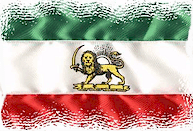
IMPERIAL EMBLEM

PERSIA
Iranian Freedom Fighters UNITE
Saturday, September 29, 2007


Subscribe to:
Post Comments (Atom)


 Posts
Posts




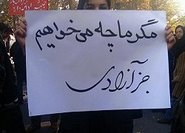
 اخبار مربوط به زندانیان سیاسی و نقض حقوق بشر







 Tulips in Holland


No comments:
Post a Comment