
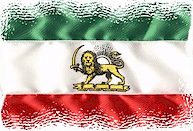

IMPERIAL EMBLEM

PERSIA
Iranian Freedom Fighters UNITE

Friday, March 02, 2007
TELL THE DOOR .....HOPING THAT THE WALL TOO WILL HEAR......
"Algeria became the pivotal Third World state, but the cost of its status - above all the financial cost - was staggering. It ate up millions of dollars for which the country had a crying need ... Gradually, the gap between Ben Bella's domestic and foreign policies grew wider. The contrast deepened. Algeria had earned an international reputation as a revolution state ... it was an example for the non-European continents, a model, bright and entrancing; while at home, the country was stagnating; the unemployed filled the square of every city; there was no investment; illiteracy ruled, bureaucracy, reaction, fanaticism ran riot; intrigues absorbed the attention of the government ... The country cannot carry the burden of these polices. It cannot afford to and it has no interest in them."
The matter with Iran Fred Halliday 1 - 3 - 2007
Fred Halliday is professor of international relations at the LSE, and visiting professor at the Barcelona Institute of International Studies (IBEI). His books include Islam and the Myth of Confrontation (IB Tauris, 2003) and 100 Myths About the Middle East (Saqi, 2005)
The key to understanding Iran's contemporary role in the middle east is less its millennia of statehood or its Shi'a identity than its political dynamic as a revolutionary state, says Fred Halliday. A few years ago, during a visit to Tehran to give some lectures at the foreign ministry research and training institute, I was taken to lunch by a senior Iranian diplomat at a once fashionable Italian restaurant in the northern middle-class suburb of Tajrish. Educated as a scientist in the United States before the 1979 revolution, he had been an important figure in the post-revolutionary regime, and later a senior diplomat. I had met him at various conferences on European-Iranian relations and we had struck up something of a rapport. On this occasion, after the usual semi-official tour d'horizon, we began talking about the early history of the Iranian revolution and of its foreign policy.
"We made three big mistakes", he said: first, in holding the American diplomats hostages for a year and a half and thereby deeply antagonising the US; second, by not accepting the very favourable peace which Saddam Hussein had offered in the summer of 1982, when Iran had the upper hand in the war, then already two years old; and third - to me the most surprising of his points - in not supporting the communist regime that came to power in Afghanistan in 1978, and instead backing the pro-American guerrillas that (with eventual success) opposed them.
The reflections of this diplomat are of considerable relevance to the situation in which Iran finds itself today. For sure, the pressure being put on Iran by the US is arrogant and in many ways illegal. For Washington to protest about Iranian "interference" in Iraq when it is the US which invaded the country in 2003, and when it is Iranian allies (if not clients) who staff much of the government and armed forces of Iraq, is also ridiculous. So too is the attempt to blame Iran for the spread of Sunni terrorism, including al-Qaida activities, in the region. No country has a greater interest in the stability of Iraq than Iran, a point Washington has stupidly failed to note these four years past.
Read the rest here :http://www.opendemocracy.net/themes/article.jsp?id=6&articleId=4396


Subscribe to:
Post Comments (Atom)


 Posts
Posts




 اخبار مربوط به زندانیان سیاسی و نقض حقوق بشر






 Tulips in Holland



No comments:
Post a Comment