


WASHINGTON -- The State Department and the Pentagon are quietly seeking congressional approval for significant new military sales to U.S. allies in the Persian Gulf region. The move is part of a broader American strategy to contain Iranian influence by strengthening Iran's neighbors and signaling that the United States is still a strong military player in the Middle East, despite the difficulties in Iraq.
Background
Buildup underway: The arms sales, which would come on top of a recent upgrade of U.S. Patriot antimissile interceptors in Qatar and Kuwait and the deployment of two aircraft carriers to the Gulf, could spark concerns that further military buildup in the volatile region would bring Washington closer to a confrontation with Iran.
The hardware: Current and former U.S. officials and analysts familiar with the discussions say items under consideration include sophisticated air and missile defense systems, advanced early warning radar aircraft that could detect low-flying missiles, and light coastal combat ships that could sweep the Gulf for mines and help gather underwater intelligence.
Cold War tactic
Isolate Iran: The arms sales are a Cold War-style geopolitical maneuver designed to isolate Iran by arming its neighbors against a perceived common threat.
"We should look at this in the broader context of what Secretary (Condoleezza) Rice calls the looming confrontation between extremists and moderates," Stephen Mull, the State Department's acting assistant secretary of political-military affairs, said. "We are on record as saying Syria and Iran sponsor these (extremist) forces."
May talks: The current arms sale proposals grew out of a diplomatic effort launched last May called the "Gulf Security Dialogue," in which U.S. officials sought to suggest ways to bolster the defenses of Saudi Arabia, Qatar, Kuwait, the United Arab Emirates, Bahrain, and Oman.
Years of U.S. effort
Early warning: The U.S. government, which has military bases in Qatar, Kuwait, and Bahrain, has tried for years to persuade Gulf allies to purchase a regionwide early warning radar system to collect intelligence and instantaneously detect a missile attack.
No threat: But efforts faltered as some Gulf countries argued that the systems were too expensive, and that possible attackers -- at that time, Iran and Iraq -- were not enough of a threat to warrant the systems.
That's changed: However, recent years have brought a change in attitude toward Iran, a neighbor that dwarfs most Gulf states in size and population. Now that Iran's two greatest enemies -- the Taliban in Afghanistan and Saddam Hussein in Iraq -- have been toppled by the US military, Iran's stature in the region has grown.
Defiance of U.N.: Iran's increasing defiance of U.N. demands to curb its nuclear program has also provoked strong reactions in the Gulf. Sunni Arab states began to complain that Washington's wars had emboldened Iran.
IMPERIAL EMBLEM

PERSIA
Iranian Freedom Fighters UNITE
Thursday, March 22, 2007


Subscribe to:
Post Comments (Atom)


 Posts
Posts




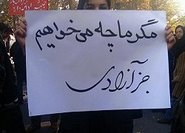
 اخبار مربوط به زندانیان سیاسی و نقض حقوق بشر







 Tulips in Holland



No comments:
Post a Comment