


By David Zucchino, Los Angeles Times March 18, 2007
JOINT SECURITY STATION SULAKH, Iraq -- The US military command center inside the cramped Sulakh Iraqi police station is off-limits to Iraqi police. A Humvee and two US soldiers block access to the American side of the station from the Iraqi side. The barricaded police post in northwest Baghdad is a joint security station, the latest US effort at teaming American soldiers with Iraqi police to battle insurgents and militiamen. But at least for now, the station is literally split down the middle. "We don't trust 'em," First Lieutenant Steve Taylor said of his Iraqi police counterparts. "There's no way to know who's good and who's bad, so we have to assume they're all bad, unfortunately." The station's fortified rooftop flies an Iraqi flag, but no Iraqis are allowed on the roof. It's restricted to US soldiers, who maintain a 24-hour watch over the adjoining neighborhood. With one eye, they watch for insurgents and militiamen. With the other, they watch their erstwhile allies, the police. Since US forces invaded Iraq four years ago, training and bolstering the Iraqi police and army have been central to the strategy for gradually withdrawing American units. But the US military is only now fully embedding its forces with Iraqi police in local neighborhoods -- and as the Sulakh station shows, the effort is daunting.
There will be no trust between US soldiers and Iraqi police until the Iraqi government fulfills its promise to root out Shi'ite militiamen who dominate the force. From the top ranks of the Interior Ministry, which controls the police, to ordinary officers, the force is riddled with members of militias notorious for killing Sunni civilians and mutilating their corpses. At the same time, the police and Shi'ite civilians are targeted by Sunni insurgents, who kill dozens at a time in mammoth explosions. "I've lost a lot of men," said Colonel Ali Mohammed Rahim, the Sulakh station commander, who leads a mostly Shi'ite force. "Snipers, [improvised explosive devices], kidnappings, murders -- all because they are Iraqi police. " At least 15 joint security stations have been set up since US and Iraqi authorities announced their latest security crackdown in Baghdad last month. A total of 28 to 30 are to be established in coming weeks, said Major General William B. Caldwell, the top US military spokesman in Iraq. Until recently, almost all US forces have lived on massive forward operating bases, venturing out for vehicle patrols but returning to base. Now, many of the 21,500 troops being deployed in the "surge" will live with Iraqi police in joint security stations and with Iraqi Army troops in combat outposts, a belated acknowledgment that effective counterinsurgency requires working hand in hand with security forces to win the confidence of civilians in their neighborhoods. Rahim used to be an army officer under the Saddam Hussein regime. Until last month, he had never worked with US forces -- and US soldiers had never entered his precinct. His area is a dumping ground for mutilated corpses, he said. But since US soldiers moved into his station last month, he said, the number has dropped from 10 a day to 10 a week. Captain Tim Marzano, who commands 66 US soldiers at the station, said he is working to "develop a base-line trust" with Rahim and his officers -- though Rahim complained that he has only 80 of the 200 officers he has been promised. For US soldiers, the station offers bare-bones living. Forward operating bases have Pizza Huts, McDonald's, bountiful hot food at mess halls, satellite television, Internet cafes, flush toilets, and hot showers. At Sulakh, the soldiers use plywood outhouses and eat packaged meals ready to eat. Taylor, the American lieutenant, said he expects insurgents to attack the station with car bombs or rocket-propelled grenades. At least three other joint security stations have been besieged by insurgents, inflicting casualties on US forces and Iraqi police. The next day, soldiers from the police station embarked on their first foot patrol with Iraqi police. Six officers carrying AK-47 automatic rifles took the lead, followed by 26 Americans in full combat gear. They walked across cracked concrete and past trash piles, drawing stares and a few waves from residents in tea shops and doorways. A mosque loudspeaker was blaring the Muslim call to prayer when Taylor knocked on the door of a two-story house. A middle-aged man in a dishdasha robe invited him into his diwaniya, or reception room, where he and Taylor discussed the local security situation through a masked interpreter named Phillip. The man, who declined to give his name, said the neighborhood was relatively safe -- he sent his children to school -- but the fish market was terrorized by insurgent gunmen. At another house, the patrol encountered a sedan pocked with bullet holes. There was dried brown blood on the back seat. As the Iraqi police officers listened in, a man who called himself Mohammed told the soldiers the blood was from a family member killed by insurgents three weeks ago at an illegal checkpoint. After the Iraqi police moved on, Mohammed approached an American reporter walking with the patrol and said, in English: "Nobody will tell you anything with the police along. Nobody trusts them. They are thieves and killers."
IMPERIAL EMBLEM

PERSIA
Iranian Freedom Fighters UNITE
Monday, March 19, 2007


Subscribe to:
Post Comments (Atom)


 Posts
Posts




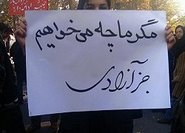
 اخبار مربوط به زندانیان سیاسی و نقض حقوق بشر






 Tulips in Holland


No comments:
Post a Comment