
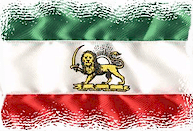


THIS IS WHY I HAVE CHANGED THE NAME OF THIS ARTICLE.
A LETTER TO Mr. Brookes.
Dear Mr. Peter Brookes
I wished that you had not sullied the good name of PERSIA with its use in the headline
PERSIAN PERIL.
The Jahadi, Mullah Mafia's running (and RUINING) my country have no connection or empathy to the glorious name of PERSIA. They call themselves, Islamic Republic of Iran.
My Persia and the Persians that I represent are a billion miles away from where they stand.
The good People of Persia have NOTHING to do with this lot.
Please do not make this mistake again and mix Persia with what they represent.
Best Regards.
Peter Brookes in his article of January 16, 2007 ( I have changed the name of this article and gave it the correct name!) states as followes.
Almost nobody noticed last week's second most important speech. President Bush's address on Iraq deserved our undivided attention - but so did Director of National Intelligence John Negroponte's Senate testimony on the intelligence community's consensus views of global threats.
The DNI talked plenty about Iraq, but the real eyebrow-raiser was his extensive testimony on Iran. He highlighted the Islamic Republic's "emboldened" nature, painting the significant increase in Iranian influence in the Middle East as a "strategic shift."
For starters, Negroponte reported that government spooks see a marked change in Tehran's international outlook: The regime is encouraged by the demise of such enemies as the Taliban in Afghanistan and Saddam in Iraq, and buoyed by vast increases in oil/gas revenues from elevated global demand and prices in recent years.
Also pumping up Persian power and morale, said the DNI, were Hamas' electoral victory last January and Hezbollah's showing in its conflict with Israel this past summer. (Tehran must be giddy about Hezbollah keeping Lebanon on the rocks, too.) The intelligence community concludes Iran sees its ability to conduct terrorism abroad as key to its national security strategy, helping to: 1) deter U.S. and Israeli intervention in Iran, 2) intimidate its neighbors and 3) drive the U.S. from the region.
Negroponte reported that our Arab allies fear Iran's increasing standing and are concerned about "worsening tensions" between the region's Shia and Sunni.
Even more ominous, he noted that Iran's growing clout has coincided with a "generational change in Tehran's leadership," now filled with "second-generation hardliners imbued with revolutionary ideology and deeply distrustful of the U.S."
Iranian President Mahmoud Ahmadinejad is a veteran of the Iranian Revolutionary Guard Corps - the hardline "children of the revolution." Many believe he was one of the students who held 52 American embassy personnel hostage for 444 days back in 1979. (No wonder Bush is reluctant to directly engage Iranian leaders. . .)
The U.S. intelligence community thinks that generational shift also explains Iran's increased use of more "assertive and offensive tactics" in its foreign policy. Negroponte was no doubt referring to Iran's mucking around in Iraq as well as the aggressive nature of its terrorist tools, Hamas and Hezbollah - not to mention Ahmadinejad's globe trotting, including his trip this week to Venezuela, Ecuador and Nicaragua.
The problems go far beyond the mullahs' drive to build nuclear weapons. Iran is also juicing up its conventional military, said the DNI - enhancing its ability to project power by developing a prodigious ballistic-missile arsenal and strengthening its navy - "with the goal of dominating" the Persian Gulf and deterring potential enemies.
All this helps account for why a number of Middle Eastern states recently declared their intention to pursue "peaceful" nuclear programs, and why most states in the regions are spending more on conventional weapons than ever before.
Fortunately, the regime faces some internal challenges. Ethnic tensions between majority Persians and minority Baloch, Kurdish, Arab and Azeri communities could foster large-scale, counter-regime activities, Negroponte noted.
The head spook pointed to Iran's shaky economy as another weakness. Both inflation and unemployment are on the rise thanks to Ahmadinejad's policies, exacerbating social pressures, especially among the restive young - and leaving Iran potentially susceptible to economic sanctions.
Last week signaled re-energized White House concern about Iran's intentions and capabilities.
In his Iraq speech, the president declared, "We will interrupt the flow of support from Iran and Syria . . . seek out and destroy the networks providing advanced weaponry and training to our enemies in Iraq." And Secretary of State Condi Rice said that the United States isn't going to simply stand idly by while Tehran continues to disrupt our efforts to stabilize Iraq.
There was more than talk, too: A second carrier battle group and Patriot air-defense batteries are being deployed to the Gulf region. Their mission wasn't specified, but you can bet that it has little - if anything - to do with securing Baghdad's streets. And U.S. troops raided an Iranian diplomatic office in Irbil, Iraq - seizing computers, documents and cuffing a number of Iranian intelligence operatives, er, I mean, "employees."
Treasury is getting tough with the Iranians, too, barring their banks from doing business in U.S. markets to hinder Iran's nuke program. (U.S. spooks now estimate Iran could have the bomb by 2010.)
Such steps aren't enough to contain Iran, but they're a start - and a framework, along with Negroponte's testimony, for Rice, on her Middle East jaunt, to convince friends that the time has come to deal with the growing Iranian menace.
IMPERIAL EMBLEM

PERSIA
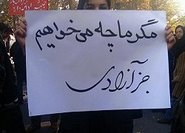
Iranian Freedom Fighters UNITE
Wednesday, January 17, 2007


Subscribe to:
Post Comments (Atom)


 Posts
Posts




 اخبار مربوط به زندانیان سیاسی و نقض حقوق بشر






 Tulips in Holland


1 comment:
I sent this e mail to Mr. Brookes.
From: SDCLTD@aol.com Sent: Thursday, January 18, 2007 7:43 AM
To: New York Post
Subject: Hello Mr Brookes
Dear Mr. Peter Brookes
I wished that you had not sullied the good name of PERSIA with its use in the headline ` PERSIAN PERIL `. The Jahadi, Mullah Mafia's running (and RUINING) my country have no connection or empathy to the glorious name of PERSIA. They call themselves, Islamic Republic of Iran. My Persia and the Persians that I represent are a billion miles away from where they stand. The good People of Persia have NOTHING to do with this lot.
Please do not make this mistake again and mix Persia with what they represent.
Best regards , Fereydon
P.S. I have done a reply/article based on this piece on my weblog if you care to read it.
And this is the answere that I received back from Mr. Brookes
Fereydon:
Thank you for your note, but while I did pen the article, the headline is the responsibility of the newspaper. I don’t pick the headlines for my weekly column in the NY Post.
Pete
Peter Brookes
Senior Fellow for National Security Affairs , The Heritage Foundation ,214 Massachusetts Ave, NE. Washington, DC 20002
Bio: http://www.heritage.org/About/Staff/PeterBrookes.cfm
Website: www.PeterBrookes.net
Author: "A Devil's Triangle: Terrorism, WMD and Rogue States"
Columnist, New York Post
Commissioner, U.S.-China Economic and Security Commission
Post a Comment