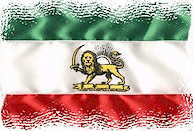

IMPERIAL EMBLEM

PERSIA
Iranian Freedom Fighters UNITE

Sunday, July 06, 2008
Wednesday, April 02, 2008
NEWS CENTRAL
Report Warns of Saudis, Turks Joining Nuke RaceWASHINGTON -- Saudi Arabia most likely would develop nuclear weapons if Iran acquires them, according to a report to the Senate Foreign Relations Committee. High-level American diplomats in Riyadh with excellent access to Saudi decision-makers said an Iranian nuclear weapon frightens the Saudis "to their core" and would compel the Saudis to seek nuclear weapons, the report said. The American diplomats were not identified.
China Gave IAEA Intel on Iran's Nuclear ActivitiesVIENNA -- China, an opponent of harsh U.N. Security Council sanctions against Iran, has nonetheless provided the International Atomic Energy Agency recently with intelligence linked to Tehran's alleged attempts to make nuclear arms, diplomats have told the Associated Press
Report Warns of Saudis, Turks Joining Nuke Race
WASHINGTON -- Saudi Arabia most likely would develop nuclear weapons if Iran acquires them, according to a report to the Senate Foreign Relations Committee. High-level American diplomats in Riyadh with excellent access to Saudi decision-makers said an Iranian nuclear weapon frightens the Saudis "to their core" and would compel the Saudis to seek nuclear weapons, the report said. The American diplomats were not identified.
Iranians Told Sadr to Stand Down
BAGHDAD -- Iranian officials helped broker a cease-fire agreement Sunday between Iraq's government and radical Shiite cleric Muqtada al-Sadr, according to Iraqi lawmakers. The deal could help defuse a wave of violence that had threatened recent security progress in Iraq. It also may signal the growing regional influence of Iran, a country the Bush administration accuses of providing support to terrorists in Iraq and elsewhere.
The Iranian Web of Influence in the United States
On March 21, 2008, the U.S. Commerce Department’s Bureau of Industry and Security (BIS) announced its decision to penalize three Iranian-connected companies as "they knowingly exported three U.S. origin aircraft to Iran in violation of the Export Administration Regulations (“EAR”) and are preparing to re-export three additional U.S. origin aircraft to Iran in further violation of the EAR."1
Americans Call Iran Top Enemy
WASHINGTON -- China has replaced North Korea as one of the top three U.S. enemies, according to a poll of Americans. Iran topped the list, with 25% naming it when asked which country is the greatest U.S. enemy, according to the Gallup Poll. Iraq came next at 22%, then China with 14%
Iranian Who Helped Stop Iraqi Violence is Linked to Terrorism
WASHINGTON -- The Iranian general who helped broker an end to nearly a week of fighting between Iraqi government forces and Shiite Muslim militiamen in southern Iraq is an unlikely peacemaker. Brig. Gen. Qassem Suleimani, who helped U.S.-backed Iraqi leaders negotiate a deal with radical Shiite cleric Muqtada al Sadr to stop the fighting in Iraq's largely Shiite south, is named on U.S. Treasury Department and U.N. Security Council watch lists for alleged involvement in terrorism and the proliferation of nuclear and missile technology.
Iran's Adventures in the Region will Fail
Recently published in the US, the book "Peace Not Terror: Leaders of the Antiwar Movement Speak out against US Foreign Policy Post 9/11" by Mary Susannah Robbins includes studies written by experts and specialists about the region
Iran Gains African Foothold up to Chad through Pacts with Sudan
Iran jumped in with gusto to meet Sudan president Omar al-Bashir’s application for a military package including arms and training of his army. The application was received after the horrendous Darfur tragedy and Khartoum’s backing for Chad rebels finally convinced Sudan’s traditional arms suppliers, Russia, China and Libya, to back away from arming Sudan’s 120,000-strong army
Iran Incites Cold War With U.S. in Lebanon Roiled by Hezbollah
When David Welch, the U.S. State Department's top Middle East envoy, wakes each morning, he asks himself, ``Is everything OK over there?'' ``Over there'' is Lebanon, caught in a political stalemate that is putting American officials and much of the Arab world on edge. During six months of paralysis in electing a Lebanese president, Iranian and Syrian support for the Shiite Muslim party, Hezbollah, has flourished while the U.S. has tried to keep its Sunni ally, Prime Minister Fouad Siniora, from being ousted.
Treasury Official Calls Iran 'Central Banker of Terrorism'
WASHINGTON -- A senior Treasury Department official called Iran "the central banker of terrorism" in testimony Tuesday before the Senate Finance Committee, but said the United States is succeeding in chasing money tied to the Al Qaeda terror group.
The Royal Road to Qom
Qom is the second most sacred place in Iran. Just over 90 miles from Tehran, it was here that Fatima, sister of the ninth century Shia imam, Reza, fell ill and died. And it is to here that Moqtada al-Sadr, he of Iraq's Sadr brigades, commutes from Najaf and Tehran to listen to Ayatollah Naser Makarem Shirazi.
Iran Number of Internet Users Increases 72-Fold in Eight Years
Tehran -- The number of internet users has increased 72- fold compared to eight years ago.
Iran Intercepting Israeli Communications Through Syria
Iran has set up sophisticated listening stations in Syria in recent months to intercept Israeli military communications, Israeli security officials say.
Friday, March 14, 2008
Funny Persian Boys & Girls & Soldiers - SEXY !!!
American Man Singing PersianAgeh Yeh Rooz
Iran's Young Women Find Private Path to Freedom
March 16, 2008 - The Observer - Peter Beaumont in Tehran
A headscarf pushed back to show off a new haircut, a tight jacket worn over traditional dress, expensive make-up ... the challenge to the hardline clerics is taking place in bars and cafes, not in the polling booth, as the youth of Tehran push the boundaries of self-expression .
On the wall of the Nadiri coffee house in Jumhoori Avenue, Tehran, a place where the young congregate, a sign reads: 'Our respected customers are kindly requested to take care of their hijab.' Shareh Beik, 27, a travel agent, sitting with her boyfriend, Mehdi Sayed, is struggling with hers. The pretty Venetian wool wrap that she wears as her headscarf - bought by Mehdi as a Valentine's Day present - is slipping off her short, fashionable feather cut and on to her shoulders. She tugs it back but it slips down again and then again. The problem is that she likes to wear her headscarf far back on her head to show as much of her hair as possible. For the men who drive the green and white vans of the gascht ershad - who police what women wear on the streets - her dress in this coffee shop, like many of the other young women, would be 'bad hijab'.
But the ershad is not in here, preferring instead to catch women on the streets to arrest and lecture over their attire: boots too high, tunics too short or hair improperly covered. The rules of the coffee houses - in comparison with the street - reflect the fundamental division in Iran. It is not the divide between the 'Reforms' and the 'Principalists' of President Mahmoud Ahmadinejad, who competed for Iran's parliamentary elections on Friday. For many of the young, including Mehdi and Shareh, those elections represented an increasingly irrelevant distinction in a clerical system they feel is stacked in favour of itself. Instead, the division is between what Iranians do and say in private, or in places where they feel comfortable, and how they are forced to behave in public. The inevitable tension between the two is defining the boundaries of the country's culture wars. For it is here, rather than in the polling booths, that Iran's most crucial competition is taking place - over the limits of what is acceptable self-expression. It is the struggle to push the boundaries of freedom in Iran. In Tehran, it is visible in the girls who wear their scarves pushed far back on their heads, hair springing free, faces heavily made up or tight jackets worn over their knee-length mantles in a challenge to the system.Even those attempting to push the boundaries insist that, despite the image of Iran in the West as virtually a totalitarian regime, Iranians enjoy more freedoms than they are credited with. Two of those are Sohrab Mahdavi, editor of the online Tehranavenue.com, and his friend Ramin Sadighi, a musician and director of a record label, who are involved in a project to bring more music into public places.'The crucial thing to understand about Iran,' said Mahdavi, 'is that we do have freedoms. The important issue is the separation between public and private space in Iranian life. Since the revolution, public space has been tightly controlled [by the clerical authorities], so people have created their own "public spaces" in private. A consequence is that what is acceptable in private is now constantly in the process of trying to nibble away at the controlled public arena.''And you have to bear in mind,' said Sadighi, 'how youthful the population is here. They are the fruits of the system in many respects. But they are going in an opposite direction to it. There is no social movement that is represented by them - and I think that is probably a good thing for the future of Iran - but what is happening is that people have joined together to form small colonies of interest.'It is a business that is explained by a young Iranian teacher. 'In the private space, you don't have to hide yourself. There are no restrictions. No boundaries. On what I read. What I believe. What I want to know.' But if there are safe areas - places and circles of friends - the process of connecting with others with similar views is a careful, disjointed and sometimes laborious business. 'If there is someone who I think I might want to make friends with,' said the teacher, 'I try to spend some time seeing what they are like. I try to see how they act around other people. In private when they are free. I try to see a way to penetrate who that person is.'It is born of necessity in a place where nonconformity is punished in a number of ways: by exclusion from work, temporary arrest, by longer sentences. By the threat, sometimes, of violence.It was evening in a small basement flat in central Tehran. Four educated women friends were meeting to eat cakes and talk. They admitted they often criticised the system, but, like many Iranians, said they felt uncomfortable doing it in front of a foreign journalist. Entering the flat, a safe, private space, from the bustling city outside, one of Iran's borders was visibly crossed. When they came in, the three youngest quickly removed their scarves and coats.It did not mean that they necessarily disagreed with the wearing of the headscarf in public. But what they did insist was that they should be able to frame it within their own beliefs as individuals and not be told how to behave by the clerical authorities.More complex still was their view of the young women in the Tehran streets with their 'bad hijab' and make-up, who are rebelling most visibly against the dress codes. 'The young girls are really against the hijab,' said one of the friends. 'You can see it in the make-up they wear.''The young girls are just the same,' said Neda, a technical translator, a little wearily. 'They are just conforming in another way.' She quickly said more sympathetically: 'But they are saying to the system: "We are here. You can't ignore us." It's the same with the boys, turning their music up loud. It is the only way they can express themselves.'The conversation turned to the issue of the elections and the widespread disillusion of many with Iran's political system, which they feel has let them down. Mehernoush, a student, is the most scathing both about her country's president - 'a foolish man' - and the clerical system of government. 'They govern for themselves,' she said. And then defiantly: 'And we live for ourselves!The women argued among themselves. 'The politics is ridiculous!' said Mansoureh, an editor. 'But we can't give up on it,' replied Mehernoush warmly. 'I mean, you used to be an activist.'Finally, it came to the issue of freedom of speech, the real question circumscribed by this informal gathering. 'I think it depends on the person, how critical you are,' said Mehernoush. 'I feel that I can do what I want. I know a lot of people feel they cannot say what they think. My colleagues at university don't have the courage to express themselves.'I took a drive out of Tehran, past grey dusty mountains coloured in places green and red with mineral deposits, or frosted with naturally occurring salt.About 100km to the south is the small country town of Aradan, where Ahmadinejad was born. There are a handful of shops on the main street, some selling traditional goldfish in bowls for the new year festival of Norouz. In a greengrocer's, men buying oranges criticised Aradan's most famous son.The complaints, even in this conservative place, were the common grumbles heard in Iran: about rampant inflation, unemployment and lack of facilities. About an unequal treatment by a clerical system that favours itself.'No one can talk about this,' said a short, heavy-set man, who would not give his name, and signed as if to seal his lips. 'If you want to talk about these things it is better to talk about them in a private place. In someone's home maybe. Not on the street. But that is not so easy.'It is only in the Pizza Shop, a little cafe selling sandwiches and soft drinks, that a resident was willing to speak on the record and to explain the reticence of the townspeople. 'It has never happened in a small place like this that people are prepared to stand up and say something,' said Ali Dwosti, the owner. 'To say we are free. We are free to speak, of course. It is just that it has never happened.'Part of the problem, as Mahmoud Beheshti Langeroudi conceded back in Tehran, is that for the freedoms that do exist - like union membership - there are red lines that quickly bring members into confrontation with the system.Twice briefly jailed for demonstrating about poor conditions for teachers, once under the Reformers and a year ago under Ahmadinejad, he explained the nature of the real limits on expression in Iran. 'The authorities act when they see something they feel is threatening to it, that they think may turn into a movement.'They are worried that any demonstration or movement could turn into something big. That is when they move to nip it in the bud. The red line is making the system feel insecure.'If, as some argue, the growing dissatisfaction with the regime under Ahmadinejad is becoming more intense, it is being driven by a younger generation. The issue of age, Ramin Sadighi conceded, is crucial to Iran's emerging tensions. Those in middle age and older, he suggested, are more willing to make compromises with the system of governance than the young.And what is holding back greater pressure for a more organised change - for a confrontation with a system that many reject - is that the different communities of interest in Iran have not learnt how to break out of their private networks and connect.'We are not used to having connections. Each small group is like an island with its own private ethics. The only real connection that the younger generation have here is to the outside via satellite television. And unfortunately that is a fake connection,' he said sadly. 'It is an illusory idea of how people live in the outside world.'And that notion of private ethics is nowhere more visible than in the underground of Tehran's party scene, where behind closed doors young Iranians take the risk of living the life of their choice.Last week a small group of artists and their friends - one of the islands of Iran - gathered to drink bootleg vodka and dance and listen to music. With self-conscious irony one of those songs was 'It's a Sin'.They included professional dancers who cannot dance in public, artists who show their work to private gatherings and activists who give speeches at invitation-only lunches. 'I gave a speech last week for International Women's Day,' said one guest. 'But it was for an invited group meeting for a lunch. I am exhibiting some of my art as well. But again it is in private.'Behind these closed doors, where women dance in halter tops and guests discuss arts and politics and music hungrily, the vans of the gascht ershad seem like a million miles away.'The question of public and private is the only real issue of interest in Iran today,' said the hostess, an energetic woman with her hair tied in a loose ponytail. 'For me the public space is surrounded by four walls. It is only here - in private - that I'm free.'

 Labels:
and persian dancing,
awesome,
best,
best break dance,
best breakdance,
boys,
breakdance,
Dance,
dancing,
funny,
Girls,
Iranian,
iranian boy,
iranian boys,
iranian dancing,
Persian,
sexy,
soldiers
Labels:
and persian dancing,
awesome,
best,
best break dance,
best breakdance,
boys,
breakdance,
Dance,
dancing,
funny,
Girls,
Iranian,
iranian boy,
iranian boys,
iranian dancing,
Persian,
sexy,
soldiers




 Posts
Posts




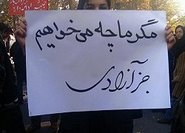
 اخبار مربوط به زندانیان سیاسی و نقض حقوق بشر






 Tulips in Holland