


US allies from Georgia to protect Iraqi border
by Jay DeshmukhFri Jul 6, 3:26 AM ET
Hundreds of troops from the former Soviet republic of Georgia will deploy to border checkpoints in Iraq to help their US allies stem the flow of deadly weapons from Iran. Last-minute preparations were under way on Friday to prepare Camp Delta, a fortified coalition base in the desert wastes of Wasit Province, for the arrival of a 2,000-strong brigade of Georgian soldiers.
For US commanders, their mission is one of the most urgent in Iraq. For Major General Rick Lynch, whose task force has seen nine US soldiers killed by Iranian-made bombs in the past four months, it is almost personal. "We just got to stop this Iranian inflow into Iraq. People talk of it all the time but we got to get out and do it," Lynch told AFP on a tour of Camp Delta, as two US self-propelled artillery pieces rolled into place. Wasit Province has a 240-kilometre (150-mile) border with Iran, which the United States accuses of supplying a variety of arms to the extremist groups fighting Iraq's sectarian war and attacking US-led forces. Some weapons doubtless come on obscure desert trails under cover of night, but many more are driven through border checkpoints manned by Iraqi forces, some of whom have cross-border tribal and religious ties. The Georgian force will man a second tier of six checkpoints just inside those operated by Iraqi forces, in a bid to intercept loads of smuggled arms, including the deadly "explosively-formed penetrator" (EFP). This Iranian-designed roadside bomb is a shaped explosive designed to fire a fist-sized chunk of molten metal fast enough to cut through American armoured vehicles. It is one of the deadliest weapons on the Iraqi battlefield.
"In the past four months there have been 29 EFP attacks in my area, of which 18 were effective... either causing damage to vehicles or killing my soldiers," Lynch said. Earlier this week, US spokesman Major General Kevin Bergner accused a covert unit of Iran's Revolutionary Guards of supporting an armed assault in the shrine city of Karbala that led to the deaths of five US soldiers. He also accused Iran of sending Lebanese Hezbollah militiamen to train special Iraqi units to battle coalition troops in Iraq. Tehran denies smuggling weapons to Iraq, but to US soldiers on the ground who come under daily attack from Iranian-made munitions, the evidence is clear. Wasit Province is a stronghold of Shiite cleric Moqtada al-Sadr's Mahdi Army militia, and many bombs smuggled across the border are destined for Baghdad, the epicentre of Iraq's civil conflict and its fiercest battlefield. But, if the mission is so vital to the stability of Iraq and safety of US troops, why assign it to troops from Georgia who, for all their pride, represent a young nation with little experience in foreign wars? Lynch admitted that he has not got enough American troops for the job, but insisted his Georgian allies are up to the task. "The Georgians are competent soldiers and they would be at the checkpoints," he said. "I do not have additional US troops. These (Georgians) are the assets available for me in my battlespace." Wasit Province, while a hotbed of support for radical Shiite figures such as Sadr, has not seen the same sectarian bloodshed as Baghdad and more central provinces. evertheless, it presents its own security problems. "Wasit acts as a natural route for smuggling because of its proximity to Iran," said Colonel Mark Mueller who is in charge of training Iraqi border guards and who is based at Camp Delta. He said coalition forces had detained at least "100 military age Iranian males" in the last year who had crossed over illegally into Iraq. "We also recently found a large cache of rockets which had Iranian production stamps on them," Mueller said, adding that such consignments are found on average at least once a month.
Camp Delta, which was handed to US forces by a Polish force in June, is key to the effort and has already become a target for militiamen eager to intimidate their new foe. "It is going to be a lucrative target. There will be militiamen surrounding the base... that is an indication," said Lynch as his team of officials showed him where the new checkpoints could be set up. Colonel Peter Baker, who is now in charge of Camp Delta, said the base had already started receiving rocket and mortar fire. "We've had several attacks since June 20 when we took command," he said, as he pointed to a small crater in a road inside the base where a Katyusha rocket had landed a few days ago. Two gaping holes could be seen on the roof and one of the walls of a gym.
Baker said although the rockets had caused no casualties, troops were prepared to launch "counter fire" with their own artillery -- the base's two M109 Paladin self-propelled howitzers.
"All I am saying is that if the people of Wasit do not want to hear incoming fire, then they should also stop outgoing fire from their areas," Baker said. "We are going to defend ourselves. We are not offensive, but we will fire back if required."
IMPERIAL EMBLEM

PERSIA
Iranian Freedom Fighters UNITE
Friday, July 06, 2007


Subscribe to:
Post Comments (Atom)




 Posts
Posts




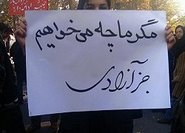
 اخبار مربوط به زندانیان سیاسی و نقض حقوق بشر






 Tulips in Holland


No comments:
Post a Comment