
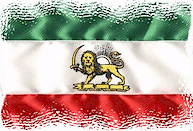

IMPERIAL EMBLEM

PERSIA
Iranian Freedom Fighters UNITE

Saturday, June 02, 2007
Why US Talks With Iran Won't Produce Results : June 02, 2007 Arab News : Amir Taheri
“Positive!” This is how the US Ambassador to Iraq Ryan Crocker and his Iranian counterpart Hussein Kaizimi-Qomi have described their first round of negotiations. Ironically, this is precisely the adjective that both sides used on all previous occasions when they talked to one another. Each time, however, the talks led to an even more intense animosity between the two countries. For some mysterious reason, the media described last weekend’s talks in Baghdad as the very first since the Shah was ousted in 1979. This, of course, is not true, as the two sides have had direct talks on a number of occasions. President Jimmy Carter started the “talk to Iran” history in January 1979, a month before the regime change in Tehran, when he established contact with Ayatollah Khomeini, then operating from a Paris suburb. Once the mullahs were in control, the administration intensified the talks via the embassy in Tehran. Bruce Laingen, the charge d’affaires and a sincere supporter of the revolution, was a daily visitor to the Foreign Ministry. Six months after the establishment of the Islamic republic, National Security Adviser Zbigniew Brzezinski held a “summit” with Mehdi Bazargan, Khomeini’s prime minister, to discuss a “strategic partnership.” The process ended when Khomeinist “students” raided the US Embassy in Tehran and took its diplomats hostage, Laingen among them. Since then, all US administrations have maintained some level of talks, often behind the scenes, with Tehran’s leadership. Yet none managed to influence the Khomeinist strategy in any way. Most recently, Washington and Tehran held direct talks in 2002 in Bonn, Germany, over Afghanistan. The result was a moment of cautious goodwill, soon to end with the Islamic republic moving onto the offensive against the US presence in Afghanistan. Others who talked to the Islamic republic fared no better. Hans-Dietrich Genscher, longtime West German foreign minister, built his career around the hope of bringing the Islamic republic into the mainstream. He invented the phrase “critical dialogue” — which, in practice, ended up with a joint Iranian-European criticism of the United States. Most recently, Jack Straw, during his tenure as British foreign secretary, visited Tehran more frequently than Washington. Russia, Kazakhstan, Turkmenistan and Azerbaijan have been talking to Iran to determine the status of the Caspian Sea for 12 years without getting anywhere. Turkey has held talks to Iran since 1989 on Turkish-Kurdish rebels and the Turkish branch of Hezbollah — again to no avail. In every case, the Islamic republic has interpreted the readiness of an adversary to talk as a sign of weakness and, as a result, has hardened its position. Two facts help explain Iran’s behavior. First, this is the last of the revolutionary regimes that thinks it has high ideals that should not be sacrificed at the altar of mundane diplomatic considerations. The second issue is rivalries among the Khomeinists. Because the overthrow of the Shah came with unexpected ease, and in a short time, the vast majority of the new regime’s personnel had no chance to secure a “revolutionary biography.” So they have tried to acquire one after the fact, by talking and behaving in the most radical way possible. Each group within the establishment is constantly watching rival groups for the slightest sign of lacking in revolutionary zeal. No Khomeinist leader can be seen making the slightest concessions to an outsider without risking political death. The regime’s history is full of officials who committed political suicide by trying to play by international rules. Khomeinist diplomacy is designed to seek total triumph for the Islamic republic and total surrender from its negotiating partners on all issues. Anyone following the official media in Tehran would soon learn that the leadership could not conceive of a “win-win” situation: It must always win and its negotiating partners must always lose. When Ayatollah Khomeini ordered the release of the American hostages, he said he had done so as a gesture of Islamic generosity toward their families, not because of months of talks with Washington. He released them when he no longer needed them — Carter had lost the election and been “punished” for brokering the Camp David peace between Egypt and Israel. The Islamic republic entered the Baghdad talks with an agenda that is markedly different from that expected by the US. Tehran believes that the US-led coalition is on its way out of Iraq and thus it is time for the Islamic republic to cast itself in the role of the power determining the future of the Iraqi regime. The US, however, hopes that the Islamic republic, once engaged in a process of negotiations, will at least tone down its support for armed groups in Iraq. The naiveté of the American analysis became apparent on the eve of the talks when Tehran returned Moqtada Sadr to Iraq and put him in stage at Kufa to deliver a militant anti-US message. At the same time, all reports from Iraq concord in one thing: Tehran has increased its support for all the militant groups it has patronized since 2003. Since 1979, the real question with regard to Iran has been simple: Should the world kowtow to the Khomeinist regime or should the Khomeinist regime accept the global rules of the game? Maybe it is time to provide a clear answer.


Subscribe to:
Post Comments (Atom)




 Posts
Posts




 اخبار مربوط به زندانیان سیاسی و نقض حقوق بشر








 Tulips in Holland



No comments:
Post a Comment